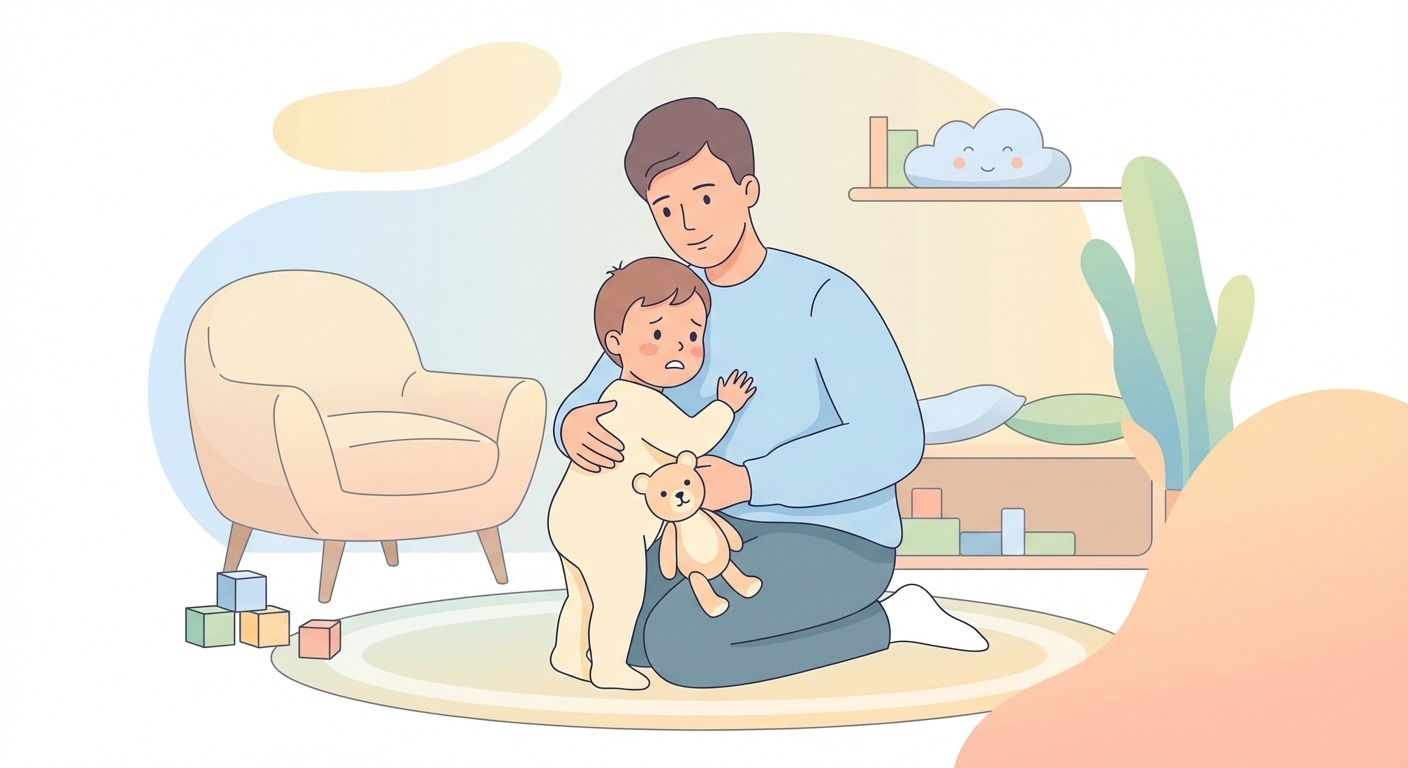
Fear in Children: Fear in children aged 1 to 3 years: how to intervene?
| Short on time? Here’s the essentials ✨ |
|---|
| Childhood fear from 1 to 3 years is normal: it protects and guides emotional development 🛡️ |
| Anxiety in the child = need for stable references, routines, and consistent messages 🧭 |
| Intervention for child fear: validate the emotion, name it, suggest a simple action, repeat 👍 |
| Fear at 1 year: separation; fear at 2 years: strangers/noises; fear at 3 years: darkness/monsters 🌙 |
| Key tools: rituals, stories, gradual exposure, symbolic play, comfort object 🧸 |
| Parent advice for fear: regulate your own stress, anticipate transitions, praise micro-progress 💬 |
Between 1 and 3 years, every new thing can surprise, sometimes terrify. However, these fears are not obstacles; they mark the path to autonomy. Thanks to consistent rituals, simple explanations, and a warm presence, a toddler learns to tame the unknown. This guide offers a concrete intervention, focused on validating emotions and gradual training, to soothe child fear without minimizing what they feel.
The guiding thread is clear: managing child fear combines kindness and strategy. Sleep routines, putting feelings into words, role-playing, and tales serve as powerful tools. By relying on emotional development and the real needs of toddlers, everyone can intervene tactfully. Because growing up is facing fear and discovering that you can overcome it.
Child fear and emotional development (1-3 years): understand to better intervene
Observing a child of this age is to see a brain under construction. Circuits linked to vigilance activate quickly, hence the frequent alertness to strangers, noises, or darkness. This hyper-reactivity is not a flaw. It serves protection and prepares exploration. For deeper insight, a detour through the brain development between 1 and 3 years sheds light on the mechanisms at work.
Child fear becomes problematic when the adult sends contradictory messages. Conversely, a stable presence, visual references, and clear language reduce uncertainty. A child gains confidence when they can predict what happens. Hence the importance of a simple, repeated, and explained routine.
The functions of fear: warning, learning, autonomy
In toddlers, fear triggers quickly. It signals a risk, real or imaginary, and triggers a call for help. The adult then becomes the secure base. By recognizing this function, intervention for child fear becomes more effective. The goal is not to extinguish the emotion. It is about helping the child regulate it and act despite it.
- 🧠 Detect the hidden need (security, closeness, predictability).
- 🗣️ Use simple words: “You’re afraid, I understand, we’ll do this together.”
- 🧩 Propose a concrete and short action (breathe, touch the comfort object, turn on the night light).
- ⏱️ Repeat the same protocol until calming down.
- 🌱 Reinforce each micro-progress with a specific compliment.
To anchor these references, stories help. The tales to tame emotions set a symbolic framework. They inspire courage scenarios suited to daily life.
| Key ages and references 🧭 | Common fears 😨 | Effective interventions 💡 |
|---|---|---|
| 1 year | Separation, sudden noises ⚡ | Short rituals, consistent messages, comfort object 🧸 |
| 2 years | Strangers, unexpected events 👀 | Gradual exposure, limited choices, imitation 🤝 |
| 3 years | Darkness, monsters, solitude 🌙 | Stories, night light, mastery scenarios ✨ |
When the adult stabilizes the framework, the child’s anxiety lowers a notch. The message becomes readable: fear warns me, then I can act. This is the foundation of healthy autonomy.

Fear at 1 year: separation and first distances, building relational security
Around 6-12 months, the child discovers object permanence. They understand that the parent exists even when out of sight. This cognitive progress often triggers separation anxiety. Crying at departures or bedtime is therefore expected. The adult’s role is to contain and guide consistently.
Step-by-step intervention at separation time
A short and identical ritual each time reassures. It reduces unpredictability and allows the child to anticipate. An effective example relies on three key steps, in under two minutes.
- 👋 Clear and positive announcement: “I’m going to work, and I’ll be back after snack.”
- ⏳ Secure transition: a reference song, a tight hug, then passage to the caregiver.
- 🚪 Clear departure: avoid back-and-forths that reactivate the alarm.
This protocol is accompanied by sensory supports. A placed photo, a music box, or a cloth with the parent’s scent become anchors. For the evening, consult sleep advice and adjust the routine to the age.
| Observed signs 👶 | What helps 💬 | What complicates ⚠️ |
|---|---|---|
| Crying at the door, clinging 🤲 | Announcement + transitional object 🧸 | Hidden departures, visible guilt 😔 |
| Frequent night awakenings 🌙 | Brief return + reference phrase 🗝️ | Long discussions in the middle of the night 🕰️ |
| Irritability at the end of the day 😵 | Slow down the pace, gentle snack 🍎 | Over-stimulation before bedtime 💥 |
In Léa’s family, 14 months old, a 30-second sung transition was enough to reduce crying at daycare. The parent breathes with her, places the comfort object on her heart, and announces the return time. In a week, the security signal became automatic.
- 📚 Support from reassuring stories works fast; also see traditional tales adapted to toddlers.
- 🍽️ Anticipating hunger or fatigue protects regulation; consider preparing a quick meal for challenging evenings.
- 🛒 Planning logistical transitions without stress helps; these tips for shopping with a child reduce unforeseen events.
Relational security is built by repetition. When the message is stable, the child internalizes “we separate and we reunite.”
If goodbyes remain difficult, a soft voice recording can serve as an auditory reference. Put at a distance, it recalls presence without keeping the child in hypervigilance. The essence rests on two axes: say and say again the same thing, then act coherently.
Fear at 2 years: strangers, noises, and the unexpected — taming caution
At 2 years, the child better evaluates what is familiar or not. This ability triggers healthy mistrust. However, it can translate into refusals or tantrums toward strangers. Managing child fear then benefits from imitation and micro-choices.
Social and environmental strategies
In a park, Noah hides behind the adult when someone approaches. Instead of insisting, the adult calmly says: “You’re watching, that’s okay.” Then they greet the stranger in a calm voice. The non-verbal message reassures. Gradually, Noah steps forward on his own.
- 🤝 Model greeting with a smile and a short sentence.
- 🎯 Offer two simple choices: “Wave hello or stay near me.”
- 🧪 Gradual exposure to noises (vacuum far away, then closer).
- 🧩 Prepare for the unexpected with “scripts”: “We’ll hear a loud bang, it’s the trash.”
- 📖 Use emotion tales to dramatize caution.
| Trigger 🔔 | Concrete example 🧪 | Effective adult response ✅ |
|---|---|---|
| Unknown faces | Unscheduled home visit 🏠 | Slow introduction, no forced contact, comfort object anchor 🧸 |
| Mechanical noises | Vacuum cleaner, hairdryer 🔊 | Show the object, touch it turned off, then turn on briefly 🔌 |
| Unexpected event | Route change 🚗 | Simple visual card, reassuring narration 🗺️ |
Apparent provocations are sometimes attempts at control. A detour through this article on provocations and challenges helps distinguish anxiety from opposition. When the child understands the “script,” the unknown loses its threatening charge.
- 🧭 Introduce routine pictograms to structure the day.
- 🪄 Name daily sounds like characters (“Mr. Vacuum Cleaner”).
- 🌟 Praise a step, not the performance (“You looked up when the neighbor spoke”).
At 2 years, fear is not extinguished. The child is shown how to cross it with measured safety.
Fear at 3 years: darkness, monsters, and imagination — turning anxiety into play
Around 3 years, imagination explodes. Fear at 3 years often clings to darkness, burglars, or monsters. Fighting fantasy with logic usually fails. The child needs an alternative narrative where they remain an actor.
Create “good ghosts” and mastery scenarios
A consistent bedtime ritual reduces anxious load. Gentle bath, dim light, story, rocking. Then a brief return ten minutes after lights out confirms the parent’s permanence. This coherence reassures more than a long speech.
- 🌙 Night light aimed at the wall to avoid strange shadows.
- 📖 Personalized story where the child helps a hero light a star.
- 🧸 Comfort object “night guardian” with a clear mission.
- 🎭 Role play during the day: tame the monster by giving it a funny hat.
- 🎵 Breathing rhyme with three breaths before turning off.
The narrative support carries weight. Traditional tales and modern stories about courage offer powerful frameworks. They can be adapted to the home context.
| Evening situation 🌜 | Creative action 🛠️ | Expected effect 🌟 |
|---|---|---|
| Shadows on the wall | Project “friendly” shadows with hands 🖐️ | Positive reassociation of darkness |
| Night call | Short reference phrase + brief return 🔁 | Reduction of awakenings and wake duration |
| Imaginary monsters | “Access card” for the room, guarded by the comfort object 🪪 | Sense of control for the child |
To consolidate, reread the same story several nights in a row. The child attaches to repetitions because they predict a reassuring outcome. Sleep routines also benefit from these practical sleep tips, simple to apply.
- 🧠 Clarify the difference between real and imaginary gently.
- 🪄 Use a “magic” water spray against fears, then put it away ritually.
- 📦 Create a “courage box” with a drawing, a feather, a mini flashlight.
The key remains coherence. When the night always tells the same story, darkness empties of enemies.
Daily management of child fear: routines, tools, and communication that soothe
Soothing a fearful child requires concrete tools and stable language. A simple “I see / I name / I suggest / I praise” protocol structures the response. It works in daycare, at home, and with the childminder.
4-step protocol to intervene
- 👁️ I see: “Your shoulders are rising, your eyes look around; you are worried.”
- 🗣️ I name: “It’s a fear, it protects.”
- 🤲 I suggest: “Let’s hold the comfort object and breathe three times.”
- 🌟 I praise: “You breathed without letting go, well done for that effort.”
Easy supports optimize the response. Picture cards, a 2-minute sand timer, a calm playlist. The quality of the setting reinforces regulation. Effective routines establish themselves during transitions: waking, departure, meals, bath, sleep.
| Key moment ⏰ | Useful ritual 🧭 | Bonus tip ✨ |
|---|---|---|
| Waking up | Soft light + rhyme 🕊️ | Choice of one outfit among two 👕 |
| Departure | Reference phrase + secret gesture 🤫 | Photo of the parent placed at child’s height 🖼️ |
| Meal | Stable sitting posture + “enjoy your meal” ritual 🍽️ | Adjust timing, and prepare a quick meal on busy days ⚡ |
| Sleep | Story + night light 🌙 | Reread the day’s fears then solution in 1 phrase 🗝️ |
Positive reinforcement must be specific. Rather than “you are brave,” we prefer “you waited until the noise stopped without hiding.” Progress accumulates and forms a solid internal base, useful for the rest of childhood.
- 📚 Moral conscience is also built through these micro-choices of courage.
- 🧠 Stories and emotion tales model calming outcomes.
- 🚗 Logistical surprises benefit from scripting; these shopping tips reduce alarm peaks.
Daily management succeeds when the adult becomes a reliable narrator. The framework carries trust, trust frees exploration.
From fear to competence: graduated approach, symbolic play, and family resources
Transforming fear into competence requires visible progression. We build “steps” that the child will climb one after another. The goal is not the absence of fear, but action despite fear. This shift gives power back to the child and calms anxiety in the child.
6-step graduated exposure plan
- 1️⃣ Define the target situation (e.g., sleeping without hallway light).
- 2️⃣ Assess fear level on a 1 to 5 scale 🎚️.
- 3️⃣ Create 3 achievable intermediate steps.
- 4️⃣ Repeat each step 3 to 5 days ✍️.
- 5️⃣ Reinforce with a specific compliment after effort 🌟.
- 6️⃣ Consolidate with a tale where the hero succeeds at the same step 📖.
Symbolic play accelerates appropriation. With two figurines, the child reenacts the scary scene and invents an outcome. Winning scenarios repeat during the week, ideally at a fixed hour, to anchor a safety groove.
| Fear theme 🎭 | Recommended symbolic play 🧩 | Success indicator ✅ |
|---|---|---|
| Darkness | Star hunt with flashlight ✨ | Fewer calls at bedtime |
| Noise | Become “boss of the vacuum button” 🔘 | Spontaneous approach of the object |
| Strangers | Puppet theater “hello/goodbye” 🎭 | First greeting at distance |
Family resources support the effort. Make the agenda visible, lighten evenings, and set two non-negotiable rituals. Meanwhile, feed imagination with emotion tales to order the inner world. When fatigue weighs, rely on reliable sleep references to keep regulation available.
- 🪜 Target only one fear at a time to avoid dispersion.
- 🧭 Write the progression on a board to reinforce motivation.
- 🧃 Plan a calm pause after effort to prevent overheating.
Graduated progression proves to the child that they are capable. And the confidence gained reflects on all other situations.
{“@context”:”https://schema.org”,”@type”:”FAQPage”,”mainEntity”:[{“@type”:”Question”,”name”:”How to distinguish normal fear from an anxiety disorder at 3 years?”,”acceptedAnswer”:{“@type”:”Answer”,”text”:”Normal fear fluctuates, yields with routines and habituation, and does not permanently prevent activities. A disorder is suspected if avoidance persists beyond several weeks despite coherent interventions, with impact on sleep, feeding, and relationships. In that case, seek specialized advice.”}},{“@type”:”Question”,”name”:”Should one check for monsters under the bed?”,”acceptedAnswer”:{“@type”:”Answer”,”text”:”No, because that would reinforce the idea that the threat is real. Better to offer a story in which the child has an active role (night light, guardian comfort object, room access card) and a short, repeated ritual each night.”}},{“@type”:”Question”,”name”:”How to respond to fear of strangers at 2 years?”,”acceptedAnswer”:{“@type”:”Answer”,”text”:”Validate caution, do not force contact, model a calm hello, and offer limited choices. Gradually expose by letting the child decide to approach when ready.”}},{“@type”:”Question”,”name”:”Do routines risk rigidifying the child?”,”acceptedAnswer”:{“@type”:”Answer”,”text”:”Well constructed, they secure without imprisoning. Essential references (key times) are stabilized, and flexibility is left elsewhere. This predictability reduces anxiety load and eases adaptation.”}},{“@type”:”Question”,”name”:”What concrete supports to use at bedtime?”,”acceptedAnswer”:{“@type”:”Answer”,”text”:”A soft night light, a comfort object, a recurring story, a reference phrase, and a scheduled brief return. Add a symbolic play during the day to replay the nighttime scene and integrate a successful outcome.”}}]}How to distinguish normal fear from an anxiety disorder at 3 years?
Normal fear fluctuates, yields with routines and habituation, and does not permanently prevent activities. A disorder is suspected if avoidance persists beyond several weeks despite coherent interventions, with impact on sleep, feeding, and relationships. In that case, seek specialized advice.
Should one check for monsters under the bed?
No, because that would reinforce the idea that the threat is real. Better to offer a story in which the child has an active role (night light, guardian comfort object, room access card) and a short, repeated ritual each night.
How to respond to fear of strangers at 2 years?
Validate caution, do not force contact, model a calm hello, and offer limited choices. Gradually expose by letting the child decide to approach when ready.
Do routines risk rigidifying the child?
Well constructed, they secure without imprisoning. Essential references (key times) are stabilized, and flexibility is left elsewhere. This predictability reduces anxiety load and eases adaptation.
What concrete supports to use at bedtime?
A soft night light, a comfort object, a recurring story, a reference phrase, and a scheduled brief return. Add a symbolic play during the day to replay the nighttime scene and integrate a successful outcome.
“Fear shows the way; support gives it wings.”