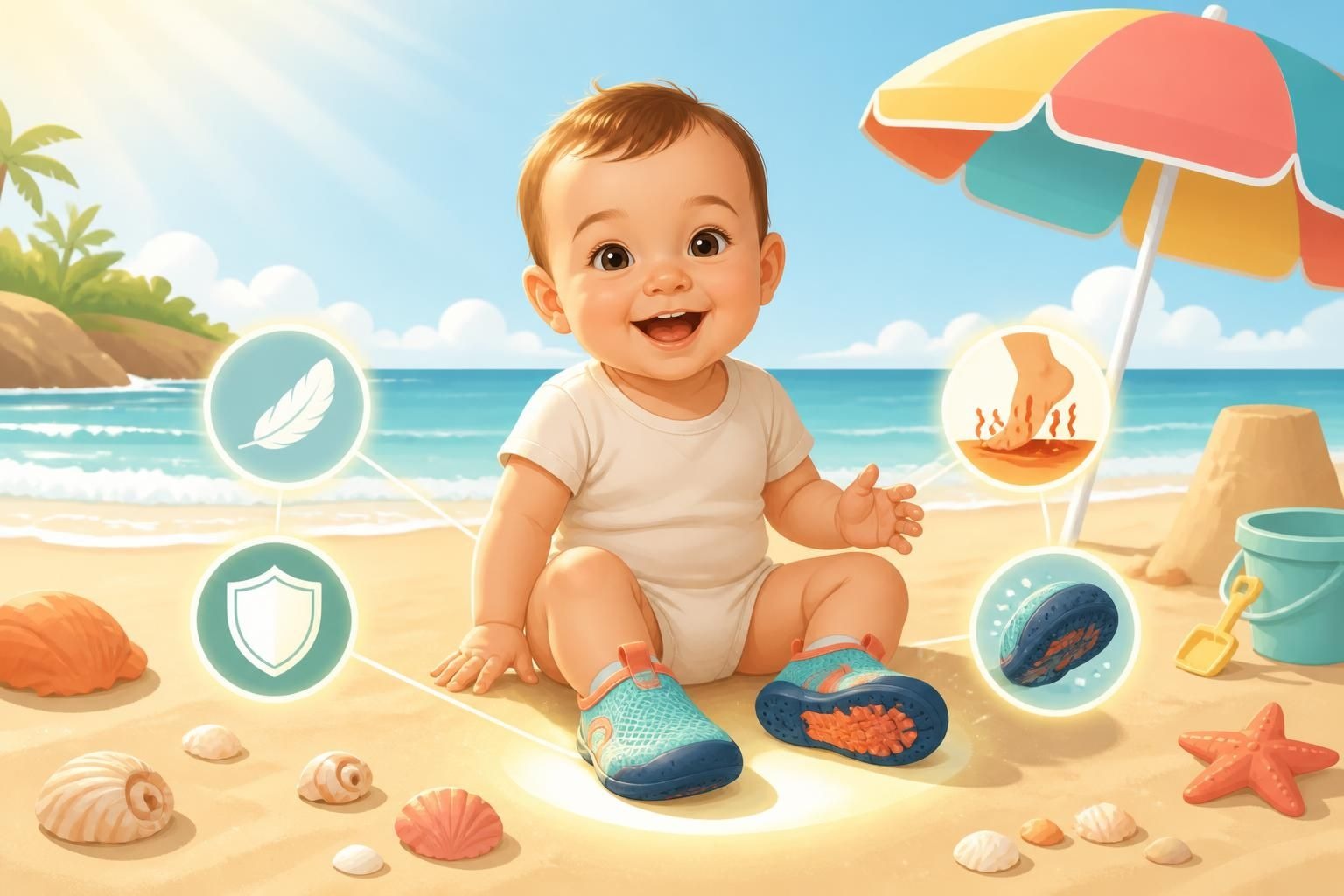
How to choose the ideal shoes to protect baby’s feet at the beach?
In Brief
- Baby beach shoes mainly serve to prevent burns, cuts, and slips on hot sand, pebbles, shells, and wet areas.
- The choice of baby shoes depends on a well-gripping sole, quick drying, soft baby shoe materials, and a reliable fastening (Velcro/elastic) without compression.
- Three categories dominate: water shoes, closed-toe water sandals, bath slippers, to be selected according to age, terrain, and wearing duration.
- Comparing models helps to balance baby foot protection, baby foot comfort, and ease of putting on, especially when baby goes from sand to water every 4 minutes.
- Simple but strict maintenance: rinse with clear water, air dry, no prolonged sun cooking to preserve glues and softness.
At the beach, baby’s sensitive feet discover a fascinating concept: sand can be soft, then suddenly turn into a frying pan, and shells into mini traps like “natural Lego”. Beach shoes are therefore not just a cute accessory for souvenir photos, but daily safety equipment. They must protect without blocking the learning of walking, stay in place when the sea decides to organize a tug of war, and dry quickly to avoid the “warm sock” effect that annoys everyone. The real issue is balancing baby foot protection and freedom of movement, while keeping a simple routine for adults: quick putting on, cleaning without an engineering degree, and a model adapted to the day’s terrain.
This guide focuses on concrete criteria that change everything: sole, support, materials, cut, water management, and even UV protection when exposure is long-lasting. It also offers a numbered comparison of accessible models, because the budget “sunscreen + hat + snack + bucket” already exists. And to avoid the classic “bought yesterday, lost today,” practical tips help to choose anti-slip beach shoes, in the right size, and to make them last more than one summer.
Why baby shoes at the beach: concrete risks and protection of baby’s feet
On the coast, the most underestimated danger is not the great white shark (which usually has other plans), but the trio of burning sand, cuts, and slips. Sand can heat up very quickly in full sun. Even without a universal figure valid for all beaches, the observation is simple: an adult jumping on spot on sand at noon is not dancing; they are regretting their choices. For a toddler, the skin is thinner and the reaction less anticipated, increasing the risk of irritation and superficial burns.
Pebbles, shells, and small stones add a second category of problems: micro-cuts and bruises. On the scale of a baby’s foot, a “small” shell can become a serious obstacle. Well-chosen baby shoes act as a physical barrier without preventing feeling the ground, which matters when the child is learning to stabilize and coordinate their steps.
The third issue, often responsible for noisy falls (and parents pretending not to run): wet surfaces. Between the damp slope near the water, smoothed rocks, and beach shower surroundings, grip becomes central. Anti-slip shoes with a sole designed for water reduce the risk, especially if baby alternates walking on sand and stepping in puddles. Baby shoe safety depends not only on the sole pattern but also on stiffness: too soft, it slips and twists; too hard, it “surfs” on the water film.
Baby foot protection is also played on the toe area. Shocks come quickly when a child trips by putting their feet flat forward. A reinforced tip or a closed front on water sandals limits bumps. The goal is not to turn baby into a mini alpine hiker, but to avoid the day ending with an improvised wound rinse tasting of salt.
Last element, less visible: prolonged moisture. Waterlogged shoes, worn for a long time, can promote chafing and irritation. A quick-drying model reduces this risk and improves baby foot comfort. Once the feet begin to “soften” in moisture, friction tolerance decreases, and complaints rise, even if baby does not yet put very precise words on the situation.
Criteria for choosing baby shoes: sole, support, drying, and materials suitable for the beach
Shopping for beach shoes can seem like a simple task: “take the prettiest one.” Except the prettiest sometimes ends up floating offshore, like a little boat. Effective baby shoe choice starts with the sole. An anti-slip sole must grip on wet ground, but also resist abrasion from sand. Deep grooves are not enough if the rubber is too hard or if the surface becomes soapy in contact with sunscreen. Good practice is to check that the sole bends at the forefoot while remaining stable on the sides.
Support is the other pillar. Velcro systems have a clear advantage: they adjust quickly and follow foot swelling variations (heat + activity). Elastics also hold well, but must remain easy to put on without a five-minute battle. Good support prevents the foot from sliding inside, a source of chafing, and reduces losses at sea when a wave decides to test the fastening’s resistance.
Baby shoe materials are as important as the shape. For the beach, priority goes to flexible, lightweight, hydrophobic or fast-draining materials: synthetic mesh, thin neoprene, EVA, rubber. A material that is too rigid hinders walking, especially in toddlers still learning to roll their foot. A soft lining limits irritation but must also dry fast: a “cuddle” lining that holds water invites redness.
Breathability plays a role on hot days. Aerated water sandals help limit sweating, but sand ingress must be monitored: too open, they turn into mini portable sandboxes. Closed-front models protect toes while allowing air circulation on top and sides. The compromise is often here: closed enough to protect, open enough not to cook.
UV protection is a useful bonus for long exposures. Some slippers and water shoes display a UPF (Ultraviolet Protection Factor) rating. In the model selection provided below, one example announces UPF50. This point does not replace sunscreen but reduces direct exposure on the top of the foot, an area easy to forget when the child wiggles during application.
Shoe size, finally, deserves a very down-to-earth approach. A space of about 0.8 to 1.2 cm in front of the toes is often used as a practical guide for children’s shoes, as it leaves room without causing tripping. If the foot swims, friction increases. If it’s too tight, nails and skin protest quickly, especially with water and sand as a bonus.
To keep the “funny” side without losing the thread, a terrain rule helps: if the shoe takes longer to put on than to build a sandcastle, it will be hated. Ease of use is part of baby shoe safety, because an easy-to-wear model is simply a worn model.
A video demonstration often allows visualizing sole flexibility, heel support, and ease of putting on, three details that don’t always jump out in store.
Water shoes, water sandals, bath slippers: which beach shoes according to age and uses
Three main options dominate when it comes to baby shoes adapted for the beach. Water shoes, first, are the most versatile. They cover the foot, protect from hot sand, and hold better in water than very open sandals. They are suitable for seaside vacations when days alternate water games and sand walks. They also offer a barrier against small stones, avoiding “foot inspection” stops every two minutes.
Water sandals, next, score points on very hot days thanks to their ventilation. Choosing a closed front limits toe shocks. Velcro fastenings allow precise adjustment of the instep and ankle. This type of shoe works well for short walks on promenades or to go from the parking lot to the beach without walking barefoot on hot zones.
Bath slippers, finally, stand out by their lightness. They are often very flexible, easy to put on, and appreciated in babies who are beginning to stand or walk. They protect from hot sand and rough ground, but their durability depends greatly on the material and sole thickness. On rocks and abrasive surfaces, some models wear out faster than reinforced water shoes.
The “age” criterion is not limited to a number but to a motor skills level. For a baby not yet walking, the priority is baby foot comfort and protection against heat and chafing, with a very flexible shoe that is easy to remove. For a child already running, lateral stability and grip take precedence, as the energy spent increases speed… and slip risks.
The terrain also changes the game. On a fine sand beach, a light sole is often enough. On a cove with pebbles, a thicker sole and a protected tip are better. On rocky areas, a water shoe with more robust rubber limits bumps and improves baby shoe safety. Poolside, anti-slip becomes central, as wet tiles have no mercy on hurried small steps.
To help decide without turning the purchase into a university thesis, a checklist allows quick filtering:
- Sole: visible relief, grippy rubber, flexion at the forefoot.
- Support: well-held heel, reliable fastening, no foot sliding inside.
- Materials: flexible, light, quick drying, non-irritating internal seams.
- Protection: closed or reinforced front depending on terrain, UPF/UV if long exposure.
- Practicality: simple to put on, easy to clean, sand evacuates without dismantling everything.
A well-chosen beach shoe is especially noticeable when it does not get noticed: baby plays, walks, sometimes falls (it’s a national sport), but feet remain protected and the day continues without a “boo-boo” break.
Comparison 2026: models and measurable criteria to protect baby’s feet at the beach
To compare without getting lost, measurable criteria help: price, type of fastening, presence of a closed front, promise of UV protection, and usage orientation (beach/pool). The selection below includes models mentioned in the provided data, with their displayed prices. Prices may vary according to seasons and stocks, but they provide a starting budget reference.
| Model | Brand | Indicated Price | Type | Fastening | Closed front | Announced UV Protection |
|---|---|---|---|---|---|---|
| Baby Sandals Sun & Surf | Decathlon | 7.99 € | Beach Sandals | Not specified | Not specified | No |
| Baby / Child Pool Sandals Shoes | Decathlon | 8.99 € | Pool Sandals | 2 adjustable Velcro straps | Not specified | No |
| Coral Baby Child Swim Sandal Shoe | Decathlon | 9.99 € | Swim Sandals | Not specified | Not specified | No |
| Bath Shoes | Petit Filippe | 26.50 € | Bath Shoes | Not specified | Yes (slipper-type coverage) | Yes (UPF50) |
The “field” reading of the table is simple. The listed Decathlon models fall within a tight budget, useful to equip a family wanting one pair dedicated to the beach and a “dry” pair. The Velcro versions are practical for support, often a decisive point when the child moves a lot. The Petit Filippe model has a higher price but highlights UPF50 protection and usage designed for early walkers, with a material announced as quick-drying.
The good comparison does not stop at the price. A shoe can cost 8.99 € and be perfect for the pool but less suitable on pebbles if the front is too exposed. Conversely, a more covering model can be very protective but too hot if the child mainly stays on dry sand in the shade of an umbrella. The choice of baby shoes is therefore based on the dominant use of the week, not an “ideal” use that never happens.
One often forgotten point concerns seam thickness and internal relief. On moist skin, a prominent seam can irritate quickly. Checking the interior by hand, gently crumpling the shoe, gives an idea of what the foot will undergo after two hours of play. This test costs nothing and avoids store returns motivated by redness.
Video tests are useful to see heel hold and sole reaction on wet ground, two key elements for baby shoe safety.
Maintenance, drying and lifespan: keeping beach shoes clean without spending the evening
The beach adds a secret ingredient to all materials: the mixture of salt + sand + sunscreen. Without maintenance, even good baby shoes can become rough, smell strong, or lose grip. The simple protocol starts just after leaving: rinse with clear water. The idea is to remove salt and sand grains that embed in seams and under the sole. A quick rinse is better than a heroic cleaning three days later.
Drying is the stage where many models “die” prematurely. Air drying, in the shade or indirect light, limits deformation and glue fatigue. Prolonged exposure in full sun can stiffen some plastics, weaken glued parts, and fade colors. The goal is to get back a flexible shoe because flexibility contributes to baby foot comfort and natural walking.
Inside, a wipe with a soft cloth or a small brush removes stuck grains. On textile water shoes, gentle hand washing often suffices. It is best to avoid aggressive cycles, especially hot ones, which can twist reinforcements and alter soles. Odors often come from trapped moisture: complete drying between uses solves much of the problem.
Fastenings also deserve attention. Velcro collects sand and loses grip. Targeted rinsing, then gentle “combing” with a brush, can restore hold. Elastics suffer when left stretched or exposed to salt: rinsing and letting them regain their shape increases their longevity.
From an organizational point of view, two habits make life easier: carry shoes in a ventilated bag (not in a closed bag that traps moisture) and shake the pair over a trash bin before putting it back in the trunk. Sand in the car has an almost magical expansion capacity, especially when hidden in the sole. A 60-second routine after the beach avoids “surprise grains” found on the living room carpet.
When a shoe starts to slip, even if it “still looks good,” it must be seen as safety equipment. A worn sole loses its anti-slip function, and the beach is not the ideal place to test gravity. Replacing a worn-down pair is often more reasonable than trying to “finish the season” with a slippery model.
What Do We Say?
To effectively protect babies’ sensitive feet at the beach, priority goes to a truly grippy sole and solid support, as falls and slips are the most frequent risk on wet areas. Covering water shoes are the most versatile choice when the child alternates between sand and water, while closed-front water sandals are more comfortable on very hot days if the terrain is not aggressive. A quick-drying model limits irritation linked to moisture, which weighs as much as the look. Regarding budget, better a simple but stable pair than a “too open” one that lets in sand and shocks.
Should I buy one size up for baby beach shoes?
A margin is useful, but too large increases chafing and falls. A practical guide is to keep about 0.8 to 1.2 cm in front of the toes, checking that the heel remains well supported. The foot must not slip inside when the child walks on wet ground.
Water shoes or water sandals: which to choose for a whole day?
For a day alternating water, sand, and rocks, water shoes protect better and often stay better on the foot. For a day mainly on dry, very hot sand, well-ventilated water sandals, ideally closed in front, can be more comfortable. The support (Velcro/elastic) remains decisive.
How to avoid irritation with baby shoes at the beach?
Irritations often come from prolonged moisture and trapped sand. Choosing flexible baby shoe materials with quick drying, rinsing with clear water after use, and letting them dry fully in the open air helps a lot. Also check the inside: thick seams and poorly placed reinforcements can rub when the foot is wet.
Does UV protection on bath shoes really help?
It can help on long exposures, especially on the top of the foot, an area sometimes forgotten during cream application. A UPF mention (like UPF50 on some models) reduces direct exposure through the fabric. This does not replace other sun protections: hat, UV clothing, and baby-appropriate cream.