Our experience with Babychou Services during a Parole de Mamans event: the full report
In Brief
- Babychou Services was mobilized for a Parole de Mamans event with care designed for children of mixed ages, to free up time for parents to engage in discussions without turning the space into an improvised gym.
- The observed setup was centered around dedicated facilitators, a clear framework of play areas, and a schedule aligned with the real rhythm of families (welcome, quiet times, energy peaks).
- The full report highlights concrete points: fluidity in event organization, calmer adult-child interactions, and a preparation level that feels less like “we’ll see on site” and more like a real plan.
- The feedback also highlights anticipated limits: noise management, circulation between spaces, and the need to brief parents on the rules upon entry.
- Behind the scenes, the data question (registrations, photos, Wi‑Fi networks) calls for vigilance: the “cookies and consent” approach à la Google reminds us that family events also touch confidentiality.
Created in 1997 according to the TopBabySit website (“Babychou: Reviews and Full Test”), Babychou Services has established itself in the child care field by multiplying formats, from home services to occasional setups for major family events. At a Parole de Mamans event, the interest is simple to measure: allowing parents to follow exchanges, workshops, or meetings, while knowing children are not “just in a corner” with three tired felt-tip pens. The field doesn’t forgive: a baby does not have the same tempo as a six-year-old, and an event space can go from dead quiet to a caffeine-fueled fair-like atmosphere in three minutes.
The full report presented here focuses on observable elements of event organization: role distribution, flow management, activity choices, communication to families, and small details that change the day (like a cuddly corner that prevents a diplomatic crisis). The tone remains factual, with a touch of humor because childhood is an unrecognized Olympic discipline. Above all, this feedback reads like a useful report: what works, what sticks, what parents should demand, and what providers should prepare in advance.
Babychou Services at Parole de Mamans: what event organization really changed
At a Parole de Mamans event, the promise of a childcare service is quickly assessed: can adults listen to a roundtable without watching a child in the corner negotiating climbing a folding chair? In the observed setup, Babychou Services fits a “supervised animation” logic more than simple “supervision.” The nuance counts: babysitting means avoiding accidents; animation means occupying with intention, thus mechanically reducing risky situations.
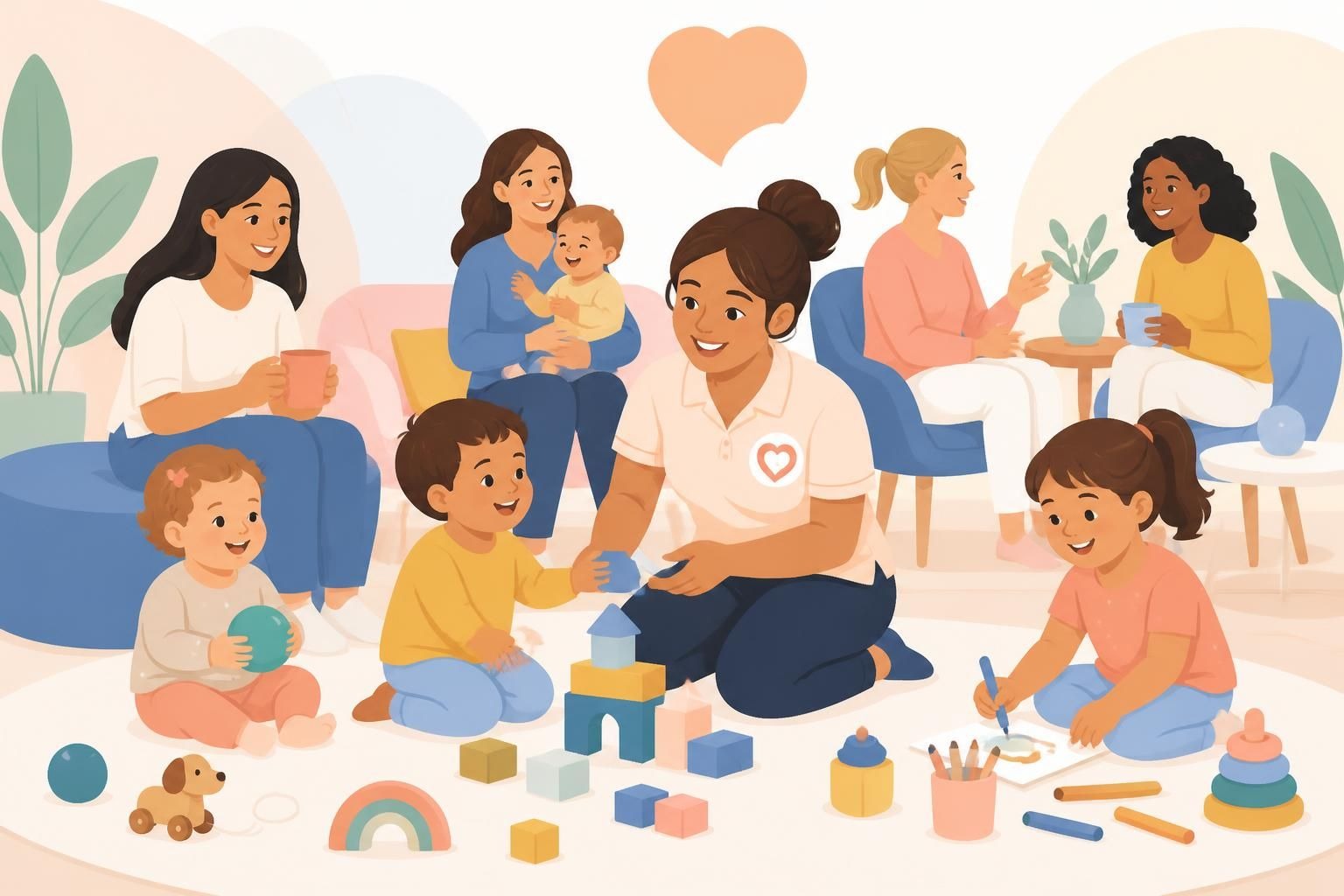
The first visible improvement concerns circulation. A family event attracts strollers, bags, cups, and children slipping through like parkour experts. The organization has an interest in defining readable zones: an active play zone, a reading/quiet zone, and a “return to parents” space for children who need to check that their reference adult hasn’t been teleported. Without this breakdown, the event turns into a noisy open space.
Another concrete change is measurable in the quality of exchanges between parents. When childcare is settled and identified, conversations happen without interruptions every two minutes. The benefit is not abstract: a “sleep” or “screens” workshop is of little interest if the parent has to leave the room in an emergency mode. Here, the presence of dedicated facilitators allowed for a steadier rhythm, with returns to parents handled as transitions, not emergencies.
The “event” format also imposes a rarely discussed constraint: the perception of safety. Parents accept letting go more easily if the framework is explicit from the start. The agency is described in some reviews as “responsive and demanding about recruitment,” notably in a testimonial excerpt highlighted under the title “BABYCHOU SERVICES – RELATIONS INTERVENANTS – Controlled Reviews.” Even without going into internal details (which are not public), the effect is observable: instructions are given calmly, rules are repeated to children without raising voices, and parents know whom to turn to.
Activities that don’t look like “filler”
When a provider improvises, it shows: one table, some sheets, and the hope that magic happens. Here, the activity selection seemed designed for different age groups. The youngest need simple manipulation and a secure corner; the older ones want challenges, instructions, and a “mission.” The presence of facilitators makes such differentiation possible, where a single adult often just manages the crowd.
A typical example at this type of event: offering a creation workshop (collage, stickers, modeling clay) alongside a mini motor skills course, then alternating to avoid congestion. The result, from the parents’ side, feels like a luxury: hearing a full sentence without it being cut off by a full-power “mom, look!”
In practice, the event organization also gains credibility when the team anticipates the “risky moments”: arrival, snack break, end of session. These three phases concentrate 80% of tensions. On the ground, this is handled through routines: individualized welcome, hand washing before snack, guided tidying at the end of the activity. The final insight is simple to verify: when the schedule is mastered, children test boundaries less.
Childcare at an event: the observed setup, from logistics to details that matter
A useful feedback does not stop at “it was good.” For an event, childcare relies on a logistical equation: how many children, which ages, which spaces, what acceptable noise level, and what realistic attention span. Without official numbers published for this specific event, the analysis is based on standard family event practices: breaking the day into short sequences, alternating activity and quiet time, and keeping a simple communication channel with parents (visual, oral, signage).
The first striking point concerns the management of mixed ages. A baby requires close attention, where a seven-year-old wants to play in a group. The setup should avoid the constant “all together,” lest the older ones get bored and the little ones endure excessive agitation. In the observed setting, the dominant impression is of modulated care, with groupings by activity affinity rather than strict age, which limits frustrations.
The space plays a central role. In a living room, a municipal hall, or an event venue, acoustics can quickly amplify the noise. It is therefore necessary to plan cushioning zones (carpets, cushions) and activities that do not require shouting to exist. Parents judge from use: if the child comes out overexcited and soaked with fatigue, the care “worked” at the moment but complicates the end of the day.
Comparative table: organizing care at an event vs home care
To clarify what really changes between an occasional event service and home services, here is a comparison based on measurable or observable parameters (duration, number of children, space constraints). The values remain common ranges in family event settings, to be adjusted depending on location and families.
| Parameter | Childcare at event | Home services | Impact on event organization |
|---|---|---|---|
| Number of simultaneous children | Often 5 to 30+ depending on format | Often 1 to 3 (siblings) | Group management, noise and group dynamics |
| Duration of activities | Short sequences: 10 to 30 minutes | Longer blocks: 30 to 90 minutes | Need for variety to prevent boredom |
| Space constraints | Shared space, public circulation | Private space, child’s home known | Zones to delimit, meeting points |
| Management of arrivals/departures | Flows, badges, quick instructions | Gradual transition with parents | Risk of confusion if rules are not posted |
Beyond the table, the stake is human: at an event, the child has to trust quickly. Facilitators who know how to introduce themselves, get down to the child’s level and propose an activity from the first minutes defuse a large part of separation tears. The final insight emerges clearly: the more structured the welcome, the less parents “come back to check” in a loop.
Feedback: what parents notice (and what annoys them) with Babychou Services
Parents don’t only comment on the kindness of the facilitators. They observe very concrete details: is the child welcomed by name, is the bag placed in a clear spot, is the snack managed properly, is the activity appropriate. In public content, Babychou Services highlights family testimonials on its channels, and posts also exist on social networks: a Facebook post titled “Mom’s feedback | Discover the …” mentions, for example, an experience during the “La Parisienne” race, with the idea that the provider facilitated adult participation by securing the children’s supervision. This type of case illustrates a use close to a Parole de Mamans event: busy adults, children to integrate smartly.
Another striking point is the tripartite relationship: parents, children, and agency. In the excerpt “Testimonials & Reviews Babychou Services – Parents & Facilitators,” a facilitator describes the development of autonomy and sense of responsibility thanks to her babysitting missions. Even if this feedback is from the facilitator’s side, it sheds light on an aspect parents feel: a person comfortable in their role manages micro-tensions better, like sharing toys or the frustration of not going first.
The “funny” side of a full report is to recognize what annoys. At an event, parents tolerate poorly two things: visible improvisation and vagueness. A child who comes back three times asking for permission to drink water is not a drama, but a signal of organization: rules were not explained or repeated. A space where children cross the main aisles also creates constant worry. Providers who manage these points quickly become the day’s quiet heroes.
Practical list: what parents can check on site in 3 minutes
- An identified welcome point and a reference adult easy to spot.
- Distinct zones (quiet / active) to avoid “everyone running everywhere.”
- A simple rule to join parents (specific place, not “you’ll find me”).
- An activity immediately offered to shy children or clinging ones.
- Clear snack management (allergies noted, hand washing).
- A small end-of-session ritual (guided tidying, calm return), useful for the rest of the day.
The most useful feedback remains what distinguishes the atmosphere from the method. The atmosphere can be excellent one day and average the next; the method is spotted quickly in how children are framed without shouting and how safety is monitored without spoiling the fun. The final insight is concrete: when rules are simple and repeated, the child calms down faster.
Data, photos, cookies: the confidentiality point that sneaks into family events
A modern parental event is not limited to on-site animation. There are online registrations, forms, sometimes Wi‑Fi connection, photo shoots, and the temptation to publish “too cute” stories. In this context, personal data issues become very concrete, especially when children appear. The reminder is useful: consent systems are not just an annoying pop-up, they structure what can be measured, stored, targeted or not.
The consent formulations used by Google for its services sum up the logic well: some cookies serve to “provide and maintain services,” “track outages,” “protect against spam, fraud, and abuse,” and “measure engagement and audience statistics.” Other purposes exist if the user chooses “Accept all,” such as “develop and improve new services,” “measure ad effectiveness,” or “display personalized content and ads” per settings. In case of “Reject all,” these additional uses do not apply. Google also refers to management tools (g.co/privacytools) to adjust preferences.
This reminder is not off-topic: it helps frame what parents should demand from a Parole de Mamans event, regardless of the childcare provider. Organizers must explain what is filmed or photographed, who accesses it, how long it is kept, and how to object to its sharing. For families, the simplest is to ask for rules upon arrival, then check if a “no photo” badge or a no-capture zone exists.
Specifically, what this changes for a childcare provider
A childcare service at an event sometimes involves attendance lists, emergency contacts, and minimal medical information (allergies, authorization to leave area). Good practice is to reduce collection to the essentials. A paper form kept under supervision does not carry the same risks as a shared document without control. Parents benefit from keeping the organization’s number and avoiding sharing unnecessary information.
The link with Babychou Services lies in the ground reality: when care is well framed, information circulation is simpler and safer. A well-organized family event looks less like a paper fair and more like a clear pathway. The final insight is operational: the fewer data wander around, the fewer misunderstandings.
What do we say about it?
The full report strongly favors a structured provider like Babychou Services at a Parole de Mamans event, because the quality of childcare is seen in flow management and sensitive moments, not in a vague promise. The strong point observed remains the event organization: readable zones, adapted activities, and a welcome that reduces “panic” returns to parents. The weak point to watch concerns initial communication: without rules explained at the entrance, even a good team wastes time recentering. For families, the recommendation is to check the welcome setup and photo/data rules before the event, as these are two frequent sources of avoidable stress.
At what age can a child be entrusted to childcare at an event?
At an event, acceptance mainly depends on the setup: secure space, adapted supervision, and a welcoming routine. For very young children, a quiet corner and close attention are essential. Parents benefit from indicating the nap schedule and specific needs upon arrival to avoid sensory overload.
What information should be given to the childcare provider during an event?
Limit to useful data: child’s first name, reachable emergency contact, allergies or immediate medical indications, and simple authorizations (leaving the area, going to the toilet accompanied). Avoid sharing unnecessary information. In case of digital registration, check the statements on data retention and use.
How to prepare an anxious child before an event like Parole de Mamans?
Explain the schedule with simple words, show the place if possible, and describe the activity as a supervised playtime. On D-day, arriving a bit early helps avoid the rush. A comforting object (security blanket) and a short separation ritual ease the transition, especially if the welcome is structured.
What signs show that an event organization is well thought out for families?
A visible welcome point, separated zones (active/quiet), repeated instructions without shouting, and a clear system to find parents. The presence of activities ready from arrival reduces crying and boredom. A declared photo/confidentiality rule also prevents tensions, especially when children are involved.