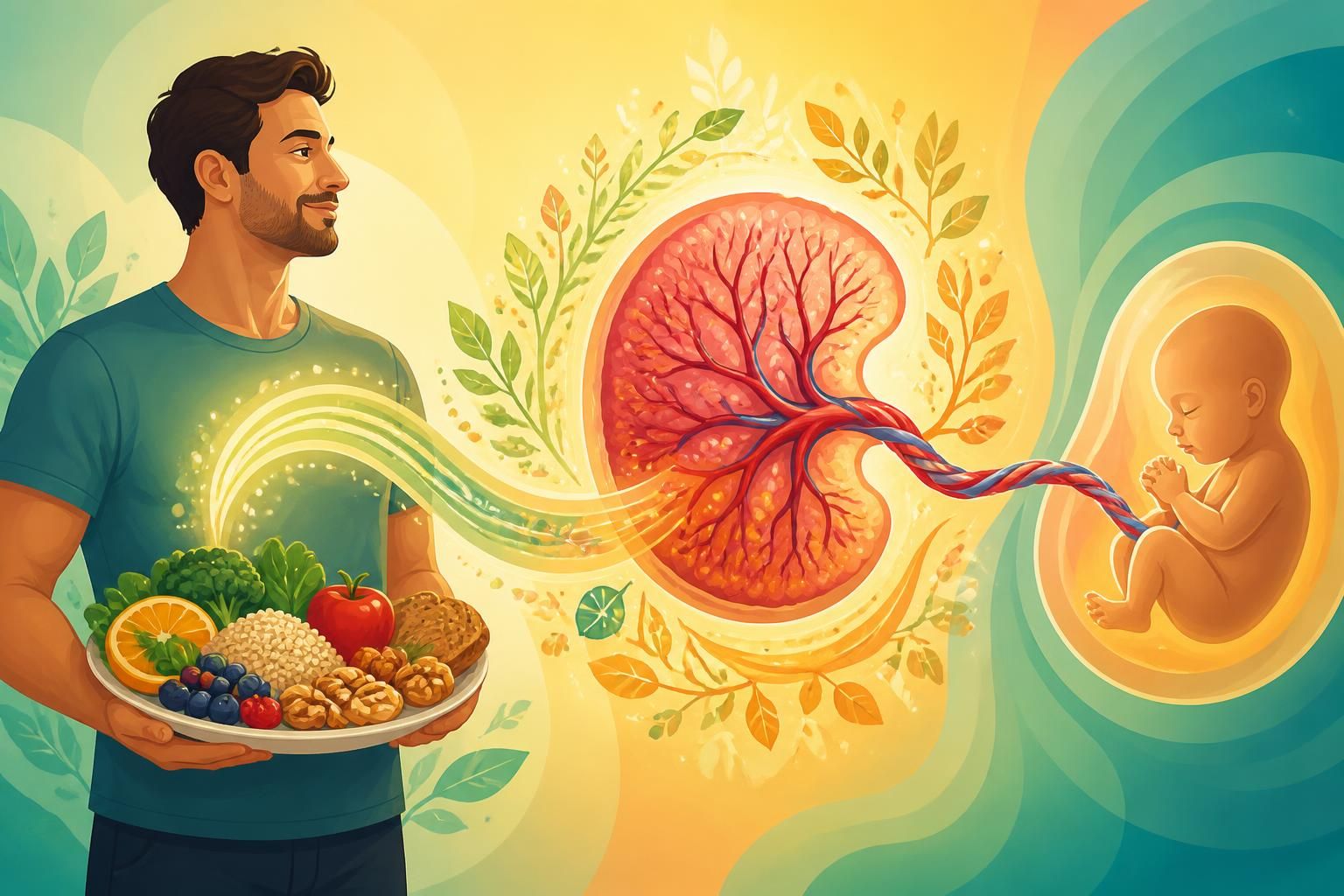
How the father’s diet before conception can shape the health of his future child’s placenta
In Brief
- The placenta forms from the first weeks of pregnancy and depends on a close biological dialogue between the embryo and the mother, a dialogue influenced by paternal factors brought via the spermatozoon.
- According to a study published on July 6, 2021, in Nature by teams from Helmholtz Munich and the German Center for Diabetes Research (DZD), a paternal high-fat diet before mating alters signals associated with placental development and offspring metabolism in mice.
- The father’s preconception nutrition acts mainly through epigenetics (small marks and sperm RNA), which can modulate the expression of genes involved in placental health and fetal development.
- Practical guidelines exist: aiming for at least 5 servings of fruits and vegetables per day and limiting industrial trans fatty acids (WHO recommendations, “Healthy diet” fact sheet, April 29, 2020) helps frame the dietary impact in the months before conception.
- The preparation window on the male side is not a “detail”: a full cycle of sperm production lasts about 74 days (American Society for Reproductive Medicine, patient fact sheet “Semen analysis”, updated June 1, 2023), which gives a concrete timeline to act.
The placenta is often presented as a “pregnancy organ” that belongs only to the mother. In reality, it is also the embryo’s first biological business card, and therefore indirectly the father’s: it derives largely from embryonic tissues, carrying paternal DNA. When the father’s nutrition is unbalanced before conception, the issue is not only the future dad’s waist size or blood work: it is also about the biological messages carried by the spermatozoon, capable of modulating placental health and, behind it, fetal development.
This topic left the “laboratory curiosity” category when teams from Helmholtz Munich and the DZD showed, in mice, that a high-fat diet given to the father before mating modified parameters related to the placenta and offspring metabolism (study published on July 6, 2021, in Nature). Direct extrapolation to humans requires caution, but the general mechanism — epigenetics as a messaging system — fits current knowledge on reproductive health. And by the way, it removes a convenient alibi: no, the “before” period is not a no-nutrition zone.
Father’s Nutrition Before Conception: What Sperm Biology Can Transmit
On the paternal side, conception is not just a simple deposit of genetic material at moment T. The sperm also carries so-called epigenetic signals: DNA methylations, histone modifications, and small RNAs. These elements do not add new genes but influence how some genes are expressed at the very beginning of development. In the context of unbalanced preconception nutrition, this “instruction package” can be reconfigured, with possible repercussions on placental health.
A very concrete detail helps understand why “a few weeks” matter: sperm production follows a cycle of about 74 days, a figure cited by the American Society for Reproductive Medicine (ASRM) in its patient fact sheet on semen analysis, updated June 1, 2023. Translation for parents: what happens on the plate two to three months before conception can somehow be reflected in gamete quality. The excuse of “we’ll see later” loses some of its charm.
Epigenetics: The Messaging System That Loves Fats… and Not Always for Good Reasons
The July 6, 2021 Nature study led by Helmholtz Munich and the DZD, on a mouse model, highlighted that a paternal high-fat diet before mating could disrupt pathways related to placental development and metabolic balance of the offspring. This type of work does not say “same menu, same fate” in humans, but it reinforces the idea that paternal factors participate in early programming.
In real life, a “high-fat” diet does not necessarily look like a butter buffet. It can take the form of an accumulation of ultra-processed foods rich in saturated fats and salt, with fiber optional. Yet, fibers play a role in the gut microbiota and systemic inflammation, two levers likely to influence reproductive health. This is not a nutritional morality contest; it’s biological plumbing.
A Field Example: The “Vegetable Drought” Period Before a Baby Project
A common scenario: a future father chains quick meals, sugary drinks, and “vegetable” becomes the name of a cartoon character. A few months later, the couple starts a conception project. The problem is not one isolated pizza but a routine: low intake of folates, antioxidants, zinc, omega-3, and excess energy. In this context, sperm quality may be affected (motility, DNA fragmentation), and the embryo starts with a less favorable informational environment.
The phrase to remember is simple: preconception nutrition on the male side is a modifiable factor, therefore a lever for action. And even busy schedules appreciate that, because a lever is more practical than a miracle.
Placental Health: Why the Placenta Reacts to Paternal Factors from the First Weeks
The placenta is not just a “nutritive cushion.” It manages oxygen, nutrient transfer, part of immunity, and hormonal signals. Since it derives mostly from embryonic tissues, it carries paternal and maternal DNA. This means that paternal factors, via genetic imprinting and epigenetics, can influence how the placenta develops, implants, and vascularizes.
In many models, genes subject to parental imprinting are important for fetal growth and placental function. Without being poetic, these are genes that “listen” more to one parent than the other, according to inherited epigenetic marks. When the father’s nutrition or metabolic state alters these marks, some growth settings can be dysregulated. This does not necessarily result in a visible catastrophe; it can be subtle but measurable.
Placenta, Fetal Development, and Metabolism: A Trio in Continuous Dialogue
Placental health weighs on fetal development because it conditions supply and stress response. A less efficient placenta can alter nutrient distribution, affect growth, and influence later metabolic trajectories. The 2021 Nature study, even though it concerns the mouse, fits this logic: paternal exposure before conception can lead to alterations in the offspring through early mechanisms involving the placenta.
A point often misunderstood: “It’s okay, the mother will compensate.” The maternal body has impressive adaptive capacities, but pregnancy is not an unlimited catch-up operation. When discussing paternal dietary impact, the subject is not to transfer more mental burden on the couple. It is about recognizing that a parameter exists and that it can be improved without turning into a nutritionist monk.
The Shortcut Trap: “If It’s the Placenta, It’s Definitely the Mother”
On social networks, the placenta is often used as a sign for “maternal responsibility.” Biologically, this shortcut is shaky. The placenta is a hybrid organ in its dialogue with the maternal organism, but its development program comes from the embryo. This program includes signals of paternal origin. This is not a slogan; it’s embryology.
The phrase that usefully reframes the debate: talking about placental health is talking about the mother–embryo duo, and the embryo carries a paternal half. This reminder prevents turning pregnancy into a permanent hearing of the future mother.
To visualize the basics of placenta and embryonic development, an educational video often helps put words on what really happens in the first weeks.
Preconception Nutrition: Concrete Guidelines to Reduce Dietary Impact on the Male Side
The future father does not need a “special conception diet” sold in pastel packaging. He mainly needs simple, applicable guidelines compatible with a normal life. Preconception nutrition aims to support reproductive health, limit chronic inflammation, stabilize weight, and provide micronutrients useful for spermatogenesis.
To frame without playing carrot professor, the World Health Organization (WHO) recommendations on healthy eating (fact sheet “Healthy diet,” April 29, 2020) provide a universal base: at least 5 servings of fruits and vegetables per day, limit free sugars and salt, and avoid industrial trans fatty acids. This framework was not written “especially for placenta,” but it acts on general determinants important for fertility and gamete quality.
A Realistic List of Actions (and Less Painful Than a Mystical Fast)
- Switch to “complete plate” mode: add a source of fiber (legumes, vegetables, whole grains) to each main meal.
- Aim for 1 to 2 servings of fish per week, including one fatty fish (such as sardine, mackerel, salmon) for omega-3s.
- Limit ultra-processed foods rich in saturated fats and salt, especially in daily routine.
- Replace some sugary drinks with water, tea, or infusions to reduce free sugars.
- Keep an eye on alcohol, which can degrade sperm parameters when consumed heavily and regularly.
- Plan action for at least 74 days before conception, consistent with the spermatogenesis cycle mentioned by ASRM.
Table: Examples of Measurable Levers to Track Before Conception
| Lever Tracked | Concrete Indicator | Useful Time Window | Example of Dietary Adjustment |
|---|---|---|---|
| Fiber Intake | 25 to 30 g/day (commonly recommended order of magnitude in nutrition) | 8 to 12 weeks | Add 150 g of cooked legumes 3 times/week |
| Fat Quality | Reduce industrial trans fats, favor oils rich in unsaturated fatty acids | 4 to 12 weeks | Replace repeated frying with oven/pan cooking using olive oil |
| Fruits and Vegetables | 5 servings/day (WHO benchmark, April 29, 2020) | 4 to 12 weeks | 1 fruit at breakfast + 2 vegetables at lunch + 2 at dinner |
| Weight and Energy Balance | Progressive stabilization, no crash diet | 12 weeks and more | Reduce late snacking, increase protein and fiber at dinner |
An amusing (and somewhat cruel) point: “heroic efforts” over 10 days often mainly give… stories. A stable pace over 2 to 3 months better fits the biology of spermatogenesis and reduces the feeling of punishment.
From Laboratory to Everyday Life: What the Helmholtz Munich/DZD Study Says and How to Avoid Misinterpretations
The temptation is strong to read an animal study and turn the future father into suspect number one. Bad idea, and not only for the home atmosphere. The right use is to understand the message: the paternal organism, via epigenetics, can influence early steps related to the placenta and child metabolism. The study published July 6, 2021, in Nature by Helmholtz Munich and the DZD used a mouse model and a high-fat diet before mating to observe effects on offspring, with associated biological signatures.
The classic misunderstanding is to believe that “everything is decided” if the father ate too much fat before conception. Health trajectories are multifactorial: maternal diet during pregnancy, environment, sleep, physical activity, medical follow-up, socio-economic status. The useful message is more operational: the dietary impact on the male side is a variable that can be adjusted, and that is better than debating whether the placenta “belongs” to one or the other.
What Couples Can Do Without Turning Conception into an Industrial Project
In real life, planning is imperfect. Some conceptions happen faster than expected, others take time. The most robust strategy is to adopt gradual improvement, then keep the pace. Replacing two ultra-processed meals per week with simple meals (protein + vegetables + whole starch) often has a more lasting effect than a punitive cure.
There are also “healthy” traps: hyper-sugary protein bars, energy drinks, or supplements taken en cascade. Before equipping oneself like a sports nutrition store, a check-up with a health professional is relevant, especially in case of overweight, diabetes, lipid disorders, or fertility history. The goal is reproductive health, not a collection of pillboxes.
Privacy Sidebar: Cookies, Ads, and Pregnancy, Same Fight Over Control
Talking about nutrition and conception often triggers an avalanche of targeted ads: tests, supplements, “fertility” programs. Advertising platforms rely on personalization mechanisms linked to browsing activity. Google explains on its help page about cookie and data use that acceptance can be used to personalize content and ads, while refusal limits these additional uses; management is available via g.co/privacytools. This aspect does not directly affect placental health, but it influences the quality of information consumed and impulsive purchases.
A simple filter: prioritize recommendations from public health organizations and medical consultations over marketing promises of “special fertility in 7 days.” Algorithms love urgencies; the body much less.
To better understand epigenetics applied to fertility and paternal factors, a general public video resource can help distinguish real mechanisms from risky interpretations.
Reproductive Health and Follow-Up: When to Consult and How to Talk About Nutrition Without Clash
Reproductive health is not a topic reserved for gynecology offices. A future father can benefit from a medical check if there are risk factors: significant overweight, high alcohol consumption, tobacco, diabetes, hypertension, long-term treatments, or history of difficulty conceiving. A general practitioner can already frame an assessment, then refer to a specialist if needed. The goal is to improve the biological conditions of conception, not to pass a “good future dad” exam.
Practically speaking, talking about the father’s nutrition in the couple requires a minimum of tact. Advice that looks like a customs check (“show your plate”) rarely ends well. A more effective approach is to reason as a “joint project”: groceries, simple menus, and a few smart swaps. It becomes easier to keep coherent preconception nutrition if logistics follow: ready lunch box, less sugary snacks, and acceptable backup meals in the freezer.
Concrete Examples of Everyday Tools (Without Mandatory Apps)
A weekly menu table can reduce last-minute trade-offs, which often end in deliveries rich in salt and fat. The other effective tool is the choice of repeatable “bases”: a fixed breakfast, two typical lunches, two typical dinners. This leaves room for weekend pleasure without the week feeling like a marathon of decisions.
Sleep and physical activity also matter because they influence insulin, inflammation, and weight. The main subject remains dietary impact, but the body does not read article headlines: it adds signals. A regular walking rhythm and going to bed earlier often make food choices more stable.
What to Avoid: The Hunt for “Miracle Foods”
Fertility attracts magic formulas. In fact, the most credible improvements come from overall coherence: enough fiber, good lipids, quality proteins, less alcohol, less ultra-processed foods. Supplements may have a targeted place (for example, in case of diagnosed deficiency), but they do not replace a structured diet.
A helpful guideline to calm eagerness: if a product promises a massive effect on sperm quality in 10 days, it clashes with the duration of spermatogenesis. Biology is not an express delivery service.
What Do We Say About It?
The topic deserves to be taken seriously: experimental data, including the July 6, 2021 Nature study (Helmholtz Munich/DZD), make plausible a link between paternal nutrition before conception, epigenetics, and placental health, even if humans are not reducible to a mouse model. The most useful recommendation is to act 8 to 12 weeks before a conception project because that corresponds to the sperm production cycle. Winning changes are simple: more plants, less ultra-processed foods, better fat quality, reduced alcohol. Couples who want to optimize without stressing out would do well to treat preconception nutrition as practical organization, not a test of willpower.
How long before conception should a future father improve his diet?
A window of 8 to 12 weeks is consistent with the duration of sperm production, often given around 74 days. This allows realistic action on preconception nutrition without aiming for a perfect overnight change. In practice, starting earlier mainly helps stabilize weight and habits.
Can the father’s diet really influence the placenta?
The placenta derives mostly from embryonic tissues, thus carrying paternal DNA. Experimental work, including a study published on July 6, 2021 in Nature (Helmholtz Munich/DZD) in mice, suggests that a high-fat diet before mating can modify signals associated with placental development and offspring metabolism.
Which foods should be favored to support male reproductive health?
The most solid guidelines are generalist: fruits and vegetables (the 5 servings/day benchmark), fibers (legumes, whole grains), fish including fatty fish, nuts, and oils rich in unsaturated fatty acids. Limiting ultra-processed foods, free sugars, salt, and alcohol also helps. The goal is to improve metabolic balance and reduce inflammation.
Should supplements be taken before a baby’s project on the male side?
Supplements can be useful in case of identified deficiency or particular medical situation, but they do not replace a structured diet. Medical advice is relevant if the future father has risk factors (significant overweight, diabetes, long-term treatment, fertility history). First focusing on the diet avoids impulsive purchases and inappropriate doses.