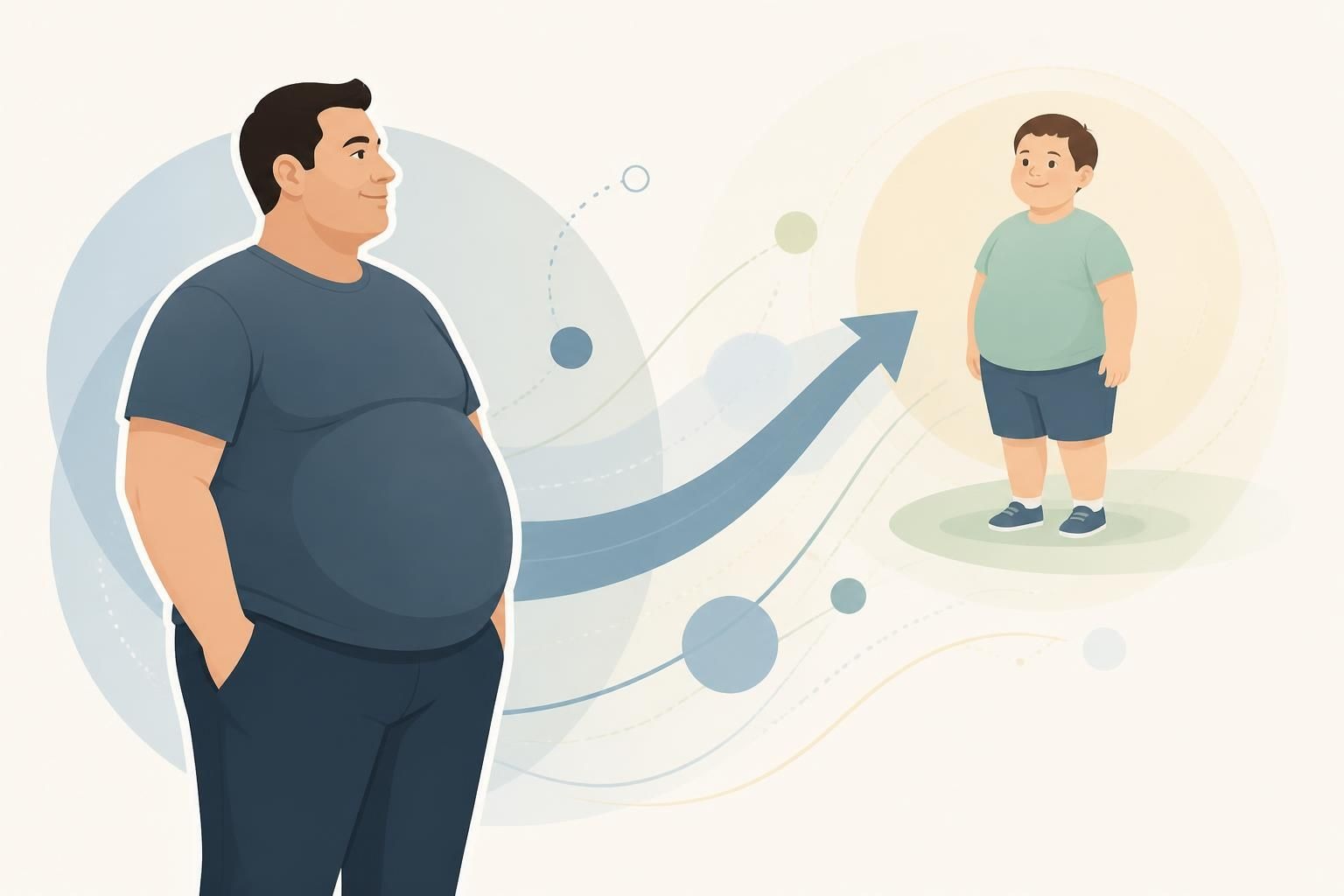
Childhood obesity: how paternal weight before pregnancy impacts the child’s future health according to a study
In Brief
- On May 26, 2026, a review of studies published in Current Obesity Reports emphasizes a frequently overlooked aspect in obesity prevention: paternal weight and, more broadly, the future father’s health before pregnancy.
- Spermatozoa transmit DNA, but also epigenetic markers that can be influenced by overweight, diet, stress, and certain lifestyle habits.
- Parental impact also takes place in daily life: eating behaviors, physical activity, screen time, and meal organization shape the child’s environment.
- The transition to fatherhood is described as a risk factor period (disrupted sleep, stress, sedentary lifestyle) where the father’s BMI can increase, which affects the child’s health.
- Paternal mental health and precariousness are mentioned as indirect elements associated with less favorable routines and increased risk of childhood obesity.
On May 26, 2026, a scientific synthesis study published in the journal Current Obesity Reports shines a spotlight where it is rarely directed: on the future father. Childhood obesity prevention is often told as a story of pregnancy, maternal plates, and baby food jars, whereas paternal weight and the father’s health status before pregnancy can also influence the child’s metabolic trajectory. The goal is not to give parents credit, but to understand how risk is created, and above all how to reduce it.
The central message is simple to remember, less simple to apply on a Tuesday evening between two laundry loads: intergenerational transmission is not limited to genes. It is also written through epigenetics, the family environment, routines, stress, and real access to quality food. And since public health loves windows of action, the period before conception becomes a strategic zone: not glamorous, but devilishly useful. The father does not arrive “after” in the story, he is already in the prologue, even if no one had thought to give him the script.
Scientific study and childhood obesity: what the review says about paternal weight before pregnancy
The review published in Current Obesity Reports highlights an idea that disrupts usual reflexes: the risk of childhood obesity is not written only during pregnancy, nor only in the first years of the child. The preconception period, on the father’s side, matters. In this synthesis, the authors gather existing works and describe associations between paternal weight, health behaviors, and offspring weight trajectories.
To properly read this type of publication, a useful reminder: a review of studies does not by itself “prove” a direct causality in each family situation. However, it serves to map risk factors and identify plausible mechanisms, especially when several results converge. Here, the focus is on concrete parameters: overweight and obesity of the father, diet, physical activity, stress, and psychological status, all located before conception.
This framing changes the obesity prevention plan, as it broadens the idea of “monitoring” to a phase where the future child is not yet there, but life decisions are already made. A very simple example: a father who moves from active work to a sedentary job, who sleeps less, snacks more, and postpones physical activity “for later” may see his body composition change. The review points out that these changes are not only aesthetic or “mood-related,” they fit within a biological and behavioral context.
Why the term “before pregnancy” changes prevention software
In classical discourse, “before pregnancy” often means vitamins for the mother, quitting smoking, screenings, medical follow-up. With paternal weight in the equation, the logic becomes family-oriented from the start. A father concerned with his health before conception can support concrete choices at home: more regular grocery shopping, more planned meals, reduction of sugary drinks, daily walking. These are mundane actions, but they change the environment in which the child will grow.
The review also highlights a socially sensitive point: studies suggest that children of overweight fathers are more likely to be overweight themselves, independently of maternal weight. In other words, there is a distinct paternal signal, which justifies talking about parental impact and not only a “mother effect.” This interpretation avoids turning the family table into a court and rather encourages shared responsibility.
For public health, this shift is practical. Preconception consultations and pregnancy follow-ups can include the father, not as a polite bystander but as an actor. Concretely, this can involve targeted advice: screening for sedentary habits, identification of sleep disorders, discussion about stress, and simple nutritional guidelines. The next section sheds light on the most discussed biological mechanism: sperm epigenetics.
Intergenerational transmission: sperm epigenetics and the role of paternal weight
The most “science-raising-an-eyebrow” point in this scientific study concerns spermatozoa. They do not only carry DNA. They also carry epigenetic information, that is, chemical marks that influence gene expression. The authors indicate that these signatures can be modified by overweight, diet, stress, and certain lifestyle habits, and then transmitted to the offspring.
In practice, this means that the father’s body, in the months preceding conception, constitutes a biological environment that can leave traces. Overweight can be accompanied by low-grade chronic inflammation, metabolic disturbances, and hormonal variations. Epigenetics then becomes a potential bridge between the father’s health status and early metabolic settings of the child.
To avoid misunderstandings, two ideas must be distinguished. First, an epigenetic marker is not a fate carved in stone. Second, a father with a high BMI is not automatically “responsible” for a future diagnosis in his child. The interest is to identify a realistic area of action: improving lifestyle before pregnancy could reduce some risks without promising an absolute guarantee.
Concrete examples of factors that can influence these markers
The review mentions families of factors that frequently recur: food quality, stress, physical activity. In real life, this looks like weeks where dinner becomes delivery due to lack of time, where screens nibble away at evenings, and where sleep comes after everything else. When these habits settle, they affect paternal weight, but also invisible parameters such as blood sugar, blood pressure, or stress level.
A concrete example, without storytelling or moralizing: a future father who replaces three car trips with walking, and who structures two additional “home-cooked” meals per week, can see simple indicators move (weight, waist circumference, energy). The goal is not to aim for a spectacular transformation but durable stabilization. In an intergenerational transmission context, a modest gain before conception can count because it occurs at the right biological moment.
For couples who like numbers and tracking, simple tools exist: weight monitoring, waist circumference, step count, frequency of meals eaten at the table. These indicators do not replace medical consultations, but they make change observable. And when it is observable, it is harder to tell yourself “everything is fine” while the couch clearly won the elections.
Biology does not explain everything. The most everyday part of parental impact is household routines. This is the subject of the next section: how the father’s example shapes the child’s food environment and activity.
Parental impact in daily life: father’s habits, family environment, and childhood obesity
The review highlights a mechanism less “laboratory” and more “kitchen table”: children observe, imitate, and internalize their parents’ habits. This concerns eating, physical activity, screen time management, and even how the body and food are discussed. In this logic, parental impact is not an abstract concept: it is in the fridge, the day’s organization, and the place given to meals.
A father who skips breakfast, snacks standing up, and finishes dinner in front of a series transmits an implicit framework. Another who cooks at least a little, sits at the table, and varies foods also transmits a framework. It is not a competition of perfect parents; it is an accumulation of repeated signals. Over several years, these signals influence childhood obesity risk, especially when they align with other risk factors (insufficient sleep, sedentary lifestyle, precariousness).
Family meals: a simple lever, not always easy to fit in
The authors remind that paternal involvement in education and family meals is associated, in several studies, with a more balanced diet and lower obesity risk. The mechanism is logical: more involved adults, often more regularity, more planning, and more consistent control of “extras.” In a family, coherence plays a huge role. When an adult says “no soda” but arrives with a bottle, the child quickly understands that the rule has a very short lifespan.
To make this concrete, here is a list of observable actions that do not require a nutrition degree:
- Set at least 3 meals per week taken at the table, without screens.
- Provide a simple pantry base: legumes, canned fish, tomatoes, whole grains.
- Put a visible and ready-to-eat “fruit option” (bananas, washed apples, clementines).
- Reduce sugary drinks by replacing them with sparkling water, lemon, cold herbal tea.
- Do a short family activity: 20-minute walk, ball games, cycling, walking trip.
The funny side is that these measures often have a side effect: they simplify logistics. Less “what are we eating?” at 7:45 pm, more “it’s already ready.” The less funny side is that they require some anticipation, so a sharing of mental load. When the father takes a visible part (shopping, cooking, planning), the child benefits from a more stable environment.
This behavioral dimension is particularly important when the father’s biological health is already fragile. The next section focuses on a period described as risky: the transition to fatherhood, with its cocktail of fatigue and disrupted routines.
Becoming a father: a risk factor period for paternal weight and child health
The review highlights a finding that will resonate with many households: between the partner’s pregnancy and the first year of the child’s life, many men gain weight. The context is quite easy to identify: fragmented sleep, fatigue, decreased physical activity, stress, faster and sometimes richer meals. The result is often reflected by increased BMI, and sometimes by the lasting establishment of sedentary behaviors.
This phenomenon is not just a locker room anecdote. It has a dual interest for obesity prevention. On one side, it identifies a moment when the father is more vulnerable to weight gain. On the other, it is a period when motivation can be strong, because child health becomes a very concrete subject, even for those who already disliked health checkups.
Sleep, stress, organization: the trio that causes weight gain without warning
Sleep plays a central role because it influences appetite, management of sweet cravings, recovery, and energy to move. In the first months with a newborn, nights do not resemble a spa. Stress also arrives: financial burden, couple reorganization, work pressure, new responsibilities. When stress and fatigue combine, food choices simplify, often towards calorie-dense options.
An important point, mentioned in the review, is that this period represents a key moment to encourage good habits in fathers. It is a window where modest actions can prevent gradual drift: walking with the stroller, preparing double portions for the next day, limiting ultra-processed snacks at home. These changes do not make fatigue disappear, but they limit the accumulation of “invisible” kilos that settle silently.
Table: useful measurable benchmarks to act before and after birth
The indicators below do not diagnose. They help monitor concrete habits linked to the risk factors mentioned in the review, and spot early drift when it is easier to adjust.
| Measurable Indicator | Monitoring Frequency | Practical Alert Threshold | Example of Concrete Adjustment |
|---|---|---|---|
| Weight (kg) | Once a week | +2 kg in 1 month | Plan 2 additional “home-cooked” meals per week |
| Waist circumference (cm) | Once a month | +2 cm in 2 months | Add 20 minutes of walking 5 days a week |
| Leisure screen time (minutes/day) | Once a week | +60 minutes vs previous week | Block a short activity slot at day’s end |
| Number of meals eaten at the table (per week) | Once a week | Less than 3 | Set a recurring “basic menu” (whole pasta + vegetables + protein) |
The table may make you smile, because it looks like a family car dashboard. The idea is precisely that: avoid discovering a warning light when the routine is already well established. The next section broadens the analysis further with variables sometimes less visible but very present in real life: mental health, stress, and precariousness.
Mental health, precariousness, and public health: indirect but powerful risk factors
The review is not limited to paternal weight or the plate. It integrates psychosocial dimensions, often treated on the sidelines although they structure daily life: stress, living conditions, financial difficulties, psychological state. In a public health context, these elements matter because they influence the ability to cook, move, sleep, consult, and establish stable routines.
A frequent example: when the budget is tight, purchasing fresh products may become irregular. Meals become more based on cheap foods, sometimes more caloric and less satiating in the long term. Time is also a currency. A father who accumulates irregular hours, long commutes, and professional pressure will have less margin to prepare meals or do sports, even with the best will in the world.
Paternal depression: an impact on involvement and family routines
The authors point out that paternal depression is associated with less involvement with the child and less favorable family health habits. The link is not an accusation; it is an observation: when psychic energy decreases, domestic organization becomes more difficult. Meals simplify, outings decrease, screens take more space. The child grows up in a more sedentary environment, with fewer regulation opportunities.
The subject remains delicate because paternal mental health is still under-discussed in some contexts. The result is sometimes a double penalty: psychological suffering on the one hand, then guilt when the child’s weight is brought to the table. Obesity prevention benefits from being formulated as support, not injunction. This involves earlier identification and referrals to professionals when necessary.
What public health can do without turning life into a checklist
The review argues for greater involvement of future fathers in preconception consultations, pregnancy follow-up, and prevention programs. In practice, this can translate into simple and repeated messages: basic dietary guidelines, importance of physical activity, attention to sleep, stress screening. A consultation where the father is present, listened to, and guided can change adherence. The right advice at the right moment sometimes avoids months of inertia.
In everyday life, this can also mean environmental choices: favor walking trips, organize regular meals, make ultra-sugary snacks less accessible at home, plan “baby-compatible” activities. The goal is to reduce exposure to risk factors without demanding a total lifestyle overhaul in one week. A coherent framework often does more than spectacular resolutions that evaporate with the first sleepless night.
The synthesis published in Current Obesity Reports on May 26, 2026, delivers a clear message: integrating the father is an obesity prevention strategy that fits better with family reality and public health challenges because it acts on several levers at once.
What Do We Say?
Childhood obesity prevention should integrate paternal weight and the future father’s health before pregnancy, as the cited review describes biological mechanisms and cumulative environmental effects. “Special mom” messages miss part of the risk, whereas an involved father can stabilize routines, meals, and household activity. The most likely scenario for public health is an expansion of consultations and programs to the family sphere, with simple and measurable benchmarks. The weak point remains unequal access to time, sleep, and quality food, which requires addressing precariousness and mental health rather than moralizing behaviors.
Can paternal weight before pregnancy really influence child health?
Yes, a review of studies published on May 26, 2026, in Current Obesity Reports describes associations and plausible mechanisms, notably via sperm epigenetics and the family environment. This does not mean a result is automatic, but that the father’s lifestyle before conception is part of the risk factors to consider in obesity prevention.
How long before conception should a future father act on his habits?
The synthesis emphasizes the months preceding conception, a period when the father’s health and habits can influence transmitted markers. In practice, starting early helps stabilize sleep, physical activity, and diet. A realistic goal is to install sustainable routines rather than aiming for rapid weight loss.
Which concrete changes have the most effect on preventing childhood obesity?
The most useful levers are those that modify the environment: meals taken at the table without screens, reduced sugary drinks, regular physical activity, and daily walking. The father has a direct role in these routines, which strengthens parental impact. These actions also help limit weight gain during the transition to fatherhood.
Does the father’s mental health play a role in the risk of childhood obesity?
The review recalls that stress, paternal depression, and financial difficulties can influence parental involvement and routine regularity. This can lead to more sedentary behavior, more screen time, and less structured meals, factors associated with increased risk. In public health logic, identification and psychological support are part of prevention.