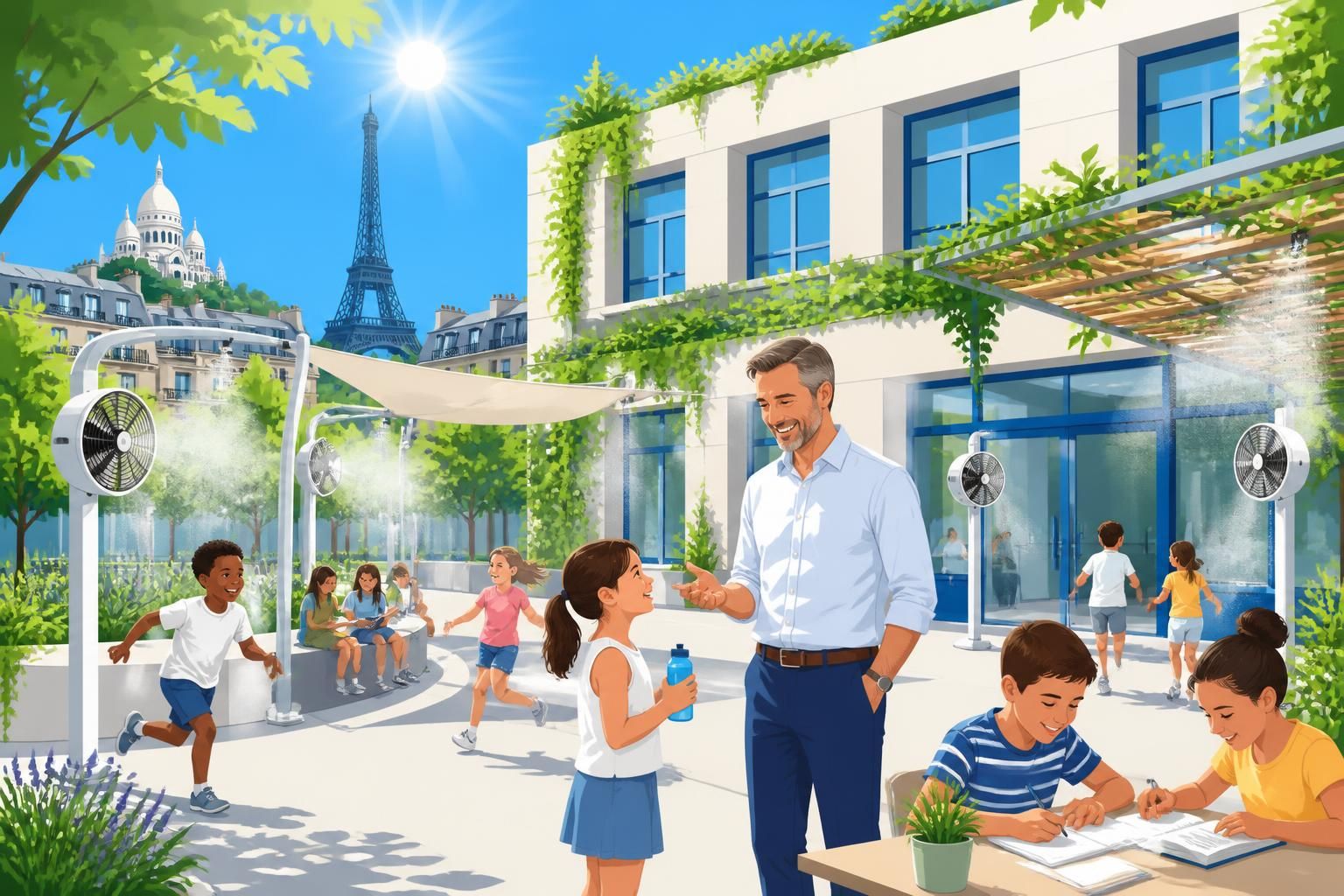
Heatwave in Paris: Emmanuel Grégoire’s initiatives to protect the capital’s schools
In Brief
- On June 7, 2026, Emmanuel Grégoire announces the order of more than 1,200 supplementary air conditioners for 620 schools in Paris, with an initial delivery of 150 units as early as the following Monday.
- The most heat-exposed preschools are announced as a priority in order to create cooler spaces for students and staff during the Heatwave episode.
- The City emphasizes the temporary nature of the air conditioners, alongside thermal renovation and simple equipment such as shutters or window glazing protection.
- The 550 municipal parks and gardens must remain open day and night, with exceptions, and several pools have their opening hours extended during the weekend.
- The municipal registry monitoring vulnerable people includes 1,000 registered individuals; more than 500 reports were recorded in a single day, with discussions announced with the prefecture to reinforce support for homeless people.
On June 7, 2026, the Paris City Hall puts on the table a heat protection kit targeting schools directly, as a new Heatwave episode is announced in Île-de-France. At the center of the device, Emmanuel Grégoire details a very concrete measure, almost “plug-and-play”: more than 1,200 mobile air conditioners ordered for 620 establishments, with 150 units delivered as early as the following Monday. The message is clear: create, in each school, a cool spot usable during the most difficult days, targeting preschools and the most exposed buildings first.
But the story is not limited to machines blowing cool air. The capital also articulates its initiatives around access to cooler places (parks open at night, pools with extended hours, swimming in the Canal Saint-Martin moved forward), and strengthened social support for vulnerable people, with a registry of 1,000 registered individuals. Behind these announcements, the question of the long term remains: how to maintain old school buildings, mineral courtyards, and a dense urban environment facing hotter summers, without turning Paris into an air conditioner showroom.
Air conditioners in Paris schools: the “cool space” initiative announced by Emmanuel Grégoire
The most immediately visible announcement concerns school equipment. Emmanuel Grégoire indicates that more than 1,200 supplementary air conditioners are ordered to cover 620 schools, with a first wave of 150 units delivered as early as the following Monday. The operational idea, on the establishment side, resembles a crisis management plan: each site must be able to open at least one “refuge” room where the temperature is lowered, even if the rest of the building remains difficult to cool.
According to Yahoo (article published June 7, 2026), priority is given to preschools most exposed to high temperatures. Practically, the decision can be based on simple and observable criteria: orientation of façades, glazed surface area, presence or absence of trees in the yard, top floor under the roof, and the ability to isolate an area (a multipurpose room, a library, a motor skills room) to make it a temporary protection space.
Why the city talks about “supplementary” equipment (and why it changes logistics)
The City stresses the temporary nature of these air conditioners, presented as an emergency response. This nuance has a concrete impact: it is not about fixed air conditioning in all rooms, but mobile equipment to be positioned, powered, monitored, and maintained. In a school, this requires organizing clear rules: where to install the unit to avoid trailing extension cords, how to secure access, and which protocol to apply for ventilation and airing in order to limit “too confined” air.
On the ground, this “supplementary” choice can also avoid heavy works in the middle of June. Parisian schools, often housed in old buildings, poorly tolerate rapid interventions requiring drilling, ducts, outdoor units, and technical permits. Here, the promise is more of a “pause” button on heat, focused on one area, to gain a few hours of real comfort.
What this implies for educational teams and families
For adults, the air conditioner is not just a comfort issue: it is a matter of continuity. A heatwave day is often when attention fades, quiet times lengthen, and physical activities become ongoing negotiations. The possibility of a cooler space makes it possible to adjust the day: gatherings, shorter workshops, group rotation, and better-protected rest for the youngest children.
For families, the effect is very concrete: school messages may evolve, asking for lighter clothing, a water bottle, or even an extra change of clothes. The existence of a cool space can also limit the anxiety of the “oven-school” and avoid a flood of early departures, especially when family organization resembles a Tetris without square pieces.
Heatwave plan in Paris: thermal renovation, shutters and solar protections for a sustainable adaptation of schools
Equipping with air conditioners does not solve the structural cause: school buildings that accumulate heat. The city hall recalls that a school thermal renovation program is already underway, aiming to improve summer comfort and reduce indoor overheating during Heatwave episodes. This approach falls within an adaptation logic: better insulation, better sun protection, better ventilation, and reduced thermal inputs.
Thermal renovation in a school is not limited to “putting insulation”. Summer comfort also depends on managing solar radiation, wall inertia, window quality, and the ability to ventilate at the right times. The initiatives mentioned include faster deployable solutions, such as installing shutters or glazing protections to limit heat entry during the day.
Shutters, solar films, blinds: small gestures that make a real difference
When the sun beats on a large window, the room can turn into a greenhouse. Solar protections (external blinds, shutters, adapted coverings) play a direct role: they reduce incoming radiation, which limits temperature rise. A solar film on glazing, for example, can reduce glare and some heat inputs, provided that useful brightness for work is not degraded.
In a school context, these devices have a practical virtue: they are visible, understandable, and their use is managed like a classroom routine. Closing on time in the morning, reopening at the right moment, managing airing early or late, and avoiding the “open all windows at 2 p.m. when it’s hotter outside than inside” effect. Instructions become a daily protection tool.
Greening and layout: the courtyard as the environment’s thermometer
Another lever, less immediate but very tangible, concerns schoolyards. Mineral yards heat up quickly, retain heat for a long time, and sometimes give the impression that the air burns “from below.” Adding shaded areas, trees, less absorbent surfaces, or water points (even simple ones) can improve thermal perception and reduce the perceived temperature.
In Paris, the urban environment imposes space and safety constraints. That does not prevent adjustments: installing shade structures, moving activities to less exposed areas, organizing quiet indoor times at the peak. Successful adaptation is also about adapting uses, not just walls.
To keep a clear direction in establishments, an operational checklist can help turn general instructions into concrete actions.
- Identify a room that can serve as a cool space (area, shade, proximity to a water point).
- Implement a morning routine for shading windows (blinds, shutters, suitable curtains).
- Organize airing at times when outside air is coolest (early morning, late evening if possible).
- Plan group rotations to avoid overcrowding a single room.
- Strengthen hydration in class and at the cafeteria, with easy access to water.
- Adapt physical activities and outings according to exposure and time.