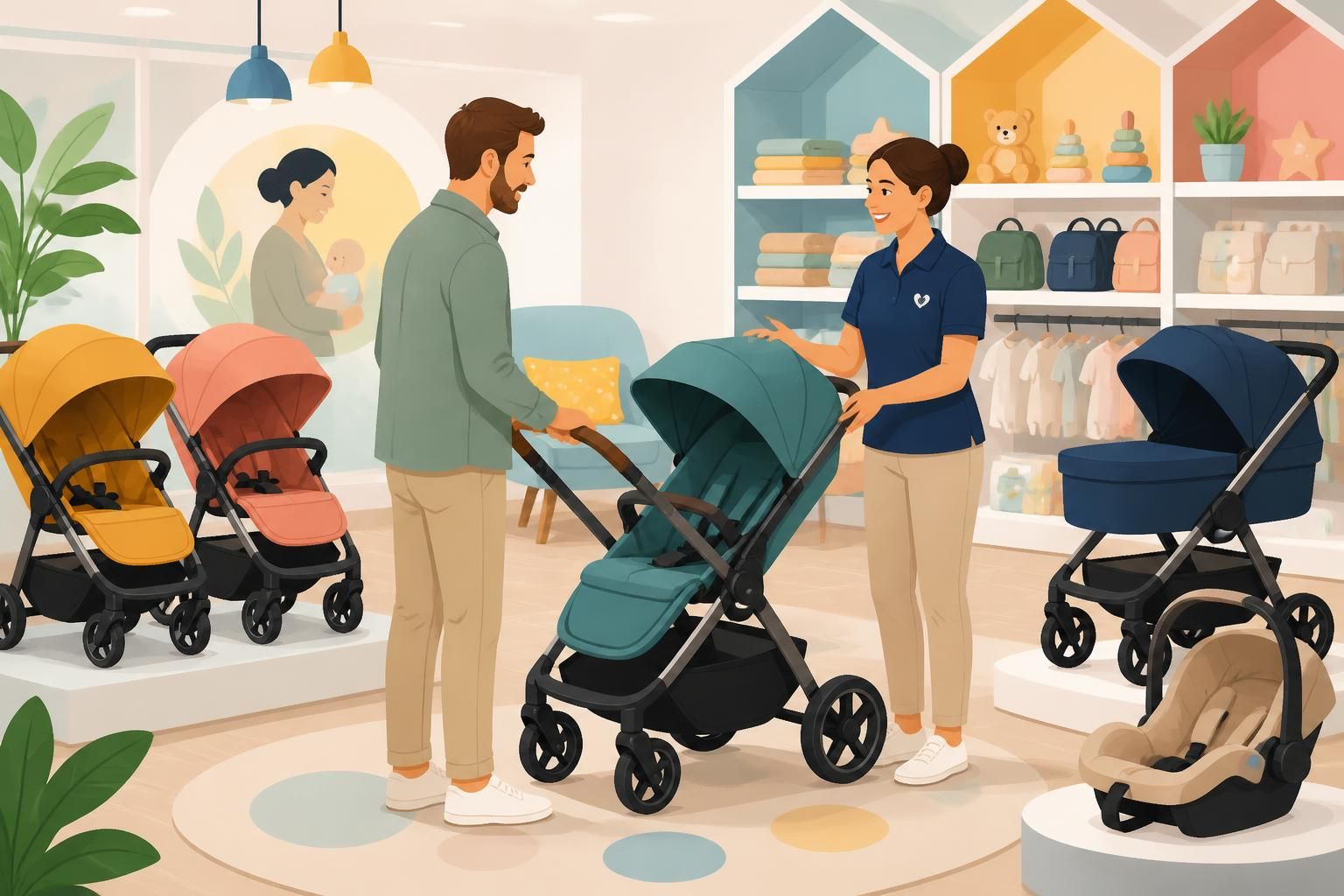
How to Choose the Ideal Stroller with Expert Advice from Joie
The European standard EN 1888-2:2018 sets the safety, strength, and durability requirements for strollers, and it is the first useful filter even before discussing lifestyle, budget, or “love at first sight” in the aisle. Then, the real match is played on the ground: narrow sidewalks, not always cooperative car trunks, stairs without elevators, improvised naps, and rain that arrives just when your hands are already busy. In this context, choosing a stroller is not just a matter of look or marketing promise. You need to prioritize: child safety, baby comfort, maneuverability, ease of folding, actual weight, and compatibility with stroller accessories that will save entire journeys (rain cover, adapters, footmuff, ride-on board).
The Joie brand has made a visible place in the market thanks to a wide range going from the lightweight urban stroller to more versatile trio-type models. The interest, when looking for the ideal stroller, lies in transforming “expert advice” into concrete, measurable, and testable daily criteria. The goal is not to collect features, but to choose a practical stroller that fits the family rhythm: urban mobility, walks on paths, shared custody, siblings, or simply the need for a robust model that survives slamming doors and overloaded baskets.
In Brief
- The EN 1888-2:2018 standard serves as a basis to compare child safety, stability, and durability.
- A lightweight stroller changes the game in urban mobility, especially if it folds with one hand and stands upright.
- Baby comfort is judged by the seat (recline, support), suspension, and protection (hood, ventilation).
- A “trio” adds versatility but requires checking weight, bulk, and adapter compatibility.
- Useful stroller accessories are decided according to local weather, journeys, and the child’s age (not the seller’s mood).
Child Safety Criteria for Choosing the Ideal Stroller (standards, harness, stability)
To choose a stroller with a minimum of calm, child safety must come before the “sand beige” color that has invaded sidewalks. The most concrete regulatory framework in Europe remains EN 1888-2:2018, which structures tests around strength, durability, and stability. Even without reading the full text, you should keep the operational idea in mind: a stroller shouldn’t just roll straight in the store, it must remain reliable after months of folding, shocks, and loads.
The harness is the first checkpoint to make, not just settling for a “yes yes, it’s 5-point.” The adjustment must be smooth, with straps that slide without catching, and a clear lock. A detail often overlooked appears during real journeys: if the buckle is hard to handle, it ends up “badly clipped,” and there, human error sneaks in. A practical stroller also helps parents stay rigorous.
Stability: the “diaper bag” effect and the sidewalk test
Tip-overs rarely happen in a perfect setting. They occur when a bag weighs on the handlebar, when a wheel catches on a curb, or when the child wiggles during braking. A simple check is to simulate real life: loaded basket, small curb, tight U-turn. The important thing is not to perform a homemade crash test but to spot a feeling of instability. A base that’s too narrow or a high center of gravity is immediately felt by hand.
The braking system also deserves a serious check. A centralized foot brake must engage sharply, without a “dead zone.” Child safety depends on this clear click, especially when stopped on a slight slope. Sloped parking lots do not ask for permission to test a stroller’s limits.
Materials and pinch points: safety for tiny fingers
A stroller is an articulated object, thus a potential catalog of pinch points. Folding areas, hinges, and adjustments (backrest, leg rest) must be designed to limit access to dangerous spaces. When handling, an “open hand” check on the joints helps identify parts where a finger might get caught during quick folding.
According to a notice published by UFC-Que Choisir on January 15, 2024, regarding childcare purchases, safety and usage gaps often hinge on design details (locks, stability, manual). The useful information here is not to reduce safety to a logo: quality is verified by the gesture, not only by the label. An ideal stroller is recognized when mechanisms naturally enforce correct reflexes.
Baby Comfort: seat, suspension, hood, and daily ergonomics
Baby comfort is not just a “soft” seat in the store because the real judge is the nap that starts when the bus brakes. An ideal stroller must limit micro-shocks, properly support the back, and allow a position adapted to the age. The recline of the backrest, the length of the seat, and the presence of an adjustable legrest affect posture, especially when the child falls asleep, and the head goes “flamingo mode.”
Suspension is a key point, even in urban mobility. Cobblestones, sidewalk joints, drainage grates, and “quickly redone” sidewalks create vibrations. An effective suspension and wheels of the correct size help maintain smooth rolling. The difference is also seen in driving: a trembling stroller is driven with tension, and tension causes a loss of precision.
Hood, ventilation, and protection: changeable weather, steady baby
The hood is used to manage several scenarios: low sun, wind, drizzle, light that disturbs sleep. Proper extension and a useful viewing window (not just decorative) improve comfort management. On some models, ventilation through panels or breathable fabrics limits the “greenhouse effect” in summer. Late-day trips, when heat builds up, quickly show the limits of a hood that’s too short.
Fabrics also matter for a very concrete reason: stains. A removable or easily cleanable fabric avoids crushed applesauce dramas. Ergonomics also play on handlebar adjustment. Suitable height reduces wrist and back pain, especially when driving takes 45 minutes and the return trip includes an unexpected sprint.
Comfort also depends on stroller accessories
Stroller accessories are not gadgets; they help stabilize comfort over time. A season-appropriate footmuff avoids piling up slipping blankets. A well-fitted rain cover protects without suffocating. A mosquito net in humid areas or countryside improves evening outings. The logic is simple: if the accessory makes use more reliable, it increases baby comfort and adult peace of mind.
According to the Public Health France site, in a prevention sheet updated April 3, 2023, on children’s daily safety, vigilance also concerns choking and thermal confinement risks related to poor ventilation or over-equipment. The idea is not to remove accessories but to favor those that respect ventilation and visibility. A good choice is seen when the child stays comfortable without overheating, even with protection installed.
In video tests, the interest lies in spotting repeated gestures: one-handed opening, accessible adjustments, backrest that maneuvers without pulling like a stuck zipper. The footage also shows the reality of sidewalks, more instructive than a showroom floor.
Lightweight stroller and urban mobility: folding, transport, bulk, and real life
Urban mobility turns weight and bulk into non-negotiable criteria because broken elevators and subway stairs don’t read manuals. A lightweight stroller is judged on two moments: carrying (climbing a few steps) and storing (trunk, narrow entrance, kitchen corner). A 2 kg difference is felt quickly when the day already includes a bag, groceries, and a child who has decided walking is fiction.
Folding must be evaluated without help. A practical stroller folds quickly but, above all, folds reproducibly: no need for a “magic little tap.” An important point is the lock safety in the folded position to prevent surprise opening during transport. The size when folded matters as much as weight, especially in compact trunks.
Maneuverability: wheels, swivel, and “tight” trajectories
City driving requires short turns: pharmacy entrance, turnstiles, crowded sidewalks. Swiveling front wheels improve agility but must also be lockable on rough surfaces. Larger wheels facilitate curbs crossing, at the cost of sometimes increased bulk. The compromise depends on the main route, not on exceptional “nice weather Sunday” strolls.
A useful check is to do a U-turn in a narrow corridor, then cross a small edge. Handlebar vibrations, the tendency to pull left, and handling of irregularities quickly emerge. In this area, the Joie brand highlights models focused on city or versatility, and the right choice is made by comparing these sensations, not just by reading the technical sheet.
Comparison table: measurable criteria to decide between models
The table below serves to compare stroller types based on concrete measurements. The values correspond to realistic ranges observed on the childcare market and help avoid the “everything is equal” trap.
| Stroller type | Typical weight (kg) | Typical folded width (cm) | Common age/weight use | Most suitable terrain |
|---|---|---|---|---|
| Compact urban | 6 to 8 | 45 to 55 | From 6 months up to 22 kg | Asphalt, sidewalks, transport |
| Ultra-compact “cabin” | 5 to 7 | 35 to 45 | From 6 months up to 22 kg | Travel, stairs, small trunks |
| All-terrain 3 wheels | 10 to 13 | 55 to 65 | From 6 months up to 22 kg | Paths, gravel, high curbs |
| Trio combo (frame + bassinet + seat shell) | 11 to 15 (total) | 55 to 65 | Birth to 22 kg (depending on configuration) | Home/car versatility |
The table helps set a simple rule: if the main constraint is stairs + transport, the ultra-compact and the lightweight stroller have the advantage. If the daily journey goes over paths or high curbs, a more robust structure becomes rational even if it weighs more.
Video comparisons often show a decisive detail: a stroller can be light but hard to steer, or very maneuverable but too bulky. Repeated folding sequences and curb tests give a closer glimpse of everyday life.
Joie brand ranges and uses: urban, all-terrain, trio, double, and compatibilities
The Joie brand offers a wide range, which helps when needs change quickly. The delicate point is not to get lost between “everyday stroller” and “complete system.” The most useful expert advice starts with the dominant journey: walking to nursery, daily car use, or alternating car + transport. Then, the configuration is built with coherent blocks: frame, seat, possible bassinet, possible compatible car seat.
The trio attracts because it promises a “birth to…” solution, but you must check the impact on bulk and weight. Many families find the seat shell is mainly used for the car and short transfers. The bassinet is comfortable for the first months but takes up space at home and in the trunk. The most realistic approach is to check, at purchase, the usage frequency of each component.
Focus on a versatile stroller like the Versatrax: usage logic
Versatile models like the Joie Versatrax are often cited in buying guides because they aim to cover city + paths. The interest of this type of stroller lies in suspension, wheel size, and seat modularity. In practice, “mixed” use works if folding remains simple and folded bulk doesn’t become a permanent obstacle.
The in-store test is like a reasonable obstacle course: assembly/disassembly, basket trial, backrest adjustment, then folding with one hand busy. If the whole requires three too-fine maneuvers, it risks being abandoned in favor of a faster solution. Everyday life always chooses what’s quick.
Double stroller: width, door passage, and logistics
For closely spaced siblings, the double stroller becomes a pragmatic option. The constraints are immediate: width to get through doors, turning radius, weight. A side-by-side configuration facilitates visibility, while a tandem version fits better in narrow corridors but can change balance. The decision depends on home, usual shops, and car.
To stay factual, a double stroller must be evaluated on a precise scenario: passing a standard door, turning on a landing, accessing a supermarket checkout. Handlebar feel matters a lot because the total load quickly increases with two children and stroller accessories.
Pre-purchase checklist (to be done in 10 minutes flat)
- Test the harness: closing, loosening, quick adjustment.
- Check the brake: sharp engagement, stability on slight slope.
- Try folding: without help, then immediate unfolding.
- Measure the trunk: compare with announced folded dimensions.
- Control the basket: easy access, realistic load, not just “big.”
- Simulate a curb: crossing edge, vibrations, trajectory.
- Look at the hood: coverage, window, ventilation.
This checklist highlights one point: an ideal stroller is not chosen from a photo. It is chosen by gestures because these are the ones repeated hundreds of times.
Budget, stroller accessories, and privacy: buying useful without being tracked
The stroller budget varies greatly depending on configurations. A city stroller can be found around €150 to €350, a combo trio often between €300 and €700, and more premium models can exceed €900 depending on brands and bundles. These ranges are useful to frame expectations, but the real cost also comes from stroller accessories: rain cover, seat shell adapters, parasol, cup holder, footmuff, carrying bag, or even ride-on board.
A coherent purchase starts with a hierarchy: first child safety and baby comfort, then urban mobility and practicality, then accessories. Buying all accessories on day one often results in half staying in the closet because real uses are not those imagined. The right compromise is to plan the essentials for weather + transport, then complete after a few weeks of use, when constraints become clear.
Accessories: what really helps depending on situations
For a rainy city, the rain cover is a priority and must be put on quickly. For a hot region, proper ventilation and effective sun protection are better than a pile of fabrics. For travel, a carrying bag protects the stroller and simplifies handling. A practical stroller also transforms thanks to its adapters: if the car seat clips on easily, car-home transfers become smoother.
Compatibility must be checked down to the millimeter: model of seat shell, specific adapters, model year. A seller may say “it fits,” but the right reflex is to verify the exact reference names. A failed purchase sometimes hinges on a missing or unfindable adapter.
Online purchase: cookies, personalization, and data control
Childcare purchases often happen online, leading to a rarely discussed point between two wheel comparisons: data collection. Google explains, on its “Privacy & Terms” page updated February 1, 2024, that cookies and data can be used to maintain services, measure engagement, secure against fraud, but also, if accepted, to personalize content and ads. Concretely, a “lightweight stroller” search can trigger recommendations and targeted ads for several days.
To keep control, simple actions exist: refuse personalization when not useful, clear cookies after purchase, use a browser dedicated to comparisons, or adjust privacy settings. The goal is not to “hide” but to avoid being influenced by repeated ads pushing to buy more accessories than needed.
This privacy aspect also impacts budget: less ad targeting often means fewer impulse buys. In practice, the choice of the ideal stroller becomes more rational when based on concrete criteria, not on advertising reminders.
What Do We Say About It?
For most city families, priority should go to a lightweight, stable stroller that’s simple to fold because it’s the “stairs-trunk-transports” trio that causes too-ambitious models to fail. The Joie brand has a practical advantage: a fairly wide range to aim for urban or versatile use without automatically tipping into very high budgets. The point to watch remains the bulk of trio configurations, which can complicate urban mobility if the trunk or building entrance is small. The stroller accessories to buy first are those that secure and protect (rain, reliable adapters), the rest can wait for the field test.
At what age can a “second age” stroller be used?
In practice, a second-age stroller is used when the child sits well and shows good trunk tone, often around 6 months. The recline of the backrest, lateral support, and quality of the harness must be checked. A position that is too upright too early can harm comfort during naps.
How to know if a stroller will fit in a small car trunk?
The most reliable method is to measure the trunk opening (width and height) and then compare it with the announced folded dimensions. It is useful to check if the wheels come off easily and if the stroller stands upright once folded. A store trial with a trunk template avoids unpleasant surprises.
Which accessories are really essential the first week?
The most useful duo remains a well-fitted rain cover and a compatible transport solution (seat shell adapters if needed, or carrying bag for travel). A footmuff or a season-appropriate blanket can come next. Decorative accessories can wait, as they neither improve child safety nor baby comfort.
How to limit wear of wheels and brakes in urban use?
It is advisable to regularly clean the wheels (dust, gravel) and check that the brake engages without abnormal resistance. Avoiding curbs head-on reduces repeated shocks. Monthly tightening checks and rinsing after rain prolong the lifespan, especially when the stroller often moves on cobblestones.