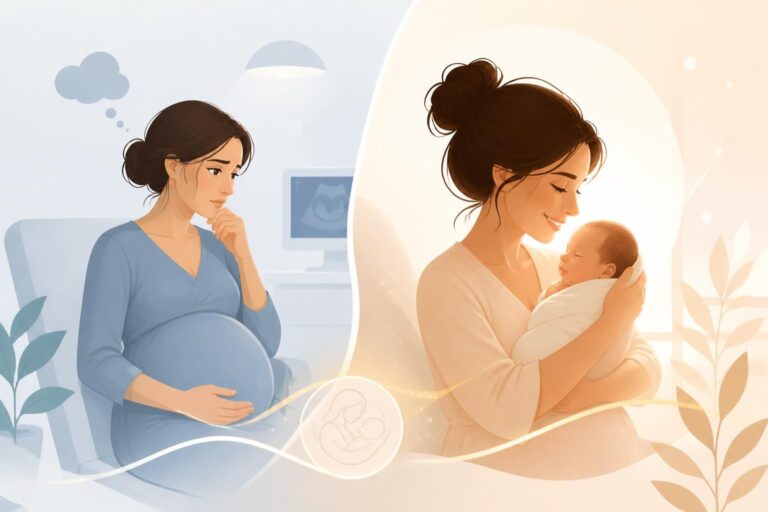
Virginie Efira, mother at 46: she reveals a surprisingly different postpartum ten years after the birth of her daughter
In Brief
- In an interview with Psychologies Magazine published on July 22, 2026, Virginie Efira reflects on a late motherhood experienced at 46 and on a postpartum described as calmer than during her first experience.
- The actress announced the birth of her son Hiro on August 28, 2023, ten years after the birth of her daughter, and describes daily life as a young parent with an assumed age gap.
- As a guest on Sept à Huit on TF1 on May 10, 2026, facing Audrey Crespo-Mara, she described her late pregnancy as “old age,” while emphasizing a form of lucidity and new calm.
- Her story highlights a very concrete aspect of parenting: a postpartum can be different from one child to another, even within the same family, depending on the context, health, the couple, and organization.
- Beyond celebrity, the topic resonates with many households: returning to work, mental load, fragmented sleep, and logistical compromises do not feel the same ten years later.
On July 22, 2026, Virginie Efira gave an interview to Psychologies Magazine where she details a surprisingly different postpartum experience, ten years after the birth of her daughter. The information is far from a “small celebrity topic” as it touches a collective nerve: that of second babies reshuffling the cards, especially when they arrive at an unexpected time. Between a first motherhood experienced in a certain state of astonishment and a second maternal experience approached with more reference points, the actress describes daily life where the body, surroundings, and mind no longer respond exactly the same.
The contrast is all the more striking as her second pregnancy occurred at 46, an age she herself commented on television, notably during an appearance on Sept à Huit. In this trajectory, there are very concrete details everyone can relate to: returning home, broken nights, self-image relationship, sometimes contradictory emotions, and that very special feeling of being both “already been there” and yet surprised by the intensity. The story, often funny despite its seriousness, reminds us that parenting is not a fixed subject: it moves with life, years, and the children themselves.
Virginie Efira as a mother at 46: what her story says about late motherhood today
When Virginie Efira talks about being a “mother at 46,” the mirror effect is immediate: it is not just a civil status fact, it is an experience that changes the way of anticipating, organizing, and even feeling. In her exchange with Psychologies Magazine, she describes a pregnancy and postpartum experienced with a different form of grounding. This late motherhood, told without a heroic posture, emphasizes a key point: age does not “guarantee” serenity or difficulties but modifies the parameters around the baby.
In daily life, differences can begin with logistics. Ten years after a first birth, many families no longer have the same work rhythm, the same housing, or the same outing habits. The support network may have expanded (parent friends, neighbors, school) or on the contrary, shrunk (moving, older relatives). With an older child, the house isn’t silent, and the newborn doesn’t alone dictate the atmosphere. This setting changes the emotional equation: fatigue remains but mixes with a feeling of habit, as if the brain already knows it will survive the broken nights.
In this context, publicly embracing a late pregnancy also has a social dimension. On Sept à Huit on TF1 aired May 10, 2026, the actress referred to this “old age” with frankness that cuts short smooth talks. The term, a bit harsh, has the merit of making visible what many keep silent: the gap felt compared to younger parents when leaving daycare, sometimes limited energy, and also a certain inner freedom. It happens that professional and personal experience gives less desire to judge oneself on everything, including on the “right” way to be a parent.
Another point stands out: the view of the body. After a birth, physical changes are universal, but the relationship to these changes varies depending on life stages. At 46, there can be more lucidity, less illusion about “returning to how it was,” and sometimes greater tolerance for slow recovery. Conversely, some women describe a more present medical requirement (monitoring, appointments, check-ups). The media story does not delve into medical details but opens a space where one can talk about very prosaic realities: healing, sleep, breastfeeding or not, resuming sports, and the impact on the couple.
In terms of parenting, late motherhood has a particularity: it can coexist with an already structured life. This sometimes gives a sensation of “two lives in one,” with a baby putting disorder into a schedule that had finally settled down. The insight that stands out here is concrete: age shifts the mental load, it does not remove it.
Differing postpartum ten years later: understanding what really changes between two births
The word “postpartum” is often used as a single block, whereas it covers a mosaic: physical recovery, hormonal variations, emotions, organization, identity, and sometimes psychological vulnerability. When Virginie Efira explains that her postpartum was different ten years later, the strong idea is not that “everything is simpler” or “everything is more complicated.” It is that the context weighs as much as the event itself.
First factor: the learning effect. During a first birth, many discover the feeling of permanent responsibility, technical gestures (bath, diaper change, carrying), and reading the baby’s signals. Ten years later, the hands often remember better than memory. The diaper goes on the right way without a tutorial, the changing bag fills without a printed checklist in size 12 font. This familiarity can free mental space, which can make postpartum “calmer” even when nights are at the same level of chaos.
Second factor: the perception of time. With a first child, the weeks can seem endless. With a second baby, especially when the older one already has their school life and activities, the days fly by. The parent doesn’t have the luxury of wondering for three hours if the baby has a “reflex smile” or a “real smile”: they also have to prepare dinner, check a notebook, manage an appointment. Postpartum can then be experienced as more integrated into daily life, less isolated.
Third factor: the surroundings and couple dynamics. In parenting stories, concrete support (grocery shopping, taking a night shift relay, managing the older child) is often what tips the balance of the experience. The actress announced the birth of her son Hiro on August 28, 2023, and being in a relationship with Niels Schneider is mentioned in media accounts around that period. Without entering intimacy, one element is verifiable in many families: when task distribution balances more, postpartum is experienced with less feeling of being overwhelmed.
Fourth factor: health status and relationship to follow-up. Some women speak of denser follow-up, others of a more direct relationship with caregivers. In all cases, the maternal experience does not unfold on neutral ground: it depends on pregnancy, delivery, and what happens in the following weeks. Virginie Efira’s public discourse mainly insists on the emotional experience, with a form of hindsight. This hindsight can also come from the fact that guilt sometimes takes less space when the person already knows that the “perfect parent” does not exist, even in HD version.
To make the difference more visible, here is a factual comparison, centered on measurable or dated elements, between the context of a first birth and that of a second birth ten years later.
| Concrete element | First birth (general references) | Second birth ten years later (general references) | Example consequence on postpartum |
|---|---|---|---|
| Gap between births | 0 years (first experience) | 10 years | Less uncertainty about gestures, but more organizational challenges with an older child |
| Age at motherhood | Age not specified here | 46 years | Different relationship to recovery, sleep, and social view |
| Domestic workload | Home focused on the baby | Home with a school-aged child | Less of a “bubble,” more multitasking |
| Media timing (dated fact) | Private event | Birth announced August 28, 2023 | Possible management of exposure, hence need for limits and protected recovery |
The final point to remember here is practical: a different postpartum is not an anomaly, it is often the direct consequence of a different life around the same event.
Between guilt and calm: what Virginie Efira’s confidences put on the table
In discussions relayed around this double motherhood, a theme recurs: guilt. The subject is nothing like a cliché of end-of-meal conversation because it influences very concrete behaviors: accepting help, resting, consulting, setting boundaries at work. When a personality like Virginie Efira verbalizes ambivalent emotions, it makes audible a banal reality: it is possible to love one’s child and feel overwhelmed, sometimes in the same hour.
The feeling of postpartum guilt often comes from three very identifiable sources. First, the gap between what was imagined and what happens: breastfeeding that doesn’t start, painful healing, a baby who cries a lot, fragmented sleep. Next, the external gaze: family, social networks, or even simply crossing parents who seem to be “better off.” Finally, self-surveillance: analyzing every emotion as a sign of parental competence, which can become exhausting.
When the actress describes a calmer experience after Hiro, the most useful reading is to search for mechanisms that can promote this calm. Experience plays a role, but it does not act alone. The ability to put things in perspective, for example, often comes from having already seen a child grow. Ten years after the birth of a daughter, the adult has real-life proof that phases pass, regressions exist, and “bad nights” don’t last forever. It is not philosophy, it is information drawn from daily observation.
There is also a very material factor: anticipation. A family who has already known a birth can prepare simple solutions before the baby arrives: meal stock, laundry organization, shopping routes, relief with relatives. The gain is not marginal when days are busy. In a lighter tone, it comes down to choosing between “discovering diaper 1, diaper 2, and diaper 3” or “already knowing that diaper 2 is hidden under the pajamas.” The funny side does not detract from the essence: fewer logistical frictions can ease emotional intensity.
To anchor these elements in the concrete, here is a list of actions frequently cited by field professionals (midwives, maternal and child protection centers, post-natal consultations) and often considered useful by families, without pretending to replace medical advice:
- Plan postnatal follow-up from pregnancy (appointments, useful numbers, emergency contacts).
- Protect short but real rest periods (20-minute nap, relay on a fixed slot).
- Distribute visible and invisible tasks (meals, laundry, administrative management, outings with the older child).
- Note emotional warning signs (persistent anxiety, dark thoughts, isolation) for early consultation.
- Limit exposure to injunctions (comparisons, guilt-inducing content), especially during the first two weeks.
The final insight is down to earth: guilt often decreases when the environment becomes more supportive and when the person can focus on care, not on performance.
Excerpts and discussions around this televised passage mainly show one element: talking about age and motherhood without gloss triggers reactions because the topic touches the intimate and social simultaneously.
Parenting with an older child: managing a birth when a daughter is already ten years old
A birth in a family where the oldest is ten is not lived as a “second first time.” The needs of a child of that age are specific: school, friendships, activities, growing autonomy, but also increased sensitivity to changes. In the case mentioned in media stories, the presence of a daughter born ten years earlier introduces a very particular sibling dynamic: the age gap transforms organization, potential jealousies, and even the way the parent perceives themselves.
Practically speaking, the eldest can become a logistical ally, without being a parental assistant. A ten-year-old can fetch a diaper, bring a cloth, signal that a pack of wipes is finished. They may also need reassurance about their place. Many parents notice that jealousy does not necessarily manifest as direct anger but through more subtle behaviors: increased attention demands, occasional regressions, restlessness at bedtime. The “different” postpartum is also played out there: the adult manages not only recovery and the newborn but a mini-permanent negotiation with an already established family life.
The question of time becomes central. Ten years after a first birth, the adult sometimes regains personal spaces: sports, outings, more stable work, functioning routines. The arrival of a baby can make these spaces disappear all at once. The elder may experience this contraction as a loss: fewer evening discussions, less availability to help with homework, fewer “moments for two.” Organization benefits from being explicit: who does what, when, and how the parent keeps regular time with the older child, even if short.
Vocabulary also matters. Saying a “baby who takes all the space” can worry the child. Saying “the baby needs a lot of care, and you also matter” sets a more comforting base. In a family known to the public, this aspect is rarely detailed, but it remains a universal parenting point: the way things are named influences everyone’s perception.
Finally, there is the issue of image. A ten-year-old understands better than a toddler that their family is commented on, especially when a parent is famous. Even without direct exposure, the eldest may hear remarks at school or on networks. Protecting privacy and establishing limits (photos, shared information) become topics of family discussion. Virginie Efira’s public account remains measured, aligning with a frequent strategy among personalities: sharing experience without revealing the child’s daily life.
The final point is concrete: when a daughter is already ten, the birth of a baby reconfigures the home like a small construction site, and the quality of organization directly influences the emotional experience of the first weeks.
The most useful video content on this topic generally focuses on domestic organization, the place of the oldest, and support, three points that weigh heavily when nights become short.
Privacy, consent and cookies: the concrete parallel with online data management
The topic seems remote, yet it closely fits reality: talking about parenting in 2026 almost automatically involves discussing screens, applications, and consent. Birth, postpartum, and family organization often pass through digital services: parent groups, shared calendars, appointment bookings, online shopping, streaming during feedings or bottles. In this landscape, the question of personal data arises simply: what is collected, what is it used for, and how to regain control when the mental load is already maximal.
A very concrete example is found in the information message displayed when using Google services: it specifies that cookies and data can serve to deliver and maintain services, track outages and protect against spam, measure engagement, and, if the user agrees, personalize content and ads. This text also reminds of options “Accept all,” “Reject all,” and “More options,” as well as the tool g.co/privacytools to manage privacy settings. In post-birth daily life, where clicks are often made with one hand while the other holds a baby, “default” consent becomes a reflex to watch closely.
The parallel with the private life of a known family is clear on the mechanism level, without confusion: on one side, a celebrity decides what is told about her late motherhood; on the other, a user decides (or forgets to decide) what platforms retain. Both situations raise the same practical question: where are the buttons, and who controls the dissemination. When Virginie Efira shares elements about her late motherhood and a different postpartum, she retains editorial control. In the digital sphere, this control goes through concrete settings.
From a parenting viewpoint, some actions are particularly relevant because they avoid involuntary exposures, especially when photos of children or health information circulate:
- Check personalization and content settings on accounts used daily.
- Favor private sharing (encrypted messaging, restricted albums) over public posts.
- Avoid posting documents containing identifying data (last name, school, address, full date of birth).
- Sort applications installed during pregnancy, then forgotten after birth (tracking, shopping, forums).
This clarification is useful because it touches on a postpartum reality: fatigue lowers vigilance levels. The final insight remains concrete: the fewer the settings left to chance, the fewer the surprises about what circulates.
What do we make of it?
Virginie Efira’s story has a clear interest: it normalizes the idea that postpartum can be different ten years later, without turning late motherhood into a feat. The strongest point lies in the description of a calm linked to context, not to a supposed universal “recipe.” The most concrete recommendation for parents who recognize themselves in it is to invest in organization and support before birth, as these are what modify daily life as soon as you return home. The only angle to watch remains the temptation to compare oneself: a publicized maternal experience does not say everything about the off-screen, and that is precisely why it should be used as a reference, not as a standard.
From when do we talk about late motherhood?
In common usage, the expression often refers to pregnancies after 40 years old, even if definitions vary according to medical and media contexts. In public debate, age is mainly a social marker: it influences monitoring, family organization, and the perception of surroundings, without summing up the pregnancy or postpartum experience alone.
Why can postpartum be very different from one child to another?
Postpartum depends on multiple factors: course of pregnancy, type of delivery, baby’s sleep, task distribution, available support, emotional state, and professional constraints. Even within the same family, these parameters can change significantly over time. A ten-year gap often modifies the living environment, which influences daily experience.
How to protect the place of the older child when a baby arrives ten years later?
The most effective strategies are concrete: keep a regular appointment with the older child (even if short), give them information adapted to their age, and avoid putting them in the position of a “little parent.” The goal is to maintain stable landmarks (school, activities, bedtime rituals) while associating them with the new family organization.
Which digital privacy reflexes are useful during postpartum?
The period is conducive to impulsive sharing and quick clicks. It is useful to check account settings (personalization, history, authorizations), limit the spread of children’s photos, and sort through apps installed during pregnancy. Consent interfaces, such as those describing cookie usage and “Accept” or “Reject” options, deserve careful reading when fatigue sets in.