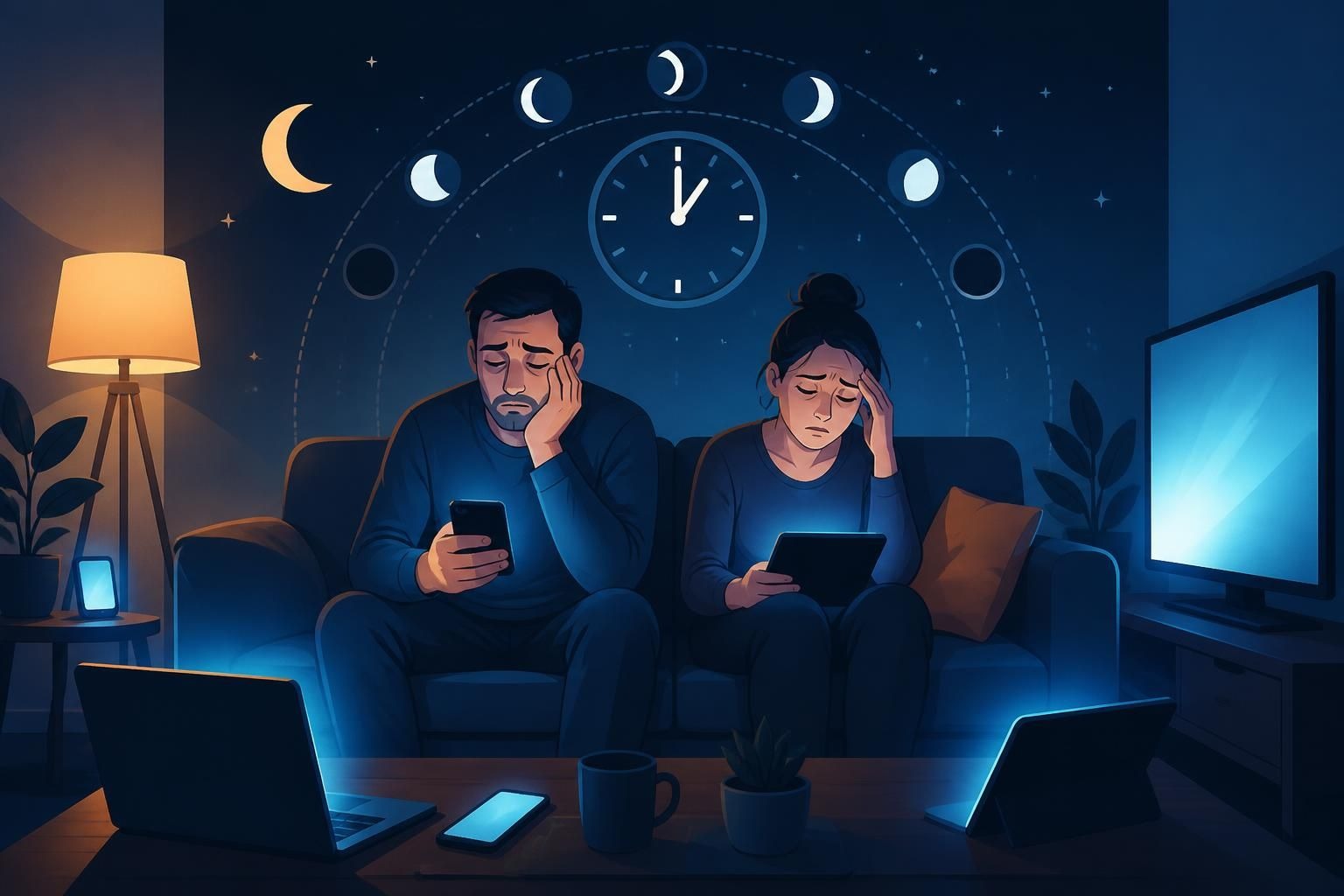
A study reveals that screens deprive parents of up to 48 nights of sleep each year
2,000 parents of school-aged children surveyed in a Talker Research study for the company Cosmo (data reported on June 7, 2026, by People.com) describe a very tangible effect of screens on family life: sleep being eaten away, week after week, by anxiety related to smartphones, social networks, and games. The figure that catches the eye is easy to visualize: up to 48 “lost” nights of sleep over a year, a total made up of delayed sleep onset, nighttime awakenings, and repetitive thoughts about what the child is watching, posting, or receiving.
The issue is not limited to a moral tension about technology. It concerns everyday trade-offs: keeping a phone for safety, limiting notifications, managing school access, understanding the impact on mental health and self-esteem. In families, the discussion often ends up resembling a business negotiation at 10:30 p.m.: “one last message,” “one last game,” “five more minutes.” And when the screen finally turns off, it’s not always the light that prevents sleep, but the anxiety about what might happen online during the night.
In Brief
- The cited survey covers 2,000 parents of school-aged children and highlights a sleep cost estimated at 7 hours per week on average.
- The cumulative total reaches up to 48 nights on an annual basis, adding up the lost hours.
- The most commonly mentioned concerns relate to screen time (24%), the effect of social media on self-esteem (20%), and the risk of addiction (18%).
- 9 out of 10 parents consider it desirable that the child can have access to a phone at school, especially to contact family.
- When phones are banned in the school, some parents report feeling anxious about contact several times a day.
Parents, screens, and sleep deprivation: what the study measures and what the “48 nights” figure covers
The figure of 48 nights has a “blinking counter” aspect: it hits, it annoys, it makes you laugh nervously. Specifically, it comes from an equivalence calculation based on an average of about 7 hours of sleep lost per week. Over 52 weeks, the total is 364 hours, the equivalent of 15 full 24-hour nights… but in real life, nobody sleeps 24 hours straight. The image of “nights” therefore mainly serves to make a diffuse deprivation visible: repeated fragments of rest lost, which end up weighing on mood, concentration, and parental patience.
This fatigue has a particular signature. It does not just look like the lack of rest of a baby waking up (the “bottle, diaper, and zombie mode” version). It resembles a brain that stays alert. A parent may have gone to bed at a reasonable hour, then wake up at 2:10 a.m. to check whether the child’s phone is still on silent mode, whether a group chat hasn’t gone off the rails, or whether the family location still shows “at home.” Even without manipulating a device, technology sneaks into the night through anticipation of risk.
In families where the child already has a smartphone, the study highlights a stronger concern about mental health, others’ opinions, and the feeling of not knowing everything about the digital day. The paradox is well known: the more useful the tool, the more doors it opens. It allows contact with the child but also reveals social worlds (groups, messages, platforms) that escape direct control. As a result, the parental brain sometimes transforms nocturnal silence into a “movie theater” where scenarios scroll by, not always realistic but very effective at stealing sleep.
Deprivation is not only quantitative. A 7-hour night may be less restorative if broken into micro-awakenings. Notifications, the vibration of a device in another room, or simple doubt (“what if…”) can be enough to break cycles. And in the early morning, the cumulative effect is not just dark circles: it manifests as family tensions, schedule conflicts, and lower tolerance for small daily provocations, like the famous “I’m coming” said from a bed… without any observable movement.
Parental “techxiety”: why technology worries even when the screen is off
The term “techxiety,” cited in the survey, puts a name to an already established phenomenon: parental anxiety related to technology. The stress does not come solely from the “screen” object, but from what it carries. The smartphone is a portal to permanent conversations, potentially inappropriate content, and accelerated social dynamics. A notebook could be lost in a bag. A hurtful message, however, can be reread ten times in ten minutes, shared, commented on, and come back like an emotional boomerang.
The most cited worry data provide a useful map. At the top, 24% of parents say they worry about the time spent in front of screens. This figure points to a simple but tricky question: how many “too many” minutes tip over an evening? Then, 20% mention the impact of social networks on self-esteem. Here, the problem is no longer duration, but social comparison, filters, implicit codes, and the race for validation signs. Finally, 18% worry about an addiction to games or applications, often noticeable when frustration becomes disproportionate when stopping.
Parental stress also has a logistical dimension. Rules must fit into a fast-changing world: new platforms, new games, new trends. Parental controls installed in September can be circumvented by October, sometimes without “malicious” intent: a friend shows a trick, a link circulates, a secondary messaging app appears. Parents find themselves updating the “home security policy” as often as the apps, with less documentation and more emotions.
The comic situation is that many parents suddenly feel promoted to system administrators… without training. Between privacy settings, time limits, in-app purchase permissions, and content discussions, digital education looks like a cockpit dashboard. The difference is that here, passengers protest when you buckle up. This stress is a direct factor disrupting sleep: the mind looks for solutions at night as if it had decided to update… at 3 a.m.
One point comes up often: anxiety increases when parent-child communication is reduced to a numbers war (“how much time,” “how many minutes”). Parents who gain serenity are often those who add qualitative markers: with whom the child talks, in what context, with what respect rules, and how to ask for help. This shift doesn’t erase risks but makes management clearer and limits nighttime rumination.
Media literacy video resources often emphasize one practical point: what prevents sleep is not just blue light, but emotional activation. A tense discussion, an anxiety-inducing video, or a dispute over a game can leave the body alert even if the device is put away. In families, working on the after-screen time (return to calm, stable routine) becomes a tool as important as the rule of turning off devices.
Phone at school: safety, learning, and conflicts, a debate that cuts the night into slices
The study highlights a clear ambivalence: parents want to protect their children without cutting them off from their environment. Nine out of ten parents consider access to a phone at school desirable. The main driver is safety: 76% prioritize the ability to quickly contact the child in an emergency. This figure explains why the question of school phones sparks very concrete discussions, far from abstract postures.
Safety is not limited to extreme scenarios. It also includes delays, schedule changes, activities that finish earlier, and transportation. In real life, a phone is used to say “I have arrived” or “the bus is canceled.” The problem is that the same device is also used for everything else, including uses that distract attention. At night, this tension turns into worry: if the phone is allowed, what happens during lessons and recess? If it is banned, how to contact the child if necessary?
Parents’ responses reflect this tug-of-war. Part (40%) see the phone as useful for emergency communication. Another (30%) consider it penalizes learning, by encouraging distraction and difficulty staying focused. Another group (28%) thinks it fuels conflicts between students, through comparisons of devices, shared photos, or chats that continue off the playground. Here, parental sleep finds itself caught in a vise: the issue often resurfaces in the evening when the family reviews the day.
When a school bans phones, some concerned parents report feeling anxiety about not being able to contact their child, on average three times a day. This detail matters because it shows stress is not an occasional “thrill.” It resembles a series of small spikes, repeated, eventually increasing mental load. And this mental load, once established, easily slips into the night in the form of checks and circular thoughts.
The debate benefits from being framed in organizational terms. A phone can remain off and stored, with access limited to specific times. Another arrangement can be provided for emergencies through school administration. Families who sleep a little better are often those who have a simple, shared protocol: where the device is, when it is used, and how a problem is handled. The goal is not to win an ideological debate but to reduce the gray areas that fuel anxiety at night.
Effects of screens on health and sleep: what science links to nighttime use
The discussion on screens tends to go in all directions, while some findings are quite stable. Regarding sleep, the most problematic combination pairs late exposure, stimulating content, and social interactions. The issue is not only total time but the place of usage in the evening. A competitive game, one short video after another, or an emotional conversation can delay sleep onset and fragment the night.
An analytical watch on hyperconnectivity published in spring 2024 reports that in 2019, 2021, and 2022, an increase of 30 minutes of screen time correlated with a decrease of about 2 minutes of sleep duration. The figure may seem low, but it describes a population trend: it’s not the lost minute that hurts, it’s the general direction, especially when the 30 minutes add up every evening. In families, this mechanism often results in a bedtime that slips, then more difficult mornings.
Mental health is the other aspect that fuels parents’ vigilance. Social networks can affect self-esteem through comparison, comments, or exposure to unrealistic norms. A parent may accept moderate use, then worry after mood changes, withdrawal, or disturbed sleep. In these cases, the smartphone becomes one index among others, not a sole culprit, but remains central to family discussions because it is omnipresent and difficult to “put away.”
Technofrictions — interruptions in relationships caused by devices — add a layer. A child who speaks and sees an adult looking at a screen in response learns that attention is divisible. A parent trying to talk but confronted with a gaze glued to a video mainly retains communication failure. At night, this feeling of having “missed” a moment can nourish rumination and delay sleep onset. The impact is thus both physiological (stimulation) and emotional (conflict, frustration, anxiety).
To make these mechanisms clearer, a table helps compare concrete situations. It does not replace a diagnosis but provides actionable references on what really changes sleep quality in a typical night.
| Screen-related situation | Typical timing | Expected effect on sleep onset | Risk of nighttime awakenings |
|---|---|---|---|
| Social networks with active notifications | After 9 p.m. | Frequent delay (interaction + emotion) | High if the phone remains accessible |
| Competitive online video game | Late evening | Possible delay (excitation, frustration) | Medium, depending on activation level |
| Long video or series watched with family | Early evening | Variable (depends on content and volume) | Low to medium |
| Phone stored outside bedroom + silent mode | From bedtime | Facilitated sleep onset | Low, except for checking anxiety |
What practical video tips show is the value of routines. The brain likes repetition and clear signals. When screen use is “negotiated” each evening, the child tests, the parent gets exhausted, and the night fills with half-decisions. When rules are stable, mental energy can be shifted to discussion about content and how to react in case of a problem.
Concrete strategies to reduce the impact of screens on parental sleep, without turning the home into a police station
Part of parental fatigue comes from a feeling of constant monitoring. The realistic goal is therefore to reduce mental load, not to achieve total control. The first strategy is to clarify the ecosystem of devices: which screens exist in the home, at what times they are used, and where they sleep. A phone that spends the night on the bedside table invites checks. A phone stored in another room, with a fixed charger, reduces temptations on both sides.
The second lever is managing notifications. Many families spend time setting screen limits, then let alerts rule. Disabling non-essential notifications, cutting previews on the lock screen, and activating a “do not disturb” mode during a regular time slot prevents micro-stimulations. At night, these interruptions often reignite worry, then a “quick” check that is never really quick.
The third lever plays on dialogue and is less technological than it seems. A parent sleeps better when they know how the child reacts to a hurtful message, a strange request, or shocking content. Setting up a simple reporting rule (showing without getting scolded, asking for help without automatically losing the device) reduces the fear of “not knowing.” This fear is a major consumer of sleep because it creates scenarios in the middle of the night.
A list of concrete actions helps move from principle to daily life. Some measures are quick, others require a calm family discussion, but all aim for the same effect: reducing the gray areas that fuel sleep deprivation.
- Set a time for parking phones outside bedrooms, with a single charging spot.
- Create a screen-free evening routine of 20 to 30 minutes, with a calm, repeatable activity.
- Set an automatic silent mode on devices during the night, including for groups.
- Check privacy settings and the list of installed apps together once a week.
- Define communication rules: no messages after a certain hour, and prioritize calls in emergencies.
- Agree on an “incident plan”: what to do in cases of harassment, violent content, or unknown contacts.
The last lever concerns school, because much anxiety comes from organizational void. When a school bans phones, it is useful to know the exact emergency contact procedure. When it allows them, the storage and sanction framework must be understood. A parent with clear contact and storage information ruminates less at night. Sleep does not become perfect, but is less frequently interrupted by “what ifs” that revolve endlessly.
What Do We Say About It?
The figure of 48 nights mainly speaks of cumulative fatigue, fueled more by anxiety than by screen light. The practical priority is to reduce verification awakenings and evening emotional activation, through stable rules for storage and notifications. Regarding the phone at school, the strongest position relies on a clear emergency protocol and a usage framework, because it is the ambiguity that sustains “techxiety.” Families who manage best treat the screen as an organizational and relational subject, not as a permanent punishment.
How to calculate “48 nights of sleep” from lost hours?
The figure corresponds to a cumulative number of hours of sleep lost over a yearly period. An average of 7 hours lost per week amounts to 364 hours over 52 weeks. Presented as “nights,” this mainly serves as a meaningful equivalence: in reality, loss happens in pieces (delayed sleep onset, awakenings, rumination).
What screen-related worries come up most among parents?
The survey data highlight three concerns: time spent in front of screens (24%), the effect of social networks on self-esteem (20%), and the risk of addiction to games or apps (18%). These themes are often associated with evening tensions and increased vigilance during the night.
How to limit the impact of screens on sleep without daily conflict?
The most effective measures are generally simple: keeping the phone out of the bedroom, reduced notifications, silent mode during the night period, and a calm end-of-evening routine. The benefit also comes from an agreement on what happens in case of problems online, to prevent anxiety from turning into nighttime checks.
Phone at school: how to reconcile safety and learning?
Reconciliation happens through an explicit framework: device turned off and stored during lessons, limited access during breaks if the school allows, and a known emergency procedure (via school administration or a call). Parents who have clear rules about contact and storage often report less communication stress during the day.