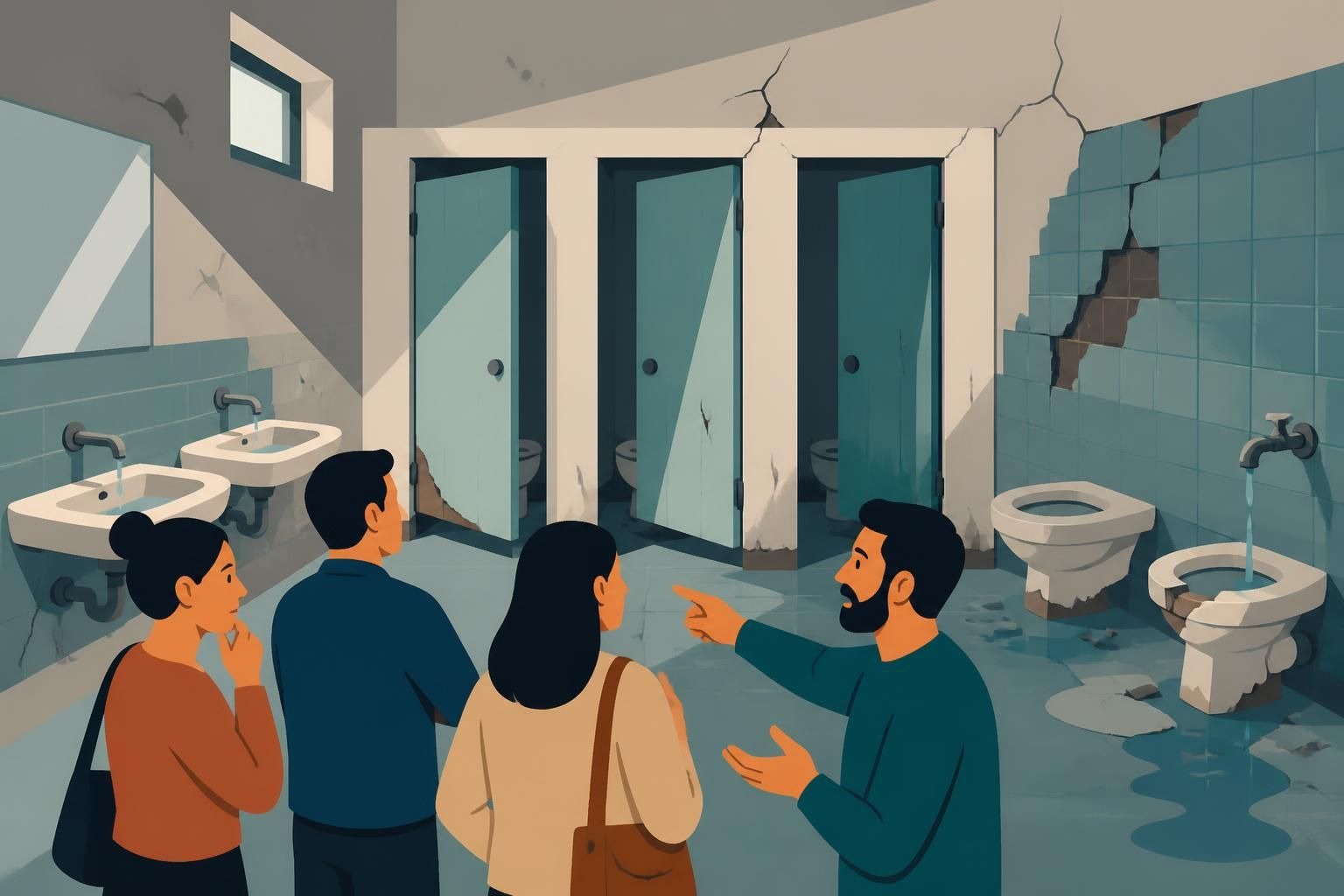
« #BalanceYourToilets »: parents sound the alarm on the deterioration of school restrooms
In Brief
- On June 5, 2026, parents of the Archereau nursery school (Paris 19th) made toilets deemed unworthy visible via the hashtag #BalanceTesToilettes.
- Videos on Instagram show empty dispensers, broken equipment, and makeshift repairs to maintain a minimum level of service.
- According to a 2022 Harris Interactive survey, over 40% of children report avoiding toilets at school and nearly 8 out of 10 say they sometimes or often hold it in.
- Reports mention degraded hygiene (lack of soap, shortage of paper) and privacy issues (absence of partitions), impacting well-being.
- FCPE Paris indicates regularly receiving similar feedback, suggesting a phenomenon that goes beyond a single establishment.
On June 5, 2026, parents of students at Archereau nursery school, in the 19th arrondissement of Paris, decided to stop pretending not to see: they show, with images as proof, the condition of the school’s toilets and the daily degradation of school sanitation. The motto, #BalanceTesToilettes, aims to bring out a subject often relegated to “detail” status while it concerns hygiene, safety, and children’s health. According to their testimony collected by 20 Minutes (June 5, 2026 edition), the problem goes beyond the musty smell: absence of paper, empty soap dispensers, faulty equipment, and sometimes even partitions missing. Videos published on Instagram also show makeshift solutions, such as tied or patched systems to maintain use.
The movement highlights a paradox that would be laughable if it were not so serious: children are asked to learn barrier gestures, to wash their hands, to drink water, then they are offered facilities that do not keep up. In families, anger is accompanied by very concrete concern: when a child holds it for hours, it is not a “small habit,” it is a risk of urinary disorders, constipation, and infections. And when shame or stress joins them in the toilets, education loses a discreet but essential ally: a school environment where basic needs are treated with respect.
#BalanceTesToilettes: what parents denounce about school toilets and hygiene
The hashtag #BalanceTesToilettes was not launched to collect likes, but to document a material reality. Parents of Archereau school describe toilets where paper regularly runs out, where soap is not available, and where some elements (dispensers, towel holders, locking systems) no longer withstand the rigors of intensive use. The fact that these problems are found in a nursery school adds a layer of discomfort: at this age, autonomy is developing, and the slightest complication turns a trip to the toilet into an obstacle course.
The issue of privacy also appears in the feedback, with toilets without partitions or with insufficient separators. For adults, this already looks like a bad memory of a rainy festival; for children, it is a cause of embarrassment, forced laughter, or giving up. In a school, privacy is not a decorative luxury: it is a condition of serenity and dignity. When this condition is missing, everyday school life is charged with unnecessary tension, and the “little corner” becomes a big problem.
“Worn out” equipment: when infrastructure becomes an education issue
Images shared on Instagram, mentioned by parents, focus on details that can unbalance a day: an empty soap dispenser, a broken paper towel holder, a locking system that no longer works. On paper, each element seems trivial. In the real life of a school, these are rubbing points multiplied by tens, even hundreds of daily passages.
The argument “children are harsh on equipment” often comes up in playground discussions. Except it sometimes serves as an alibi to normalize the degradation of school sanitation. Toilets designed for collective use must be sturdy, maintained, and repaired quickly. If a device breaks down and stays broken, the school teaches, despite itself, something other than the curriculum: it teaches that basic needs can wait. Education, here, also plays out in what the building “says” to the children.
A movement driven by images: effective but uncomfortable
Showing toilets on social media means accepting to expose an unglamorous part of everyday life. Mobilized parents are betting: if the issue remains locked in corridors, it will be treated as a trifle. If it becomes public, it gains political status. The hashtag also groups testimonials and compares situations, helping to move beyond “it’s only at our place.”
At the same time, mediatisation through images can be uncomfortable. Schools do not like being reduced to their toilets, and educational teams may feel caught between budgets, deadlines, and legitimate demands. The movement’s target remains clear: infrastructure and organisation that must guarantee a level of hygiene compatible with community life. The discussion benefits from remaining factual, because it is material facts that triggered the alarm.
School sanitation: impacts on children’s health, stress, and safety
The issue of school toilets is sometimes treated as secondary, although it directly affects health. A parent quoted by 20 Minutes (June 5 edition) reports that his daughter no longer wants to go to the toilet because she cannot clean herself. This simple sentence sums up a well-known mechanism: when the environment is perceived as dirty or insufficient, the child avoids it. Avoidance leads to holding it in, and holding it in can open the door to very concrete problems.
Physiologically, holding it in too long increases the risk of constipation and can promote urinary disorders. The fact that some children limit their water intake to reduce toilet visits is also mentioned in testimonies associated with this type of situation. The result is doubly counterproductive: less hydration, more retention, and a day’s comfort that collapses. In a classroom, this translates into agitated, distracted children, or conversely very quiet because they are managing constant discomfort.
Numbers speak: avoiding toilets is not marginal
Available data provide a useful scale. According to a Harris Interactive survey conducted in 2022, more than 40% of children report avoiding going to the toilet at school. The same survey indicates that nearly 80% say they sometimes or often hold it in. These numbers do not tell everything, but they show that the problem is structural: even when sanitation is not “catastrophic,” the experience can be uncomfortable, pressing, or stressful.
The logic is easy to follow. A door that doesn’t close, lack of soap, strong odor, wet floor, too long a queue: each of these elements adds a layer of discouragement. The sum ends up creating an avoidance strategy. And this strategy, in a child, sets in quickly because it seems to “work” short-term: he or she holds it until home. In the long term, the school ends up with a miniature public health problem, repeated every school day.
Hygiene and safety: a duo that also counts during viral circulation periods
Since the Covid-19 pandemic, schools have integrated daily reminders about handwashing. This makes the absence of soap even harder to justify, even occasionally. Hygiene is a basic condition of community life, especially in schools where children touch the same handles, toys, tables, handrails, then spontaneously bring their hands to their faces.
Safety is not limited to immediate physical risks. Toilets without privacy can foster teasing, fear of being seen, or a feeling of insecurity. In a school, the goal is not only to teach but to create an environment where children feel confident enough to learn. When access to toilets becomes a source of anxiety, the school gains a stress factor that was not on the agenda but chips away at the day.
Educational videos on handwashing often remind of the 20 to 30 seconds friction rule and soap use. In a school, these recommendations have an impact only if the school sanitation facilities allow them to be applied without improvisation.
Degradation of school toilets: possible causes and responsibilities on the municipalities’ side
When parents raise an alarm about toilets, the institutional response often oscillates between two registers: “we are doing our best” and “it’s not so simple.” The key point remains the chain of responsibilities and resources. In many municipalities, routine maintenance, repairs, and investments are handled by distinct actors, with separate calendars and budgets. Result: a leak may be reported, re-reported, then filed in a stack waiting for a slot, a quote, or approval.
In the case mentioned in Paris 19th, parents said they alerted the town hall for several months without concrete improvement. The feeling of blockage plays a role in the move to action on social media: when the “classic” request does not move, visibility becomes a lever. The paradox is that sanitation facilities are heavily used infrastructure but still little visible in budget decisions, because they do not “show” in an end-of-year report like a computer room or a renovated courtyard.
Why “small equipment” brings down major services
The lack of soap or toilet paper looks like a logistics problem, not a construction site. Yet, this small equipment conditions the use of the place. A broken dispenser or irregular restocking can be enough to overturn the experience, especially in nursery school, where a child cannot improvise. “Simple” equipment becomes critical because it carries everyday hygiene.
Parents also tell of makeshift arrangements. This patchwork is an indicator: when a school community begins to patch things up, it is often because maintenance does not arrive at the necessary pace. And when maintenance is too slow, equipment degrades faster, because a broken element leads to diverted uses. A door that doesn’t close properly undergoes more pulling. A dispenser that blocks gets hit. The circle is known, and it costs more in the long run.
Table: common failure points and observed effects at school
The table below summarizes problems mentioned in testimonies linked to #BalanceTesToilettes and concrete effects on the school day. It is not a technical audit, but a useful framework for objectifying the discussion.
| Observed element | Immediate effect on use | Associated risk or impact | Simple indicator to monitor |
|---|---|---|---|
| Absence of soap | Incomplete handwashing | Degraded hygiene, increased germ transmission | Number of days with empty dispenser per month |
| Lack of toilet paper | Discomfort, refusal to go | Retention, stress, accidents | Reports of stock outages |
| Defective equipment (door, dispenser) | Limited or diverted use | Accelerated degradation, incidents | Average repair delay (days) |
| Absence of partition or insufficient privacy | Discomfort, avoidance | Stress, teasing, feeling of insecurity | Number of stalls with functional locking |
A widespread problem in schools: what FCPE Paris and field feedback suggest
Parents mobilized at Archereau claim that several dozen Parisian establishments could face comparable difficulties. FCPE Paris concurs, indicating it regularly receives reports about lack of soap, shortage of toilet paper, and equipment unsuitable for intensive use by children. This accumulation of feedback outlines a pattern: it is not just a story of a “bad week” or a “forgotten stock,” but a recurring fragility of school sanitation.
The issue goes beyond the capital, as alerts have already been relayed in recent years in other French cities. Details vary according to buildings: here, outdated toilets; there, insufficient cleaning; elsewhere, lack of consumables. The common point lies in the place given to these facilities in priorities. Sanitation is a basic service, but it often remains invisible as long as it does not malfunction. Once it becomes a problem, it affects everything: break management, adult organisation, concentration in class, relationship with parents.
What establishments can measure without turning the school into an inspection office
Making the issue operational involves simple, understandable, and verifiable indicators. It is not about adding paperwork but securing the minimum. Monitoring restocking (soap, paper), a fault log with report and repair dates, regular visual checks of stalls and door locking: these elements help clear the fog.
From a safety perspective, a stall door that no longer locks is not a detail. A constantly wet floor is not “just annoying,” it is a risk of falling. An unusable water point makes prevention messages obsolete. This sorting helps prioritize interventions and argues requests to the competent services.
List: concrete signs that toilet degradation is no longer “anecdotal”
- Repeated soap or paper shortages over several weeks despite reports.
- Stalls without functional locking or insufficient separation, leading to massive avoidance.
- Broken equipment left unrepaired, leading to diverted use and more breakage.
- Cleaning perceived as insufficient to the point that children limit water intake during the day.
- Increase in incidents (accidents, urgent exit requests, crying, refusal to go).
- Recurring tensions among adults about “who manages what,” indicating an organisation that no longer holds up.
When several of these signals appear together, toilets cease being a technical issue and become a school climate factor. Everyday life quickly reminds, even the most skeptical.
Public medical content on urinary retention and constipation in children helps understand why schools cannot treat toilets as an annex. Symptoms sometimes have simple causes but repeated, and the school environment matters in the equation.
Realistic solutions to improve hygiene and school toilet infrastructure
The #BalanceTesToilettes movement raises a practical question: what can change quickly, and what requires a project? The first level concerns organisation. Reliable restocking of soap and paper, with identified storage points and responsible persons, solves part of the problems without construction. Parents do not ask for a “designer” bathroom, they ask for a functional service, every school day.
The second level concerns maintenance. A too long repair delay turns a small breakdown into a lasting difficulty. Establishing a clear reporting procedure, accessible to teams, with visible follow-up, reduces the feeling of abandonment. Follow-up can remain simple: report date, nature of the fault, status. This kind of tool also prevents “everyone thought someone else had done it.” In a school, this misunderstanding is classic and costs a lot of energy.
Material improvements: choices that withstand real school life
Regarding infrastructure, some technical choices better resist intensive use: more robust dispensers, easy-to-clean materials, anti-waste systems for paper and soap, doors and locks adapted to children. The goal is to reduce breakdowns, not to add gadgets. A simple, solid, and maintainable equipment saves time for everyone.
The issue of partitions and privacy deserves priority treatment. Restoring proper separation and functional locks reduces avoidance and stress. It also improves the climate, as some teasing or tensions around toilets arise from exposure. A school that secures this point sends a clear message: basic needs are respected.
What parents can do without becoming a technical service
Parents have concrete levers, especially when coordinated. Documenting shortages (without staging children), centralizing feedback, requesting an intervention schedule, seeking a visit of the toilets with the team and concerned services: these approaches anchor the discussion in reality. They also avoid emotional ping-pong, where everyone ends up talking about “feeling” due to lack of shared facts.
Using social media, as in #BalanceTesToilettes, has an accelerator effect. It is not necessarily the starting tool but becomes a pressure tool when usual channels do not succeed. Prudence consists in staying on the equipment and hygiene field, because that is where the alarm is hardest to ignore.
What do we say about it?
#BalanceTesToilettes points to a subject too often treated as a nuisance when it touches hygiene, safety, and well-being at school. Harris Interactive figures (2022) on toilet avoidance indicate the problem goes beyond the most visible cases. The most realistic priority is to ensure daily restocking of soap and paper, then drastically reduce repair times, because a long-lasting breakdown encourages avoidance. About privacy, the absence of partition or proper locking must be considered an urgent intervention point, because the impact on stress is immediate.
What can a school do from the following week to improve school sanitation?
The quickest actions relate to organisation: securing a buffer stock of paper and soap, setting a verification rhythm (morning and afternoon), and designating a single reporting channel for breakdowns. Simple tracking with report date and repair date prevents defective equipment from remaining stuck in a blind spot.
Can holding in going to the toilet at school have health effects?
Yes. Repeated retention can promote constipation and urinary disorders, and increases stress in some children. When a student also reduces water consumption to avoid toilets, fatigue and concentration difficulties may add up. In case of symptoms, medical advice remains necessary.
How to approach the subject without blaming teachers?
By sticking to material facts: soap availability, presence of paper, door condition, observed cleanliness, repair delays. Educational teams do not always manage budgets or technical interventions. An on-site visit with concrete criteria allows discussion about infrastructure rather than people.
Why is privacy (partitions, doors) so important in nursery and primary school?
Because it conditions usage. A stall without a lock or sufficient separation can cause discomfort, avoidance, and teasing. The child may hold it in, ask to go home, or experience toilets as a stressful moment. Simple and sturdy arrangements quickly reduce this type of difficulty.