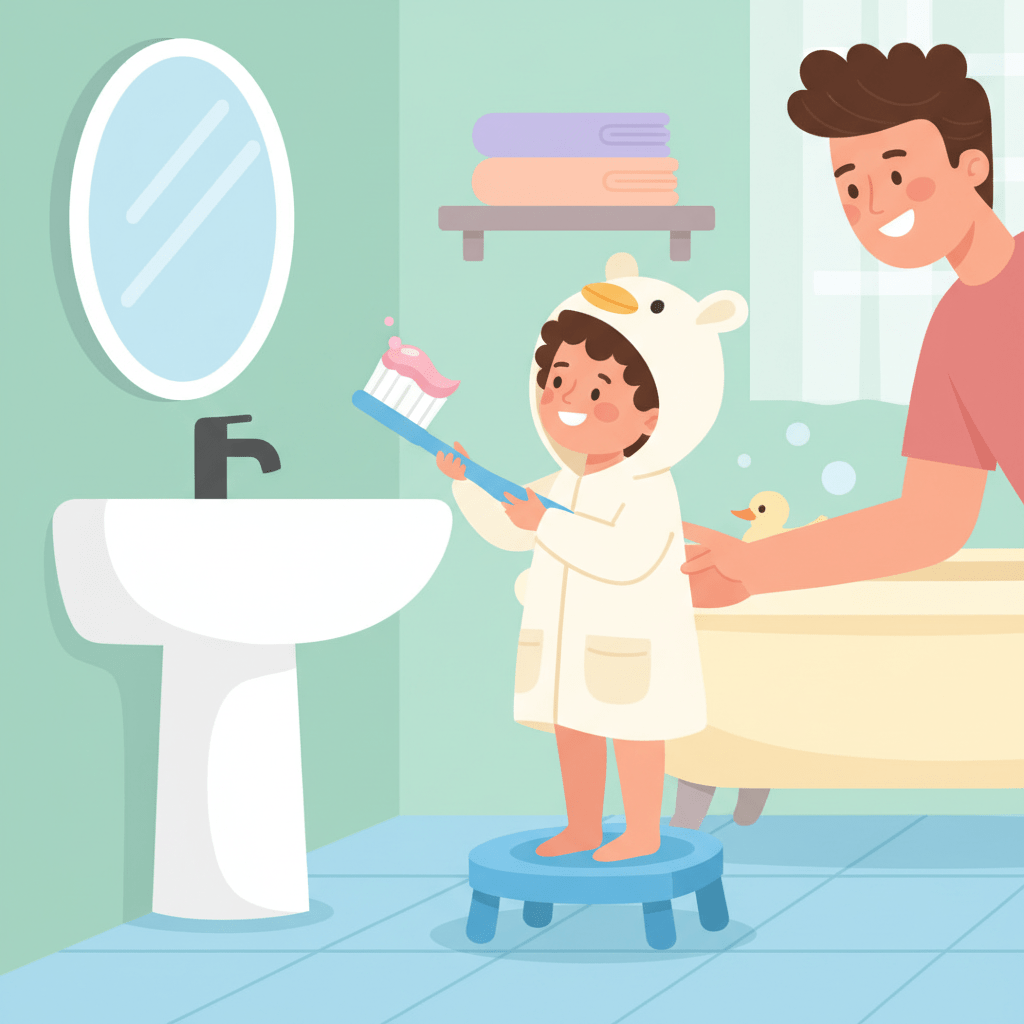
Brossage Dents Toddler: 8 questions about brushing toddlers’ teeth
| Short on time? Here’s the essentials ⏱️ |
|---|
| 🦷 Start brushing teeth from the first tooth, around 6 months old. |
| 🌙 The evening brushing is non-negotiable for cavity protection. |
| 🪥 Before 1 year: silicone compress or finger guard. After 12 months: small-head brush with soft bristles. |
| 🧴 Children’s fluoridated toothpaste: 1000 ppm from 6 months, rice grain amount, then small pea after 3 years. |
| 🎵 Short, regular gestures + playful routines = better cooperation from toddlers. |
| 🥤 Water between meals, no bottle at bedtime. Healthy habits first and foremost. |
| 🗓️ Annual dental visit starting at 1 year old. Program for ages 3–24 “M’T teeth every year!” free. |
| 💡 The first permanent molar (around 6 years) is fragile: pay extra attention. |
Updated on May 13, 2025 — First teething brings a flood of questions. When to start brushing a 6-month-old baby? Which toothpaste to choose? How to avoid tears at bedtime? Guidelines exist, and they reassure, because a oral hygiene from early childhood influences much of the future dental development. Malo’s parents, 20 months old, for example, turned a complicated moment into a timed game, and progress came quickly.
Since 94% of parents find this kind of guide useful, this document answers the 8 questions that recur constantly, backed by evidence. Proper brushing techniques, fluoride dose, tools, routines, dental prevention through diet and dentist visits: everything is scrutinized. Goal: simple, consistent, effective children’s dental care, without unnecessary battles.
When to start brushing toddlers’ teeth and how often?
Age benchmarks and realistic schedule
From the eruption of the first tooth, often around 6 months, brushing becomes part of the routine. Once a day is enough until about 18 months, ideally in the evening. Then, around 2 years, the frequency increases to twice a day, morning and evening. This schedule accounts for reduced nighttime saliva flow, which leaves residues sticking to the enamel. Also, milk teeth enamel is thinner and more vulnerable.
When parents wonder about nighttime feedings or bottles at bedtime, the answer is clear. Sugary intake at bedtime promotes acidity and thus cavities. After evening brushing, no food or drink other than water. This simple rule protects teeth and sleep. The routine can be tied to the bedtime story to create a stable cue.
- 🗓️ 6–18 months: 1 gentle, regular brushing in the evening.
- 🌞 From 2 years: 2 brushes per day, morning after breakfast and evening before bed.
- 🚫 After evening brushing: no milk, no juice, only water.
- 🧸 Set a fixed routine: lullaby, hourglass, teddy bear “observer”.
Concrete examples to instill the habit
With Lina, 3 years old, parents placed the brush in a colorful pot near pajamas. This simple visual cue reduces forgetfulness. Other families use a 2-minute timer shaped like animals. Routines should stay short and predictable. A sticky note on the bathroom mirror is often enough to establish consistency.
In the morning, brushing after breakfast immediately removes sugars and acidity. In the evening, brushing caps off the food chapter of the day. With this logic, the child understands that their teeth need real rest, just like them. This framework protects their teeth and calms the evening.
| Age 👶 | Frequency ⏰ | Focus of the routine 🎯 | Fun tip 🎵 |
|---|---|---|---|
| 6–18 months | Once a day | Gentle evening cleaning | 60–90 sec lullaby 🎶 |
| 2–4 years | Twice a day | Repeat top/bottom sequence | Hourglass or timer ⏳ |
| 5–6 years | Twice a day | Internal surfaces + molars | Sticker chart ⭐ |
Establishing solid cues early makes subsequent routines easier and calmer.
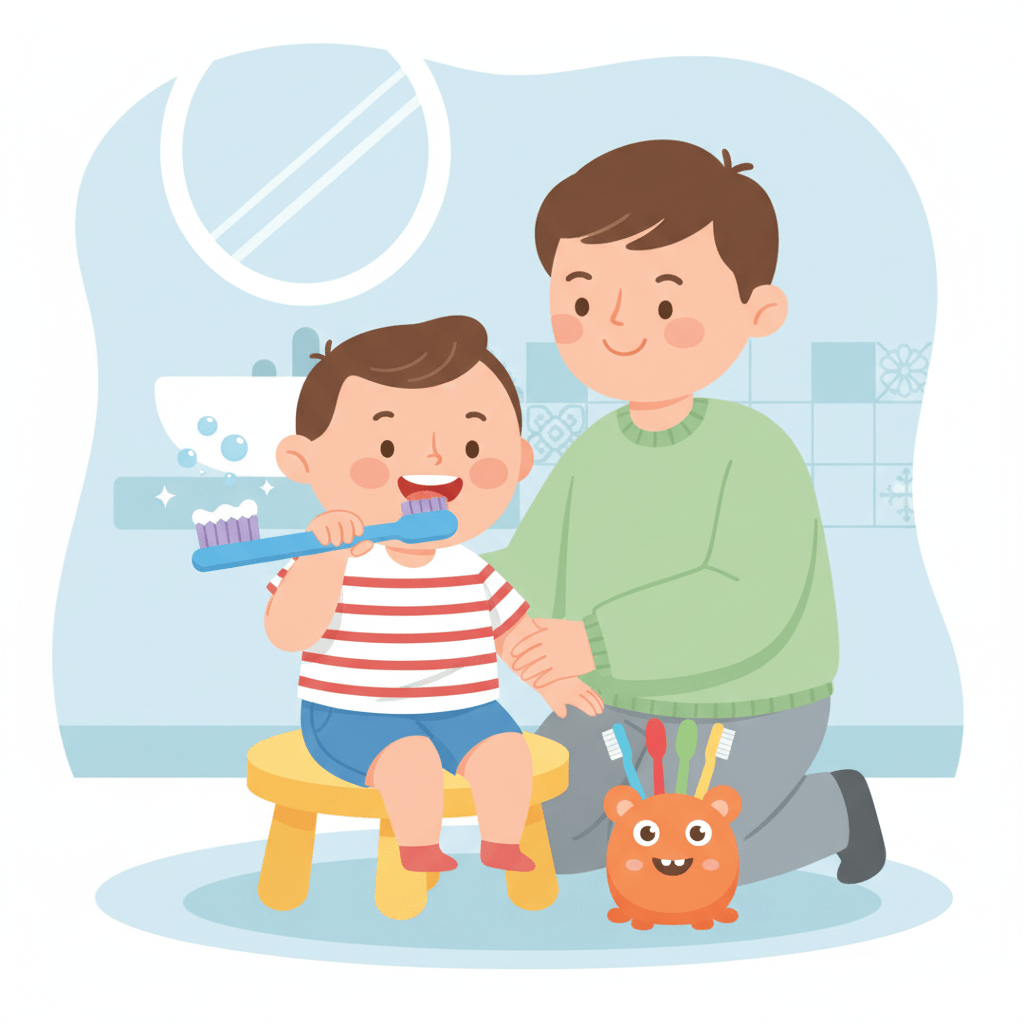
What equipment for brushing young children’s teeth: brush, children’s toothpaste, and accessories
Before 1 year: maximum gentleness
Infant gums are sensitive. A warm, moist compress or silicone finger guard cleans without irritating. From the appearance of the first tooth, a small amount of children’s fluoridated toothpaste: a rice grain size. This micro-dose is sufficient to strengthen enamel. It reduces the risk of insufficient cavity protection while avoiding excess fluoride.
Menthol flavors often repel babies. Fruity tastes, like strawberry or raspberry, are more accepted. A hygienic cover protects the brush or finger guard. Finally, an open-air storage avoids contact brush to brush, limiting microbial exchange among siblings.
- 🍼 Compress or silicone finger guard until 12 months.
- 🍓 Fruit flavors better accepted than menthol.
- 🧼 Air drying, no contact with other brushes.
- 🧴 1000 ppm fluoride from 6 months, minimal amount (rice grain); oral hygiene maintained.
After 12 months: small head and soft bristles
From 1 year old, the child can hold their first brush, always guided by an adult. Choose a small-head brush with soft bristles, non-slip handle, and short neck. This trio ensures precision and comfort. The brush should be replaced every three months or when the bristles flare out “like a palm tree”. A travel case is useful for daycare or trips.
For consistent children’s dental care, a simple kit suffices: suitable brush, calibrated fluoridated toothpaste for age, dedicated cup, and visual timer. Extra accessories complicate routine. Fun tools remain useful if they boost motivation. The goal remains a thorough, genuine brushing.
| Tool 🧰 | Age/use 👶 | Why ✅ | Practical tip 💡 |
|---|---|---|---|
| Compress | 0–12 months | Ultra-gentle cleaning | Warm water + micro-trace of toothpaste 🍃 |
| Silicone finger guard | 0–12 months | Control of the gesture | Gum massage to soothe 😌 |
| Children’s toothbrush | 12 months+ | Soft bristles + small head | Replace every 3 months 🔁 |
| Fluoride toothpaste 1000 ppm | 6 months–6 years | Strengthens enamel | Rice grain then small pea 🫛 |
The right equipment simplifies routine, but consistency ensures effectiveness.
To visualize the gestures, an educational video often helps families.
After watching, it’s helpful to repeat the sequence with the child, step by step.
Effective brushing techniques and tips for tear-free cooperation
Precise gestures, targeted zones
Brushing benefits from following the same “choreography.” Start with the upper teeth, then the lower. On each arch, pass the outside, the top, then the inside. Movements are short, circular, and regular. Fifteen back-and-forth strokes per zone are enough. Avoid aggressive back-and-forth motions that push plaque under the gum.
When the child moves, lying down on the bed provides better access. The head remains stable, the mouth is visible, and molars are easier to reach. A cup of water nearby builds confidence. A mirror can also stimulate curiosity: the child sees themselves “working.”
- 🎯 Fixed order: top → bottom, outside → top → inside.
- 🌀 Circular, gentle, short movements.
- 🛏️ Lying position: stable head, increased visibility.
- 🪥 Adult brushes, child “finishes” to imitate 👏.
Conflict-free cooperation: turn the task into a game
Cooperation is not innate. It is built. A 90-second lullaby creates a time cue without imposing a cold timer. A glowing toothbrush attracts attention. A sticker chart rewards efforts throughout the week. The golden rule: praise the behavior, not the perfection of the gesture.
As soon as teeth touch, dental floss becomes useful. It cleans contacts that bristles cannot reach. For young children, a floss holder shaped like an arch helps adults handle it. Two to three gentle passes are enough on tight areas.
| Zone 🧭 | Movement 🌀 | Duration ⏳ | Watch out for ⚠️ |
|---|---|---|---|
| External faces | Gentle circles | 20–30 sec | Do not “saw” the gum ❌ |
| Masticatory surfaces | Short back-and-forths | 20–30 sec | Focus on molar grooves 🍽️ |
| Internal faces | Incline at 45° | 20–30 sec | Keep gestures light 🪶 |
This clear structure reassures the child and enhances effectiveness at each session.
Dental prevention and fluoride: understanding cavities and dosing without excess
Cavities: an avoidable process
Cavities start when bacteria convert sugars into acids. Acidity demineralizes enamel. Initially, the tooth becomes dull. Then the lesion deepens and becomes painful. Salivary transmissions within the family exist: shared spoons, “cleaned” pacifiers, kisses on the mouth. Good oral hygiene and regular brushing protect against these risks.
The risk increases with snacking, sugary drinks, and falling asleep with a bottle. Conversely, flat water and structured meals reduce acid exposure. Increased supervision is advised if a parent or siblings have a history of cavities. Early clinical check-ups offer reassurance and guidance in case of concern.
- 🥤 Water between meals, no repeated syrups or juices.
- 🍬 Limit sugary and sticky snacks.
- 🪥 Two daily brushings, including a systematic evening one.
- 👨👩👧 Family history: increased vigilance.
Fluoride: the well-dosed ally
Fluoride strengthens and repairs enamel. It remains the key tool for dental prevention. However, excess can stain enamel (fluorosis). The dosage of children’s toothpaste depends on age and caries risk. Recent recommendations confirm 1000 ppm from 6 months, in minimal amounts. For high risk, the practitioner may adjust the concentration according to age groups.
Achieving the right balance involves a simple action: spread the recommended dose over the bristles, no more. Children sometimes swallow toothpaste. This micro-quantity is designed to limit ingestion. Effective brushing requires no more. When caries risk is high, a higher concentration can be discussed with the dentist.
| Age 👶 | Caries risk 🔎 | Recommended concentration (ppm) 🧴 | Quantity 🥄 |
|---|---|---|---|
| 6 months–3 years | Low | 1000 | Rice grain 🍚 |
| 3–6 years | Low | 1000 | Small pea 🫛 |
| 3–10 years | High | 1450 | Small pea 🫛 |
| 10–16 years | High | 2500 | Thin strip 🧵 |
| 16+ years | High | 5000 | Dental follow-up 🩺 |
To supplement these guidelines, a video demonstration on fluoride can help visualize the correct usage.
Correct dosing, repeated daily, secures enamel and simplifies family routines.
Everyday healthy habits: diet, family rhythms, and dental calendar
Plates, drinks, and timing of intake
Healthy habits shape oral hygiene. Water remains the default drink. One fruit juice per day is sufficient. Sodas are limited to twice a week, preferably during a meal. Avoid constantly drinking compotes, sticky cereals, and sugary snacks between meals to reduce continuous acid exposure.
Four intake moments a day establish a clear rhythm: breakfast, lunch, snack, dinner. Between them, nothing sugary. Parents can offer naturally flavored water (cinnamon stick, strawberry slices) without added sugar. This small twist encourages hydration and motivation.
- 💧 Unlimited water between meals.
- 🍊 One juice/day, sodas 0–2/week, during meals.
- 🥪 Four meals, no repeated sugary snacking.
- 🧃 Caution with drinking compotes and sticky bars.
Visits to the dentist and prevention programs
A first appointment around 1 year old introduces the clinic gently. Afterwards, an annual visit is usually enough. If risk factors are present (family cavities, snacking, bottle at bedtime), a check-up every 3 to 6 months is advisable. Since April 2025, the “M’T teeth every year!” program offers a free consultation annually for ages 3–24, including associated care.
To prepare the child, a “dentist game” at home offers reassurance. Count the teddy bear’s teeth, look at an illustrated story, then name the steps: chair, light, mirror. Children arrive curious, not scared. This preparation ensures smooth follow-up.
| Age 📅 | Visit frequency 🩺 | Main goal 🎯 | Parental advice 👨👩👧 |
|---|---|---|---|
| 1–2 years | Once a year | Habituation, prevention | Dentist game at home 🎭 |
| 3–6 years | Once a year (M’T dents) | Early detection | Visible calendar on the fridge 🧲 |
| 6–8 years | Once a year | Monitor first molar | Reinforce suture brushing 🪥 |
| High risk | Every 3–6 months | Close follow-up | Family action plan 📋 |
Aligning diet, routine, and monitoring simplifies and sustains oral health.
{“@context”:”https://schema.org”,”@type”:”FAQPage”,”mainEntity”:[{“@type”:”Question”,”name”:”At what age can a child brush their own teeth?”,”acceptedAnswer”:{“@type”:”Answer”,”text”:”Most children start participating around 3–4 years old, but parental supervision remains necessary until about 6–7 years old. The child becomes more autonomous when they can tie their shoelaces; the adult completes brushing to ensure effective results.”}},{“@type”:”Question”,”name”:”Should you use dental floss with young children?”,”acceptedAnswer”:{“@type”:”Answer”,”text”:”Yes, as soon as two teeth touch. Bristles do not clean contact points. An arch-shaped floss holder makes the gesture easier for adults, used one to three times a week, depending on tight spaces.”}},{“@type”:”Question”,”name”:”My child swallows toothpaste: is that serious?”,”acceptedAnswer”:{“@type”:”Answer”,”text”:”Ingesting small amounts is expected with the recommended doses (rice grain/petit pois) and 1000 ppm fluoride. Respect the quantity. If significant repeated ingestion occurs, consult the dentist.”}},{“@type”:”Question”,”name”:”Electric toothbrush: a good idea for a young child?”,”acceptedAnswer”:{“@type”:”Answer”,”text”:”It’s possible but not essential. Choose a child model with a small head and a soft tip. The adult guides the placement on each surface. The priority remains regularity and proper sequence of gestures.”}}]}At what age can a child brush their teeth alone?
Most start participating around 3–4 years old, but parental supervision is necessary until about 6–7 years old. The child gains autonomy when they can tie their shoelaces; the adult completes the brushing for effective results.
Should you use dental floss with young children?
Yes, as soon as two teeth touch. Bristles do not clean contact points. An arch-shaped floss holder makes the gesture easier for adults, used one to three times a week, depending on tight spaces.
My child swallows toothpaste: is that serious?
Ingesting small quantities is intended by the recommended doses (rice grain/petit pois) and 1000 ppm fluoride. Respect the amount. In case of repeated large ingestion, consult the dentist.
Electric toothbrush: a good idea for a young child?
It’s possible but not indispensable. Choose a child model, small head, soft tip. The adult guides the placement on each surface. The priority remains regularity and proper sequence of gestures.
“Short gestures, twice a day; protected smiles, for a lifetime.”