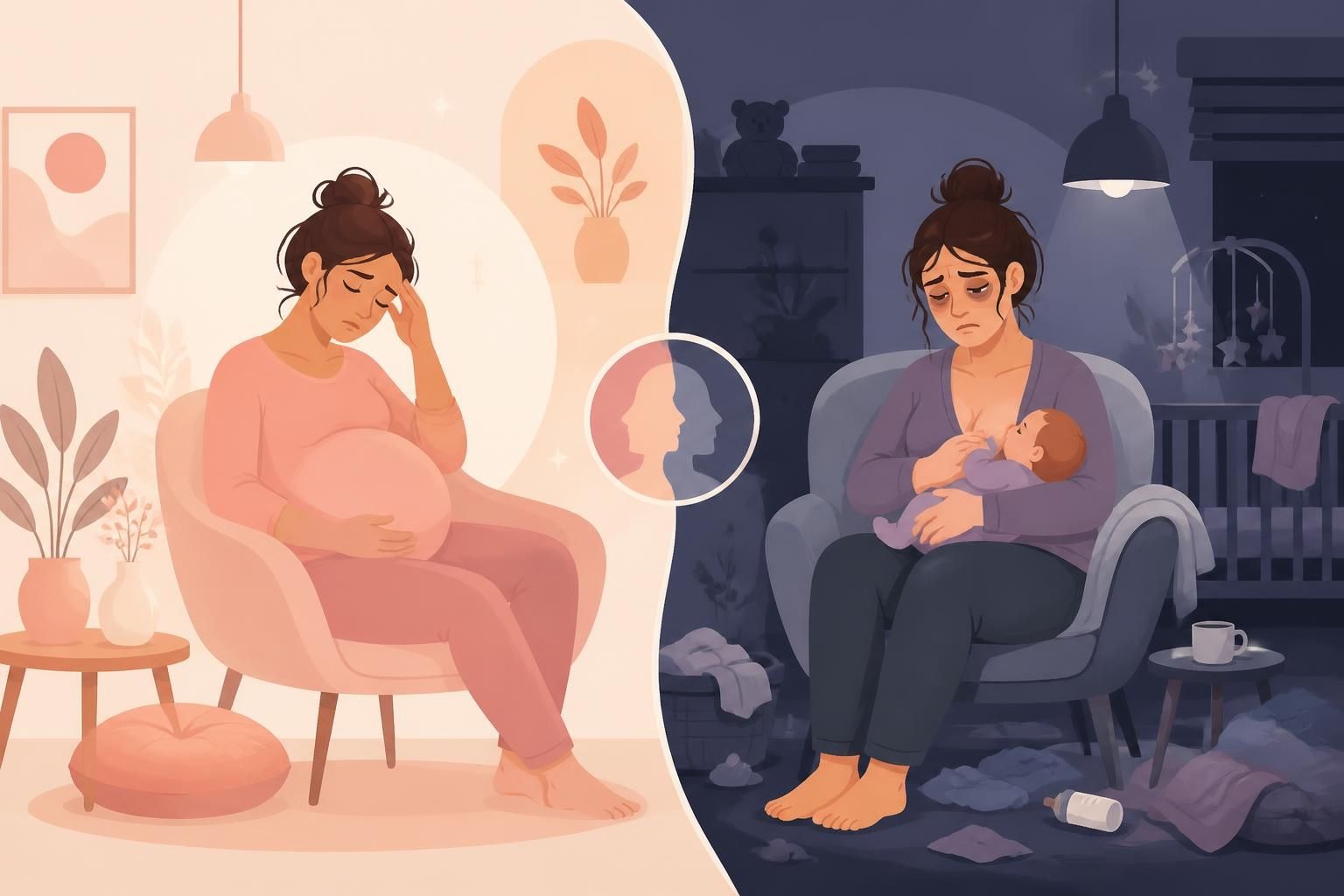
Fatigue during pregnancy vs postnatal exhaustion: which is more challenging?
A figure sets the tone: a pregnancy lasts on average 40 weeks of amenorrhea, like a marathon where pregnancy fatigue can set in very early, sometimes even before the belly announces the news. On paper, postnatal exhaustion has a strong argument: it occurs at the moment when recovery should begin, whereas the baby has not signed a sleep contract. In real life, the two fatigues do not attack the same areas. During motherhood “pregnancy version,” the body manages intense hormonal changes, increased blood volume, possible nausea, and sleep often fragmented by night awakenings and discomforts. After childbirth, the sleep debt becomes more mechanical, more social too: breastfeeding, bottle feeding, crying, appointments, mental load, and parental stress in the background, with an implicit pressure to “manage.” The question “which is more exhausting?” is rarely decided by simple intensity. It depends on duration, the possibility to stop, family support, and the fact that the body is still under construction while daily life demands continuous service.
In Brief
- Pregnancy fatigue is often marked in the 1st trimester and at the end of pregnancy, with less restorative sleep linked to discomfort and hormonal fluctuations.
- Postnatal exhaustion combines sleep debt, physical recovery, and organization around the baby, with parental stress often more “logistical.”
- Certain signals (palpitations, abnormal breathlessness, persistent sadness) justify medical advice, both during pregnancy and after.
- Family support significantly changes the experience: tangible relief, meals, chores, or simply protected “shower time.”
- Fatigue is better managed when it is measured: rest schedules, hydration, iron intake, and targeted nap strategies.
Pregnancy Fatigue: Biological Mechanisms, Trimester Rhythms, and Effects on Sleep
Pregnancy fatigue has a reputation as a “heavy blow” from the first weeks, and it’s not just an impression. Hormonal changes, notably the increase in progesterone, are often associated with daytime sleepiness and a sensation of slowing down. The body does not “pretend”: it modifies its circulation, thermoregulation, and metabolism to support the pregnancy. In this context, an ordinary day can cost more energy, even without spectacular effort.
The 1st trimester is frequently described as a period where fatigue resembles flu without fever: heaviness, need to sleep early, difficulty concentrating. Nausea, when present, plays the role of a discreet saboteur. Eating becomes complicated, hydration can drop, and the body does not like working at full stretch. Pregnancy can also reveal or worsen anemia, which adds fatigue “in the muscles” and not only in the head. At this stage, sleep can sometimes be longer but not always more restorative.
The 2nd trimester is often presented as the moment when energy returns. This “better” is not guaranteed, especially if work is physical, stress is high, or sleep was already fragile before pregnancy. The night can remain fragmented: more intense dreams, gastroesophageal reflux, cramps, more frequent need to urinate. The amount of sleep may seem correct, but the quality sometimes goes on strike.
At the end of pregnancy, mechanics take over: a larger belly, difficulty finding a comfortable position, quicker breathlessness, ligament pains, baby’s movements manifesting just when the adult wants to turn off the light. A nap can help but it does not erase the fact that the body works 24/7. A detail often underestimated: mental anticipation. Preparing for maternity, organizing afterwards, managing appointments and possible medical concerns maintains a background noise that does not help to “switch off.”
When Fatigue Becomes a Signal: Concrete Markers Without Dramatizing
Fatigue is expected, but some signs deserve medical advice because they may be linked to something other than a simple lack of rest. Significant breathlessness on slight effort, frequent palpitations, unusual paleness, or persistent sadness are not endurance badges to collect. A health professional can check simple parameters (iron, blood pressure, thyroid, general condition) and propose realistic adjustments.
To lighten daily life, “small but concrete” solutions often work better than heroic injunctions. Distribute tasks, reduce unnecessary outings, plan tolerated snacks in case of nausea, and protect a rest period after lunch can make a difference. Pregnancy fatigue is not a contest: it is an indicator that the body is already in construction mode.
Postnatal Exhaustion: Sleep Debt, Physical Recovery, and Daily Parental Stress
Postnatal exhaustion is often described as fatigue “that works”: you have to move forward, even when the body would ask for a technical stop. After delivery, there is physical recovery, sometimes with pain, healing, and rapid hormonal fluctuations. And alongside, the baby imposes a rhythm unrelated to the adult clock. Night awakenings can be frequent, especially the first weeks, and the sleep debt accumulates quickly.
The game changer is fragmentation. Sleeping 8 hours “in theory” does not have the same effect as sleeping 8 hours in four chunks. Many parents discover that daytime sleepiness is not just a desire for a nap: it’s a difficulty staying alert, remembering things, managing simple tasks without feeling foggy. This fatigue is less “cottony” and more “functional”: it affects coordination, patience, and decision-making ability.
Parental stress adds a layer. It is not always spectacular: sometimes, it’s just the impression of having 25 tabs open in your head. Feeding the baby, understanding cries, tracking weight, managing visits, answering messages, organizing the household, sometimes returning to work or administrative tasks. In this environment, good family support is not just to “help,” it makes minimal recovery possible. One hour of relief can be worth more than a motivating speech.
Breastfeeding, Bottle Feeding, and Fatigue: What Really Weighs
Feeding the baby can influence fatigue, but not only by the method. Breastfeeds can be long, close together, and sometimes difficult at the start. Bottles also require time: preparation, cleaning, organization, and sometimes pumping. In both cases, the mental load can be high, especially if the parent feels alone in deciding, noting, comparing, monitoring. A pragmatic approach consists of securing non-negotiable rest slots, even short, and sharing peripheral tasks (laundry, meals, shopping) so energy serves care and sleep.
An educational video on infant sleep rhythms and parental rest strategies can help distinguish what is normal, what relates to organizational difficulties, and what should be discussed with a professional.
Concrete Comparison: Intensity, Duration, Sleep Quality, and Ability to “Function”
Comparing pregnancy fatigue and postnatal exhaustion is like comparing two different sports: even if the sensation of fatigue is strong in both cases, constraints and margins do not resemble each other. During pregnancy, fatigue is often continuous but more predictable: rest is socially more acceptable, schedules can sometimes adapt, and the environment more easily understands the need to slow down. After birth, the need for rest is real, but the schedule depends on the baby, with significant variability from one day to another.
Sleep quality is a pivot. At the end of pregnancy, sleep is disturbed by discomfort but it sometimes remains possible to compensate with longer nights or naps. In the postpartum period, the challenge becomes fragmentation and unpredictability. Recovery is not just a question of hours but of continuity and timing. Waking every two hours does not always allow time to reach sufficient deep sleep phases, which can increase irritability and the sensation of “empty battery.”
The ability to “function” is a social dimension. During pregnancy, very intense fatigue can make work or home management difficult, but there is often a possibility to rest, at least sometimes. After birth, baby care cannot be postponed to tomorrow, and fatigue becomes a safety issue: carrying, moving around, driving, handling hot water, staying attentive to the infant’s signals.
| Measurable Criterion | Fatigue During Pregnancy | Postnatal Exhaustion |
|---|---|---|
| Typical Duration | Can span several trimesters, with frequent peaks in the 1st and 3rd | Often very marked the first weeks, then variable depending on baby’s sleep and relief |
| Sleep Fragmentation | Awakenings linked to discomfort, reflux, urination, baby movements | Awakenings linked to baby care (feeding, changing, soothing), more unpredictable |
| Nap Possibilities | Sometimes possible depending on schedule and daytime fatigue | Often dependent on baby’s naps and family support |
| Biological Factors | Progressive hormonal change, cardiovascular and metabolic adaptations | Rapid hormonal variations, healing, possible milk rise, post-delivery recovery |
| Daily Mental Load | Preparation, appointments, maternity organization, possible anxiety | Baby care, household management, social constraints, increased parental stress |
List of Concrete Actions to Reduce Damage in Terms of Sleep and Energy
- Protect a fixed rest slot every day (even 20 to 40 minutes) and treat it like a medical appointment.
- Break domestic tasks into micro-tasks of 10 minutes instead of aiming for an unrealistic “big clean-up.”
- Plan simple and repeatable meals over 3 days (soup, whole wheat pasta, eggs, frozen vegetables) to limit mental load.
- Establish a night relay rule when possible: a 3-hour consecutive sleep period for an adult often improves recovery.
- Note signals that exceed expected fatigue (significant pain, persistent sadness, dizziness) and talk quickly to a professional.
In this comparison, pregnancy fatigue can be more crushing on bodily sensation, while postnatal exhaustion is often more corrosive on alertness and organization. Feelings vary, but the daily structure weighs heavily on real hardship.
Family Support and Organization: What Really Changes the Hardship of Both Periods
Family support is often presented as a “plus.” In reality, it is sometimes a variable that determines whether fatigue remains manageable or becomes chronic exhaustion. During pregnancy, help can be anticipated: appointments, errands, meal prep, home adjustments. After birth, help must be synchronized with baby’s needs and parent recovery, which requires more coordination.
A frequent difficulty: the environment offers support in the form of presence, while what really relieves is more like concrete actions. Bringing a meal, doing a load of laundry, taking out the trash, watching the baby for 45 minutes while the adult sleeps or showers, accompanying to a medical appointment. “Useful” help reduces mental load and frees recovery time.
Visits can become a factor of parental stress if they follow one another, even with good intentions. The baby has their own pace, and the recovering adult does not necessarily have the energy to receive. Clarifying simple rules (duration, hours, practical help needed) limits social fatigue that adds to physical fatigue. The funny thing in this story is that many parents do not dare ask for relief while they perfectly ask for a phone charger at work. Yet here, the “charger” is called sleep.
The Role of Digital Tools: Useful, but to Be Moderated
The phone can help organize the relay and track certain aspects (reminders, lists, appointments). It can also feed a spiral of comparison or hypervigilance, especially when fatigue reduces sorting capacity. On this point, a concrete parallel with online data management applies: Google explains, on its page about cookies and data (available via g.co/privacytools), that the acceptance or refusal of certain settings influences content and ad personalization, and that tools exist to adjust privacy. The idea is not to give a settings lesson but to remind that an exhausted parent does not need an ultra-personalized stream continuously triggering anxious content.
Limiting notifications, setting screen-free periods before sleeping, and choosing two or three reliable sources instead of endless scrolling often improves sleep quality. The brain recovers better when it has fewer micro-alerts to process.
A video content focused on implementing a relay, tasks that really relieve, and communication with the environment can help transform family support into concrete recovery.
Position Statement: The Most Exhausting Depends on Control Over Rest, and Postnatal Often Wins by Wearing Down
In raw feeling, pregnancy fatigue can be more “physical,” more internal, with heaviness and sleep that does not always repair. Many describe it as a drop in energy that sticks to the skin, even while remaining still. Yet, when it comes to deciding which is more exhausting, postnatal exhaustion often wins on the duration of functional impact, because rest is less controllable and alertness is continuously required.
The reason is simple: the baby imposes a rhythm. When sleep is fragmented several nights in a row, recovery becomes difficult, and basic tasks become more complex. Parental stress rises quickly, especially if the environment is scarcely available or if performance pressure sneaks into maternity (“getting back in shape,” “staying calm,” “enjoying every moment”). This framework can make exhaustion more exhausting than pregnancy fatigue, even if the bodily intensity of the latter is real.
This position does not erase cases where pregnancy is medically complicated, where fatigue is massive and persistent, or where sleep is highly disturbed. In these situations, pregnancy can be the hardest episode, notably if anemia, thyroid disorders, or psychological distress overlap. But in a “standard” situation where the medical condition is monitored, post-birth accumulates sleep debt, recovery, constraints, and mental load, with fewer pause possibilities.
The most operational point is organization. When a night relay exists, even partial, and days include micro-windows of rest, postnatal exhaustion decreases significantly. Without family support, it tends to stretch out and colonize everyday life.
What Do We Say About It?
Postnatal exhaustion is often the most exhausting, because it combines fragmented sleep debt and ongoing physical recovery, with non-negotiable tasks around the baby. Pregnancy fatigue can be more intense in the body, especially in the 1st and 3rd trimesters, but it more often leaves room for rest. The priority lever, in both cases, remains family support in the form of relay and practical help, not just presence. If worrying symptoms add to fatigue, quick medical advice prevents letting a spiral set in.
Quels signes doivent pousser à consulter si la fatigue devient trop forte ?
Un avis médical est pertinent en cas d’essoufflement important au moindre effort, palpitations fréquentes, pâleur marquée, vertiges répétés, ou tristesse persistante. Pendant la grossesse, ces signes peuvent être liés à une anémie ou à un trouble thyroïdien. Après l’accouchement, ils peuvent aussi s’associer à une récupération difficile ou à une détresse psychique. Mieux vaut consulter tôt que tenir jusqu’à la casse.
Comment améliorer le sommeil quand le bébé se réveille souvent la nuit ?
L’objectif réaliste est de protéger au moins un bloc de sommeil continu pour l’adulte, même court, en organisant un relais quand c’est possible. Réduire les stimulations la nuit (lumière faible, interactions minimales) aide aussi le bébé à différencier jour et nuit. En journée, privilégier une sieste alignée sur celle du bébé plutôt que des tâches ménagères lourdes améliore la récupération.
La fatigue pendant la grossesse peut-elle être liée à l’alimentation ?
Oui, surtout si les nausées réduisent les apports ou si l’hydratation devient insuffisante. Une anémie en fer peut majorer la fatigue et doit être évaluée par un professionnel. Des collations simples, tolérées et régulières peuvent stabiliser l’énergie. En cas de vomissements importants ou de perte de poids, il faut consulter pour adapter la prise en charge.
Le soutien familial, c’est quoi concrètement au quotidien ?
Le soutien efficace ressemble à des actions mesurables : apporter des repas, gérer courses et linge, faire une tournée de vaisselle, ou garder le bébé pendant que le parent dort. Fixer des créneaux précis évite les aides floues qui ne se transforment pas en récupération. Clarifier aussi les règles de visite (horaires, durée) réduit la fatigue sociale, qui peut aggraver le stress parental.