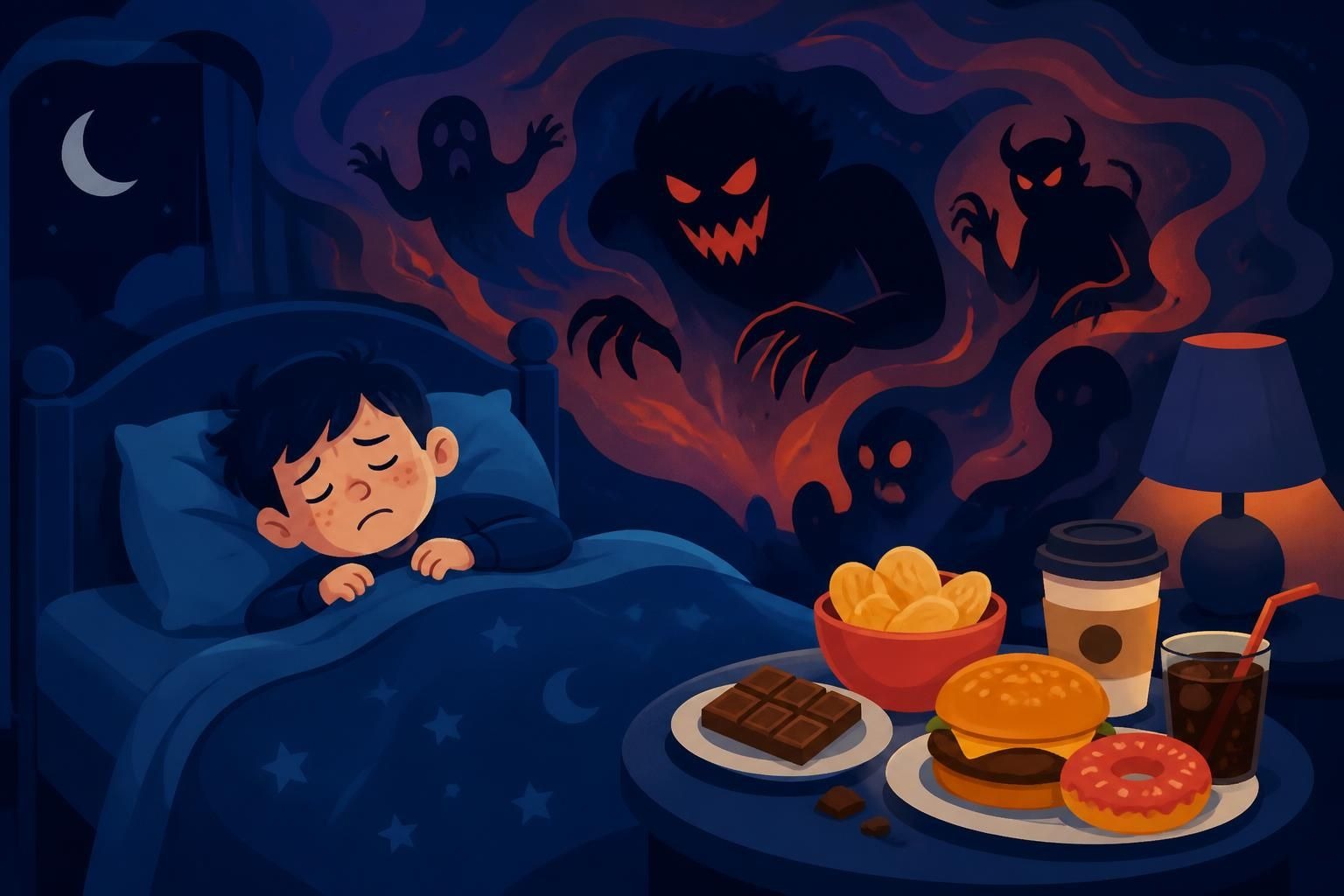
Frequent nightmares in your child: these evening foods singled out by a study
This kind of observation benefits from being noted over several days. A child can have a nightmare after a birthday without the cake being the only suspect: excitement, late bedtime, noise, all count.
The subject is also a matter of consistency. A single late meal does not write the script for all nights. On the other hand, a routine where the child eats heavy, late, and sweet food several school nights in a row can set up disturbed sleep over time, with a domino effect on mood and concentration.
Comparative table: evening foods, digestion, and risks of disturbed sleep
The goal is not to demonize foods but to identify those which, taken at the wrong time or in too large quantities, can increase nighttime discomfort. The table below helps choose simple adjustments, especially on school nights.
| Category of evening foods | Common examples | Digestibility (general) | Risk of disturbed sleep (if taken late) |
|---|---|---|---|
| Rich dairy products | Aged cheese, cream gratin | Slower | Moderate to high (depending on sensitivity, lactose, fat) |
| Sweets and very sweet desserts | Candies, pastries, milk chocolate | Fast, but glycemic variations | Moderate (restlessness, awakenings, more intense dreams) |
| Fatty/fried dishes | Nuggets, fries, heavily topped pizza | Slow | High (reflux, discomfort, micro-awakenings) |
| Light snacks | Compote, banana, simple slice of bread | Rather easy | Low to moderate (depending on quantity and timing) |
This table does not replace medical advice, especially in cases of pain, significant reflux, or intense nighttime anxiety. It serves to set a framework: a stable night is often the result of small adjustments, not a big cleanout in the cupboard.
Why children react differently to the same foods
Three factors often explain the differences. The first is digestive sensitivity: lactose intolerance, reflux, slower transit. The second is age, because sleep evolves: as the child grows, phase distribution changes, and so does how they remember dreams. The third is the emotional context: school stress, fear of the dark, separation, overstimulation late in the day.
A “perfect” dinner does not compensate for a day when the child felt stressed. On the other hand, a very rich dinner can amplify an already existing fragility. This mix explains why some weeks feel like a nightmare festival, then calm down for no obvious reason, even though the plate barely changed.
For many families, the most cost-effective angle is not to look for the “cursed” food but to reduce occasions where digestion and falling asleep conflict. Results are often visible in morning energy, even before counting nightmares.
Family strategy: testing the “evening foods” hypothesis without turning dinner into a police investigation
When a child has frequent nightmares, the desire to “change everything starting tonight” is understandable. The risk is to create additional tension around the meal and to create a new problem: a child who associates dinner with a list of prohibitions and the idea that they will inevitably sleep badly. A more effective method is based on observation, regularity, and modest adjustments.
The basis is to keep a small notebook over 10 to 14 days. Nothing exotic: dinner time, overall menu, presence of dessert, drink, bedtime, awakenings, and if possible a note on dreams (scary, restless, neutral). Trends often appear quickly: the most complicated nights follow late meals, or “dessert + screen + quick bedtime” evenings.
Simple adjustment protocols (and socially acceptable)
A protocol that works well is to change only one parameter at a time for a few evenings. For example, keep the same menu but move the meal earlier. Then, another week, keep the time but lighten the dessert. This approach avoids concluding too quickly that “cheese causes nightmares,” when the real factor was the delayed bedtime.
Another option is to move some foods earlier in the day. Cheese for snack or lunch can be suitable, especially if the child digests it well. For sweets, a smaller portion taken earlier avoids the spike just before night. The goal is to preserve food pleasure without paying for it in disturbed sleep.
The detail that changes the night: the environment, not just the plate
Sleep disorders rarely have a single trigger. An overheated room, uncomfortable pajamas, too bright a night light, or a too stimulating story can be enough to make the night lighter. Adding a heavy dinner to the mix does not help. A child who sweats, wakes more, and remembers dreams more, even if the diet is correct.
In families, a concrete adjustment is to secure a stable routine: dinner at a similar time, calm activity afterward, then bedtime. The brain loves repetitive signals. This does not eliminate all nightmares but reduces “roller coaster” nights, those where the child wakes several times and dreams seem more aggressive.
When a child has frequent nightmares, a useful marker is daytime impact: sleepiness, irritability, school difficulties. If these signs settle in, food observation should not delay a discussion with a health professional, especially in the presence of abdominal pain, reflux, or intense nighttime anxiety.
Digital life, consent, and sleep: the trap of evenings ending with “one more video”
Nightmares are not only fueled by cheese and candies. Evenings where the child snacks in front of a screen, then goes through an end-of-the-world negotiation to turn off the tablet, remain a classic. The consequence is not just light or content: it is also the timing of the late snack, often sweet, and the loss of fatigue signals. Night then starts with a brain still in “activity” mode, which favors disturbed sleep.
A detail often ignored is platform mechanics. Digital services measure engagement, tailor recommendations, and use personalization settings. Google, for example, explains on its privacy tools page (g.co/privacytools) that cookies and data can be used to measure engagement, offer personalized content, and adapt the experience, notably according to age settings. In a household, this means content that flows easily and evenings that slip away. This is not a theory: it is a usage reality.
When evening food mixes with the attention economy
A child who watches videos late, even without scary content, may end up with a compensatory snack: sugary cereals, biscuits, hot chocolate. The “screen + sugar” association is an effective duo to delay sleep onset. Sleep becomes lighter, and dreams more emotionally charged. The family then retains the image of the nightmare, whereas the initial problem was an overly stimulating evening.
The most pragmatic solution is to treat the end of the day as a whole: a screen-free window before bedtime, a simple drink, and a light snack if needed. The child does not experience this measure as a food punishment but as a night routine. The result is often visible in faster sleep onset, then in fewer awakenings.
Making the routine more fun than the negotiation
The evening tone matters. A simple family rule, calmly announced, works better than a legal debate about “five more minutes.” An effective idea is to ritualize the choice: an evening food “gentle for the night” (compote, banana, slice of bread) and a calm activity (reading, drawing). The child’s brain then associates bedtime with a predictable sequence.
The goal is to reduce factors that fragment the night: stimulation, heavy digestion, sugar variations. When these elements decrease, sleep quality often improves, and nightmares decrease in frequency or intensity, even if some episodes remain normal in school age.
What’s the verdict?
The riskiest evening foods are not enemies but possible triggers of slow digestion and disturbed sleep, especially when consumed late. The most cost-effective adjustment is to move dinner earlier, limit very sweet desserts near bedtime, and monitor dairy products if the child shows signs of intolerance. A 10 to 14-day tracking allows avoiding random decisions and identifying concrete patterns. In the presence of pain, reflux, or a significant daytime impact, the most responsible option is to consult a healthcare professional rather than multiply prohibitions.
Which evening foods are most often associated with nightmares?
The study published on July 1, 2025, mainly cites dairy products (including cheese) and sweets among the foods frequently reported as linked to nightmares. In practice, very fatty dishes and very sweet desserts taken late can also fragment the night by making digestion more active and sleep lighter.
How to know if a child has nightmares because of food?
The most reliable way daily is to observe over 10 to 14 days: dinner times, menu, dessert, drink, bedtime, awakenings, and dream content. If episodes concentrate after late, very rich, or very sweet meals, the food lead becomes credible. It is necessary to avoid concluding from a single night.
Should cheese and desserts be removed in the evening?
Systematic removal is not necessary. Many children tolerate these foods well. A gradual adjustment is often more useful: smaller portions, cheese placed at lunch, reduced or earlier dessert. In case of suspected lactose intolerance (pain, bloating), medical advice helps clarify.
What to do if the child wakes up crying after a nightmare?
The most effective is to briefly reassure, help the child fall asleep again, then note the episode and context (meal, bedtime, screens, stress). The next day, a stable routine and a lighter dinner can be tested without dramatizing. If awakenings become very frequent, with significant daytime fatigue, a consultation is appropriate.
This kind of observation benefits from being noted over several days. A child can have a nightmare after a birthday without the cake being the only suspect: excitement, late bedtime, noise, all count.
The subject is also a matter of consistency. A single late meal does not write the script for all nights. On the other hand, a routine where the child eats heavy, late, and sweet food several school nights in a row can set up disturbed sleep over time, with a domino effect on mood and concentration.
Comparative table: evening foods, digestion, and risks of disturbed sleep
The goal is not to demonize foods but to identify those which, taken at the wrong time or in too large quantities, can increase nighttime discomfort. The table below helps choose simple adjustments, especially on school nights.
| Category of evening foods | Common examples | Digestibility (general) | Risk of disturbed sleep (if taken late) |
|---|---|---|---|
| Rich dairy products | Aged cheese, cream gratin | Slower | Moderate to high (depending on sensitivity, lactose, fat) |
| Sweets and very sweet desserts | Candies, pastries, milk chocolate | Fast, but glycemic variations | Moderate (restlessness, awakenings, more intense dreams) |
| Fatty/fried dishes | Nuggets, fries, heavily topped pizza | Slow | High (reflux, discomfort, micro-awakenings) |
| Light snacks | Compote, banana, simple slice of bread | Rather easy | Low to moderate (depending on quantity and timing) |
This table does not replace medical advice, especially in cases of pain, significant reflux, or intense nighttime anxiety. It serves to set a framework: a stable night is often the result of small adjustments, not a big cleanout in the cupboard.
Why children react differently to the same foods
Three factors often explain the differences. The first is digestive sensitivity: lactose intolerance, reflux, slower transit. The second is age, because sleep evolves: as the child grows, phase distribution changes, and so does how they remember dreams. The third is the emotional context: school stress, fear of the dark, separation, overstimulation late in the day.
A “perfect” dinner does not compensate for a day when the child felt stressed. On the other hand, a very rich dinner can amplify an already existing fragility. This mix explains why some weeks feel like a nightmare festival, then calm down for no obvious reason, even though the plate barely changed.
For many families, the most cost-effective angle is not to look for the “cursed” food but to reduce occasions where digestion and falling asleep conflict. Results are often visible in morning energy, even before counting nightmares.
Family strategy: testing the “evening foods” hypothesis without turning dinner into a police investigation
When a child has frequent nightmares, the desire to “change everything starting tonight” is understandable. The risk is to create additional tension around the meal and to create a new problem: a child who associates dinner with a list of prohibitions and the idea that they will inevitably sleep badly. A more effective method is based on observation, regularity, and modest adjustments.
The basis is to keep a small notebook over 10 to 14 days. Nothing exotic: dinner time, overall menu, presence of dessert, drink, bedtime, awakenings, and if possible a note on dreams (scary, restless, neutral). Trends often appear quickly: the most complicated nights follow late meals, or “dessert + screen + quick bedtime” evenings.
Simple adjustment protocols (and socially acceptable)
A protocol that works well is to change only one parameter at a time for a few evenings. For example, keep the same menu but move the meal earlier. Then, another week, keep the time but lighten the dessert. This approach avoids concluding too quickly that “cheese causes nightmares,” when the real factor was the delayed bedtime.
Another option is to move some foods earlier in the day. Cheese for snack or lunch can be suitable, especially if the child digests it well. For sweets, a smaller portion taken earlier avoids the spike just before night. The goal is to preserve food pleasure without paying for it in disturbed sleep.
The detail that changes the night: the environment, not just the plate
Sleep disorders rarely have a single trigger. An overheated room, uncomfortable pajamas, too bright a night light, or a too stimulating story can be enough to make the night lighter. Adding a heavy dinner to the mix does not help. A child who sweats, wakes more, and remembers dreams more, even if the diet is correct.
In families, a concrete adjustment is to secure a stable routine: dinner at a similar time, calm activity afterward, then bedtime. The brain loves repetitive signals. This does not eliminate all nightmares but reduces “roller coaster” nights, those where the child wakes several times and dreams seem more aggressive.
When a child has frequent nightmares, a useful marker is daytime impact: sleepiness, irritability, school difficulties. If these signs settle in, food observation should not delay a discussion with a health professional, especially in the presence of abdominal pain, reflux, or intense nighttime anxiety.
Digital life, consent, and sleep: the trap of evenings ending with “one more video”
Nightmares are not only fueled by cheese and candies. Evenings where the child snacks in front of a screen, then goes through an end-of-the-world negotiation to turn off the tablet, remain a classic. The consequence is not just light or content: it is also the timing of the late snack, often sweet, and the loss of fatigue signals. Night then starts with a brain still in “activity” mode, which favors disturbed sleep.
A detail often ignored is platform mechanics. Digital services measure engagement, tailor recommendations, and use personalization settings. Google, for example, explains on its privacy tools page (g.co/privacytools) that cookies and data can be used to measure engagement, offer personalized content, and adapt the experience, notably according to age settings. In a household, this means content that flows easily and evenings that slip away. This is not a theory: it is a usage reality.
When evening food mixes with the attention economy
A child who watches videos late, even without scary content, may end up with a compensatory snack: sugary cereals, biscuits, hot chocolate. The “screen + sugar” association is an effective duo to delay sleep onset. Sleep becomes lighter, and dreams more emotionally charged. The family then retains the image of the nightmare, whereas the initial problem was an overly stimulating evening.
The most pragmatic solution is to treat the end of the day as a whole: a screen-free window before bedtime, a simple drink, and a light snack if needed. The child does not experience this measure as a food punishment but as a night routine. The result is often visible in faster sleep onset, then in fewer awakenings.
Making the routine more fun than the negotiation
The evening tone matters. A simple family rule, calmly announced, works better than a legal debate about “five more minutes.” An effective idea is to ritualize the choice: an evening food “gentle for the night” (compote, banana, slice of bread) and a calm activity (reading, drawing). The child’s brain then associates bedtime with a predictable sequence.
The goal is to reduce factors that fragment the night: stimulation, heavy digestion, sugar variations. When these elements decrease, sleep quality often improves, and nightmares decrease in frequency or intensity, even if some episodes remain normal in school age.
What’s the verdict?
The riskiest evening foods are not enemies but possible triggers of slow digestion and disturbed sleep, especially when consumed late. The most cost-effective adjustment is to move dinner earlier, limit very sweet desserts near bedtime, and monitor dairy products if the child shows signs of intolerance. A 10 to 14-day tracking allows avoiding random decisions and identifying concrete patterns. In the presence of pain, reflux, or a significant daytime impact, the most responsible option is to consult a healthcare professional rather than multiply prohibitions.
Which evening foods are most often associated with nightmares?
The study published on July 1, 2025, mainly cites dairy products (including cheese) and sweets among the foods frequently reported as linked to nightmares. In practice, very fatty dishes and very sweet desserts taken late can also fragment the night by making digestion more active and sleep lighter.
How to know if a child has nightmares because of food?
The most reliable way daily is to observe over 10 to 14 days: dinner times, menu, dessert, drink, bedtime, awakenings, and dream content. If episodes concentrate after late, very rich, or very sweet meals, the food lead becomes credible. It is necessary to avoid concluding from a single night.
Should cheese and desserts be removed in the evening?
Systematic removal is not necessary. Many children tolerate these foods well. A gradual adjustment is often more useful: smaller portions, cheese placed at lunch, reduced or earlier dessert. In case of suspected lactose intolerance (pain, bloating), medical advice helps clarify.
What to do if the child wakes up crying after a nightmare?
The most effective is to briefly reassure, help the child fall asleep again, then note the episode and context (meal, bedtime, screens, stress). The next day, a stable routine and a lighter dinner can be tested without dramatizing. If awakenings become very frequent, with significant daytime fatigue, a consultation is appropriate.
This kind of observation benefits from being noted over several days. A child can have a nightmare after a birthday without the cake being the only suspect: excitement, late bedtime, noise, all count.
The subject is also a matter of consistency. A single late meal does not write the script for all nights. On the other hand, a routine where the child eats heavy, late, and sweet food several school nights in a row can set up disturbed sleep over time, with a domino effect on mood and concentration.
Comparative table: evening foods, digestion, and risks of disturbed sleep
The goal is not to demonize foods but to identify those which, taken at the wrong time or in too large quantities, can increase nighttime discomfort. The table below helps choose simple adjustments, especially on school nights.
| Category of evening foods | Common examples | Digestibility (general) | Risk of disturbed sleep (if taken late) |
|---|---|---|---|
| Rich dairy products | Aged cheese, cream gratin | Slower | Moderate to high (depending on sensitivity, lactose, fat) |
| Sweets and very sweet desserts | Candies, pastries, milk chocolate | Fast, but glycemic variations | Moderate (restlessness, awakenings, more intense dreams) |
| Fatty/fried dishes | Nuggets, fries, heavily topped pizza | Slow | High (reflux, discomfort, micro-awakenings) |
| Light snacks | Compote, banana, simple slice of bread | Rather easy | Low to moderate (depending on quantity and timing) |
This table does not replace medical advice, especially in cases of pain, significant reflux, or intense nighttime anxiety. It serves to set a framework: a stable night is often the result of small adjustments, not a big cleanout in the cupboard.
Why children react differently to the same foods
Three factors often explain the differences. The first is digestive sensitivity: lactose intolerance, reflux, slower transit. The second is age, because sleep evolves: as the child grows, phase distribution changes, and so does how they remember dreams. The third is the emotional context: school stress, fear of the dark, separation, overstimulation late in the day.
A “perfect” dinner does not compensate for a day when the child felt stressed. On the other hand, a very rich dinner can amplify an already existing fragility. This mix explains why some weeks feel like a nightmare festival, then calm down for no obvious reason, even though the plate barely changed.
For many families, the most cost-effective angle is not to look for the “cursed” food but to reduce occasions where digestion and falling asleep conflict. Results are often visible in morning energy, even before counting nightmares.
Family strategy: testing the “evening foods” hypothesis without turning dinner into a police investigation
When a child has frequent nightmares, the desire to “change everything starting tonight” is understandable. The risk is to create additional tension around the meal and to create a new problem: a child who associates dinner with a list of prohibitions and the idea that they will inevitably sleep badly. A more effective method is based on observation, regularity, and modest adjustments.
The basis is to keep a small notebook over 10 to 14 days. Nothing exotic: dinner time, overall menu, presence of dessert, drink, bedtime, awakenings, and if possible a note on dreams (scary, restless, neutral). Trends often appear quickly: the most complicated nights follow late meals, or “dessert + screen + quick bedtime” evenings.
Simple adjustment protocols (and socially acceptable)
A protocol that works well is to change only one parameter at a time for a few evenings. For example, keep the same menu but move the meal earlier. Then, another week, keep the time but lighten the dessert. This approach avoids concluding too quickly that “cheese causes nightmares,” when the real factor was the delayed bedtime.
Another option is to move some foods earlier in the day. Cheese for snack or lunch can be suitable, especially if the child digests it well. For sweets, a smaller portion taken earlier avoids the spike just before night. The goal is to preserve food pleasure without paying for it in disturbed sleep.
The detail that changes the night: the environment, not just the plate
Sleep disorders rarely have a single trigger. An overheated room, uncomfortable pajamas, too bright a night light, or a too stimulating story can be enough to make the night lighter. Adding a heavy dinner to the mix does not help. A child who sweats, wakes more, and remembers dreams more, even if the diet is correct.
In families, a concrete adjustment is to secure a stable routine: dinner at a similar time, calm activity afterward, then bedtime. The brain loves repetitive signals. This does not eliminate all nightmares but reduces “roller coaster” nights, those where the child wakes several times and dreams seem more aggressive.
When a child has frequent nightmares, a useful marker is daytime impact: sleepiness, irritability, school difficulties. If these signs settle in, food observation should not delay a discussion with a health professional, especially in the presence of abdominal pain, reflux, or intense nighttime anxiety.
Digital life, consent, and sleep: the trap of evenings ending with “one more video”
Nightmares are not only fueled by cheese and candies. Evenings where the child snacks in front of a screen, then goes through an end-of-the-world negotiation to turn off the tablet, remain a classic. The consequence is not just light or content: it is also the timing of the late snack, often sweet, and the loss of fatigue signals. Night then starts with a brain still in “activity” mode, which favors disturbed sleep.
A detail often ignored is platform mechanics. Digital services measure engagement, tailor recommendations, and use personalization settings. Google, for example, explains on its privacy tools page (g.co/privacytools) that cookies and data can be used to measure engagement, offer personalized content, and adapt the experience, notably according to age settings. In a household, this means content that flows easily and evenings that slip away. This is not a theory: it is a usage reality.
When evening food mixes with the attention economy
A child who watches videos late, even without scary content, may end up with a compensatory snack: sugary cereals, biscuits, hot chocolate. The “screen + sugar” association is an effective duo to delay sleep onset. Sleep becomes lighter, and dreams more emotionally charged. The family then retains the image of the nightmare, whereas the initial problem was an overly stimulating evening.
The most pragmatic solution is to treat the end of the day as a whole: a screen-free window before bedtime, a simple drink, and a light snack if needed. The child does not experience this measure as a food punishment but as a night routine. The result is often visible in faster sleep onset, then in fewer awakenings.
Making the routine more fun than the negotiation
The evening tone matters. A simple family rule, calmly announced, works better than a legal debate about “five more minutes.” An effective idea is to ritualize the choice: an evening food “gentle for the night” (compote, banana, slice of bread) and a calm activity (reading, drawing). The child’s brain then associates bedtime with a predictable sequence.
The goal is to reduce factors that fragment the night: stimulation, heavy digestion, sugar variations. When these elements decrease, sleep quality often improves, and nightmares decrease in frequency or intensity, even if some episodes remain normal in school age.
What’s the verdict?
The riskiest evening foods are not enemies but possible triggers of slow digestion and disturbed sleep, especially when consumed late. The most cost-effective adjustment is to move dinner earlier, limit very sweet desserts near bedtime, and monitor dairy products if the child shows signs of intolerance. A 10 to 14-day tracking allows avoiding random decisions and identifying concrete patterns. In the presence of pain, reflux, or a significant daytime impact, the most responsible option is to consult a healthcare professional rather than multiply prohibitions.
Which evening foods are most often associated with nightmares?
The study published on July 1, 2025, mainly cites dairy products (including cheese) and sweets among the foods frequently reported as linked to nightmares. In practice, very fatty dishes and very sweet desserts taken late can also fragment the night by making digestion more active and sleep lighter.
How to know if a child has nightmares because of food?
The most reliable way daily is to observe over 10 to 14 days: dinner times, menu, dessert, drink, bedtime, awakenings, and dream content. If episodes concentrate after late, very rich, or very sweet meals, the food lead becomes credible. It is necessary to avoid concluding from a single night.
Should cheese and desserts be removed in the evening?
Systematic removal is not necessary. Many children tolerate these foods well. A gradual adjustment is often more useful: smaller portions, cheese placed at lunch, reduced or earlier dessert. In case of suspected lactose intolerance (pain, bloating), medical advice helps clarify.
What to do if the child wakes up crying after a nightmare?
The most effective is to briefly reassure, help the child fall asleep again, then note the episode and context (meal, bedtime, screens, stress). The next day, a stable routine and a lighter dinner can be tested without dramatizing. If awakenings become very frequent, with significant daytime fatigue, a consultation is appropriate.
This kind of observation benefits from being noted over several days. A child can have a nightmare after a birthday without the cake being the only suspect: excitement, late bedtime, noise, all count.
The subject is also a matter of consistency. A single late meal does not write the script for all nights. On the other hand, a routine where the child eats heavy, late, and sweet food several school nights in a row can set up disturbed sleep over time, with a domino effect on mood and concentration.
Comparative table: evening foods, digestion, and risks of disturbed sleep
The goal is not to demonize foods but to identify those which, taken at the wrong time or in too large quantities, can increase nighttime discomfort. The table below helps choose simple adjustments, especially on school nights.
| Category of evening foods | Common examples | Digestibility (general) | Risk of disturbed sleep (if taken late) |
|---|---|---|---|
| Rich dairy products | Aged cheese, cream gratin | Slower | Moderate to high (depending on sensitivity, lactose, fat) |
| Sweets and very sweet desserts | Candies, pastries, milk chocolate | Fast, but glycemic variations | Moderate (restlessness, awakenings, more intense dreams) |
| Fatty/fried dishes | Nuggets, fries, heavily topped pizza | Slow | High (reflux, discomfort, micro-awakenings) |
| Light snacks | Compote, banana, simple slice of bread | Rather easy | Low to moderate (depending on quantity and timing) |
This table does not replace medical advice, especially in cases of pain, significant reflux, or intense nighttime anxiety. It serves to set a framework: a stable night is often the result of small adjustments, not a big cleanout in the cupboard.
Why children react differently to the same foods
Three factors often explain the differences. The first is digestive sensitivity: lactose intolerance, reflux, slower transit. The second is age, because sleep evolves: as the child grows, phase distribution changes, and so does how they remember dreams. The third is the emotional context: school stress, fear of the dark, separation, overstimulation late in the day.
A “perfect” dinner does not compensate for a day when the child felt stressed. On the other hand, a very rich dinner can amplify an already existing fragility. This mix explains why some weeks feel like a nightmare festival, then calm down for no obvious reason, even though the plate barely changed.
For many families, the most cost-effective angle is not to look for the “cursed” food but to reduce occasions where digestion and falling asleep conflict. Results are often visible in morning energy, even before counting nightmares.
Family strategy: testing the “evening foods” hypothesis without turning dinner into a police investigation
When a child has frequent nightmares, the desire to “change everything starting tonight” is understandable. The risk is to create additional tension around the meal and to create a new problem: a child who associates dinner with a list of prohibitions and the idea that they will inevitably sleep badly. A more effective method is based on observation, regularity, and modest adjustments.
The basis is to keep a small notebook over 10 to 14 days. Nothing exotic: dinner time, overall menu, presence of dessert, drink, bedtime, awakenings, and if possible a note on dreams (scary, restless, neutral). Trends often appear quickly: the most complicated nights follow late meals, or “dessert + screen + quick bedtime” evenings.
Simple adjustment protocols (and socially acceptable)
A protocol that works well is to change only one parameter at a time for a few evenings. For example, keep the same menu but move the meal earlier. Then, another week, keep the time but lighten the dessert. This approach avoids concluding too quickly that “cheese causes nightmares,” when the real factor was the delayed bedtime.
Another option is to move some foods earlier in the day. Cheese for snack or lunch can be suitable, especially if the child digests it well. For sweets, a smaller portion taken earlier avoids the spike just before night. The goal is to preserve food pleasure without paying for it in disturbed sleep.
The detail that changes the night: the environment, not just the plate
Sleep disorders rarely have a single trigger. An overheated room, uncomfortable pajamas, too bright a night light, or a too stimulating story can be enough to make the night lighter. Adding a heavy dinner to the mix does not help. A child who sweats, wakes more, and remembers dreams more, even if the diet is correct.
In families, a concrete adjustment is to secure a stable routine: dinner at a similar time, calm activity afterward, then bedtime. The brain loves repetitive signals. This does not eliminate all nightmares but reduces “roller coaster” nights, those where the child wakes several times and dreams seem more aggressive.
When a child has frequent nightmares, a useful marker is daytime impact: sleepiness, irritability, school difficulties. If these signs settle in, food observation should not delay a discussion with a health professional, especially in the presence of abdominal pain, reflux, or intense nighttime anxiety.
Digital life, consent, and sleep: the trap of evenings ending with “one more video”
Nightmares are not only fueled by cheese and candies. Evenings where the child snacks in front of a screen, then goes through an end-of-the-world negotiation to turn off the tablet, remain a classic. The consequence is not just light or content: it is also the timing of the late snack, often sweet, and the loss of fatigue signals. Night then starts with a brain still in “activity” mode, which favors disturbed sleep.
A detail often ignored is platform mechanics. Digital services measure engagement, tailor recommendations, and use personalization settings. Google, for example, explains on its privacy tools page (g.co/privacytools) that cookies and data can be used to measure engagement, offer personalized content, and adapt the experience, notably according to age settings. In a household, this means content that flows easily and evenings that slip away. This is not a theory: it is a usage reality.
When evening food mixes with the attention economy
A child who watches videos late, even without scary content, may end up with a compensatory snack: sugary cereals, biscuits, hot chocolate. The “screen + sugar” association is an effective duo to delay sleep onset. Sleep becomes lighter, and dreams more emotionally charged. The family then retains the image of the nightmare, whereas the initial problem was an overly stimulating evening.
The most pragmatic solution is to treat the end of the day as a whole: a screen-free window before bedtime, a simple drink, and a light snack if needed. The child does not experience this measure as a food punishment but as a night routine. The result is often visible in faster sleep onset, then in fewer awakenings.
Making the routine more fun than the negotiation
The evening tone matters. A simple family rule, calmly announced, works better than a legal debate about “five more minutes.” An effective idea is to ritualize the choice: an evening food “gentle for the night” (compote, banana, slice of bread) and a calm activity (reading, drawing). The child’s brain then associates bedtime with a predictable sequence.
The goal is to reduce factors that fragment the night: stimulation, heavy digestion, sugar variations. When these elements decrease, sleep quality often improves, and nightmares decrease in frequency or intensity, even if some episodes remain normal in school age.
What’s the verdict?
The riskiest evening foods are not enemies but possible triggers of slow digestion and disturbed sleep, especially when consumed late. The most cost-effective adjustment is to move dinner earlier, limit very sweet desserts near bedtime, and monitor dairy products if the child shows signs of intolerance. A 10 to 14-day tracking allows avoiding random decisions and identifying concrete patterns. In the presence of pain, reflux, or a significant daytime impact, the most responsible option is to consult a healthcare professional rather than multiply prohibitions.
Which evening foods are most often associated with nightmares?
The study published on July 1, 2025, mainly cites dairy products (including cheese) and sweets among the foods frequently reported as linked to nightmares. In practice, very fatty dishes and very sweet desserts taken late can also fragment the night by making digestion more active and sleep lighter.
How to know if a child has nightmares because of food?
The most reliable way daily is to observe over 10 to 14 days: dinner times, menu, dessert, drink, bedtime, awakenings, and dream content. If episodes concentrate after late, very rich, or very sweet meals, the food lead becomes credible. It is necessary to avoid concluding from a single night.
Should cheese and desserts be removed in the evening?
Systematic removal is not necessary. Many children tolerate these foods well. A gradual adjustment is often more useful: smaller portions, cheese placed at lunch, reduced or earlier dessert. In case of suspected lactose intolerance (pain, bloating), medical advice helps clarify.
What to do if the child wakes up crying after a nightmare?
The most effective is to briefly reassure, help the child fall asleep again, then note the episode and context (meal, bedtime, screens, stress). The next day, a stable routine and a lighter dinner can be tested without dramatizing. If awakenings become very frequent, with significant daytime fatigue, a consultation is appropriate.
This kind of observation benefits from being noted over several days. A child can have a nightmare after a birthday without the cake being the only suspect: excitement, late bedtime, noise, all count.
The subject is also a matter of consistency. A single late meal does not write the script for all nights. On the other hand, a routine where the child eats heavy, late, and sweet food several school nights in a row can set up disturbed sleep over time, with a domino effect on mood and concentration.
Comparative table: evening foods, digestion, and risks of disturbed sleep
The goal is not to demonize foods but to identify those which, taken at the wrong time or in too large quantities, can increase nighttime discomfort. The table below helps choose simple adjustments, especially on school nights.
| Category of evening foods | Common examples | Digestibility (general) | Risk of disturbed sleep (if taken late) |
|---|---|---|---|
| Rich dairy products | Aged cheese, cream gratin | Slower | Moderate to high (depending on sensitivity, lactose, fat) |
| Sweets and very sweet desserts | Candies, pastries, milk chocolate | Fast, but glycemic variations | Moderate (restlessness, awakenings, more intense dreams) |
| Fatty/fried dishes | Nuggets, fries, heavily topped pizza | Slow | High (reflux, discomfort, micro-awakenings) |
| Light snacks | Compote, banana, simple slice of bread | Rather easy | Low to moderate (depending on quantity and timing) |
This table does not replace medical advice, especially in cases of pain, significant reflux, or intense nighttime anxiety. It serves to set a framework: a stable night is often the result of small adjustments, not a big cleanout in the cupboard.
Why children react differently to the same foods
Three factors often explain the differences. The first is digestive sensitivity: lactose intolerance, reflux, slower transit. The second is age, because sleep evolves: as the child grows, phase distribution changes, and so does how they remember dreams. The third is the emotional context: school stress, fear of the dark, separation, overstimulation late in the day.
A “perfect” dinner does not compensate for a day when the child felt stressed. On the other hand, a very rich dinner can amplify an already existing fragility. This mix explains why some weeks feel like a nightmare festival, then calm down for no obvious reason, even though the plate barely changed.
For many families, the most cost-effective angle is not to look for the “cursed” food but to reduce occasions where digestion and falling asleep conflict. Results are often visible in morning energy, even before counting nightmares.
Family strategy: testing the “evening foods” hypothesis without turning dinner into a police investigation
When a child has frequent nightmares, the desire to “change everything starting tonight” is understandable. The risk is to create additional tension around the meal and to create a new problem: a child who associates dinner with a list of prohibitions and the idea that they will inevitably sleep badly. A more effective method is based on observation, regularity, and modest adjustments.
The basis is to keep a small notebook over 10 to 14 days. Nothing exotic: dinner time, overall menu, presence of dessert, drink, bedtime, awakenings, and if possible a note on dreams (scary, restless, neutral). Trends often appear quickly: the most complicated nights follow late meals, or “dessert + screen + quick bedtime” evenings.
Simple adjustment protocols (and socially acceptable)
A protocol that works well is to change only one parameter at a time for a few evenings. For example, keep the same menu but move the meal earlier. Then, another week, keep the time but lighten the dessert. This approach avoids concluding too quickly that “cheese causes nightmares,” when the real factor was the delayed bedtime.
Another option is to move some foods earlier in the day. Cheese for snack or lunch can be suitable, especially if the child digests it well. For sweets, a smaller portion taken earlier avoids the spike just before night. The goal is to preserve food pleasure without paying for it in disturbed sleep.
The detail that changes the night: the environment, not just the plate
Sleep disorders rarely have a single trigger. An overheated room, uncomfortable pajamas, too bright a night light, or a too stimulating story can be enough to make the night lighter. Adding a heavy dinner to the mix does not help. A child who sweats, wakes more, and remembers dreams more, even if the diet is correct.
In families, a concrete adjustment is to secure a stable routine: dinner at a similar time, calm activity afterward, then bedtime. The brain loves repetitive signals. This does not eliminate all nightmares but reduces “roller coaster” nights, those where the child wakes several times and dreams seem more aggressive.
When a child has frequent nightmares, a useful marker is daytime impact: sleepiness, irritability, school difficulties. If these signs settle in, food observation should not delay a discussion with a health professional, especially in the presence of abdominal pain, reflux, or intense nighttime anxiety.
Digital life, consent, and sleep: the trap of evenings ending with “one more video”
Nightmares are not only fueled by cheese and candies. Evenings where the child snacks in front of a screen, then goes through an end-of-the-world negotiation to turn off the tablet, remain a classic. The consequence is not just light or content: it is also the timing of the late snack, often sweet, and the loss of fatigue signals. Night then starts with a brain still in “activity” mode, which favors disturbed sleep.
A detail often ignored is platform mechanics. Digital services measure engagement, tailor recommendations, and use personalization settings. Google, for example, explains on its privacy tools page (g.co/privacytools) that cookies and data can be used to measure engagement, offer personalized content, and adapt the experience, notably according to age settings. In a household, this means content that flows easily and evenings that slip away. This is not a theory: it is a usage reality.
When evening food mixes with the attention economy
A child who watches videos late, even without scary content, may end up with a compensatory snack: sugary cereals, biscuits, hot chocolate. The “screen + sugar” association is an effective duo to delay sleep onset. Sleep becomes lighter, and dreams more emotionally charged. The family then retains the image of the nightmare, whereas the initial problem was an overly stimulating evening.
The most pragmatic solution is to treat the end of the day as a whole: a screen-free window before bedtime, a simple drink, and a light snack if needed. The child does not experience this measure as a food punishment but as a night routine. The result is often visible in faster sleep onset, then in fewer awakenings.
Making the routine more fun than the negotiation
The evening tone matters. A simple family rule, calmly announced, works better than a legal debate about “five more minutes.” An effective idea is to ritualize the choice: an evening food “gentle for the night” (compote, banana, slice of bread) and a calm activity (reading, drawing). The child’s brain then associates bedtime with a predictable sequence.
The goal is to reduce factors that fragment the night: stimulation, heavy digestion, sugar variations. When these elements decrease, sleep quality often improves, and nightmares decrease in frequency or intensity, even if some episodes remain normal in school age.
What’s the verdict?
The riskiest evening foods are not enemies but possible triggers of slow digestion and disturbed sleep, especially when consumed late. The most cost-effective adjustment is to move dinner earlier, limit very sweet desserts near bedtime, and monitor dairy products if the child shows signs of intolerance. A 10 to 14-day tracking allows avoiding random decisions and identifying concrete patterns. In the presence of pain, reflux, or a significant daytime impact, the most responsible option is to consult a healthcare professional rather than multiply prohibitions.
Which evening foods are most often associated with nightmares?
The study published on July 1, 2025, mainly cites dairy products (including cheese) and sweets among the foods frequently reported as linked to nightmares. In practice, very fatty dishes and very sweet desserts taken late can also fragment the night by making digestion more active and sleep lighter.
How to know if a child has nightmares because of food?
The most reliable way daily is to observe over 10 to 14 days: dinner times, menu, dessert, drink, bedtime, awakenings, and dream content. If episodes concentrate after late, very rich, or very sweet meals, the food lead becomes credible. It is necessary to avoid concluding from a single night.
Should cheese and desserts be removed in the evening?
Systematic removal is not necessary. Many children tolerate these foods well. A gradual adjustment is often more useful: smaller portions, cheese placed at lunch, reduced or earlier dessert. In case of suspected lactose intolerance (pain, bloating), medical advice helps clarify.
What to do if the child wakes up crying after a nightmare?
The most effective is to briefly reassure, help the child fall asleep again, then note the episode and context (meal, bedtime, screens, stress). The next day, a stable routine and a lighter dinner can be tested without dramatizing. If awakenings become very frequent, with significant daytime fatigue, a consultation is appropriate.
This kind of observation benefits from being noted over several days. A child can have a nightmare after a birthday without the cake being the only suspect: excitement, late bedtime, noise, all count.
The subject is also a matter of consistency. A single late meal does not write the script for all nights. On the other hand, a routine where the child eats heavy, late, and sweet food several school nights in a row can set up disturbed sleep over time, with a domino effect on mood and concentration.
Comparative table: evening foods, digestion, and risks of disturbed sleep
The goal is not to demonize foods but to identify those which, taken at the wrong time or in too large quantities, can increase nighttime discomfort. The table below helps choose simple adjustments, especially on school nights.
| Category of evening foods | Common examples | Digestibility (general) | Risk of disturbed sleep (if taken late) |
|---|---|---|---|
| Rich dairy products | Aged cheese, cream gratin | Slower | Moderate to high (depending on sensitivity, lactose, fat) |
| Sweets and very sweet desserts | Candies, pastries, milk chocolate | Fast, but glycemic variations | Moderate (restlessness, awakenings, more intense dreams) |
| Fatty/fried dishes | Nuggets, fries, heavily topped pizza | Slow | High (reflux, discomfort, micro-awakenings) |
| Light snacks | Compote, banana, simple slice of bread | Rather easy | Low to moderate (depending on quantity and timing) |
This table does not replace medical advice, especially in cases of pain, significant reflux, or intense nighttime anxiety. It serves to set a framework: a stable night is often the result of small adjustments, not a big cleanout in the cupboard.
Why children react differently to the same foods
Three factors often explain the differences. The first is digestive sensitivity: lactose intolerance, reflux, slower transit. The second is age, because sleep evolves: as the child grows, phase distribution changes, and so does how they remember dreams. The third is the emotional context: school stress, fear of the dark, separation, overstimulation late in the day.
A “perfect” dinner does not compensate for a day when the child felt stressed. On the other hand, a very rich dinner can amplify an already existing fragility. This mix explains why some weeks feel like a nightmare festival, then calm down for no obvious reason, even though the plate barely changed.
For many families, the most cost-effective angle is not to look for the “cursed” food but to reduce occasions where digestion and falling asleep conflict. Results are often visible in morning energy, even before counting nightmares.
Family strategy: testing the “evening foods” hypothesis without turning dinner into a police investigation
When a child has frequent nightmares, the desire to “change everything starting tonight” is understandable. The risk is to create additional tension around the meal and to create a new problem: a child who associates dinner with a list of prohibitions and the idea that they will inevitably sleep badly. A more effective method is based on observation, regularity, and modest adjustments.
The basis is to keep a small notebook over 10 to 14 days. Nothing exotic: dinner time, overall menu, presence of dessert, drink, bedtime, awakenings, and if possible a note on dreams (scary, restless, neutral). Trends often appear quickly: the most complicated nights follow late meals, or “dessert + screen + quick bedtime” evenings.
Simple adjustment protocols (and socially acceptable)
A protocol that works well is to change only one parameter at a time for a few evenings. For example, keep the same menu but move the meal earlier. Then, another week, keep the time but lighten the dessert. This approach avoids concluding too quickly that “cheese causes nightmares,” when the real factor was the delayed bedtime.
Another option is to move some foods earlier in the day. Cheese for snack or lunch can be suitable, especially if the child digests it well. For sweets, a smaller portion taken earlier avoids the spike just before night. The goal is to preserve food pleasure without paying for it in disturbed sleep.
The detail that changes the night: the environment, not just the plate
Sleep disorders rarely have a single trigger. An overheated room, uncomfortable pajamas, too bright a night light, or a too stimulating story can be enough to make the night lighter. Adding a heavy dinner to the mix does not help. A child who sweats, wakes more, and remembers dreams more, even if the diet is correct.
In families, a concrete adjustment is to secure a stable routine: dinner at a similar time, calm activity afterward, then bedtime. The brain loves repetitive signals. This does not eliminate all nightmares but reduces “roller coaster” nights, those where the child wakes several times and dreams seem more aggressive.
When a child has frequent nightmares, a useful marker is daytime impact: sleepiness, irritability, school difficulties. If these signs settle in, food observation should not delay a discussion with a health professional, especially in the presence of abdominal pain, reflux, or intense nighttime anxiety.
Digital life, consent, and sleep: the trap of evenings ending with “one more video”
Nightmares are not only fueled by cheese and candies. Evenings where the child snacks in front of a screen, then goes through an end-of-the-world negotiation to turn off the tablet, remain a classic. The consequence is not just light or content: it is also the timing of the late snack, often sweet, and the loss of fatigue signals. Night then starts with a brain still in “activity” mode, which favors disturbed sleep.
A detail often ignored is platform mechanics. Digital services measure engagement, tailor recommendations, and use personalization settings. Google, for example, explains on its privacy tools page (g.co/privacytools) that cookies and data can be used to measure engagement, offer personalized content, and adapt the experience, notably according to age settings. In a household, this means content that flows easily and evenings that slip away. This is not a theory: it is a usage reality.
When evening food mixes with the attention economy
A child who watches videos late, even without scary content, may end up with a compensatory snack: sugary cereals, biscuits, hot chocolate. The “screen + sugar” association is an effective duo to delay sleep onset. Sleep becomes lighter, and dreams more emotionally charged. The family then retains the image of the nightmare, whereas the initial problem was an overly stimulating evening.
The most pragmatic solution is to treat the end of the day as a whole: a screen-free window before bedtime, a simple drink, and a light snack if needed. The child does not experience this measure as a food punishment but as a night routine. The result is often visible in faster sleep onset, then in fewer awakenings.
Making the routine more fun than the negotiation
The evening tone matters. A simple family rule, calmly announced, works better than a legal debate about “five more minutes.” An effective idea is to ritualize the choice: an evening food “gentle for the night” (compote, banana, slice of bread) and a calm activity (reading, drawing). The child’s brain then associates bedtime with a predictable sequence.
The goal is to reduce factors that fragment the night: stimulation, heavy digestion, sugar variations. When these elements decrease, sleep quality often improves, and nightmares decrease in frequency or intensity, even if some episodes remain normal in school age.
What’s the verdict?
The riskiest evening foods are not enemies but possible triggers of slow digestion and disturbed sleep, especially when consumed late. The most cost-effective adjustment is to move dinner earlier, limit very sweet desserts near bedtime, and monitor dairy products if the child shows signs of intolerance. A 10 to 14-day tracking allows avoiding random decisions and identifying concrete patterns. In the presence of pain, reflux, or a significant daytime impact, the most responsible option is to consult a healthcare professional rather than multiply prohibitions.
Which evening foods are most often associated with nightmares?
The study published on July 1, 2025, mainly cites dairy products (including cheese) and sweets among the foods frequently reported as linked to nightmares. In practice, very fatty dishes and very sweet desserts taken late can also fragment the night by making digestion more active and sleep lighter.
How to know if a child has nightmares because of food?
The most reliable way daily is to observe over 10 to 14 days: dinner times, menu, dessert, drink, bedtime, awakenings, and dream content. If episodes concentrate after late, very rich, or very sweet meals, the food lead becomes credible. It is necessary to avoid concluding from a single night.
Should cheese and desserts be removed in the evening?
Systematic removal is not necessary. Many children tolerate these foods well. A gradual adjustment is often more useful: smaller portions, cheese placed at lunch, reduced or earlier dessert. In case of suspected lactose intolerance (pain, bloating), medical advice helps clarify.
What to do if the child wakes up crying after a nightmare?
The most effective is to briefly reassure, help the child fall asleep again, then note the episode and context (meal, bedtime, screens, stress). The next day, a stable routine and a lighter dinner can be tested without dramatizing. If awakenings become very frequent, with significant daytime fatigue, a consultation is appropriate.
- Repeated awakenings during the night, with belly complaints, intense thirst, or feeling hot.
- Motor restlessness in bed, frequent position changes, night sweating.
- More frequent scary dreams after a dinner rich in cheese, cream, fried foods, or desserts.
- Unusual sleepiness in the morning, irritability, or decreased attention at school after a broken night.
- Need to eat “just a little something more” right before sleeping, often very sweet.
This kind of observation benefits from being noted over several days. A child can have a nightmare after a birthday without the cake being the only suspect: excitement, late bedtime, noise, all count.
The subject is also a matter of consistency. A single late meal does not write the script for all nights. On the other hand, a routine where the child eats heavy, late, and sweet food several school nights in a row can set up disturbed sleep over time, with a domino effect on mood and concentration.
Comparative table: evening foods, digestion, and risks of disturbed sleep
The goal is not to demonize foods but to identify those which, taken at the wrong time or in too large quantities, can increase nighttime discomfort. The table below helps choose simple adjustments, especially on school nights.
| Category of evening foods | Common examples | Digestibility (general) | Risk of disturbed sleep (if taken late) |
|---|---|---|---|
| Rich dairy products | Aged cheese, cream gratin | Slower | Moderate to high (depending on sensitivity, lactose, fat) |
| Sweets and very sweet desserts | Candies, pastries, milk chocolate | Fast, but glycemic variations | Moderate (restlessness, awakenings, more intense dreams) |
| Fatty/fried dishes | Nuggets, fries, heavily topped pizza | Slow | High (reflux, discomfort, micro-awakenings) |
| Light snacks | Compote, banana, simple slice of bread | Rather easy | Low to moderate (depending on quantity and timing) |
This table does not replace medical advice, especially in cases of pain, significant reflux, or intense nighttime anxiety. It serves to set a framework: a stable night is often the result of small adjustments, not a big cleanout in the cupboard.
Why children react differently to the same foods
Three factors often explain the differences. The first is digestive sensitivity: lactose intolerance, reflux, slower transit. The second is age, because sleep evolves: as the child grows, phase distribution changes, and so does how they remember dreams. The third is the emotional context: school stress, fear of the dark, separation, overstimulation late in the day.
A “perfect” dinner does not compensate for a day when the child felt stressed. On the other hand, a very rich dinner can amplify an already existing fragility. This mix explains why some weeks feel like a nightmare festival, then calm down for no obvious reason, even though the plate barely changed.
For many families, the most cost-effective angle is not to look for the “cursed” food but to reduce occasions where digestion and falling asleep conflict. Results are often visible in morning energy, even before counting nightmares.
Family strategy: testing the “evening foods” hypothesis without turning dinner into a police investigation
When a child has frequent nightmares, the desire to “change everything starting tonight” is understandable. The risk is to create additional tension around the meal and to create a new problem: a child who associates dinner with a list of prohibitions and the idea that they will inevitably sleep badly. A more effective method is based on observation, regularity, and modest adjustments.
The basis is to keep a small notebook over 10 to 14 days. Nothing exotic: dinner time, overall menu, presence of dessert, drink, bedtime, awakenings, and if possible a note on dreams (scary, restless, neutral). Trends often appear quickly: the most complicated nights follow late meals, or “dessert + screen + quick bedtime” evenings.
Simple adjustment protocols (and socially acceptable)
A protocol that works well is to change only one parameter at a time for a few evenings. For example, keep the same menu but move the meal earlier. Then, another week, keep the time but lighten the dessert. This approach avoids concluding too quickly that “cheese causes nightmares,” when the real factor was the delayed bedtime.
Another option is to move some foods earlier in the day. Cheese for snack or lunch can be suitable, especially if the child digests it well. For sweets, a smaller portion taken earlier avoids the spike just before night. The goal is to preserve food pleasure without paying for it in disturbed sleep.
The detail that changes the night: the environment, not just the plate
Sleep disorders rarely have a single trigger. An overheated room, uncomfortable pajamas, too bright a night light, or a too stimulating story can be enough to make the night lighter. Adding a heavy dinner to the mix does not help. A child who sweats, wakes more, and remembers dreams more, even if the diet is correct.
In families, a concrete adjustment is to secure a stable routine: dinner at a similar time, calm activity afterward, then bedtime. The brain loves repetitive signals. This does not eliminate all nightmares but reduces “roller coaster” nights, those where the child wakes several times and dreams seem more aggressive.
When a child has frequent nightmares, a useful marker is daytime impact: sleepiness, irritability, school difficulties. If these signs settle in, food observation should not delay a discussion with a health professional, especially in the presence of abdominal pain, reflux, or intense nighttime anxiety.
Digital life, consent, and sleep: the trap of evenings ending with “one more video”
Nightmares are not only fueled by cheese and candies. Evenings where the child snacks in front of a screen, then goes through an end-of-the-world negotiation to turn off the tablet, remain a classic. The consequence is not just light or content: it is also the timing of the late snack, often sweet, and the loss of fatigue signals. Night then starts with a brain still in “activity” mode, which favors disturbed sleep.
A detail often ignored is platform mechanics. Digital services measure engagement, tailor recommendations, and use personalization settings. Google, for example, explains on its privacy tools page (g.co/privacytools) that cookies and data can be used to measure engagement, offer personalized content, and adapt the experience, notably according to age settings. In a household, this means content that flows easily and evenings that slip away. This is not a theory: it is a usage reality.
When evening food mixes with the attention economy
A child who watches videos late, even without scary content, may end up with a compensatory snack: sugary cereals, biscuits, hot chocolate. The “screen + sugar” association is an effective duo to delay sleep onset. Sleep becomes lighter, and dreams more emotionally charged. The family then retains the image of the nightmare, whereas the initial problem was an overly stimulating evening.
The most pragmatic solution is to treat the end of the day as a whole: a screen-free window before bedtime, a simple drink, and a light snack if needed. The child does not experience this measure as a food punishment but as a night routine. The result is often visible in faster sleep onset, then in fewer awakenings.
Making the routine more fun than the negotiation
The evening tone matters. A simple family rule, calmly announced, works better than a legal debate about “five more minutes.” An effective idea is to ritualize the choice: an evening food “gentle for the night” (compote, banana, slice of bread) and a calm activity (reading, drawing). The child’s brain then associates bedtime with a predictable sequence.
The goal is to reduce factors that fragment the night: stimulation, heavy digestion, sugar variations. When these elements decrease, sleep quality often improves, and nightmares decrease in frequency or intensity, even if some episodes remain normal in school age.
What’s the verdict?
The riskiest evening foods are not enemies but possible triggers of slow digestion and disturbed sleep, especially when consumed late. The most cost-effective adjustment is to move dinner earlier, limit very sweet desserts near bedtime, and monitor dairy products if the child shows signs of intolerance. A 10 to 14-day tracking allows avoiding random decisions and identifying concrete patterns. In the presence of pain, reflux, or a significant daytime impact, the most responsible option is to consult a healthcare professional rather than multiply prohibitions.
Which evening foods are most often associated with nightmares?
The study published on July 1, 2025, mainly cites dairy products (including cheese) and sweets among the foods frequently reported as linked to nightmares. In practice, very fatty dishes and very sweet desserts taken late can also fragment the night by making digestion more active and sleep lighter.
How to know if a child has nightmares because of food?
The most reliable way daily is to observe over 10 to 14 days: dinner times, menu, dessert, drink, bedtime, awakenings, and dream content. If episodes concentrate after late, very rich, or very sweet meals, the food lead becomes credible. It is necessary to avoid concluding from a single night.
Should cheese and desserts be removed in the evening?
Systematic removal is not necessary. Many children tolerate these foods well. A gradual adjustment is often more useful: smaller portions, cheese placed at lunch, reduced or earlier dessert. In case of suspected lactose intolerance (pain, bloating), medical advice helps clarify.
What to do if the child wakes up crying after a nightmare?
The most effective is to briefly reassure, help the child fall asleep again, then note the episode and context (meal, bedtime, screens, stress). The next day, a stable routine and a lighter dinner can be tested without dramatizing. If awakenings become very frequent, with significant daytime fatigue, a consultation is appropriate.
In Brief
- According to a study published on July 1, 2025, conducted with 1,082 participants, certain evening foods (notably dairy products and sweets) are often associated with nightmares and more unpleasant dreams.
- In the same survey, 5% of the students questioned stated that specific foods seemed to trigger nightmares, without implying that everything should be banned after 7 p.m.
- Disturbed sleep can also come from dinner timing: late meal, portions that are too rich, or a sweet snack just before night.
- A link is particularly discussed around lactose intolerance and gastrointestinal symptoms, often correlated with more fragile sleep quality.
- The most useful daily method remains structured observation: noting food intake, times, awakenings, and dream content over 10 to 14 days.
On July 1, 2025, a study conducted with 1,082 participants brought back an idea that has been lingering in family kitchens for generations: some evening foods could affect sleep quality and increase the frequency of nightmares. Nothing mystical here, rather a mix of capricious digestion, sugar spikes, micro-awakenings, and a child’s brain that loves turning the slightest discomfort into an IMAX horror movie. The interest in this work, often relayed because it points to very “everyday” culprits (cheese, desserts, sugary snacks), is to remind that sleep disorders are not only played out in the head or on screens.
In many families, the evening is a little marathon: homework, bath, pajamas, story, negotiation worthy of an international summit… and sometimes a somewhat late meal, a dessert as a “reward,” or a big glass of milk “to sleep well.” When a child wakes up crying in the middle of the night, there is a strong temptation to find a single culprit. The picture is often more nuanced: a working stomach, an overheated room, separation anxiety, a busy school schedule. Food, however, becomes a simple lever to test without turning dinner into a people’s court.
What the study says about evening foods and nightmares in children
The most commented point of the study published on July 1, 2025, concerns the list of foods reported as “suspects” in the onset of nightmares or unpleasant dreams. Dairy products, including cheese, and sweets come up regularly. On paper, it sounds like a punishment for Sunday raclette and Tuesday chocolate mousse. In real life, the interest lies elsewhere: these foods are mostly markers of two common mechanisms, slow digestion and blood sugar variations, two elements that fragment sleep.
Nightmares in children are not rare. They often occur in the second half of the night, during REM sleep, when brain activity is intense. Disturbed sleep, even without full awakening, can make dreams more memorable and emotional. A child who chains micro-awakenings and digestive discomfort is more likely to remember a scary scenario, then explain it at 2:37 a.m. with a level of detail that would make a screenwriter pale.
In the same survey, 5% of students interviewed said they identified foods triggering nightmares. This figure has practical value: it shows that, for a minority, the association is clear enough to be perceived. It does not mean that 95% of children can gorge on a dessert buffet without effect. It simply reminds that the experience varies depending on digestive sensitivity, anxiety, sleep rhythm, and age.
Cheese and sweets: recurring suspects, plausible explanations
Cheese concentrates several “to watch” factors at dinner: fat, salt, proteins, and sometimes lactose. A meal rich in fats slows gastric emptying. Result: the body continues to actively digest when it should be going into night mode. For some children, this translates into restlessness, sweating, uncomfortable position, then awakenings. Sweets can cause a blood sugar spike followed by a drop, which affects alertness and sleep stability.
A concrete example: a slice of cheese pizza + a sweet dessert + a quick bedtime because “otherwise we will be late tomorrow” creates a combo of slow digestion and metabolic excitement. Nothing guarantees a nightmare, but the night is more likely to be fragmented. The child remembers dreams better, and negative emotions take over.
The role of intolerances and digestive discomfort
Dr. Tore Nielsen, sleep specialist, explained in statements taken up by MSN that nightmares can be more severe in lactose-intolerant people who have severe gastrointestinal symptoms and disturbed sleep. Family translation: a big glass of “anti-monsters” milk does not calm a protesting stomach. In children, bloating or pain can turn into night anxiety, then into scary dreams, because the brain interprets bodily signals during sleep.
The important point is personalization. Two children can eat the same yogurt: one sleeps like a log, the other wakes up with a nightmare and a belly ache. Dinner then becomes an experience to adjust, not a list of prohibitions engraved in stone.
Late meals, rich portions, and sweet snacks: when timing disrupts sleep quality
Evening foods affect sleep not only by their composition but also by their timing. A meal taken late, especially if hearty, delays the time when the body can focus on rest. In children, the rhythm is even more sensitive: the need for sleep is high, and the falling asleep window is often narrow. When exceeded, the child may become overexcited, then fall asleep “in free fall” with more unstable sleep.
The logic is simple: active digestion = higher body temperature, increased circulation, potential discomfort. Yet, falling asleep usually involves a drop in internal temperature. If the body stays in “kitchen mode,” the night can become more fragmented. Micro-awakenings sometimes go unnoticed, but they favor the memory of intense dreams, including nightmares.
What matters on the plate, but also on the clock
A very fatty dinner, combined with a sugary drink, then immediate bedtime, increases the chances of reflux, bloating, or unpleasant sensations. In some children, it’s not spectacular: no vomiting, no sharp pain, just nighttime restlessness. The next day, it resembles “he got up grumpy,” and the previous night sums up to “another nightmare.”
To avoid the wide gap between “nothing changes” and “we remove everything,” a realistic approach is to adjust three sliders: time, quantity, and density. For example, moving dinner 30 minutes earlier, lightening the cheese portion, and reserving the sweet dessert for a small amount rather than a “national holiday” size on a school night.
Practical list: signals that evening food disrupts the night
When food influences sleep disorders, certain signs often recur. They do not prove anything alone but help spot a credible lead without turning the child into a guinea pig.
- Repeated awakenings during the night, with belly complaints, intense thirst, or feeling hot.
- Motor restlessness in bed, frequent position changes, night sweating.
- More frequent scary dreams after a dinner rich in cheese, cream, fried foods, or desserts.
- Unusual sleepiness in the morning, irritability, or decreased attention at school after a broken night.
- Need to eat “just a little something more” right before sleeping, often very sweet.
This kind of observation benefits from being noted over several days. A child can have a nightmare after a birthday without the cake being the only suspect: excitement, late bedtime, noise, all count.
The subject is also a matter of consistency. A single late meal does not write the script for all nights. On the other hand, a routine where the child eats heavy, late, and sweet food several school nights in a row can set up disturbed sleep over time, with a domino effect on mood and concentration.
Comparative table: evening foods, digestion, and risks of disturbed sleep
The goal is not to demonize foods but to identify those which, taken at the wrong time or in too large quantities, can increase nighttime discomfort. The table below helps choose simple adjustments, especially on school nights.
| Category of evening foods | Common examples | Digestibility (general) | Risk of disturbed sleep (if taken late) |
|---|---|---|---|
| Rich dairy products | Aged cheese, cream gratin | Slower | Moderate to high (depending on sensitivity, lactose, fat) |
| Sweets and very sweet desserts | Candies, pastries, milk chocolate | Fast, but glycemic variations | Moderate (restlessness, awakenings, more intense dreams) |
| Fatty/fried dishes | Nuggets, fries, heavily topped pizza | Slow | High (reflux, discomfort, micro-awakenings) |
| Light snacks | Compote, banana, simple slice of bread | Rather easy | Low to moderate (depending on quantity and timing) |
This table does not replace medical advice, especially in cases of pain, significant reflux, or intense nighttime anxiety. It serves to set a framework: a stable night is often the result of small adjustments, not a big cleanout in the cupboard.
Why children react differently to the same foods
Three factors often explain the differences. The first is digestive sensitivity: lactose intolerance, reflux, slower transit. The second is age, because sleep evolves: as the child grows, phase distribution changes, and so does how they remember dreams. The third is the emotional context: school stress, fear of the dark, separation, overstimulation late in the day.
A “perfect” dinner does not compensate for a day when the child felt stressed. On the other hand, a very rich dinner can amplify an already existing fragility. This mix explains why some weeks feel like a nightmare festival, then calm down for no obvious reason, even though the plate barely changed.
For many families, the most cost-effective angle is not to look for the “cursed” food but to reduce occasions where digestion and falling asleep conflict. Results are often visible in morning energy, even before counting nightmares.
Family strategy: testing the “evening foods” hypothesis without turning dinner into a police investigation
When a child has frequent nightmares, the desire to “change everything starting tonight” is understandable. The risk is to create additional tension around the meal and to create a new problem: a child who associates dinner with a list of prohibitions and the idea that they will inevitably sleep badly. A more effective method is based on observation, regularity, and modest adjustments.
The basis is to keep a small notebook over 10 to 14 days. Nothing exotic: dinner time, overall menu, presence of dessert, drink, bedtime, awakenings, and if possible a note on dreams (scary, restless, neutral). Trends often appear quickly: the most complicated nights follow late meals, or “dessert + screen + quick bedtime” evenings.
Simple adjustment protocols (and socially acceptable)
A protocol that works well is to change only one parameter at a time for a few evenings. For example, keep the same menu but move the meal earlier. Then, another week, keep the time but lighten the dessert. This approach avoids concluding too quickly that “cheese causes nightmares,” when the real factor was the delayed bedtime.
Another option is to move some foods earlier in the day. Cheese for snack or lunch can be suitable, especially if the child digests it well. For sweets, a smaller portion taken earlier avoids the spike just before night. The goal is to preserve food pleasure without paying for it in disturbed sleep.
The detail that changes the night: the environment, not just the plate
Sleep disorders rarely have a single trigger. An overheated room, uncomfortable pajamas, too bright a night light, or a too stimulating story can be enough to make the night lighter. Adding a heavy dinner to the mix does not help. A child who sweats, wakes more, and remembers dreams more, even if the diet is correct.
In families, a concrete adjustment is to secure a stable routine: dinner at a similar time, calm activity afterward, then bedtime. The brain loves repetitive signals. This does not eliminate all nightmares but reduces “roller coaster” nights, those where the child wakes several times and dreams seem more aggressive.
When a child has frequent nightmares, a useful marker is daytime impact: sleepiness, irritability, school difficulties. If these signs settle in, food observation should not delay a discussion with a health professional, especially in the presence of abdominal pain, reflux, or intense nighttime anxiety.
Digital life, consent, and sleep: the trap of evenings ending with “one more video”
Nightmares are not only fueled by cheese and candies. Evenings where the child snacks in front of a screen, then goes through an end-of-the-world negotiation to turn off the tablet, remain a classic. The consequence is not just light or content: it is also the timing of the late snack, often sweet, and the loss of fatigue signals. Night then starts with a brain still in “activity” mode, which favors disturbed sleep.
A detail often ignored is platform mechanics. Digital services measure engagement, tailor recommendations, and use personalization settings. Google, for example, explains on its privacy tools page (g.co/privacytools) that cookies and data can be used to measure engagement, offer personalized content, and adapt the experience, notably according to age settings. In a household, this means content that flows easily and evenings that slip away. This is not a theory: it is a usage reality.
When evening food mixes with the attention economy
A child who watches videos late, even without scary content, may end up with a compensatory snack: sugary cereals, biscuits, hot chocolate. The “screen + sugar” association is an effective duo to delay sleep onset. Sleep becomes lighter, and dreams more emotionally charged. The family then retains the image of the nightmare, whereas the initial problem was an overly stimulating evening.
The most pragmatic solution is to treat the end of the day as a whole: a screen-free window before bedtime, a simple drink, and a light snack if needed. The child does not experience this measure as a food punishment but as a night routine. The result is often visible in faster sleep onset, then in fewer awakenings.
Making the routine more fun than the negotiation
The evening tone matters. A simple family rule, calmly announced, works better than a legal debate about “five more minutes.” An effective idea is to ritualize the choice: an evening food “gentle for the night” (compote, banana, slice of bread) and a calm activity (reading, drawing). The child’s brain then associates bedtime with a predictable sequence.
The goal is to reduce factors that fragment the night: stimulation, heavy digestion, sugar variations. When these elements decrease, sleep quality often improves, and nightmares decrease in frequency or intensity, even if some episodes remain normal in school age.
What’s the verdict?
The riskiest evening foods are not enemies but possible triggers of slow digestion and disturbed sleep, especially when consumed late. The most cost-effective adjustment is to move dinner earlier, limit very sweet desserts near bedtime, and monitor dairy products if the child shows signs of intolerance. A 10 to 14-day tracking allows avoiding random decisions and identifying concrete patterns. In the presence of pain, reflux, or a significant daytime impact, the most responsible option is to consult a healthcare professional rather than multiply prohibitions.
Which evening foods are most often associated with nightmares?
The study published on July 1, 2025, mainly cites dairy products (including cheese) and sweets among the foods frequently reported as linked to nightmares. In practice, very fatty dishes and very sweet desserts taken late can also fragment the night by making digestion more active and sleep lighter.
How to know if a child has nightmares because of food?
The most reliable way daily is to observe over 10 to 14 days: dinner times, menu, dessert, drink, bedtime, awakenings, and dream content. If episodes concentrate after late, very rich, or very sweet meals, the food lead becomes credible. It is necessary to avoid concluding from a single night.
Should cheese and desserts be removed in the evening?
Systematic removal is not necessary. Many children tolerate these foods well. A gradual adjustment is often more useful: smaller portions, cheese placed at lunch, reduced or earlier dessert. In case of suspected lactose intolerance (pain, bloating), medical advice helps clarify.
What to do if the child wakes up crying after a nightmare?
The most effective is to briefly reassure, help the child fall asleep again, then note the episode and context (meal, bedtime, screens, stress). The next day, a stable routine and a lighter dinner can be tested without dramatizing. If awakenings become very frequent, with significant daytime fatigue, a consultation is appropriate.