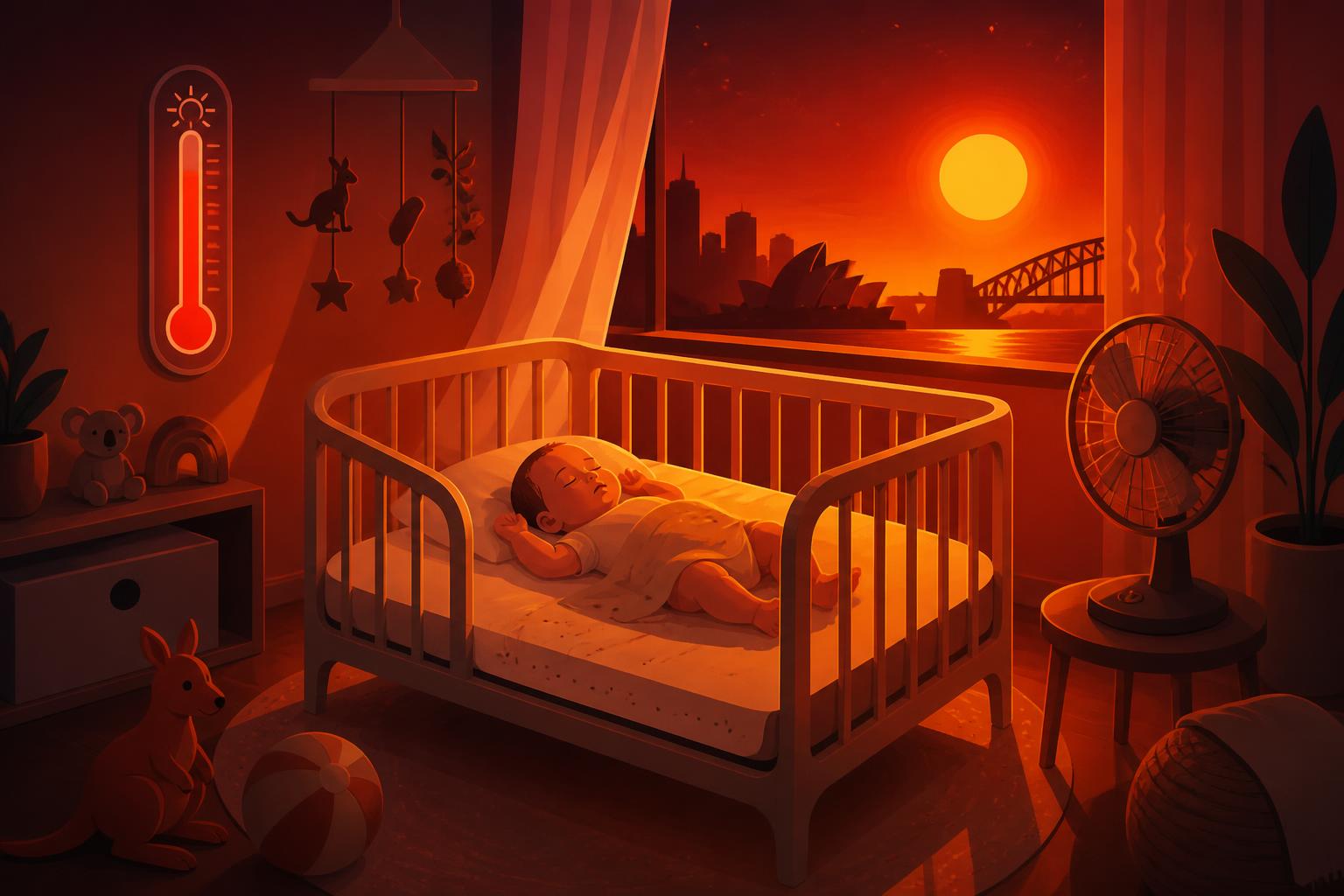
Heatwave: an Australian study warns of the increased risk of sudden infant death syndrome during suffocating nights
In Brief
- According to an Australian study published on February 12, 2025, high night temperatures are associated with an increased risk of sudden infant death syndrome, with a stronger signal from 3 months of age onward.
- Public Health France reminds in its heatwave prevention content (viewed during alert periods) that heat can quickly worsen the condition of vulnerable people, including babies, especially when it persists at night.
- Météo-France states, in a study published in June 2025, that very hot heatwave episodes are expected to become more frequent, longer, and more intense in France, making domestic prevention more central.
- Prevention relies on simple and measurable actions at home: room temperature, clothing, clear bedding, and monitoring signs of overheating.
- Stifling nights pose a specific challenge: the body recovers less well, and “comfort” mistakes (too many layers, overheating) become more likely.
The risk of sudden infant death syndrome has concerned families long before heatwaves, but heat reshuffles the cards, especially when it does not subside after sunset. An Australian study spotlighted a very concrete detail: a stifling night is not just a bad moment to endure; it can also change the risk level around the baby’s sleep. And as heatwave episodes spread, the issue ceases to be “exceptional” and becomes a routine summer topic.
At home, there is a strong temptation to “do the best possible” with improvised solutions: fan directed at the bed, fewer layers, wide-open window in the middle of the city, or conversely a room turned into a pressure cooker to avoid drafts. The problem is that babies do not negotiate with physiology: they regulate their temperature less well, and some signals (drowsiness, irritability, hot skin) may be confused with simple fatigue. The topic is not inherently anxiety-inducing; it is technical, domestic, and often hinges on a few degrees.
What the Australian Study Says About Night Heat and Sudden Infant Death Syndrome Risk
According to an Australian study cited as published on February 12, 2025, high outdoor temperatures the day before and the day of a death are associated with an increased probability of sudden infant death syndrome, with an effect particularly observed in babies aged three months or more. The alert is not “heat kills” but “heat modifies an already sensitive sleep context.” This framing matters because it puts prevention back at the center without suggesting that a heatwave episode mechanically triggers a tragedy.
The key point is night. A hot day is uncomfortable, but the night normally serves to recover, cool the home, and stabilize the body. During a stifling night, the temperature drop is delayed or does not occur. The baby can then accumulate heat, especially if the sleeping environment is too insulating (thick sleeping bag, linens, crib bumper, blanket). Usual recommendations on sudden infant death syndrome already emphasize clear bedding and sleeping on the back. With high temperatures, “clear” also becomes a thermal issue.
Why the “3 Months and Older” Age Factor Appears in the Results
The Australian study mentions a stronger signal starting at three months. This threshold is interesting because it corresponds to a phase where sleep habits evolve: some babies move more, fall asleep longer, and parents adjust the bedding to avoid awakenings. Heat then becomes a confusion factor: a sweating baby may appear “agitated” and prompt adding or removing layers in an inappropriate way.
In real life, the risk rarely increases due to a single factor. It adds up with known conditions: overheating, sharing an unsafe sleeping surface, cluttered bedding, smoking in the environment. A heatwave does not create these factors but can make them more likely because everyone sleeps less well, thinks less clearly at 3:20 a.m., and seeks the quickest solution to resettle the infant.
What the Study Does Not Say and What It Requires Checking at Home
A statistical association is not proof of a unique mechanism. However, it gives a practical direction: reduce heat exposure during sleep. This involves concrete and repeatable checks: room temperature, indirect ventilation, appropriate hydration (not forced), and light clothing. Families need a simple protocol because during a stifling night, creativity is rarely a superpower.
Note: the outdoor thermometer is not enough. Two apartments on the same floor of the same street can vary significantly depending on orientation, insulation, and whether it is top floor. The “high outdoor temperature” signal must therefore translate into “real temperature at the bed level,” because that is where exposure occurs.
Heatwave and Stifling Nights: What Heat Does to Infant Sleep (and Adult Common Sense)
A heatwave has a particularity: it breaks routines. Meals change, baths multiply, naps shift, and the baby’s room suddenly becomes a “technical” place with curtains closed during the day and windows opened at dawn. For infant health, the difficulty lies in thermoregulation: an infant dissipates heat less efficiently than an adult, and overheating can occur faster, especially when the air is still and humid.
A stifling night is also a night when adults tinker. The fan sometimes ends up directed too directly toward the bed, whereas direct airflow can cool locally or dry out without solving ambient heat. Another classic is hesitation between “no draft” and “fresh air is necessary.” Result: some homes remain closed even though outdoor temperature has dropped, or remain open while the air is still warm and urban pollution high. The baby does not vote on the strategy.
Practical Guidelines: Recognize Overheating Without Panicking
Signs of overheating can be subtle: moist neck, warm skin, redness, agitation, or conversely unusual drowsiness. The trap is interpreting these signals as “being fussy” or “just having slept poorly.” A simple check is to touch the neck and chest rather than the hands and feet, which can be misleading.
Preventive actions remain basic but must be coherent. Bedding must be firm, clear, and the baby on the back. During heat periods, clothing must be adjusted to the actual feeling in the room, not the calendar. Nights at 27 °C in the room are not managed like a “normal summer” evening at 22 °C.
Concrete Action List for a More Bearable Room During a Heatwave
- Measure the temperature at the bed level with a room thermometer, not only via a weather app.
- Darken windows during the day (shutters, blinds) and ventilate when outdoor air is cooler than indoor air.
- Avoid any unnecessary bedding: blanket, pillow, crib bumper, stuffed animals in the bed.
- Prefer light, breathable clothing, adapting the sleeping bag to the real room temperature.
- Use a fan with indirect air circulation (towards a wall), without direct airflow on the infant.
- Check the neck and chest at bedtime and during a night awakening, to adjust without overcorrecting.
This list seems simple on paper, but it avoids a common bias: compensating adults’ discomfort by modifying the baby’s bedding. During stifling nights, the priority remains sleep safety, then thermal comfort, in that order.
Videos from pediatricians and midwives about heat and sleep can help visualize proper adjustments, notably for indirect ventilation and bedding lightening, without drifting toward “tips” that contradict basic recommendations.
Prevention During a Stifling Night: Sleep Safety Gestures and Realistic Trade-offs
Prevention during heatwaves plays on two fronts: bedding safety and thermal management of the home. The first front does not vary with weather: baby on the back, on a firm mattress, no objects in the bed, and a smoke-free environment. The second front becomes more demanding when heat persists because the home can store temperature and release it at night.
Public Health France, in its content dedicated to heatwaves, emphasizes that heat can rapidly worsen the condition of fragile individuals. Infants are among the groups to protect, especially because they cannot verbalize their discomfort or adapt their environment. The challenge is to limit overheating while avoiding solutions that add risk (cluttered bed, falling asleep on a couch, etc.).
Measurable Reference Table to Adapt the Nocturnal Environment
| Element to Control | Simple Measure | Practical Objective | Common Heatwave Mistake |
|---|---|---|---|
| Room Temperature | Room thermometer at bed level | Detect real overheating and act (darkening, ventilation) | Relying only on outdoor weather |
| Ventilation | Indirect airflow (towards a wall) + airing at cool hours | Circulate air without direct draft on the baby | Fan directed at the bed |
| Clothing | Check neck/chest, adjust layer by layer | Avoid sweating and overheating | Add a blanket “just in case” |
| Bedding | Empty bed, firm mattress, back sleeping position | Reduce sleep-related risk factors | Add accessories to “prop up” the baby |
When the Home Becomes an Oven: Domestic Options and Limits
In some homes, especially under the roof, the air remains hot despite airing. A portable air conditioner can cool, but it must be used carefully: avoid directing the airflow toward the bed, maintain a stable temperature, and limit abrupt swings. Public recommendations generally emphasize the importance of a cool environment but discourage thermal shocks or direct drafts.
“Grandmother’s tricks” live on. A wet sheet on the window can help cool a little by evaporation, but it increases humidity and can give a heavy feeling. A bowl of ice cubes in front of a fan circulates air without turning the living room into a ski resort. The effect sometimes exists but does not replace daytime darkening or ventilation at the right times.
The most solid point remains anticipation: preparing the room from the afternoon, closing at the right time, reopening when outdoor air cools down, and checking the real temperature before bedtime. This routine reduces nighttime improvisations that waste time and lucidity.
Video reminders about safe bedding are useful in summer because heat sometimes pushes to change bedding. Reviewing fundamentals helps keep the bed simple, even when the weather tempts a full reorganization at 2 a.m.
Heat, Public Data, and the 2026 Outlook: Why the Risk Increase Deserves a Family Plan
The interest of an Australian study is that it forces viewing heatwaves as a concrete domestic risk, not just a weather event. In France, exposure to heat waves is a closely monitored subject. Météo-France, in a study published in June 2025, indicates that very hot heatwave periods are expected to become more frequent, longer, and more intense in the territory. This means stifling nights will not be very rare exceptions but episodes to incorporate into family organization.
Heat-related mortality also exists in French data. After the 2003 shock, prevention has strengthened, and public health messages are more visible. Public Health France maintains surveillance and communication dedicated to heatwaves, with recommendations targeting vulnerable people. For infant health, the challenge is to adapt these messages to sleep reality: a room may be “bearable” for an awake adult and become too hot for a sleeping infant, especially if the air does not circulate.
What the Family Can Plan Before Summer (and Test Before the First Heatwave)
A family plan is not an Excel spreadsheet stuck on the fridge, even if the fridge might serve as emergency air conditioning for drinks. It’s a series of cold decisions: where the baby sleeps if the room becomes too hot, how to darken windows effectively, what equipment is used, and who checks the temperature. Last-minute adjustments create errors, especially when fatigue accumulates.
A concrete and realistic example: many households test a “trial night” during the first big heat by placing the thermometer exactly where the bed is, then noting the evolution between 8 p.m. and 6 a.m. This observation avoids debates based on impressions. It also helps identify rooms that store the most heat and prepare a secure alternative bedding if needed.
The Role of Digital Tools: Useful but Not Magical
Weather apps help anticipate a hot night, but they do not replace an indoor measurement. Connected sensors can provide temperature and humidity curves, which is relevant when the home reacts strongly to sunlight. The limit is over-interpretation: a curve does not feed a baby and does not clear a bed of unnecessary objects.
Families also navigate a digital universe where cookies and data shape displayed content. Google explains on its data and privacy management page (g.co/privacytools, continuously accessible) that accepting cookies can be used to measure engagement, personalize content and ads, or improve services. In the prevention context, this matters: a search for “stifling night baby” may then push very variable sponsored content. Public health recommendations remain the most stable reference to sort through information.
The 2026 outlook is clear: if heatwaves become more frequent, prevention must become a summer habit, like sunscreen. The benefit is immediate because a better-managed room also improves adult sleep, and an adult who sleeps better makes better decisions.
Adapting Recommendations to Real Life: Common Mistakes and Validated Good Practices
Recommendations around sudden infant death syndrome are well known, but heatwaves create detours. The number one mistake is modifying bedding to “fix” the heat: adding a towel, changing the mattress, inclining the baby, or having them sleep elsewhere without an adapted surface. A stifling night tires everyone, and the temptation to “keep it simple” can lead to less safe choices. The goal is to increase thermal comfort without touching the basic rules of safe sleep.
Another trap is comparison between babies. Some sweat little, others a lot. Some fall asleep easily, others wake up at every variation. Prevention must be based on measurable markers and baby observation, not on a neighbor’s story or a 12-second video tip.
Recurring Mistakes During a Heatwave (and How to Correct Them)
The fan aimed directly at the bed returns very often. The fix is simple: direct it toward a wall to circulate air, or place it further away while keeping the bed clear. The window left open all night is another habit. In urban zones, this can maintain a high temperature if outdoor air does not cool and increase noise that fragments sleep. Targeted airing at cool hours, combined with daytime darkening, often yields better results.
“Too many layers” is a classic, especially when the adult is cold because of a draft in the hallway. Checking the neck and chest allows adjustment without relying on hands. A summer sleeping bag adapted to room temperature can simplify trade-offs because it avoids adding blankets.
What Really Helps When a Stifling Night Sets In
Effective actions are sometimes less spectacular than online hacks: reduce heat sources in the room (devices, lamps), move the bed away from a window facing the setting sun, and maintain a stable bedtime ritual. Stability matters because a baby stressed by permanent changes sleeps less well and may wake more often, increasing night interventions and improvisations.
A concrete example: during heatwaves, some parents shorten the bedtime ritual to “go faster.” The result can be the opposite, with a baby falling asleep more difficultly. Keeping a short but constant ritual (lukewarm bath, aired room, low light) helps reduce agitation and thus night handling.
The guiding thread remains prevention: act before the room is too hot, keep safe bedding, and favor simple, reversible, and measurable adjustments. This approach reduces errors born of combined fatigue and heat.
What Do We Say?
The alert from the Australian study must be taken seriously because it points to a concrete and frequent factor: night heat. The most solid strategy is to treat heatwaves as a room management issue, with thermometer, darkening, and ventilation at the right hours, without ever complicating bedding. Stifling nights justify increased vigilance on clothing and signs of overheating, especially after three months, as this is where the signal appears in the results published on February 12, 2025. Families benefit from planning a simple plan before summer because fatigue makes “good ideas” less reliable at 3 a.m.
What temperature should be aimed for in an infant’s room during a heatwave?
There is no universal value that suits all homes, but the goal is to avoid real overheating at the bed level. A room thermometer placed near the sleeping area helps decide: darken during the day, ventilate when outdoor air is cooler than indoor air, and lighten clothing if the neck and chest are hot or damp.
Is a fan recommended during a stifling night to reduce risk?
A fan can help by circulating air, especially when the heat is heavy. It is better to avoid direct airflow toward the infant. Using it with indirect ventilation (directed at a wall) limits air drafts on the bed while improving the feeling of freshness in the room.
Should windows be left open all night during a heatwave?
Opening at night can be useful only if the outdoor air is truly cooler than the indoor air. In certain urban environments, temperature remains high and noise fragments sleep. Targeted ventilation early in the morning or late in the evening, combined with daytime darkening, is often more effective for stabilizing the room.
How to dress an infant when it is very hot at night?
Clothing decisions depend on room temperature and the baby’s observation, not the date. Checking the neck and chest allows adjustment. The objective is to avoid sweating and heat buildup. A summer sleeping bag adapted to temperature can simplify because it avoids blankets, which are discouraged in the bed.
Why is increased risk mentioned from 3 months in the Australian study?
According to the Australian study published on February 12, 2025, the association between high temperatures and sudden infant death syndrome appears stronger in babies aged three months or more. This age corresponds to sleep and home habit changes, which may affect heat exposure and how bedding is adjusted during hot nights.