Jack-of-All-Trades: Game: Jack-of-all-trades for children from 1 to 3 years old.
| Short on time? Here’s the essentials ⏱️ |
|---|
| The touch-and-feel game stimulates sensory awakening, fine motor skills, and language in children from 1 to 3 years old 🎯 |
| Regular tactile exploration promotes the development of hand-eye coordination and attention 👀✋ |
| A good tactile educational toy is safe, washable, varied in textures, and offers short playful activities ✅ |
| At home, create a mystery box, a sensory bin, or a tactile wheel with everyday materials 🧺 |
| Observe progress in small steps, adjust challenges, and ritualize tidying up for autonomy 🧹 |
Between a hand-sewn texture mat and a thick-paged picture book, the touch-and-feel game transforms ordinary gestures into engines of sensory awakening. From 12 months, children learn by touching, crumpling, scratching. Then, at 3 years, they compare, sort, and name with growing confidence.
This form of exploration offers short, enjoyable, and repeated challenges. Thus, it naturally engages fine motor skills, curiosity, and language. Using simple supports or a well-designed educational toy, playful activities become springboards to overall development.
Touch-and-feel 1-3 years: proven benefits for sensory awakening and fine motor skills
The brain learns quickly when the hand discovers. Thanks to tactile exploration, children identify contrasts in temperature, weight, or texture. This sensory sorting strengthens joint attention and gaze orientation. Meanwhile, grasping sharpens through pinching, pulling, and turning.
Then, fine motor skills advance through small challenges. A tab to pull trains finger extension. A button to push works thumb strength. A screw lid calls for bilateral coordination. These micro-actions add up and create gestural ease useful at the table, dressing, and drawing.
Multimodal sensory awakening
Sensory circuits connect better when several senses cooperate. For example, touching a rough surface while naming it strengthens memory. Also, associating a soft scent with a plush fabric soothes, which facilitates exploration. Thus, the child dares and repeats without getting bored.
Large-format tactile picture books act like markers. A recent model combines clear photos and three materials per board. Thick pages turn easily. The square format (approximately 225 x 223 mm) fits well in the hand. Over 12 pages, the child points, names, and compares. This type of educational toy structures discovery.
Language and socialization
Naming a material already means categorizing. Saying “soft,” “rough,” or “sticky” helps describe the world. Also, naming an animal and its fur strengthens syntax. When an adult reformulates, the child gains precision. This routine feeds conversation and supports confidence.
In pairs, cooperation emerges. One closes their eyes and guesses. The other describes and encourages. This turn-taking enacts the group’s implicit rules. Later, at 3 years, the child explains their strategy. They justify choices and accept mistakes. Socio-emotional development solidifies.
Case study: Lina’s journey
At 16 months, Lina pulled each tab without aiming. Two weeks later, she pinched small tags better. Then she began sorting “soft / not soft.” At 24 months, she named colors and spotted pairs. Finally, at 3 years, she guided a friend in a guessing game.
This path shows the logic of touch-and-feel. First, you touch. Then, you name. Finally, you explain. Each step prepares the next. Progress remains smooth when challenges are short and repeated.
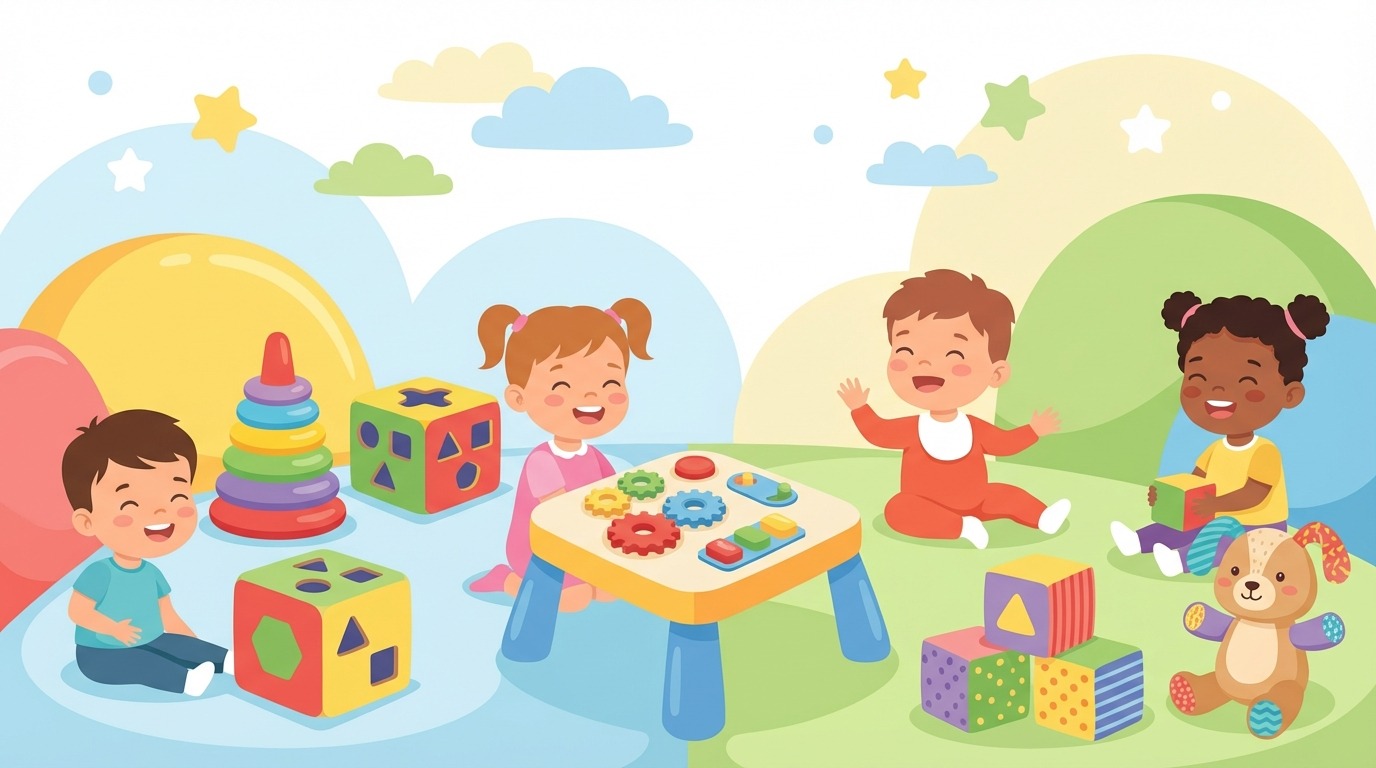
Making a Touch-and-feel game at home: playful and safe activities
Creating a homemade touch-and-feel game doesn’t require much. First, gather contrasting materials. Then, attach them securely. Finally, offer age-appropriate challenges. The goal remains sensory awakening with short, joyful interactions.
Above all, check safety. Avoid small parts. Prefer washable elements. Verify the sturdiness of fastenings. Close supervision is necessary, especially between 1 and 2 years. And of course, tidy up after each session.
Simple and safe materials
- 🧵 Squares of varied fabrics (velvet, waffle cotton, felt) for fine motor skills.
- 🧽 Sponges, silicone brushes, non-slip mats for tactile exploration.
- 🧴 Sealed sensory bottles (rice, water beads) to shake rhythmically.
- 🧲 Manipulable fasteners (Velcro, large buttons, secure clasps).
- 🧺 Opaque boxes for the “mystery bag” and guessing games.
Three workshop scenarios
1) Mystery box. The child dips their hand and describes. Then, they name the category. Then they pull out the object and check. This loop reinforces working memory. 2) Exploration bin. Fill with semolina. Add cups and spoons. The child transfers and measures. Coordination develops. 3) Tactile board. Stick six materials in a checkerboard. Ask to sort from “softest to roughest.” Touch refines.
Offer short variations. For example, time 3 minutes to find two pairs. Or close eyes to guess a material. With simple instructions, the challenge stays clear. Engagement follows naturally.
The support can evolve. At 12 months, favor wide grips. At 24 months, add openings to push or screw. Then, at 3 years, insert mini game rules. For example, “find three smooth things.” This progression nurtures development without frustration.
Organizing Touch-and-feel in daycare and at home: rituals, safety, and observation
The setting makes the difference. A floor corner, a basket of materials, and a washable mat are enough. First, announce the duration. Then, set a clear rule. Finally, praise the attempt. This triad structures attention and reassures.
A simple ritual works very well. Entrance song. Presentation of two textures. Child’s choice. Small challenge. Then guided tidying. In five to ten minutes, the session is paced. The desire to repeat grows.
Observe to guide better
Observation focuses on three markers. Is the pincer grip strengthening? Is hand-eye coordination improving? Is vocabulary growing? Note these clues once a week. Thus, adjusting challenges becomes objective.
Sensory reactions are very personal. Some avoid rough textures. Others seek deep pressure. Offer choices without forcing. Propose a gentle alternative. Respecting pace protects engagement.
Cleanliness and autonomy
Tidying is part of the game. Provide a small broom and dustpan. Invite the child to pick up spilled material. This gesture develops autonomy and responsibility. And the space stays pleasant.
Between groups, clean surfaces. Wash textile materials regularly. Label baskets by category. This simple system ensures quick and smooth resumption.
Adapt according to profiles
A very cautious child needs a gentle start. Begin with two similar textures. Then increase the contrast. Conversely, an intense seeker channels energy with sequenced instructions. The setting secures without constraining.
For neurodivergent children, provide a sequence pictogram. Add a visual timer. Reduce noise from materials. Sensory awakening is enriched by these adjustments. Everyone finds their entry point.
Choosing a Touch-and-feel educational toy in 2026: concrete criteria and useful selections
A good tactile educational toy meets three criteria. It is safe, sturdy, and relevant. Look for clear CE compliance. Prefer washable materials. Check texture variety. Thus, the item supports exploration without overwhelming.
Format matters too. Thick pages help turn without pinching. A large format stabilizes the book flat. Real photos guide vocabulary. Finally, three materials per board suffice. Attention stays focused.
Focus on tactile picture books
Recent “baby touch-and-feel” collections offer clear photos and contrasting materials. A large-format model around first words includes 12 sturdy pages. Dimensions close to 225 x 223 mm ease handling. The observed price around €14.95 remains consistent in bookstores in 2026. This choice becomes a routine pivot.
The themes vary by interest: toys, animals, clothes. Tender and clear images appeal to toddlers. Also, rounded corners and reinforced binding limit wear. The product will survive enthusiastic handling.
Complementary games to combine
Three proposals enrich the panel. The game “Where do you live?” pairs animals and habitats. The “Colors Game” adds speed and imitation. A homemade tactile wheel introduces chance. Together, these playful activities nourish cognitive flexibility.
For busy families, an animated fabric book is a gentle alternative. Lift-the-flap windows, varied textures, and a small rattle invite handling. Outdoors, it occupies without screens. And it washes easily. Hygiene stays easy to maintain.
Before buying, ask a key question. Does the game invite the child to act, compare, and name? If yes, it will support development. If not, it will remain decorative. A good tool triggers a gesture, a glance, and a word.
Tracking development with Touch-and-feel: age markers and signals to watch
Markers reassure without confining. Around 12 months, the child touches and shakes. At 18 months, they point and choose. Around 24 months, they sort two categories. Finally, at 3 years, they classify by intensity and explain. These milestones guide challenge adjustment.
To assess without pressure, observe micro-skills. Does focus time stretch? Does the dominant hand become clear? Does sensory vocabulary expand? Note three brief facts after each session. Progress appears.
Positive signs and gentle alerts
- 🌱 Expected progress: pincer grasp, more precise transfers, beginnings of verbal sorting.
- 🧩 Normal variability: marked tactile preferences, need for stable routines, long observation times.
- ⚠️ To discuss if persistent: refusal to touch various textures, very stiff gestures, little eye contact.
- 👂 Action points: reduce number of stimuli, offer a gentle alternative, accompany verbally.
- 🤝 Useful referrals: consult a professional if sensory avoidance blocks daily life.
A guideline helps adults. Remember the sequence: touch, name, explain. If a step blocks, return to the previous one. Add an easy success. Then, slightly raise the challenge. Confidence follows success.
Finally, ritualize pleasure. Play a short tune at the start. Offer a choice at the end. Praise effort with a precise phrase. The game keeps its magic, and development stays in motion.
“Little hands, big discoveries: each mastered texture opens a door to the world.”
How long should a session last?
Between 5 and 10 minutes is enough for a good impact. It’s better to have short and repeated sessions than a long workshop. This keeps attention lively and the child wanting more.
What materials should be avoided for a sensory bin?
Avoid small unsealed parts, fragile or sharp elements, and non-washable materials. Prefer safe, clean textures that are easy to rinse.
How to evolve the game at 3 years old?
Introduce simple rules: sort from softest to roughest, find three pairs, describe without looking. The child gains in logic and explanatory language.
A child refuses to touch certain textures, what to do?
Give them a choice between two reassuring alternatives. Offer gradual progression and verbalize the sensation. Respecting the pace renews exploration.
Tactile book or sensory bin: what to choose?
Both complement each other. The book structures lexicon and fine motor skills. The bin develops coordination and autonomy. Alternating maintains motivation.