Michael Olise: the role of his mother in his deep attachment to France
In Brief
- Michael Olise, born on December 12, 2001, in London, had four international options related to his nationality and roots: England, Nigeria, Algeria, and France.
- In a press conference in September 2024, the player explained that language structured family life: English with his father, French with his mother, still used daily.
- His regular stays in France during childhood strengthened a lasting attachment to French culture, beyond football.
- Olise said he has “always had a connection with the French team,” explicitly mentioning his mother’s role and a mother-son relationship strongly marked by transmission.
- In Highsnobiety in June 2026, he cited Zidane, Thierry Henry, and Ribéry as childhood references, showing that his sporting identity was built early within a French imagination.
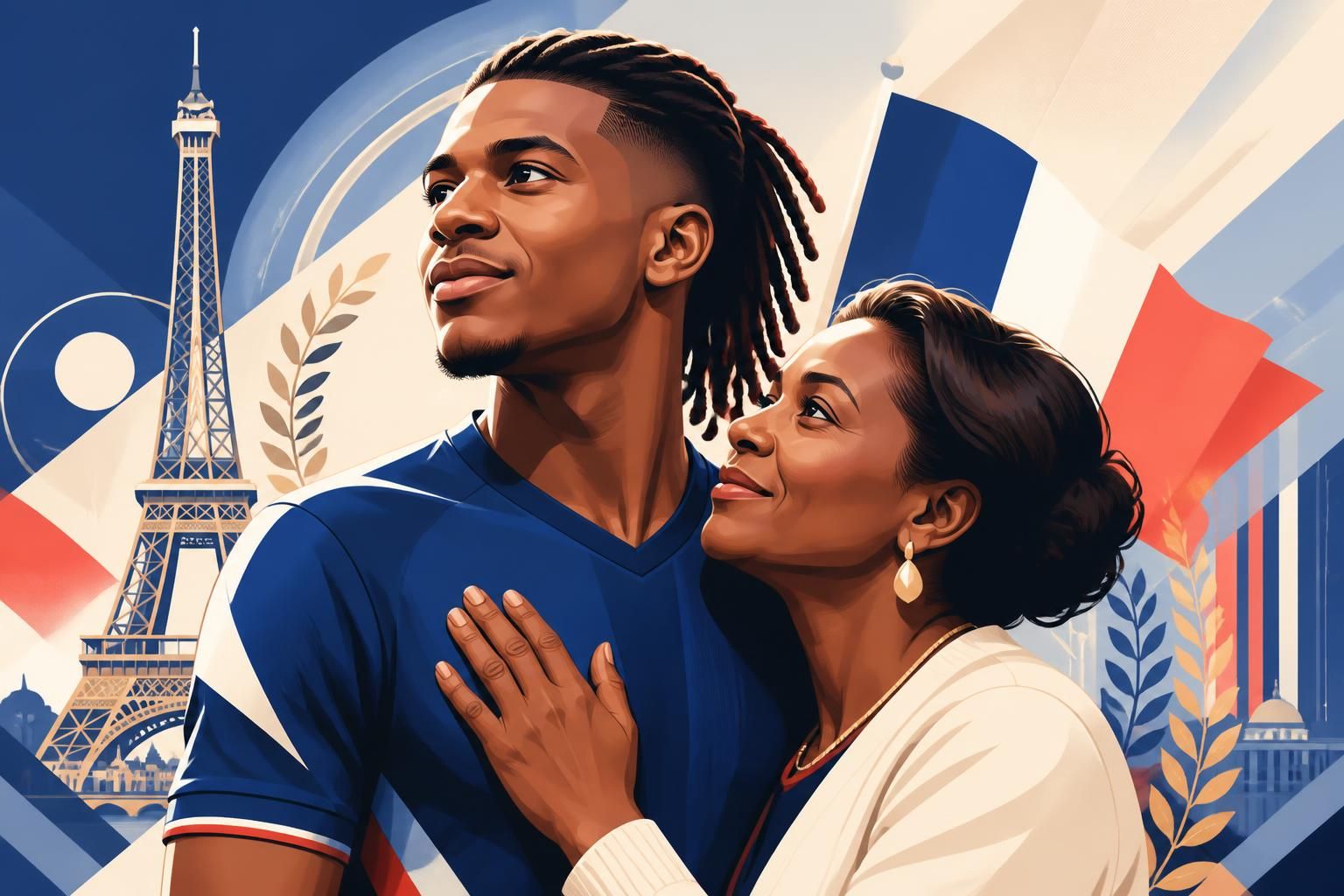
Born on December 12, 2001, in London, Michael Olise became, at 24 years old, one of the faces of the renewal of Les Bleus in the 2026 World Cup, with a path that intrigues as much as it reassures the selectors: a player trained in England, but who claims a strong emotional place for France. The subject quickly goes beyond the simple “career choice” box and turns into a story of home, languages spoken at the table, suitcases packed for holidays, and jerseys worn very early in front of the television. In this narrative, the mother occupies a central role because she anchors French culture in the routine, not only on match days.
Olise could theoretically choose among four teams, depending on his nationality and origins: England, Nigeria, Algeria, and France. Yet, when questioned about the subject at the time of his first steps with the senior team, he insisted on a simple idea: France was already part of his identity. Behind this apparent obviousness, there is a structuring family influence, a mother-son relationship shaped by language, references, and lifestyle habits that give the word “attachment” a very concrete thickness.
Michael Olise, an identity built between nationality, roots, and family daily life
The Michael Olise case is typical of a generation of footballers for whom nationality is no longer reduced to a place of birth, nor even to a passport kept in a drawer. Born in London to a Nigerian father and a Franco-Algerian mother, he is at the crossroads of several family histories, therefore of several possible affiliations. This plurality of roots does not automatically create a dilemma: it offers a framework, then experience fills in the boxes. In his case, France does not appear as an “opportunistic” option but as an emotional continuity, nourished since childhood.
What weighs most in this type of trajectory are often micro-rituals: the language spoken at home, meals, cultural references, the way the family story is told. When a child hears a language every day, he does not classify it as “heritage,” he lives it as part of his environment. This is a concrete difference: an inherited but little practiced language becomes symbolic; a language used daily becomes structuring. Here, the mother plays the role of a constant bridge, as she brings the language and a familiarity with France that settles without ceremony.
Identity, in a binational or multinational family, often looks like a wardrobe: some clothes are worn often, others remain for occasions, and no one needs to organize a meeting to decide the program. Football arrives later as a revealer, because it forces one to officially declare what until then was lived flexibly. In Olise’s case, the moment of the international choice makes visible what was already there: an old attachment, an integrated French culture, and a family influence that has given France depth over the years.
Four possible teams, but very hierarchized emotional landmarks
On paper, options existed: England (birth and training), Nigeria (father), Algeria (mother), and France (mother). In the reality of a player, the decision also relies on the relational environment: who does he speak to daily, where does he feel “at home” culturally, and which family story has been most embodied. France benefited from a discreet but solid advantage: it was present in domestic exchanges, during childhood stays, and in a sporting imagination nourished by French figures.
Plurality does not mean confusion. Many players with comparable paths rather describe an addition of landmarks, with a center of gravity that shifts according to life periods. In Olise’s case, this center of gravity seems to have been stabilized early, precisely because transmission by the mother gave continuity. This stability avoids simplistic readings: the final decision appears as the last link in a chain, not as a turn taken at the last moment.
The mother at the heart of attachment: language, French culture, and mother-son relationship
In a family where several languages coexist, the distribution is never neutral: it organizes proximity and creates automatisms. In a press conference in September 2024, Michael Olise explained a very revealing detail: English with his father, French with his mother, and exchanges that remain “practically always in French” with her. This sentence has a very concrete meaning. A language used to talk about ordinary things — tiredness, school, projects, doubts — ends up becoming the language of comfort and clarification. In this context, the mother does not only transmit vocabulary; she transmits a way of telling oneself.
French culture often transmits through simple things that never make the headlines: expressions, humor, the way of commenting on sports news, the importance given to certain holidays, or even the relationship to meals. The result is a player who can grow up in England while having a “living” France at home. Attachment is then built by repetition, like a song we end up knowing without having looked for the lyrics.
The mother-son relationship, in a sporting trajectory, has a very direct effect: it is often the person who organizes the framework, manages constraints, and maintains the link with origins when daily life accelerates. In top-level football, where everything goes fast, this link acts as continuity. This is not about romanticizing: it is a family mechanism, with its habits and discipline. A young player can change clubs, coaches, playing systems; he does not change so easily the language in which he confides at home.
French as the “language of the home,” not a media accessory
For the general public, language may seem a detail, while it influences the feeling of belonging. A player who thinks and jokes in French with his mother does not need intensive training to feel comfortable in a Francophone locker room. This also helps practically: understanding instructions, catching irony, participating in informal exchanges. In team sports, such moments often build the team feeling.
This familiarity is visible when a player speaks of France without effort to justify. Olise summed up his decision with a clear formula about his “connection” with Les Bleus. This type of formulation is not a legal argument, it is a lived observation. The importance of the mother here lies in the fact that she has made this connection daily, thus ordinary in the good sense of the term: present without being spectacular.
What strikes in this kind of sequence is rarely an isolated sentence: it is the coherence between the story and the attitude. A player may recite a prepared answer; it is more difficult to fake cultural ease over time. In Olise’s case, the place of the mother, the role of the language, and the constancy of references come back as stable elements, which makes the explanation more readable for the public.
Childhood and stays in France: how experience strengthens family influence
Cultural transmission is not limited to a language spoken in the living room. It is strengthened when the child puts images and sensations on words: a neighborhood, cousins, trips, holidays, a different way of living everyday life. In Michael Olise’s case, he explained having regularly come to France when he was young. This repetition matters because it transforms a country “of origin” into a “familiar” country. A child who has habits somewhere does not perceive that place as a distant set but as a concrete space.
These stays act as an attachment accelerator. French culture ceases to be a collection of symbols and becomes a set of experiences: hearing French everywhere, watching matches on television with different commentary, eating things that are not quite found on the other side of the Channel, observing social codes. This also shapes identity: the child learns he can be comfortable in several contexts without having to choose at every moment.
For a future top-level athlete, these details matter in the long term. When the time for decisions comes, memories serve as landmarks. A national team is not only a sporting status: it is also gatherings, transfers, discussions. Already having experience in France makes everything more natural. The mother, in this logic, does not only “tell” France; she makes it live by making these stays possible and giving them meaning.
Concrete landmarks: family, habits, and familiarity with codes
Cultural landmarks also form through interactions with extended family. Even without detailing the composition of the family circle, one fact remains: going to France often means meeting relatives, getting used to first names, accents, ways of joking. These are markers of belonging that cannot be decreed. In a sporting trajectory, they can even serve as a pressure valve: a place associated with childhood can remain a place where the player feels less like a “public object.”
There is also a very practical dimension: a young person who travels early learns to navigate between environments. This develops adaptability useful in professional football, where one constantly changes stadiums, hotels, and rhythms. This skill does not alone explain the choice of France, but it makes integration smoother because the novelty is already known in another form.
Les Bleus in the head: French idols, football culture, and construction of a sporting identity
When a player explains his attachment to a national team, the list of childhood idols is a very reliable indicator: it reveals what nourished the imagination long before career stakes. In an interview granted to Highsnobiety in June 2026, Michael Olise cited Zinedine Zidane, Thierry Henry, and Franck Ribéry as players he followed when he was young. This trio is not accidental. It crosses different eras and embodies several styles: the playmaker, the complete attacker, the explosive winger. It also outlines a very French mental landscape of football, with its gestures, narrations, and references.
The role of the mother can be read here implicitly: without regular access to French culture, these references could have been less central. Obviously, Thierry Henry also shone in the Premier League, and Zidane has worldwide influence. Nevertheless, the way of identifying with a national team is often built through what one watches at home, what one comments on, and the emotions shared during a match. In a home where French holds a strong place, the French team can become a familiar object, not an exotic choice.
The link between French culture and football is not limited to names. It encompasses collective moments, such as major competitions, discussions around selected players, or debates about playing styles. A young person growing up with these conversations acquires implicit knowledge: he knows what the jersey represents, the public’s expectations, and the way victories and defeats are told in France. For a player, this context can strengthen the desire to belong to this story.
A national team as a story shared at home
Families transmit sporting stories as they transmit recipes: by repeating, commenting, and attaching to details. The mother-son relationship, when crossed by language and culture, transforms a match into a moment of complicity. This may seem light, but it is often this lightness that remains when the career intensifies. A player can forget a score; he less easily forgets the atmosphere of a living room on a big match night.
In Olise’s case, the idea of “connection” with Les Bleus is also explained by this emotional capital. A connection does not arise when signing a paper; it arises when the child associates a team with a form of familiarity, voices, expressions, a way of rejoicing or grumbling. Football, under these conditions, becomes an extension of identity.
On the field, this imagination can also guide playing choices. A player who admired Zidane or Ribéry does not mechanically copy their gestures, but he can develop a taste for certain areas, rhythms, and risks. Childhood references do not dictate a career; they illuminate preferences, and these preferences sometimes end up resembling a style.
Choosing France in 2024: a sporting decision, but above all a continuity of family influence
When Michael Olise was called to the French senior team in 2024, the choice question became inevitable because international football works like a closing door. His public response emphasized an “old connection” with the French team, and he explicitly linked this closeness to his mother and his visits to France during childhood. The story has simple coherence: a French culture transmitted at home, regular experiences in France, and a football imagination nourished by French players.
This choice does not erase other roots. Having a Franco-Algerian mother and a Nigerian father establishes a lasting plurality, which can continue to exist in personal life even when the international career is decided. In public perception, there is sometimes an expectation of exclusive loyalty, as if choosing one team means erasing the rest. Family reality is often more flexible: origins continue to exist because they are carried by relatives, habits, memories, and an identity that is not limited to a jersey.
What makes the story interesting to the general public is that it recalls a very parental mechanism: it is repeated gestures, not grand speeches, that shape attachment. Speaking French at home, organizing stays, transmitting references, supporting during moments of doubt: these are concrete acts. Football only makes this discreet work visible at the moment when a choice must be announced.
Table: concrete factors of attachment to France in Michael Olise’s case
| Factor | Concrete Indicator | Cited Period | Expected Effect on Integration |
|---|---|---|---|
| Family Language | French spoken with mother, English with father | Mentioned in September 2024 | Ease in informal exchanges and understanding codes |
| Stays in France | Regular visits during childhood | Childhood | Familiarity with the country, concrete sense of belonging |
| Football References | Zidane, Thierry Henry, Ribéry cited as idols | Statement published in June 2026 | Sporting imagination aligned with the French team |
| Selection Choice | Claimed connection with Les Bleus | First steps in senior team in 2024 | Durable motivation, public coherence of international project |
What the story also says about binational families: decisions prepared long before
In many families, family influence is especially visible when a child becomes an adult and must formalize what he feels. The Olise case reminds us that attachment is not a switch turned on at 18. It is maintained over years, through routines and a mother-son relationship where encouragement and rigor can coexist. The “funny” side is that all this looks like an ultra-sophisticated strategy, while it is often just a mother staying her course: speaking her language, sharing her culture, and ensuring the child knows where he comes from.
Football adds a layer of visibility, therefore comments. Yet, the most solid elements are those that resist debates: a spoken language, lived stays, assumed references, and an identity built daily. Within this framework, choosing France appears as the logical continuation of a family story already well written, even if it was not meant to become public.
What do we say about it?
The decisive factor in Michael Olise’s attachment to France lies in domestic transmission: a mother who installs the French language and culture in daily life, not only in symbols. Stays in France during childhood give concrete content to this closeness, making the international choice more understandable. The claimed references to Zidane, Thierry Henry, and Ribéry confirm that sporting identity was built early within a French imagination. In this type of trajectory, coherence prevails: the 2024 decision looks more like the official confirmation of an experience than a late calculation.
Did Michael Olise really have four selection choices?
Yes, his family profile and place of birth gave him access to several teams: England (born in London), Nigeria (father), Algeria (maternal origins), and France (Franco-Algerian mother). The exact detail depends on FIFA rules and administrative situations, but the general framework of these four options is publicly presented around his case.
Why does the language spoken with the mother matter so much in this type of decision?
Because a language practiced daily structures emotions, humor, and the way of telling one’s life. Michael Olise explained in September 2024 that he spoke English with his father and French with his mother, still very regularly. In a Les Bleus locker room, this linguistic ease also facilitates off-field integration.
Does choosing France mean denying other roots?
No, a sporting choice fixes an international affiliation in official competition, but it does not erase family history. In Olise’s case, Nigerian and Algerian roots remain part of his personal identity. Plurality is lived in the family, habits, and culture, even if the national jersey is unique.
Which French references did Olise cite to explain his attachment?
In an interview published by Highsnobiety in June 2026, he mentioned Zinedine Zidane, Thierry Henry, and Franck Ribéry as players he followed when he was young. These references indicate that his football imagination was built around French figures, which strengthens the coherence of his link with Les Bleus.