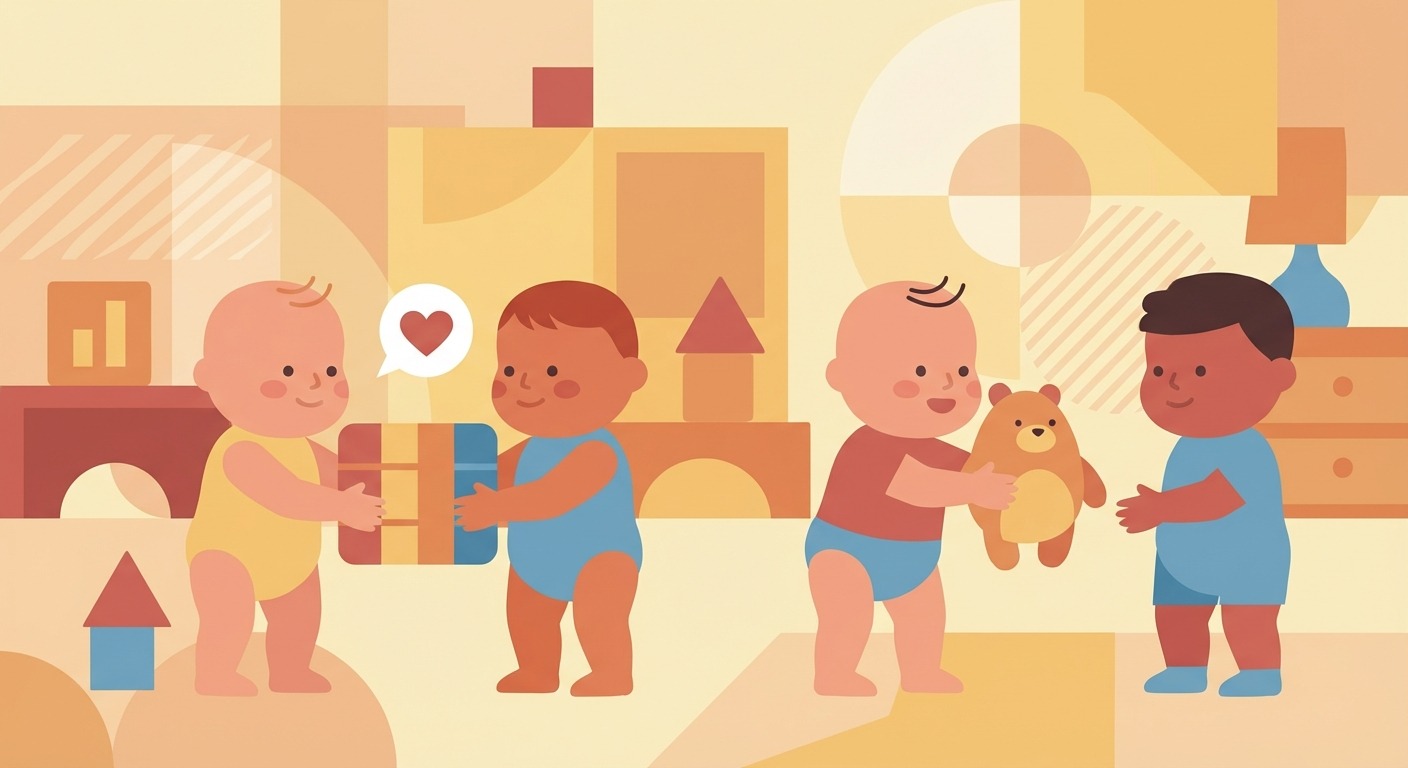
Moral Conscience : The development of moral conscience in children aged 1 to 3 years.
| Short on time? Here’s the essentials ⏱️ |
|---|
| 👶 Between 1 and 3 years old, moral consciousness arises from the reactions of adults and peers. |
| 🧭 Before age 4, the child mainly judges based on visible consequences and others’ emotions. |
| 🧩 Simple rules + consistent praise = faster moral learning. |
| 🤝 Repair is better than punishment. We learn to repair, not to feel guilty. |
| 💬 Talking about emotions from 18 months develops child empathy and child values. |
| 📚 Modeling, ritualizing, repeating = moral education aligned with social norms. |
| 🎯 At 3 years, expect simple requests, guided apologies, and some prosocial choices. |
Between 1 and 3 years, a toddler does not yet “know” if their actions are good or bad. They observe, imitate, and experiment. The reactions of close ones then guide their emerging judgment, closely linked to behavioral development and group life. This age is a delicate crossroads: immediate pleasure clashes with acceptance of the first social norms.
Within this framework, moral education takes place in micro-situations: sharing a toy, waiting for a turn, consoling a friend. Routines, simple words, and repairing wrongs lay the first stones of a solid child ethic. Child development is thus enriched with clear markers, motivated by attachment, example, and the desire to cooperate.
Moral consciousness between 1 and 3 years: foundations, markers, and models
Moral consciousness refers to the ability to consider others before acting. Between 12 and 36 months, this skill emerges step by step. It relies on imitation, emotional regulation, and repeated experience of social consequences.
Studies based on Piaget and Kohlberg illuminate this phase. The young child reasons mostly according to what happens to themselves, then gradually opens up to others’ viewpoints. Abstract reasoning will come later. Here, moral learning passes through the concrete.
Markers by age range, without rigidity
Each child progresses at their own pace. However, some milestones help guide expectations and support child empathy. Adult clarity secures the exploration ground while channeling impulsive drives.
| Age | Signs of moral conscience 😊 | Concrete examples 🧠 |
|---|---|---|
| 12-18 months | Reacts to visible emotions | Looks at a crying friend and stops ✋ |
| 18-24 months | Imitates prosocial gestures | Offers a security blanket to console 🧸 |
| 24-36 months | Follows simple rules and repairs | Returns a toy and says “sorry” with help 🤝 |
Why “consequences” outweigh “intention” before age 4
At this age, the child first understands what is seen. A broken vase, even by accident, can trigger the fear of being scolded. Conversely, a discreet transgression may seem “neutral.” Hence the importance of explaining and showing how to repair, rather than moralizing coldly.
- 🌟 State what is expected: “We step inside, throw outside.”
- 🧰 Make repairs visible: pick up, return, help to console.
- 🎯 Give a brief reason: “It hurts,” “He is sad.”
- 🔁 Repeat in various contexts to consolidate moral learning.
In the background, a character like Lina, 2 years old, illustrates these steps. When guided by visible actions, she better understands the meaning of shared “good.” This foundation prepares for more abstract reasoning in primary school.

Role of adults and environment: simple rules, strong models, calm climate
Home and daycare serve as moral laboratories. Adults structure the framework, embody values, and give meaning to social norms. A warm climate eases adherence, especially between 1 and 3 years.
Positive reinforcement and consistent framework
A predictable framework reduces conflicts. Short rules, repeated kindly, guide choices and reassure. Targeted praise strengthens prosocial behavioral development.
| Situation | Brief message ✅ | Moral effect 💡 |
|---|---|---|
| Sharing a toy | “Thanks for lending, that’s kind.” | Values cooperation 🤗 |
| Waiting for a turn | “We wait, after you it’s them.” | Establishes fairness ⏳ |
| Rough gesture | “We touch gently.” | Regulates impulsivity 👐 |
Modeling child ethics daily
Little ones copy moral postures they see. Holding the door, apologizing, repairing oneself after a clash show the way. Alignment between words and actions makes the framework credible.
- 🪞 Show by example before demanding.
- 📖 Read stories about friendship and repair.
- 🎭 Act out scenes: “Lend, ask, return.”
- 🧭 Explain why: “It protects, it reassures.”
To deepen these educational gestures, video research can inspire and equip parents and professionals.
This joyful yet firm framework allows Lina and her friends to understand what is expected of them. They then orient towards more supportive choices without fear of trying again.
Repair rather than punish: effective moral education strategies between 1 and 3 years
Repair is better than punishment. This axiom, supported by contemporary educational approaches, develops responsibility without fostering shame. The child feels like an actor, not guilty for life.
Turning fault into repair action
A blow happens too fast. Repair gives a path: check if the other is okay, find a tissue, offer an alternative. This scenario gives meaning to child values.
| Behavior | Educational response 🧩 | Why it works ✅ |
|---|---|---|
| Snatching a toy | “We return, then ask.” | Restores fairness ⚖️ |
| Pushing a peer | “We check if they are okay, offer a hug.” | Activates child empathy 💞 |
| Yelling indoors | “Inside we whisper, shout at the park after.” | Context and social norms 🏠/🏞️ |
Accessible and stable moral language
Short sentences facilitate adherence. Three keywords suffice: “kind,” “gentle,” “wait.” A stable vocabulary is easier to retain at 2 years.
- 🗣️ Short script: “We return,” “We ask,” “We wait.”
- 👂 Listen before correcting to calm the storm.
- 🔄 Repeat the same words in several places.
- 🧸 Use a “mediator” stuffed toy to symbolize repair.
Over weeks, Lina anticipates repair. She no longer fears punishment. She understands that relationships are woven and rewoven daily.
Empathy and prosocial values: nurturing care in toddlers
Child empathy emerges early. It is refined by observing faces, affective synchrony, and guided interactions. Cultivating this soil strengthens moral consciousness without waiting for school.
Activities that promote cooperation
Role-playing games, dialogical reading, and mini-missions for two encourage perspective taking. Each concrete success lays another stone in moral education.
| Activity | Moral skill 🌱 | Indicator of behavioral development 📈 |
|---|---|---|
| Turn-taking with ball | Patience, fairness | Waits without crying 10-20 s ⏳ |
| Read “we ask, we lend” | Recognition of rules | Says “please” 🙌 |
| Playing at caring for a doll | Compassion | Caresses after distress 💗 |
Naming emotions to guide child ethics
By naming “angry,” “sad,” “happy,” adults help the child link action and feeling. This affective bond structures a simple yet powerful judgment: do good, avoid harm.
- 🧠 Describe what is seen: “Tears are falling.”
- 👃 Recall the body: “Your heart beats fast, we breathe.”
- 💞 Value care: “You comforted them, well done.”
- 🧭 Recall the framework: “Here, we speak softly.”
A short video exploration complements these practices and inspires other cooperative games suitable for 2-3 year olds.
By combining activities, simple language, and rituals, the seed of cooperation sprouts faster. Morality becomes a daily, joyful, and shareable experience.
At 3 years: concrete milestones, gentle warning signs, and digital world
At 3 years, the child recognizes contexts. They understand that one can shout at the park but whisper in the library. This emerging flexibility signals the establishment of first social norms.
What to expect at 3 years
Without demanding the impossible, some benchmarks guide observation. The goal remains progress, not perfection. Adults mostly assess the drive towards others.
| Expected at 3 years 🎯 | Support to provide 🛠️ | Norms in play 🧭 |
|---|---|---|
| Ask before taking | Games of “ask/return” | Respect for others 🤝 |
| Guided apologies | Script “sorry + repair” | Repair rather than punishment 🩹 |
| Wait a short turn | Hourglasses, waiting songs | Justice and patience ⏳ |
When to worry… and how to support
Some signs deserve attention if they persist and intensify. The idea is not to label but to support earlier.
- 🚩 Repeated indifference to others’ distress.
- 🚩 Frequent aggression without possible soothing.
- 🚩 No sensitivity to framework despite stable rules.
- 👩⚕️ Seek professional advice if doubt persists.
2025 context: screens, diversity, and coherence
Digital content can help if it remains co-viewed, short, and interactive. Prosocial models from books and videos reinforce lived messages. Coherence between home and daycare speeds up moral learning.
- 📺 Co-view and comment on emotions seen on screen.
- 🌍 Value family and cultural diversity.
- 🔁 Coordinate among adults for identical rules.
- 🧭 Recall common values: respect, gentleness, mutual aid.
At 3 years, the child already links context and behavior. With aligned surroundings, they choose care more often, and cooperation becomes their compass.
“Moral consciousness is born from a repeated gesture, a right word, and a look that shows the way.”
{“@context”:”https://schema.org”,”@type”:”FAQPage”,”mainEntity”:[{“@type”:”Question”,”name”:”How to react if my child hits another child?”,”acceptedAnswer”:{“@type”:”Answer”,”text”:”Hold the hand, name the emotion (“you are angry”), then guide a concrete repair: check the other’s state, offer a tissue, return the object. Remind the short rule (“we touch gently”) and praise the repair.”}},{“@type”:”Question”,”name”:”Is it serious if my child doesn’t want to share at 2 years?”,”acceptedAnswer”:{“@type”:”Answer”,”text”:”No. At this age, sharing is built. Offer very short turn-taking, duplicate objects, and praise each attempt. The goal is the drive towards the other, not permanent sharing.”}},{“@type”:”Question”,”name”:”Should punishment be used before 4 years for the rule to be understood?”,”acceptedAnswer”:{“@type”:”Answer”,”text”:”Repair is more effective. It shows what to do after a mistake and avoids shame. Simple, stable rules and precise praise better reinforce understanding.”}},{“@type”:”Question”,”name”:”How to integrate screens without harming moral education?”,”acceptedAnswer”:{“@type”:”Answer”,”text”:”Watch short prosocial sequences together, comment on emotions, then reenact the scene. Avoid screen/child isolation and favor real interaction.”}},{“@type”:”Question”,”name”:”What words to use to ease understanding?”,”acceptedAnswer”:{“@type”:”Answer”,”text”:”Prefer short and consistent scripts: “we ask,” “we return,” “we wait,” “we speak softly.” Repetitions in several contexts consolidate learning.”}}]}How to react if my child hits another child?
Hold the hand, name the emotion (“you are angry”), then guide a concrete repair: check the other’s state, offer a tissue, return the object. Remind the short rule (“we touch gently”) and praise the repair.
Is it serious if my child doesn’t want to share at 2 years?
No. At this age, sharing is built. Offer very short turn-taking, duplicate objects, and praise each attempt. The goal is the drive towards the other, not permanent sharing.
Should punishment be used before 4 years for the rule to be understood?
Repair is more effective. It shows what to do after a mistake and avoids shame. Simple, stable rules and precise praise better reinforce understanding.
How to integrate screens without harming moral education?
Watch short prosocial sequences together, comment on emotions, then reenact the scene. Avoid screen/child isolation and favor real interaction.
What words to use to ease understanding?
Prefer short and consistent scripts: “we ask,” “we return,” “we wait,” “we speak softly.” Repetitions in several contexts consolidate learning.