Rhyming Fun: Game for making rhymes with children aged 3 to 5 years.
| Short on time? Here’s the essential ⏱️ |
|---|
| Objective 🎯: develop phonological awareness through rhymes to strengthen learning to read and write in children aged 3 to 5 years. |
| Format 🧩: short sessions of 15 to 20 minutes, for a total of about 3 h 30 over several days. |
| Method 🗣️: oral games, educational game like rhyme bingo, nursery rhymes and image manipulation to link words, rhythm and meaning. |
| Skills 🧠: listening, auditory memory, attention, creativity, pleasure of linguistic entertainment. |
| Inclusive ♿: effective for preschool, early elementary, and adapted for DYS children or those with language difficulties. |
Playing with rhymes transforms language into a playground of sounds. Between ages 3 and 5, the ear develops, the rhythm settles, and the words come alive like pieces of music. A simple educational game then triggers a cascade of learning: discriminating sounds, associating images, constructing meaning, then trying writing with a finger on a sand table. The advantage is twofold: everything is light for the child, yet powerful for their learning.
In many classrooms and living rooms, the same observation comes up: rhymes are a springboard. They offer initial support to enter the correspondences between sounds and letters, then encourage reading nursery rhymes again and again. Sessions benefit from staying short, dynamic, and joyful. A realistic program fits into blocks of 15 to 20 minutes, totaling about 3 h 30 of exploration, to support the children’s attention and establish bold automatisms, without pressure or overload.
Rhyme game 3-5 years: a decisive lever for language and emerging reading
At 3 years old, the child understands that words can “sound the same.” At 5 years old, they enjoy creating them, sometimes inventing words that don’t exist but rhyme correctly. This pleasure in sonic entertainment is no accident. It nourishes phonological awareness, the foundation of reading. Spotting a rhyme means isolating the sound ending of a word and comparing it to another. This practice trains the ear to cut, bring closer, then anticipate sounds.
When Léa, 4 years old, hears “boat,” she manages to point to “castle” and “coat.” She can’t read yet, yet she builds a key skill: detecting phonological families. Tomorrow, this same child will use this clue to decipher similar words she will encounter in a book. Experience shows that a well-led educational game of rhymes results in measurable progress in phonemic awareness, attention, and verbal creativity.
Phonological awareness and word structure
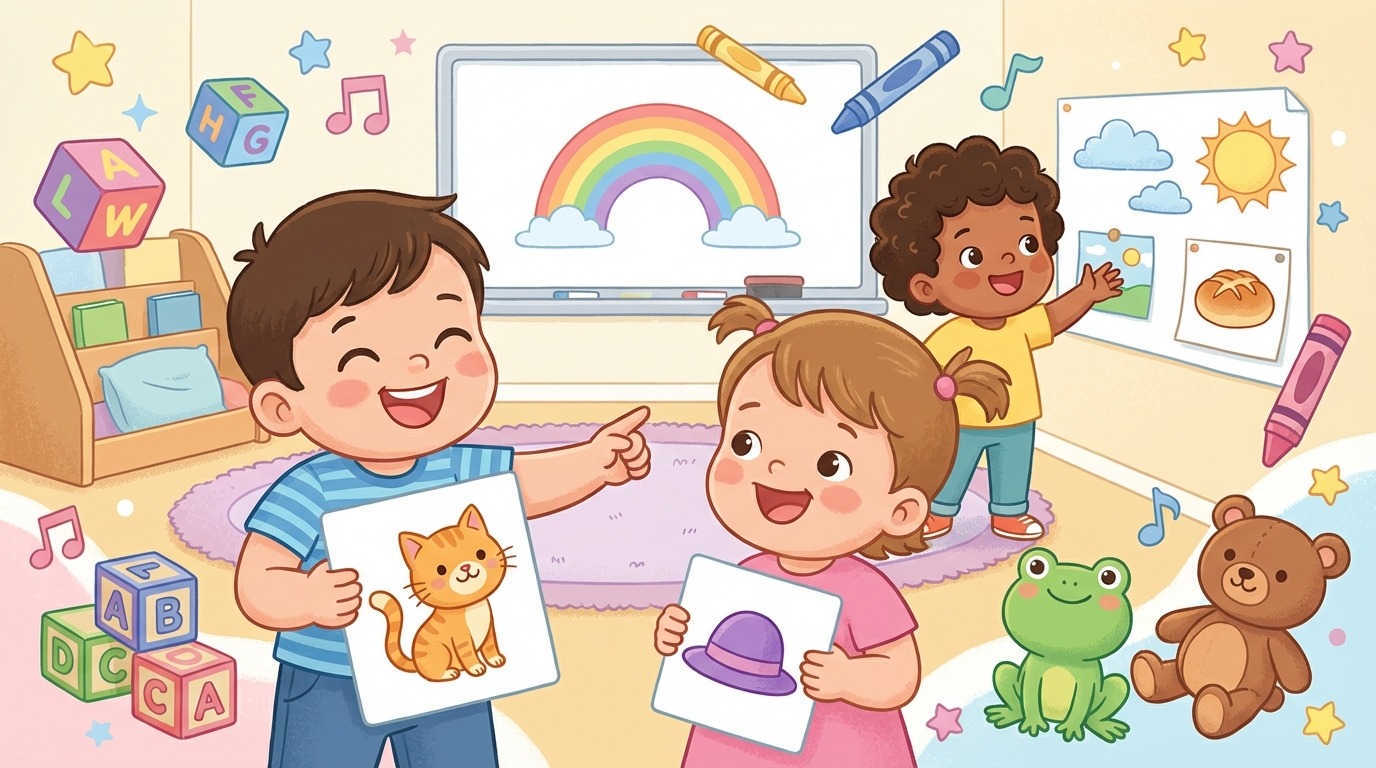
Rhymes serve as a concrete entry into word structure. The child discovers that their name, their friends’ names, and everyday objects obey sound regularities. Targeted activities reinforce this discovery: grouping images that rhyme, clapping when a word “sounds the same,” or sorting word cards by families. These simple gestures fix the concept in the body and ear.
Gradually, the student also manipulates syllables, then initial sounds. This passage from global to precise prepares the grapheme-phoneme correspondence. The link is not theoretical. It is observed when the child dictates a birthday card and draws a boat next to the word “gift,” because these words “belong together at the sound level.”
Emerging reading and writing: skills that light up
Rhymes boost interest in writing. In the workshop, a “rhyme post-it” corner invites sticking images in pairs. Another corner proposes labeling a block construction: “bridge” and “giraffling” don’t have the same ending, and this observation triggers a rich discussion. By mastering these micro-tasks, the child develops the ability to organize ideas and communicate. They gain pride that reactivates motivation session after session.
This dynamic is strengthened with audio supports. Nursery rhymes and children’s songs offer ideal material. Their rhythm, their rich or adequate rhymes, and their recurring refrains sculpt the ear. The child surprises themselves by anticipating the end of a line. This anticipation confirms they spot sound regularities and understand what will rhyme with what.
In short, the rhyme game installs robust auditory landmarks. It consolidates the understanding of oral language, then serves as a bridge to writing, with a smile.
Rhyme bingo and easy activities: user guide at home and in class
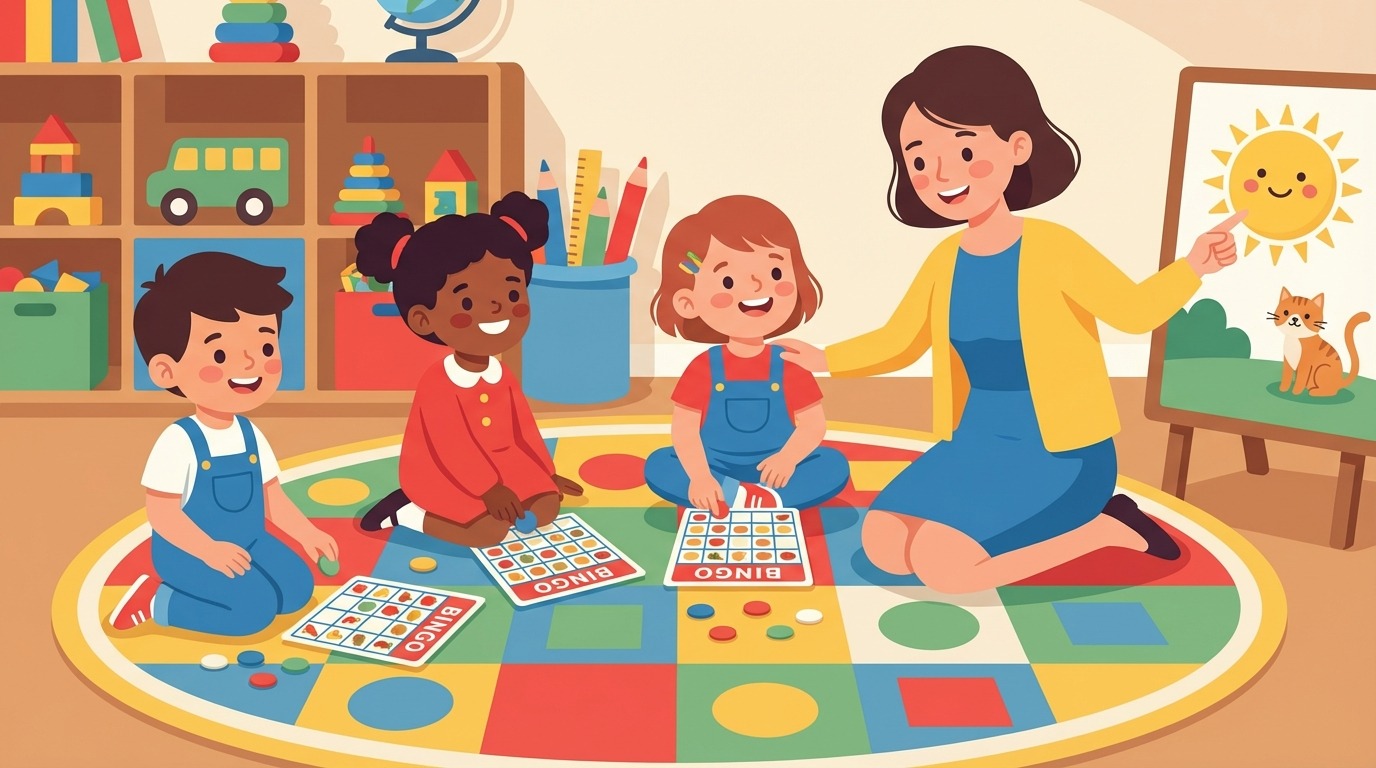
Rhyme bingo is an extremely accessible educational game. The principle: one illustrated board per child, and a pack of word cards. The adult draws a card and announces the word. The children look for an image that rhymes and mark it. The first to complete their grid wins. This simple mechanic fits at home, in preschool, or in speech therapy.
No prerequisite is necessary. The child who cannot read relies on drawings. The child at 5 years old who begins to decode can read the card. This double level maintains the heterogeneous engagement of a group. The animation remains lively: quick rounds, short response times, and continuous drawing. The pleasure comes from rhythmic repetition and surprise at each card.
Prepare the material without constraint
To start, a set of 24 word cards is enough. We include frequent, concrete, and illustrated words: cat, boat, mill, coat, bucket, piano, cake, hat. Boards include six to nine images. A erasable marker makes handles reusable when boards are laminated. Depending on time, add two bonus boards to vary rhyme families and avoid boredom.
A drawer of “creative supports” enriches the setup: envelopes, labels, colored paper, crayons, stickers. After the game, each draws a new word card and slips it into the pack. This co-creation increases motivation and nourishes creativity.
Simple rules, playful variations
Variations sustain interest. Cooperative mode: the whole table wins if all grids are marked before the pack ends. Mystery mode: the adult mimes the word instead of saying it; the child guesses, then searches for the rhyme. “Echo” variation: repeat the word loudly then whisper it, to enhance fine listening. “Fast” variation: set a 20-second timer to stimulate attention.
Class scenario: four pairs, each with a board. A leader rotates each round. The leader role develops oral ease, polite turns, and self-control. Then the written record is made: collages in pairs on a “rhyme families” display.
Link rhymes to nursery rhymes and the body
The link with nursery rhymes is precious. The same game can be restarted with a known song. Snap fingers on the rhyme, gently tap foot on the attack syllable. The child feels the rhythm and memorizes better. This motor approach also benefits more kinesthetic students. It creates a sound signature that anchors learning in pleasure.
For parents and professionals alike, a short example video helps visualize the support posture: clear voice, brief instructions, valuing attempts and positive prompts.
Progression over 3 h 30: 15–20 minute sessions for truly effective rhythm
A preschooler’s attention span demands short sessions. Blocks of 15 to 20 minutes, repeated over one to two weeks, allow time to tame sounds, without fatigue. A total of about 3 h 30 builds a solid and measurable foundation. The red thread: from oral to written, from collective to autonomy, from simple to combined.
A typical progression mobilizes three axes: rhyme spotting, visual and sound sorting, then playful production. Each session begins with a 60-second ritual: two rhymes to guess, a breath, a musical wink. This ritual prepares the ear and announces the day’s challenge. The teacher or parent notes a short observation to track evolution.
Precise sequencing and objectives
| Session | Key objective | Examples and tips |
|---|---|---|
| 1️⃣ Discovery | Hear identical endings | Game “do I hear the same?” with images 🖼️; clap 👏 on the rhyme; value listening. |
| 2️⃣ Sorting | Group by families | Rhyme baskets: -eau, -ou, -on; gestures for each family ✋. |
| 3️⃣ Bingo | Match heard word and image | Short rounds; hourglass ⏳; oral feedback “why does this rhyme?” |
| 4️⃣ Production | Invent rhymes | Invent a “funny” word that rhymes; draw ✏️; tell a story. |
| 5️⃣ Emerging reading | Link sound and letter | Simple labels; spot endings; writing corner 📝. |
| 6️⃣ Reinvestment | Play independently | Mini game tour; daily word leader 🌟. |
This framework adapts: Nora, 3 years old, stays on the first two sessions, while Milo, at 5 years old, loves producing rhymes and drawing them. Differentiation comes from image choice and pace. A logbook groups three criteria: listening, sorting, production. At cycle end, a mini sound party reactivates the desire to play again.
Light micro-assessments
Measure without stress, it’s possible. Three quick questions suffice: “What rhymes with ‘cake’?”, “Which images go together?”, “Can you invent a word that rhymes with ‘hat’?”. Each tests a specific skill. A green, orange, red smiley visualizes the child’s feeling and closes the session. We stay in a progression dynamic, never sanction.
The essential boils down to one sentence: steady rhythm, short rituals, and pleasure in rhymes transform repetition into lasting success.
Montessori, speech therapy and DYS adaptations: truly inclusive rhyme games
Montessori and speech therapy approaches converge on one point: the importance of gesture, choice, and self-correction. The “rhyme board” presents two families to sort, with a simple visual error check. The child progresses alone, tests, corrects, then explains. This autonomy nurtures attention and perseverance. For DYS profiles, we favor clear visual support, strong contrasts, and limited cognitive load per step.
Speech therapy emphasizes sound precision. Games like “listen-repeat-match” reinforce auditory memory. Short, highly illustrated words chosen from daily life help anchor. Ambiguous pairs are avoided at first. Once the mechanic is understood, less obvious rhymes are introduced to maintain the challenge. The principle remains playful, never heavy-school-like.
Concrete advice for all profiles
For families welcoming a new baby, additional steps sometimes occupy the mind. Better to equip with reliable resources to keep a clear head during the game. A guide on the maternity checklist facilitates daily organization. For formalities, the pregnancy declaration and its stages are well detailed, including this concise version. In case of health questions, educational content exists on vaginal discharge, bleeding during pregnancy trimesters, or groin pain. Finally, playful tools like the certificate of good habits promote positive routines, useful before or after a rhyme session.
Inclusion is won in details: legible font, generous spacing, immediate validation of correct answers. A simple pictogram on each rhyme family helps the youngest find their way without the adult. This accessibility strengthens confidence, a condition for lasting learning.
A second video will show concrete adaptations: progression of difficulty, contrasted supports, and short but warm instructions.
Conclusion of this inclusive part: one golden rule suffices, “make visible what the ear hears,” so that every child finds their entry door.
Idea box: 10 mini rhyme games combining creativity, rhythm, and entertainment
When variety sets in, the desire to play does not fade. Here are ten proposals to keep the spark alive, to mix according to the day’s energy and age. Each idea links words, rhythm, and images while staying short to preserve attention. Oral variants suitable for stroller or car rides complement “table” formats. All adapt to 3 years old and enrich at 5 years old.
- 🎲 Express bingo: only 6 squares, two rounds; ideal to warm up the ear at session start.
- 🎤 Micro-poet: one child proposes a word, the group responds in chorus with two rhymes; the leader validates.
- 🧺 Sound baskets: three baskets, three families; “feed” the right basket with matching images.
- 👂 Whisper echo: say the word loudly then whisper it; choose an image that rhymes; great for shy children.
- 🖼️ Rhyme gallery: display pairs on a wall; “hello rhyme” ritual during the line pass.
- 🧠 Rhyme memo: 12 cards in memory; turn two cards that rhyme; keep the pair if correct.
- 🏃 Sound relay: run to place the card in the right family’s hoop; welcome energy release.
- 🎵 Fill-in-the-blank nursery rhyme: sing a line, leave rhyme blank, child completes; wonderful for confidence.
- ✏️ Dictionary of invented rhymes: draw an imaginary word that rhymes and give it a funny function.
- 📦 Mystery box: touch an object in a box and invent a rhyme with its name; multisensory mobilization.
A common thread can spice up the week: “the -eau family” Monday, “the -ou family” Wednesday, “the -on family” Friday. Each “family” receives a color and a gesture. Over the days, the child recognizes the sound and visual signature. This smart repetition structures memory without boring. In class, a corner “I drop my rhyme of the day” feeds a living exhibition.
Last practical tip: prepare a mini travel box with 20 cards and an erasable marker. Fifteen minutes suffice to restart the game at a restaurant or waiting room. Language stays alive everywhere, and learning follows naturally.
Track progress and keep momentum: observation, feedback, and links with other domains
Observing is already teaching. During games, the adult notes three indicators: attention, rhyme spotting, production. Each indicator gets a brief note, for example “solid spotting on -eau.” This quick follow-up makes advances visible. It allows adjusting difficulty from the next session. The child gains confidence because their successes are made explicit.
Feedback remains warm and precise. Saying “you found ‘hat’ because it ends like ‘boat,’ well done for listening to the end of the word” reinforces the listening strategy. The child can mime this “end” with their hand to memorize the gesture. Peer cooperation also contributes to self-regulation: role of leader, checker, hourglass keeper.
Link rhymes to other learning
Rhymes radiate toward vocabulary, syntax, and oral comprehension. In a book, we track the “twin word” that rhymes with a key term on the page. In a writing corner, we create a simple label: “coat” near the cloakroom, “hat” near the dress-up corner. These concrete anchors unite image, sound, and use. They set class or home landmarks that reassure the youngest.
Cultural dimension counts. Nursery rhyme repertoires promote transmission. We pick according to seasons, holidays, class themes. Very short poems, recited ritually, give a sound color to the day. This color nourishes pleasure, thus motivation, thus consolidation of skills.
Minute checklist and organizational tips
A mini reminder before each session guarantees efficiency:
- 🗂️ 10 to 24 ready word cards, mixed in difficulty.
- ⏳ Hourglass and written game rules in 2 lines.
- 🎶 A starter nursery rhyme and a gesture per rhyme family.
- 📝 Observation notebook with three simple criteria.
- 😊 A congratulation ritual: “rhyme of the day” or sticker.
When organization is smooth, animation becomes light. And when animation is light, the child learns better without noticing. Such is the virtuous circle of rhymes in preschool and at home.
{“@context”:”https://schema.org”,”@type”:”FAQPage”,”mainEntity”:[{“@type”:”Question”,”name”:”Combien de temps dure une bonne su00e9ance de rimes ?”,”acceptedAnswer”:{“@type”:”Answer”,”text”:”Entre 15 et 20 minutes suffisent. Trois u00e0 quatre su00e9ances par semaine, sur une u00e0 deux semaines, mu00e8nent u00e0 environ 3 h 30 de pratique, un format optimal pour maintenir lu2019attention et installer des automatismes.”}},{“@type”:”Question”,”name”:”Faut-il savoir lire pour jouer au bingo des rimes ?”,”acceptedAnswer”:{“@type”:”Answer”,”text”:”Non. Les images guident les plus jeunes. Les enfants de 5 ans qui commencent u00e0 du00e9chiffrer peuvent lire les cartes. Le jeu reste inclusif et motivant dans les deux cas.”}},{“@type”:”Question”,”name”:”Comment aider un enfant en difficultu00e9 de langage ?”,”acceptedAnswer”:{“@type”:”Answer”,”text”:”Limiter la charge: peu de cartes, images tru00e8s claires, gestes associu00e9s, consignes bru00e8ves et ru00e9pu00e9tu00e9es. Valoriser chaque tentative et utiliser des comptines u00e0 rimes marquu00e9es pour ancrer lu2019u00e9coute.”}},{“@type”:”Question”,”name”:”Quels mots choisir au du00e9part ?”,”acceptedAnswer”:{“@type”:”Answer”,”text”:”Des mots courts, concrets et fru00e9quents: chat, rat, bateau, manteau, seau, chapeau, piano. u00c9viter les paires ambiguu00ebs au du00e9but, puis complexifier progressivement.”}},{“@type”:”Question”,”name”:”Peut-on jouer sans matu00e9riel imprimu00e9 ?”,”acceptedAnswer”:{“@type”:”Answer”,”text”:”Oui. Dites un mot u00e0 voix haute et demandez une rime. En promenade ou en voiture, ce jeu oral rapide maintient lu2019entrau00eenement et la joie du2019apprendre.”}}]}How long does a good rhyme session last?
15 to 20 minutes suffices. Three to four sessions per week, over one to two weeks, lead to about 3 h 30 of practice, an optimal format to maintain attention and install automatisms.
Do you need to know how to read to play rhyme bingo?
No. Images guide the youngest. Children aged 5 who start decoding can read the cards. The game remains inclusive and motivating in both cases.
How to help a child with language difficulties?
Limit the load: few cards, very clear images, associated gestures, brief and repeated instructions. Value every attempt and use nursery rhymes with marked rhymes to anchor listening.
Which words to choose at the start?
Short, concrete, and frequent words: cat, rat, boat, coat, bucket, hat, piano. Avoid ambiguous pairs at first, then progressively complexify.
Can you play without printed material?
Yes. Say a word aloud and ask for a rhyme. On a walk or in a car, this quick oral game maintains training and the joy of learning.
“Rhymes are sound steps: with each step, the child climbs toward reading with a smile.”
- 🧠 Choose concrete and visual words: cat, bucket, piano, cake; only one new sound per session.
- 🎶 Rhythm the listening: clapping, whispering, gestures; mark the rhyme to make it memorable.
- 🧩 Break down: 10 to 15 cards at start; gradually add according to group energy.
- 🖍️ Leave a trace: pair collages, drawings of invented words, “rhyme of the day” label.
- 🤝 Vary roles: leader, rhyme referee, hourglass keeper; engagement stays high.
For families welcoming a new baby, additional steps sometimes occupy the mind. Better to equip with reliable resources to keep a clear head during the game. A guide on the maternity checklist facilitates daily organization. For formalities, the pregnancy declaration and its stages are well detailed, including this concise version. In case of health questions, educational content exists on vaginal discharge, bleeding during pregnancy trimesters, or groin pain. Finally, playful tools like the certificate of good habits promote positive routines, useful before or after a rhyme session.
Inclusion is won in details: legible font, generous spacing, immediate validation of correct answers. A simple pictogram on each rhyme family helps the youngest find their way without the adult. This accessibility strengthens confidence, a condition for lasting learning.
A second video will show concrete adaptations: progression of difficulty, contrasted supports, and short but warm instructions.
Conclusion of this inclusive part: one golden rule suffices, “make visible what the ear hears,” so that every child finds their entry door.
Idea box: 10 mini rhyme games combining creativity, rhythm, and entertainment
When variety sets in, the desire to play does not fade. Here are ten proposals to keep the spark alive, to mix according to the day’s energy and age. Each idea links words, rhythm, and images while staying short to preserve attention. Oral variants suitable for stroller or car rides complement “table” formats. All adapt to 3 years old and enrich at 5 years old.
- 🎲 Express bingo: only 6 squares, two rounds; ideal to warm up the ear at session start.
- 🎤 Micro-poet: one child proposes a word, the group responds in chorus with two rhymes; the leader validates.
- 🧺 Sound baskets: three baskets, three families; “feed” the right basket with matching images.
- 👂 Whisper echo: say the word loudly then whisper it; choose an image that rhymes; great for shy children.
- 🖼️ Rhyme gallery: display pairs on a wall; “hello rhyme” ritual during the line pass.
- 🧠 Rhyme memo: 12 cards in memory; turn two cards that rhyme; keep the pair if correct.
- 🏃 Sound relay: run to place the card in the right family’s hoop; welcome energy release.
- 🎵 Fill-in-the-blank nursery rhyme: sing a line, leave rhyme blank, child completes; wonderful for confidence.
- ✏️ Dictionary of invented rhymes: draw an imaginary word that rhymes and give it a funny function.
- 📦 Mystery box: touch an object in a box and invent a rhyme with its name; multisensory mobilization.
A common thread can spice up the week: “the -eau family” Monday, “the -ou family” Wednesday, “the -on family” Friday. Each “family” receives a color and a gesture. Over the days, the child recognizes the sound and visual signature. This smart repetition structures memory without boring. In class, a corner “I drop my rhyme of the day” feeds a living exhibition.
Last practical tip: prepare a mini travel box with 20 cards and an erasable marker. Fifteen minutes suffice to restart the game at a restaurant or waiting room. Language stays alive everywhere, and learning follows naturally.
Track progress and keep momentum: observation, feedback, and links with other domains
Observing is already teaching. During games, the adult notes three indicators: attention, rhyme spotting, production. Each indicator gets a brief note, for example “solid spotting on -eau.” This quick follow-up makes advances visible. It allows adjusting difficulty from the next session. The child gains confidence because their successes are made explicit.
Feedback remains warm and precise. Saying “you found ‘hat’ because it ends like ‘boat,’ well done for listening to the end of the word” reinforces the listening strategy. The child can mime this “end” with their hand to memorize the gesture. Peer cooperation also contributes to self-regulation: role of leader, checker, hourglass keeper.
Link rhymes to other learning
Rhymes radiate toward vocabulary, syntax, and oral comprehension. In a book, we track the “twin word” that rhymes with a key term on the page. In a writing corner, we create a simple label: “coat” near the cloakroom, “hat” near the dress-up corner. These concrete anchors unite image, sound, and use. They set class or home landmarks that reassure the youngest.
Cultural dimension counts. Nursery rhyme repertoires promote transmission. We pick according to seasons, holidays, class themes. Very short poems, recited ritually, give a sound color to the day. This color nourishes pleasure, thus motivation, thus consolidation of skills.
Minute checklist and organizational tips
A mini reminder before each session guarantees efficiency:
- 🗂️ 10 to 24 ready word cards, mixed in difficulty.
- ⏳ Hourglass and written game rules in 2 lines.
- 🎶 A starter nursery rhyme and a gesture per rhyme family.
- 📝 Observation notebook with three simple criteria.
- 😊 A congratulation ritual: “rhyme of the day” or sticker.
When organization is smooth, animation becomes light. And when animation is light, the child learns better without noticing. Such is the virtuous circle of rhymes in preschool and at home.
{“@context”:”https://schema.org”,”@type”:”FAQPage”,”mainEntity”:[{“@type”:”Question”,”name”:”Combien de temps dure une bonne su00e9ance de rimes ?”,”acceptedAnswer”:{“@type”:”Answer”,”text”:”Entre 15 et 20 minutes suffisent. Trois u00e0 quatre su00e9ances par semaine, sur une u00e0 deux semaines, mu00e8nent u00e0 environ 3 h 30 de pratique, un format optimal pour maintenir lu2019attention et installer des automatismes.”}},{“@type”:”Question”,”name”:”Faut-il savoir lire pour jouer au bingo des rimes ?”,”acceptedAnswer”:{“@type”:”Answer”,”text”:”Non. Les images guident les plus jeunes. Les enfants de 5 ans qui commencent u00e0 du00e9chiffrer peuvent lire les cartes. Le jeu reste inclusif et motivant dans les deux cas.”}},{“@type”:”Question”,”name”:”Comment aider un enfant en difficultu00e9 de langage ?”,”acceptedAnswer”:{“@type”:”Answer”,”text”:”Limiter la charge: peu de cartes, images tru00e8s claires, gestes associu00e9s, consignes bru00e8ves et ru00e9pu00e9tu00e9es. Valoriser chaque tentative et utiliser des comptines u00e0 rimes marquu00e9es pour ancrer lu2019u00e9coute.”}},{“@type”:”Question”,”name”:”Quels mots choisir au du00e9part ?”,”acceptedAnswer”:{“@type”:”Answer”,”text”:”Des mots courts, concrets et fru00e9quents: chat, rat, bateau, manteau, seau, chapeau, piano. u00c9viter les paires ambiguu00ebs au du00e9but, puis complexifier progressivement.”}},{“@type”:”Question”,”name”:”Peut-on jouer sans matu00e9riel imprimu00e9 ?”,”acceptedAnswer”:{“@type”:”Answer”,”text”:”Oui. Dites un mot u00e0 voix haute et demandez une rime. En promenade ou en voiture, ce jeu oral rapide maintient lu2019entrau00eenement et la joie du2019apprendre.”}}]}How long does a good rhyme session last?
15 to 20 minutes suffices. Three to four sessions per week, over one to two weeks, lead to about 3 h 30 of practice, an optimal format to maintain attention and install automatisms.
Do you need to know how to read to play rhyme bingo?
No. Images guide the youngest. Children aged 5 who start decoding can read the cards. The game remains inclusive and motivating in both cases.
How to help a child with language difficulties?
Limit the load: few cards, very clear images, associated gestures, brief and repeated instructions. Value every attempt and use nursery rhymes with marked rhymes to anchor listening.
Which words to choose at the start?
Short, concrete, and frequent words: cat, rat, boat, coat, bucket, hat, piano. Avoid ambiguous pairs at first, then progressively complexify.
Can you play without printed material?
Yes. Say a word aloud and ask for a rhyme. On a walk or in a car, this quick oral game maintains training and the joy of learning.
“Rhymes are sound steps: with each step, the child climbs toward reading with a smile.”