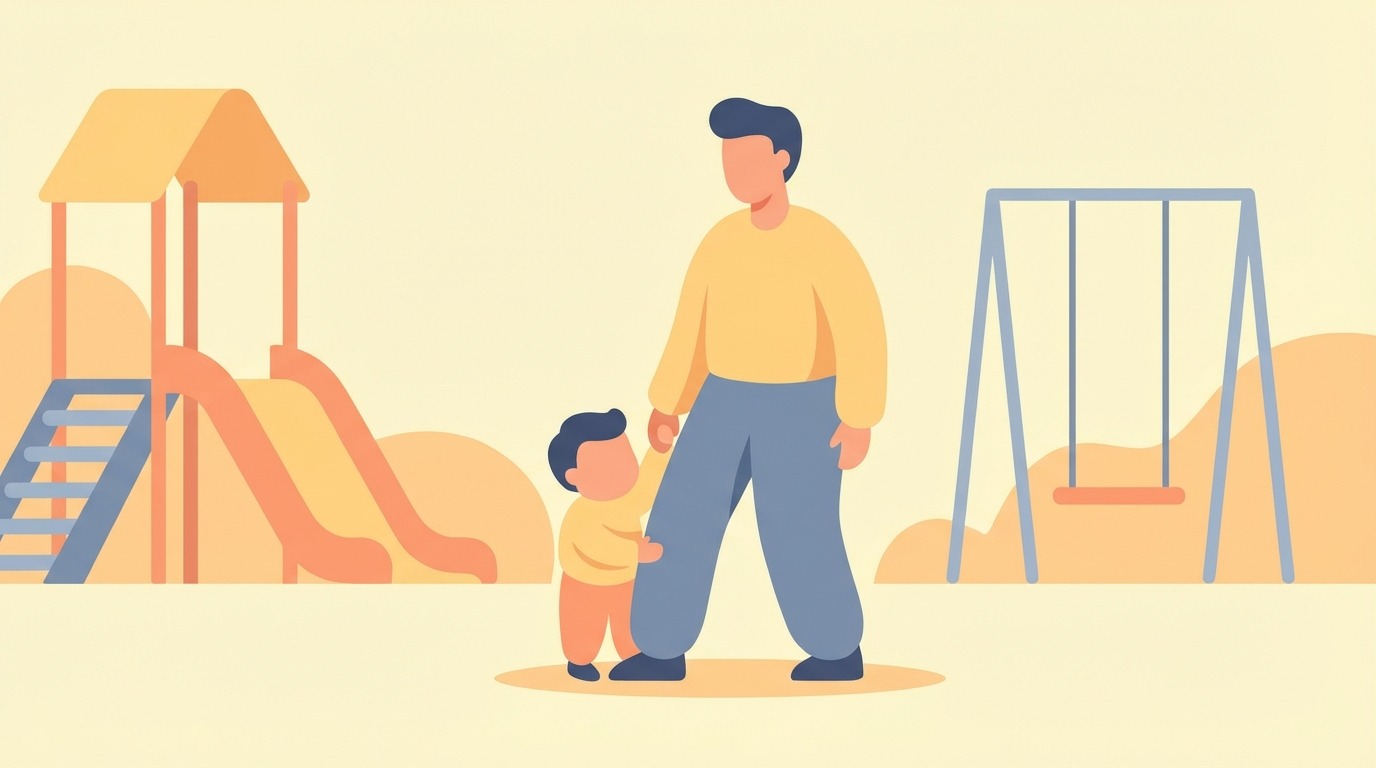
Shy Child: Helping a shy child aged 1 to 3 overcome shyness.
| Short on time? Here is the essential ✨ |
|---|
| Childhood shyness is not a flaw. It is a relational pace to gently tame 🤝 |
| For a shy child 1-3 years old, securing routines and naming baby emotions paves the way 🌱 |
| Favoring one-on-one meetings and games with simple rules promotes baby socialization 🧩 |
| Daily micro-victories nourish child self-confidence 💪 |
| Coordinating parents and early childhood professionals helps to overcome shyness without rushing 🚀 |
Shyness in toddlers, often visible between 1 and 3 years old, is neither a fear of others nor a lack of interest. It rather resembles a voluntary slowdown before entering social interaction. This observation time protects the child, but it can also limit explorations. For the adult, the challenge is clear: provide a secure framework, pace positive experiences, and multiply opportunities for success. Thus, child self-confidence grows without pressure.
These early years are crucial for emotional development. Routines, role-playing, stories, and guided meetings become powerful levers. When the adult names baby emotions, the child better understands what is happening inside. And when concrete activities mark the week, baby socialization naturally takes its place. With detailed guidelines, simple scenarios, and concrete landmarks, it becomes possible to provide tailored, respectful, and effective help for shy children.
Understanding shyness in 1-3 year olds to act better
Shyness is defined by a relational apprehension, often discreet, that slows engagement in a social situation. In a shy child 1-3 years old, this translates into prolonged observation, an evasive look, or a clear need to anticipate. The goal is not to avoid, but to check that the context is safe. This mechanism acts as a shield, especially in new environments.
Contrary to popular belief, shyness does not equate to a lack of interest in others. Many shy children enjoy company, but in small doses. They appreciate duos, parallel play, and gentle transitions. This apparent slowness announces future stronger engagement, if the adult respects this tempo and proposes progressive steps rather than an immediate crowd immersion.
Signs that alert without alarming
Some signs recur: withdrawal when arriving at daycare, refusal to say hello, body pressed against the adult, or silence when addressed. These isolated signs are not sufficient to conclude. However, a cluster of signs, lasting over time and disturbing daily life, invites structuring support. Observing how the child behaves at the park, at home, and at the nanny clarifies the situation.
Two stories illustrate these nuances. Lucie, 2 years old, watched the games in the playground for a long time before joining the sandbox. After three visits, she began to lend her shovel. Her pace was respected. Victor, 3 years old, lowered his head and refused to speak to adults outside the family. By ritualizing the welcome, naming his emotions, and creating small social missions, he progressed step by step.
Common causes and action levers
Shyness can be influenced by temperament, early experiences, or the quality of the environment. A noisy or unpredictable setting strengthens it. Conversely, a stable daily life often reduces it. Care policies evolve and encourage gentler transitions between family and institutions. To better understand these changes and adjust the child’s path, it is useful to explore the references offered on the evolutions of young child care.
To anchor concrete landmarks, a clear resource on the link between early relationships and social skills can help. Practical references are available on children’s social development, with useful insights for these early years.
Differentiating shyness from other difficulties
Shyness eases when the child is secure, prepared, and supported. If avoidance becomes generalized, prevents usual activities, or frequent crises occur, professional advice will be relevant. Landmarks designed for preschool environments offer targeted ideas to help a shy child in a preschool context. These strategies are also suitable for 2-3 year olds in group care.
Useful interim conclusion: understanding shyness means recognizing a unique relational rhythm. By respecting this tempo, the adult opens doors rather than forcing passages.
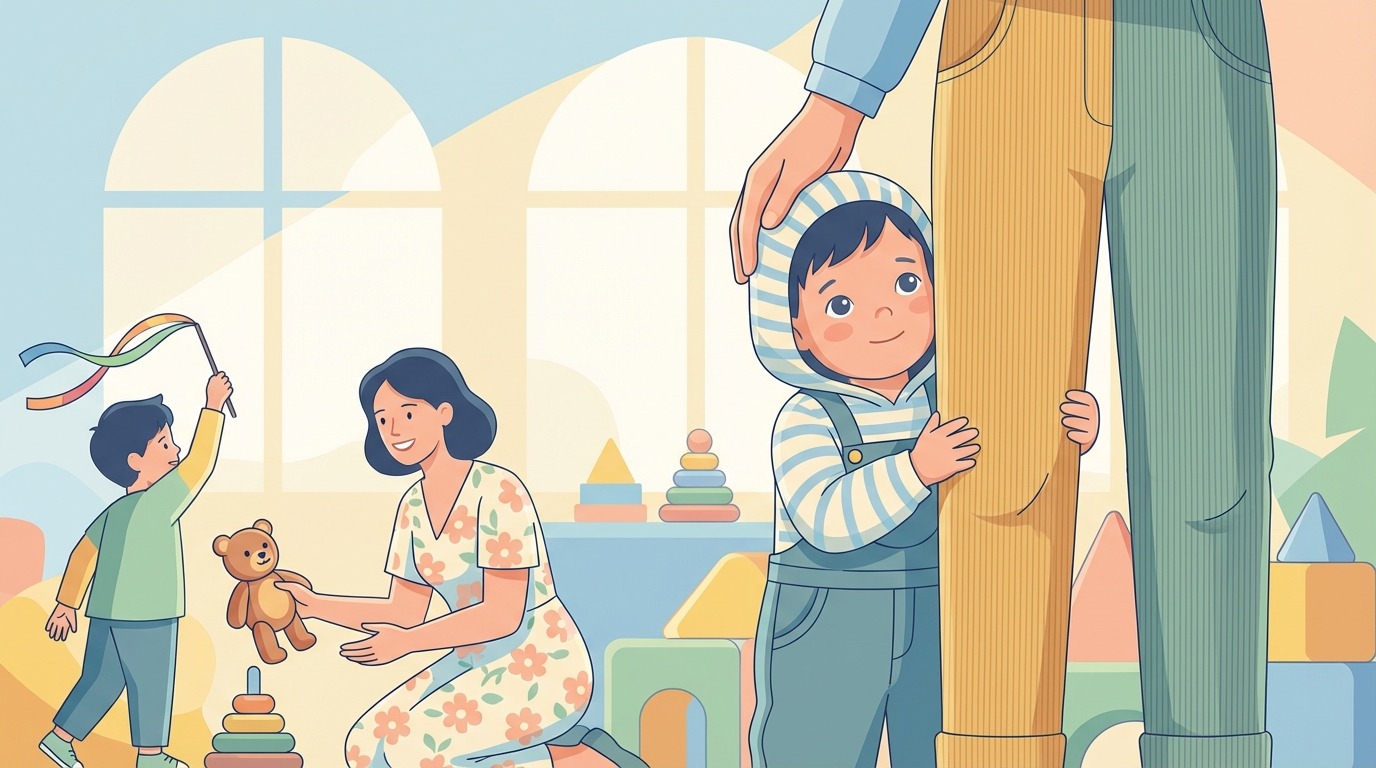
Create a secure cocoon: routines, emotions, and first successes
Before seeking external solutions, securing the daily environment transforms the trajectory. Between 1 and 3 years old, predictability calms internal alarm. A daycare arrival ritual, a symbolic goodbye, then a familiar little game before joining others soothe the child. This passage allows them to dare.
Naming baby emotions structures thinking. Saying “You want to watch first, that’s normal” reduces tension. Adding “When you’re ready, we’ll say hello together” offers a positive exit. The child feels understood. They gain control over the situation. Child self-confidence takes root this way.
Micro-challenges, maxi-effects
Daily micro-challenges create a snowball effect. The child sticks a sticker on their coat after saying “hi” to the educator. They place a car on the shared track and retrieve it after a turn. These simple scenes encourage without overstimulation. Successes multiply when the adult emphasizes effort rather than performance.
A challenge chart is not necessary at this age. A courage badge box suffices. You slip in a sticker, a smiling stamp, or a shiny pebble found at the park. This ritual materializes the day’s boldness and strengthens continuity from one week to the next.
Material atmosphere and games within reach
A calm space, familiar toys, and a “refuge” zone where the child can observe without being solicited facilitate entering the group. Creative activities in pairs reassure because they offer a specific goal. To fuel these times at home, simple ideas can be found in creative activities to do at home. When the weather complicates outings, resources for activities on rainy days keep relational dynamics going.
Long-distance connections can also support social interaction without pressure. A short video call with a relative, a “show your teddy” game, or a sound hide-and-seek familiarize the child with others’ voices and faces. Fun ideas are among distance games with relatives.
Practical checklist to anchor
- 🗓️ Clear morning and evening routines, with only one change at a time.
- 🧸 Comfort object available during transitions.
- 🗣️ Simple words to name emotion and need (“You observe”, “You want to try”).
- 🎯 One social micro-challenge per day, adapted to the mood.
- 👏 A specific child encouragement for effort (“You whispered hi, well done”).
Main idea: the more reassuring the environment, the more the child dares to explore. Security is not the enemy of boldness; it is its source.
Progressive socialization: from reassuring duo to small group
Baby socialization benefits from starting in a familiar setting. Offering a meeting at home with a single peer reduces social complexity. The living room reassures, toys are familiar, and the adult frames the exchange. The shy child discovers the pleasure of being with a peer, without unnecessary fuss. This success prepares the next step.
Then extending to a mini-group of three children opens a higher level of social interaction. Roles diversify, turns organize, frustrations are negotiated. The adult guides the flow (“yours, mine”), verbalizes intentions, and reminds rules. This brief and positive verbal piloting smooths exchanges.
Relationship rituals that work
Three rituals prove effective. The “hello duo” where the child says hello with the adult, the “host’s mission” where they show a toy, and the “bridge game” that gathers everyone (e.g. fitting, stacking, rolling). These rituals reduce uncertainty. The shy child knows what to do, and the other understands how to connect without pushing.
When going outside, a familiar landmark helps. Bringing a small bag of already known games to the park or a friend’s house creates this reassuring continuity. Introducing only one new game per meeting avoids overload. Progress becomes observable session after session.
Graduated steps to overcome shyness
A typical four-week progression often works. Week 1: duo meeting at home for 30 minutes. Week 2: same place, same duo, 45 minutes with cooperative play. Week 3: a third child joins the meeting for 30 minutes. Week 4: same trio, but in neutral territory. At each step, a clear micro-challenge structures the session and a calm time concludes.
This rhythm meets 1-3 year olds’ needs. It establishes landmarks that normalize peer presence. Day-to-day differences do not pose problems. The important thing remains the overall direction and the quality of support.
Landmarks for parents and professionals
Linking these practices to the main lines of emotional development consolidates the approach. One can deepen social and emotional milestones with this file on social development. Advice applied to preschool is transferable, with tact, to 2-3 year olds. Several useful suggestions are here: supporting shyness in preschool.
To complete, a video selection helps visualize simple scenes. It will be useful before organizing a bridge game at home.
Important reminder: socialization is built like a ramp, not a diving board. Momentum comes from shared pleasure and a series of small victories.
Speak, play, tell: communication as a superpower
Between 1 and 3 years old, language emerges, gestures refine, and stories structure imagination. For a shy child 1-3 years old, these tools become bridges to others. Role-plays set a clear, repeatable scenario. The child knows who is who, what will happen, and how to act. Uncertainty decreases. The desire to try grows.
A simple device has proven effective: three puppets, a short scene, a single problem. “The little bear doesn’t dare say hello. He watches. He waves. Then he whispers hello.” The adult shows; the child imitates. The tone varies. Success is celebrated. This sequence, repeated in different contexts, feeds child self-confidence.
Stories and imagination to tame novelty
Albums about daycare arrival, separations, or first friends act as mental rehearsals. After reading, the adult asks two open questions: “What does the character feel?” and “What will he try next?”. At this age, a few words are enough. The seed is planted. Inventing an alternative ending together turns the child into the author of their solution.
In some toddlers, the imaginary friend appears. This fictional companion serves as a reassuring interface. Used with tact, it can help verbalize fears and test social roles. Useful landmarks can be found in this guide on the imaginary friend in children. The goal is not to dismiss it but to use it as a relational springboard.
Concrete games that smooth social interaction
Three categories gain by alternating. Parallel games (building side by side), very simple cooperative games (pushing a car in turns), and presentation games (showing, naming, passing). Each category develops a different social skill. The dosage depends on the day’s energy.
These proposals gain effectiveness with playful supports. To broaden the repertoire, practical ideas of creative activities at home offer easy-to-reproduce scenarios. They energize exchanges without generating competition.
Strengthening the social voice step by step
A three-step sequence structures progress. Step 1, the body speaks: show, mime, wave. Step 2, the voice attempts: whisper a keyword (“hello”, “your turn”). Step 3, the sentence settles: combine gesture and words. Over four weeks, the difference is visible. Adults measure progress by spontaneous initiatives count.
A visual aid can inspire new role plays. Searching for ideas in video will illustrate a realistic progression, from gesture to word.
Key takeaway: playing means rehearsing the future safely. The shy child trains courage while having fun.
Coordinating parents and professionals: the winning duo to overcome shyness
Adult coherence speeds up progress. When the family and care team share the same direction, the child receives aligned messages. A brief meeting, a communication notebook, and a joint micro-challenge plan make the difference. This coordination reduces misunderstandings, especially during sensitive transitions.
Care facilities evolve and offer useful arrangements: gradual adaptation, stable reference, calm corner. Better understanding these advances helps to ask the right questions during appointments. Recent landmarks are presented in the evolution of early childhood care. Families find ideas there to personalize morning arrival and separation.
4-week action plan
Week 1, focus on security. Goal: ritualized welcome, comfort object, duo meeting at home. Indicator: less clinging time to adult. Week 2, focus on guided participation. Goal: one bridge game per day in care, one vocal micro-challenge (“hi”). Indicator: two social initiatives observed.
Week 3, focus on extended socialization. Goal: mini-group of three children, very simple cooperative game, calm ending time. Indicator: 50% of the session spent near peers. Week 4, focus on adjusted autonomy. Goal: spontaneous hello in a known context, park outing with a peer. Indicator: smile or gesture initiating play without prompting.
Evaluate without labeling
Avoid using “shy” as a permanent identifier reassures the child. Value behavior, not the label. Formulations like “You observed first” or “You waited your turn” steer narration toward progress. Sparse use of compliments strengthens their value. Specific encouragements for efforts guide better than general praise.
If doubts persist, professional advice proves valuable. Resources adapted to preschool can inspire arrangements for 2-3 year olds as well: ways to help a shy child. Families benefit from co-constructed support, respecting tempo and temperament.
Final key message: a clear alliance, a simple plan, and concrete indicators give the child the opportunity to dare, at their own pace.
Smart tools and bonus ideas to nurture confidence daily
Some well-chosen tools facilitate help for shy children. A “courage” bag accompanies the child during outings. It contains a familiar book, a figurine, and a “hello” gesture card. A visual clock, even handmade, makes transitions readable. A photo corner of friends and daycare professionals helps fix faces in emotional memory.
On gloomy days, proposals of games and activities for rainy days maintain social continuity. At home, brief manual activities suggested in this range of creative ideas nurture expression and mutual aid within the family. Remote times with grandparents, inspired by these games with relatives, support the relationship when physical meetings are rare.
“3 Rs” routine for child self-confidence
Reassure. Slow down. Repeat. This triptych makes boldness likely. Reassure with simple words and a shared look. Slow the pace to allow initiative to arise. Repeat the winning scenario in different places. These three gestures, embodied day after day, transform reserve into a springboard.
A final systematic resource consolidates everything: a success notebook. You note a micro-victory per day, with a drawing or sticker. Rereading this notebook before a new step reminds the brain that the child has already succeeded. They remember. They dare.
“Not yet” culture
When a child does not dare, saying “not yet” changes perspective. This word sets a trajectory. It removes the pressure of “now” and creates a near future where the child will succeed. This “not yet” culture aligns the language of parents and professionals. It erases failure. It values effort. It opens the way forward.
Ultimate synthesis: daily life becomes a discreet training ground. Tools do not replace the relationship; they amplify it.
“Shyness is not a wall, it is a door that opens when you know where to place your hand.”
{“@context”:”https://schema.org”,”@type”:”FAQPage”,”mainEntity”:[{“@type”:”Question”,”name”:”How to encourage without putting pressure?”,”acceptedAnswer”:{“@type”:”Answer”,”text”:”Offer one single social micro-challenge per day, value the specific effort (“You said hi”), and offer an escape route. Avoid public injunctions and prefer brief and repeated rituals.”}},{“@type”:”Question”,”name”:”Which games to choose for a shy child 1-3 years old?”,”acceptedAnswer”:{“@type”:”Answer”,”text”:”Favor parallel games, very simple cooperative games, and role-play games with puppets. Alternate categories according to the day’s energy, in short sessions.”}},{“@type”:”Question”,”name”:”My child does not talk to adults, is it worrying?”,”acceptedAnswer”:{“@type”:”Answer”,”text”:”If they speak in familiar contexts and progress with rituals, the tempo is respected. If avoidance extends and disrupts daily life, professional advice will help adjust support.”}},{“@type”:”Question”,”name”:”Should we avoid saying the child is shy?”,”acceptedAnswer”:{“@type”:”Answer”,”text”:”Yes, avoid the label. Rather describe what the child does (“You observe first”). Confidence is nurtured by valuing initiative, not supposed identity.”}},{“@type”:”Question”,”name”:”How to prepare a serene daycare entry?”,”acceptedAnswer”:{“@type”:”Answer”,”text”:”Plan progressive adaptation, name emotions, keep a stable goodbye ritual, and coordinate a simple plan with the care team. Gentle transitions favor socialization.”}}]}How to encourage without putting pressure?
Offer one single social micro-challenge per day, value the specific effort (“You said hi”), and offer an escape route. Avoid public injunctions and prefer brief and repeated rituals.
Which games to choose for a shy child 1-3 years old?
Favor parallel games, very simple cooperative games, and role-play games with puppets. Alternate categories according to the day’s energy, in short sessions.
My child does not talk to adults, is it worrying?
If they speak in familiar contexts and progress with rituals, the tempo is respected. If avoidance extends and disrupts daily life, professional advice will help adjust support.
Should we avoid saying the child is shy?
Yes, avoid the label. Rather describe what the child does (“You observe first”). Confidence is nurtured by valuing initiative, not supposed identity.
How to prepare a serene daycare entry?
Plan progressive adaptation, name emotions, keep a stable goodbye ritual, and coordinate a simple plan with the care team. Gentle transitions favor socialization.