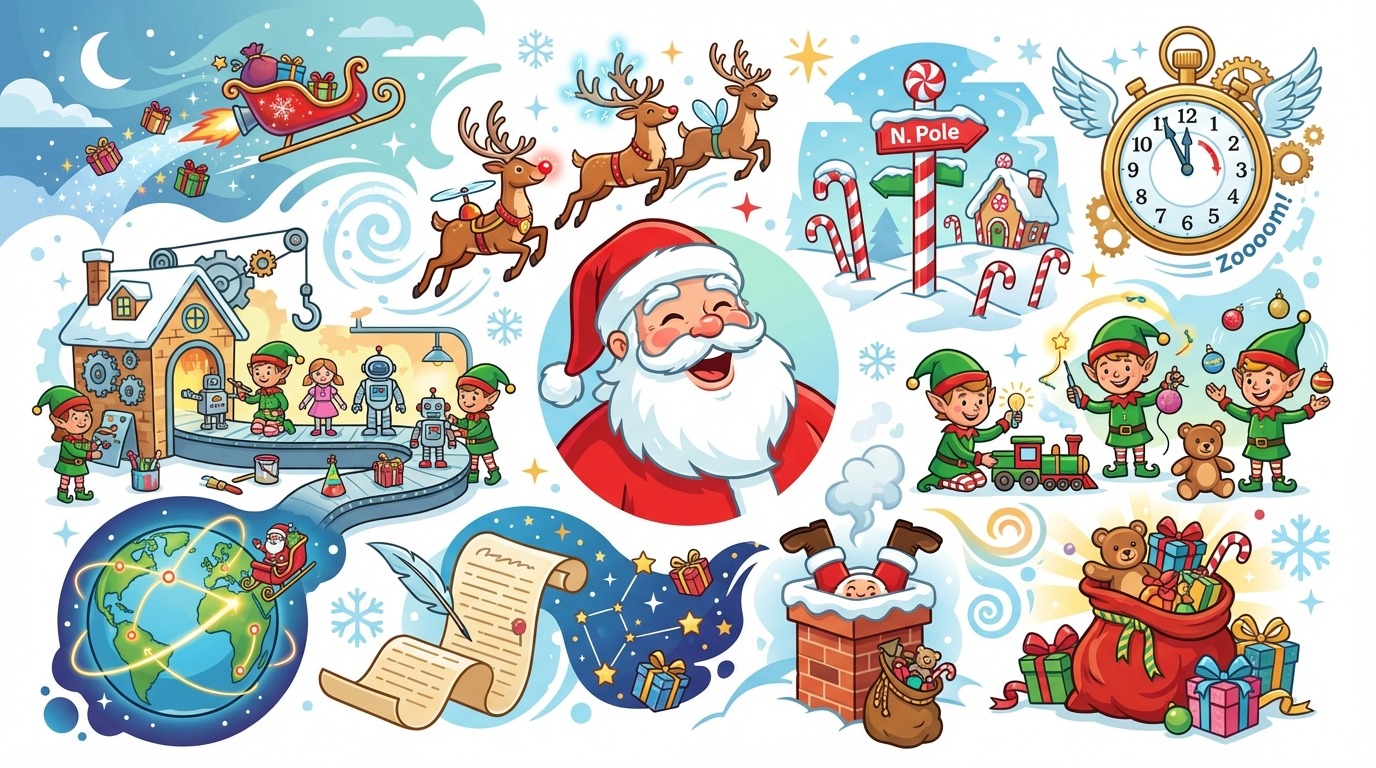
Ten amazing things to know about Santa Claus
Between traditions, legends, and popular culture, Santa Claus still fascinates children… and adults. Behind the white beard and the red coat lies a rich heritage, made up of stories from Europe, American adaptations, and family customs passed down with tenderness. This figure brings people together, inspires generosity, and invites the creation of reassuring rituals for the youngest. Through surprising facts, concrete examples, and practical ideas, this file explores what magic says about our values and the ways we awaken curiosity while protecting the sensitivity of little ones.
The holiday season also brings together surprising symbols: December 25th chosen much later, a name inherited from Latin, a fir tree with pagan roots, not to mention the famous yule log of old that warmed hearths. So many elements that illuminate the place of Santa Claus in a broader calendar, one of regained light, sharing, and family memory. For parents, these markers become educational support points. They offer stories to tell, activities to prepare, and simple rituals to repeat, helping each child to master waiting, surprise, and empathy.
| In Brief ✨ |
|---|
| 🎅 Santa Claus is inspired by Saint Nicholas and European traditions. |
| 🗓️ December 25th is not the historical date of Jesus’ birth. |
| 🌟 “Noël” comes from natalis, the Latin word for “birth.” |
| 🌲 The fir tree has pagan roots linked to the winter solstice. |
| 🛷 The modern image also comes from artists and advertisements of the 20th century. |
| 🎁 Gifts recall the presents of the Magi to the baby Jesus. |
| 🔥 The yule log was originally a real log protecting the hearth. |
| 🍷 Mulled wine warms winter markets in Europe. |
| 🌍 Traditions vary according to countries and climates. |
| 👶 Magic is built gently thanks to family rituals. |
Santa Claus: origins and transformations of a popular myth
At the starting point, a 4th-century bishop, Nicholas of Myra, known for his generosity towards the most vulnerable. Stories say he slipped purses through windows to help families in need. This reputation nourished a living tradition in Europe, where Saint Nicholas, on December 6th, is still widely celebrated. The habit of giving presents to well-behaved children took hold with surprising strength, preparing the ground for the winter avatar that became global.
When Dutch settlers carried “Sinterklaas” to the New World, the story continued to evolve. In the United States, the poem A Visit from St. Nicholas (1823) gave the character a sleigh, reindeer, and a jovial air. This vision offered a clear narrative framework: a nighttime tour, chimneys, hanging stockings. Gradually, Santa Claus established himself as a cultural landmark, while remaining close to the core value: rewarding effort and encouraging kindness.
Santa Claus and modern visual culture
The 19th and then the 20th century fixed a face. Thomas Nast, American illustrator, produced many drawings that established a red coat, a wide belt, and a generous beard. Later, widely broadcast advertising campaigns reinforced this silhouette familiar to children’s eyes. This convergence between folklore, art, and media created a common imaginary, instantly recognizable, beyond languages and borders.
For families, this visual unity simplifies bedtime stories and symbolic games. It also allows addressing local differences: Saint Nicholas remains present in several European regions, sometimes alongside the Père Fouettard or accompanied by angels. From one country to another, benevolence remains the common thread. This contrast fosters beautiful conversations with curious children, sensitive to nuances and customs.
Roots, values, and transmission
In many homes, the figure of Santa Claus serves as an entry point to important themes: generosity, mutual aid, gratitude. It recalls simple gestures, like saying thank you, offering a drawing, sharing a toy. Some families make a “donation bag” before the holidays to give away games that have become too small. This ritual helps the youngest associate celebration and solidarity without losing the magic.
The Martin family, for example, prepares a kindness box every year. Each member slips in an action done for a neighbor, a classmate, a grandparent. On the evening of the 24th, they read these words aloud. This calm moment strengthens trust and emphasizes what each person can offer. Santa Claus then becomes a symbolic guide, more than a distributor of toys.
At the heart of the myth, an educational truth persists: children mainly remember shared emotions. Stories make sense when they take place during gentle and recurring moments.
Ten surprising facts about Santa Claus: dates, words, and symbols to know
The date of December 25th does not come from a biblical verse. Gospel accounts do not specify the day of Jesus’ birth. The Church adopted this date in the 4th century, at a time when festivals linked to the winter solstice already celebrated light. Associating Christmas with the heart of winter helped unite populations and guide practices towards a horizon of hope. This story explains the coexistence of religious traditions and popular customs.
The word “Noël” comes from the Latin natalis, meaning birth. It recalls the spiritual dimension that many families wish to transmit. In English, “Christmas” refers to the mass of Christ, while “Navidad” and “Natale” maintain traces of Latin roots. These vocabulary differences provide a nice opportunity to open a map and start a linguistic journey with children. Older ones enjoy comparing, repeating, and linking a word to a story.
Santa Claus, fir tree, and nativity scene: a meaningful trio
The evergreen fir tree comes from a much older tradition. Before electric garlands, peoples honored greenery in the middle of winter, a symbol of life that resists the cold. Today, this habit is combined with the nativity scene, which tells the story of Jesus’ birth in Bethlehem. One celebrates persistent light, the other the arrival of a child bearing hope. Together, they offer a rich setting to welcome Santa Claus’s visit.
Many families use this setting to establish a waiting routine. An Advent calendar helps little ones orient themselves in time. For adapted ideas, Advent calendars for babies offer gentle and sensory surprises. These micro-rituals guide towards the evening of the 24th with patience. They also help manage the frequent excitement at the end of the year.
The symbolism of gifts adds a layer of meaning. The Magi bring gold, frankincense, and myrrh in the biblical story. The family tradition extended this gesture into shared gifts, often on Christmas morning. Remembering this source can soothe expectations and value handmade attentions. A letter to Santa Claus then becomes a means of expression, where the child formulates their wishes and feelings.
When the question arises — “But then, who is Santa Claus?” — it is possible to explain that adults agree to create magic together. This answer respects imagination while preparing for what comes next. When the moment comes, the child understands that passing the surprise to younger ones is also growing up.
How Santa Claus delivers in one night: logistical secrets and educational tips
Children marvel at the express tour. Adults can rely on small scientific tips to nurture amazement. Time zones virtually extend the night, and Santa Claus starts far in the east. The reindeer fly fast because magic reduces distances. In the workshop, elves organize bags by regions to avoid unnecessary returns. This playful explanation structures the imagination and reassures curious minds.
In the Martin family, a homemade “flight plan” is displayed near the tree. A world map, some stickers, and red threads trace the steps. Each child bets on the order of arrival. In the morning, they compare what happened. This game strengthens patience and turns waiting into an investigation.
Gifts chosen with meaning
For toddlers, simple and sturdy gifts soothe better than overly complex toys. A Fisher-Price educational toy accompanies first discoveries. A Dodie or Avent bottle facilitates routines. Mustela care products support wellness gestures. For textiles, a Petit Bateau pajama or a Vertbaudet sleeping bag provides comfort and softness. A well-thought-out Baby stroller, like a Bébé Confort model, lightens family outings.
To create anticipation, a keepsake book such as The Birth Book gathers anecdotes, photos, and footprints. This trace nourishes memory and becomes a treasure. Specialized stores, like Natalys, also offer quality items to compose a durable trousseau.
- 🎁 Encourage 1 “wow” gift + 2 useful surprises (balance pleasure/practical).
- 📚 Include a gentle story for the night of the 24th (guaranteed soothing).
- 🧸 Provide a twin comforter as backup (anti-tears tip).
- 🗺️ Set up a map of Santa’s stages (observation game).
- 🍪 Leave a cookie and a glass of milk, plus a carrot for the reindeer 🥕.
For progressive waiting, families lean towards adapted Advent rituals. Concrete ideas exist, such as Advent calendars for babies or fine motor activities. The activities with a 17-month-old baby provide guidance for structuring the day and channeling joy.
Underlying it all is a clear goal: make waiting active and joyful. A child occupied with a role — decorator, cartographer, cookie cook — experiences the buildup of excitement better.
Santa Claus around the world: Christmas markets, yule log, and mulled wine
Christmas markets immerse families and children in a sensory atmosphere. Historically medieval, they offered victuals and crafts for winter. Today, their chalets offer decorations, nativity figures, carols, and lights. In Alsace, Germany, or Austria, a glass of mulled wine warms the hands. This drink, inherited from ancient recipes, perfumes the air with spices. In an engraved cup, the ritual becomes a memory.
The yule log tells another story. Before becoming a rolled cake, it was a real log carefully chosen, sometimes from a fruit tree. It was decorated, sprinkled with wine. It burned for a long time, its ashes kept to protect the house and crops. Today, the dessert retains the shape, with cream, mousse, or an iced version. In each slice, a nod to shared warmth.
Christmas changes face depending on the country
In Latin America, “posadas” reenact Mary and Joseph’s search for shelter. In Africa, Christian communities celebrate outdoors, with songs and dances. In Asia, some cities transform the period into a luminous festival, rather secular, with friendly dinners. In Oceania, Christmas rhymes with sun, beach, and barbecue. Everywhere, generosity is expressed, but the forms vary according to climate and local history.
This world tour offers great ideas to import. A lantern procession in the garden, an improvised choir in the living room, or a world flavors table. Sometimes, magic meets a new happy family. Expectant parents take advantage of holidays to share big news. To get inspired, a guide to original ideas for announcing a pregnancy gathers tender suggestions.
Depending on the context, the announcement is first made to close ones. Simple resources exist to announce a pregnancy to the family or surprise the future dad. A “surprise” bodysuit slipped under the tree, a personalized bauble on the tree, or a sealed envelope under the plate. These moments become precious milestones, entered into the home’s collective memory.
The essential thing remains to align the chosen tradition with the age of the children. A simple ritual, repeated every year, soothes. The youngest love knowing in advance “what will happen.” This predictability supports inner security. Within this stable framework, Santa Claus’s visit keeps all its magic, without exaggeration.
The diversity of customs recalls a key point: magic feeds on meaning. When a family knows the story behind a gesture, it protects it better and transmits it confidently.
Accompanying children in the magic of Santa Claus with kindness
Children ask straightforward questions. A respectful approach consists of welcoming curiosity and answering according to age. The youngest need images, gestures, and repetitions. Older kids seek explanations that leave a door ajar. Saying that “adults join forces to offer a wonderful night” protects wonder while preparing the transition.
The body also experiences excitement. Soothing routines, like a warm bath with gentle Mustela care products, help before bedtime. A peaceful story, hand massage, stable nightlight. For babies, rhythmic feeding remains the priority. An Avent or Dodie bottle simplifies everyday life. Comfortable clothes from Petit Bateau or Vertbaudet prevent night awakenings caused by cold.
Rituals that structure waiting
Each day of December can welcome a small gesture. A nursery rhyme, a coloring card, a mini solidarity mission. Families appreciate practical ideas offered by activities with a 17-month-old baby. Adapted, they become markers. In the evening, a walk around the neighborhood to admire lights calms the more emotional. The brain records these signals as a path to rest.
Well-chosen equipment reassures. An easy-to-fold Baby stroller facilitates outings in the cold. Bébé Confort models are often mentioned for their maneuverability. Gift lists benefit from staying short. A strong piece, useful accessories, and an immaterial memory, like an outing in January. The child anchors the celebration in a longer perspective than just December 25th.
To give meaning, a corner of the house can become “the story space.” You place the nativity scene there, books, and a globe. You read there at night, drop the letter to Santa Claus. The older ones prepare the cookies there, while the youngest put away carrots for the reindeer. Each has a mission, adapted to their abilities. Feeling useful soothes the emotional whirlwind.
When it’s time to “pass the baton,” the adult can entrust the child with a secret role: become Santa’s assistant for a younger child. This responsibility supports self-esteem and turns discovery into pride.
{“@context”:”https://schema.org”,”@type”:”FAQPage”,”mainEntity”:[{“@type”:”Question”,”name”:”Comment ru00e9pondre u00e0 la question u00ab Le Pu00e8re Nou00ebl, cu2019est vrai ? u00bb”,”acceptedAnswer”:{“@type”:”Answer”,”text”:”Valider la curiositu00e9, puis expliquer que des adultes se coordonnent pour offrir de la magie. Proposer de devenir, quand lu2019enfant su2019y sent pru00eat, un assistant pour les plus petits. Cette transition valorise la bienveillance et u00e9vite la du00e9ception.”}},{“@type”:”Question”,”name”:”Pourquoi Nou00ebl se fu00eate-t-il le 25 du00e9cembre ?”,”acceptedAnswer”:{“@type”:”Answer”,”text”:”La date a u00e9tu00e9 fixu00e9e au IVe siu00e8cle, autour du solstice du2019hiver. Les textes bibliques ne donnent pas de jour pru00e9cis. Le choix visait u00e0 fu00e9du00e9rer des traditions et u00e0 mettre lu2019accent sur la lumiu00e8re au cu0153ur de lu2019hiver.”}},{“@type”:”Question”,”name”:”Le sapin a-t-il une origine chru00e9tienne ?”,”acceptedAnswer”:{“@type”:”Answer”,”text”:”Ses racines sont pau00efennes et liu00e9es au solstice. La tradition a u00e9tu00e9 intu00e9gru00e9e aux fu00eates de Nou00ebl au fil des siu00e8cles, puis re-signifiu00e9e autour de la vie, de la paix et de la lumiu00e8re.”}},{“@type”:”Question”,”name”:”Comment u00e9viter la surstimulation le 24 au soir ?”,”acceptedAnswer”:{“@type”:”Answer”,”text”:”Mettre en place un rythme doux: sieste respectu00e9e, promenade u00e0 lu2019air frais, bain tiu00e8de, histoire courte et lumiu00e8re stable. Pru00e9parer un seul grand cadeau et des surprises calmes aide aussi.”}},{“@type”:”Question”,”name”:”Quu2019offrir u00e0 un tout-petit pour une fu00eate apaisu00e9e ?”,”acceptedAnswer”:{“@type”:”Answer”,”text”:”Privilu00e9gier des essentiels: biberons Avent ou Dodie, soins Mustela, pyjamas doux Petit Bateau ou Vertbaudet, jouets du2019u00e9veil Fisher-Price. Un souvenir symbolique, comme Le Livre de la Naissance, enrichit la mu00e9moire familiale.”}}]}How to answer the question “Is Santa Claus real?”
Validate curiosity, then explain that adults coordinate to create magic. Suggest becoming, when the child feels ready, an assistant for younger children. This transition values kindness and prevents disappointment.
Why is Christmas celebrated on December 25th?
The date was fixed in the 4th century, around the winter solstice. Biblical texts do not specify an exact day. The choice aimed to unite traditions and emphasize light in the heart of winter.
Does the fir tree have a Christian origin?
Its roots are pagan and linked to the solstice. The tradition was integrated into Christmas celebrations over the centuries, then re-signified around life, peace, and light.
How to avoid overstimulation on the evening of the 24th?
Establish a gentle rhythm: respected nap, walk in fresh air, warm bath, short story, and stable light. Preparing one big gift and calm surprises also helps.
What to offer a toddler for a peaceful celebration?
Favor essentials: Avent or Dodie bottles, Mustela care products, soft Petit Bateau or Vertbaudet pajamas, Fisher-Price educational toys. A symbolic keepsake, like The Birth Book, enriches family memory.