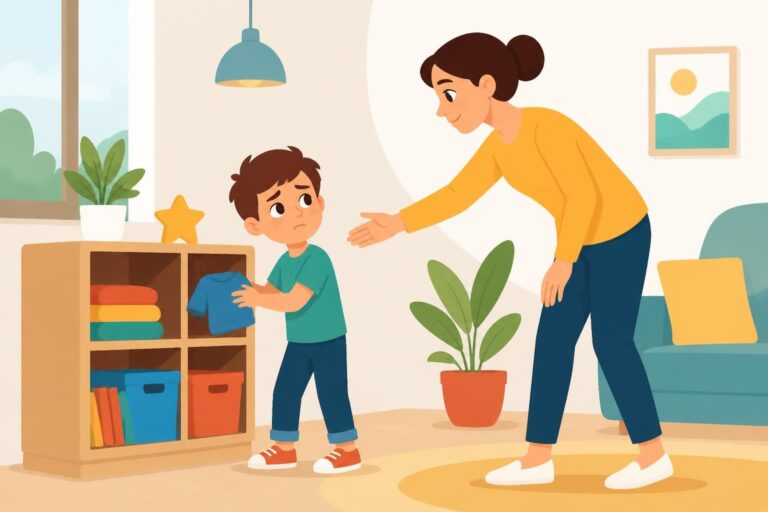
The impact of “please” on children: a study sheds light on its effectiveness
In Brief
- According to a study published in Developmental Psychology (American Psychological Association), 273 mother-child dyads were followed in the United Kingdom and Uganda to measure the impact of different request styles on helping behavior.
- The team from Durham University, led by Zanna Clay, observes that clear and direct instructions are associated with more help, including spontaneous help, among young children.
- The phrase “please” is not a magic button: placed in the middle of a vague sentence, it may mostly decorate the communication without guiding behavior.
- Cultural differences matter: participation in daily tasks is expected earlier in the observed Ugandan contexts, whereas help is more often presented as a choice in the UK.
- To convey politeness and respect, effectiveness often comes from a simple trio: understandable instruction, stable tone, and consistent adult model (thank you, please, excuse me) in real situations.
In daily education, “please” has long been presented as a universal pass: the word that would make a request acceptable, a child cooperative, and family life surprisingly quiet (which, statistically, resembles an urban legend). However, a study published in the scientific journal Developmental Psychology sheds light on a more concrete mechanism: the way a request is formulated, and not just its politeness layer, influences the helping behavior of very young children. The team linked to Durham University observed 273 young children and their mothers in three contexts: in the UK, in a rural area of Uganda, and in an urban area of Uganda.
The result, more useful than yet another “nice parents vs strict parents” duel, puts communication at the center: a simple, explicit instruction, given at the right time, appears associated with more help, including unsolicited help. Enough to look at “please” with fresh eyes. Not as a word to demand mechanically, but as a social tool that works better when it relies on an understandable framework and a clear expectation, without turning politeness into an automatic dispenser of favors.
What the study says about request effectiveness: beyond “please”
The work reported in Developmental Psychology focuses on a concrete question: why do some children help spontaneously very early, while others seem to need instructions, reminders, then reminders of reminders. The researchers observed two dimensions. First, spontaneous help: the child lends a hand without an adult explicitly formulating it. Then, solicited help: the adult encourages the child to participate in a simple task, for example putting objects away into a box.
The protocol relies on 273 mother-child dyads observed in the UK and Uganda (rural and urban areas). This choice of settings aims to test the cultural hypothesis: does early helping depend mainly on individual temperament, or on how participation in daily life is expected and staged? The authors do not describe “a universal good way,” but compare communication styles and their association with observed behavior.
Two types of requests stand out. On one side, an accompaniment described as assertive, common in the observed Ugandan contexts: direct, precise, action-oriented instructions, like “Put the pen in the box now.” On the other, accompaniment described as deliberate, more observed in the UK: encouraging formulations, longer, allowing some choice, like “Mom needs the pen to be put away, can you help mom please? Well done!”
The point that makes some teeth grind (not just those of children refusing to brush their teeth): clear and assertive instructions are associated with more help, including spontaneous help. Effectiveness therefore does not seem to come only from a polite wrapping, but from the readability of the expectation. A long sentence, with several bits of information, a final validation, and a “please” inserted like confetti, may remain vague for a very young child. Conversely, a short instruction gives a simple behavioral target.
Zanna Clay, professor and lead author cited in the context of this work, also recalls an important element: young children show motivation to help very early, “everywhere in the world.” The question is therefore not to create helping behavior from scratch, but to create conditions where this natural desire turns into concrete acts. The section ends with a practical idea: politeness helps us live together, but immediate understanding of an instruction helps action.
Politeness, respect and communication: when “please” becomes a tool (or background noise)
In many households, “please” is taught as a politeness rule equivalent to “thank you.” The stated goal is respect: learning to ask rather than demand, and to acknowledge the other. On paper, it is coherent. In real life, the word can end up in two very different categories: a social tool that genuinely softens an interaction, or background noise recited to “have the right” to demand.
The trap is known: some children quickly understand that just saying the phrase makes the request legitimate. When this happens, politeness becomes a token. The result: the adult becomes the referee of a mini-game: did the child say the right words, in the right order, with the right intonation, before still refusing? It’s a family comedy quite playable, but not always educational.
The interest of the “request effectiveness” prism is to bring the conversation back to communication. For a two or three-year-old child, “please” does not clarify what they must do. It can make the request more pleasant, but it does not replace precision or context. An effective request describes the action, the object, and sometimes the timing. For example: “Put the markers in the blue box” gives guidance that “Can you be nice please?” does not provide, even if the second sentence is perfectly polite.
Politeness works better when linked to an observable behavior. In a calm moment, the adult can model: “Please, pass me the towel,” then “thank you.” The child sees a social sequence, with a beginning and an end. Conversely, demanding “please” during conflict can slide the scene into a battle of form, while the underlying issue remains: frustration, fatigue, need for structure.
Another dimension is mutual respect. Saying “please” to a child is not a luxury. It’s a message: cooperation is built by two, even if the adult sets the rules. The comic (and very human) effect is that some children then reuse the phrase with surgical precision: “Please, give me three candies.” The adult then discovers that politeness does not forbid negotiation; it organizes it. The section closes with an observation: a polite word is powerful when it supports an understandable request, not when it serves as a varnish.
To situate different request styles, a comparative overview helps visualize what really changes in communication.
| Request Style | Typical Length | Level of Precision (action/object) | Example Formulation |
|---|---|---|---|
| Direct instruction (assertive) | Short (often 5 to 10 words) | High | “Put the pen in the box now.” |
| Polite but vague request | Medium | Low to medium | “Please be nice.” |
| Encouraging request (deliberate) | Long (often 15 to 25 words) | Medium | “Mom needs the pen to be put away, can you help please?” |
| Limited choice + politeness | Medium | High | “Are you putting the markers in the red box please, or in the blue one?” |
Cultural differences observed: why helping does not have the same place everywhere
The study comparing the UK and Uganda is not meant to award points, but to show that education is also a matter of collective expectations. In the observed Ugandan contexts, mothers use more direct instructions, and children are involved early in daily tasks. Helping is not presented as an optional activity “if the child feels like it,” but as a normal participation in family life.
In the UK, according to the observations reported, help is more often framed as a personal choice, consistent with a stronger value on individual autonomy. This changes the way of speaking. When the adult insists on choice, it is verbalized: “Can you…?”, “Do you want to…?”. The child also hears that refusal is an option, sometimes negotiable. This is not necessarily negative, but it changes the expected behavior.
In this context, it becomes logical that clear instructions are associated with more help, including spontaneous help. The child who grows up in an environment where participation is expected has more chances to practice. Helping behavior then looks less like a big unpredictable moment of generosity, and more like a daily skill. The spontaneous gesture is not a miracle; it is a cultivated reflex.
Regarding “please,” the cultural comparison reminds a useful point: a politeness marker can play a different role depending on the social norm. In a setting where the child is already expected to act, the adult can afford to be brief, because the request fits into a routine. In a setting where the child is more often solicited as a willing partner, the request is dressed with justification, encouragement, and recognition. The polite word can then be part of a broader relational strategy.
A too quick reading would lead to conclude that polite formulations should be banned in favor of dry orders. This is not what the observations suggest. They rather show that effectiveness depends on adjustment: child’s age, task complexity, routine frequency, fatigue level, and consistency between what is requested and what is usually expected. A child can perfectly cooperate with a “please” if the instruction is clear, and resist an order if the context seems unfair or incomprehensible.
The final point, useful in 2026 when educational debates circulate fast on social media: a method is not an incantation. Culture, daily life, and task type change the impact of the same formula on behavior.
Video content about children’s politeness often shows real scenes: repeated requests, negotiations, and difference between “learned formula” and “social skill.” This material helps spot what, in communication, makes a request actionable.
Should a child be forced to say “please”? Between social rule and real learning
Forcing a child to say “please” raises two issues: transmitting a norm of politeness, and building a respectful relationship that is not limited to recitation. In practice, imposing the word may work short-term. The child learns the formula, the adult obtains an “acceptable” request, and the world keeps turning. The risk is to create a toll logic: the word becomes a condition of access, without understanding the social meaning.
The study cited above on request effectiveness recalls that, for toddlers, the main lever is often clarity. An obligation of politeness should not therefore overshadow the essential: understanding the expected action and being able to do it. A child may be in full language acquisition. Forcing them to produce a long formula can turn a simple request into a linguistic ordeal, with frustration at the end. In this case, politeness becomes an obstacle to the prosocial behavior the adult hoped to encourage.
A pragmatic approach is to distinguish three situations:
- When the child asks for a simple service: “please” can be required, but the adult benefits from keeping the instruction short and reminding the model (“we ask with please, we thank afterwards”).
- When the child is in crisis or very tired: demanding the formula can be postponed, the immediate objective being emotional regulation and relational safety.
- When the child must participate in a task: the request can remain direct and clear, and politeness can slip into the exchange after the action (“thank you for helping me”), which links the formula to real cooperation.
This sorting avoids confusing politeness and obedience. A child can say “please” in an angelic voice while then throwing a tantrum if the answer is no. The formula is not a contract that obliges the adult to yield. It marks respect in the way of asking, not the right to get. Clarifying this point reduces disappointment, especially when the child discovers that social life is not a candy machine.
The debate, very present on TikTok and Instagram, sometimes tends to caricature: “forcing” would necessarily be violent, or “not demanding anything” would necessarily be benevolent. The ground is more concrete. A requirement can be set without humiliation, and total permissiveness can put the child in difficulty facing social codes. Politeness is a cultural skill useful at school, with friends, and later at work. What matters is the manner: explaining, modeling, repeating without dramatizing, and staying focused on respect for the person.
The section closes with a simple criterion: if the adult obtains the formula but loses cooperation, educational effectiveness is low, even if the scene sounds polite.
Videos oriented towards “clear instructions” often illustrate micro-adjustments: naming the action, showing the object, limiting choices, and keeping a stable tone. These are details that matter a lot in daily behavior.
Concrete strategies to increase request effectiveness without sacrificing politeness
Improving the effectiveness of a request does not require speaking like a robot or erasing “please” from the family dictionary. It involves building sentences that help the child succeed, then associating politeness with meaningful interactions. An effective instruction starts with an action verb, then specifies the object and place. A toddler’s brain likes short sentences, especially when the living room already looks like a Lego contemporary art exhibition.
The first lever is reducing complexity. “Put away” is vague. “Put the markers in the blue box” is precise. The child has a target. Communication becomes operational. “Please” can be added without diluting the message: “Put the markers in the blue box, please.” The polite word then serves to soften, not replace, the information.
The second lever is timing. A request made when the child is already engaged in an intense activity (drawing, pretend play, building) has less chance of success. In this case, announcing a simple transition helps: “In two minutes, we put the markers away.” The child anticipates, and the instruction does not come like an arbitrary cut. This method does not guarantee enthusiasm, but it increases cooperation observed in many daily situations.
The third lever is limited, measurable choice. Offering “Do you want to put away now or in five minutes?” is sometimes too open. Offering “Are you putting away books or markers?” keeps the goal intact while giving a space of autonomy. A stable politeness in voice and words supports mutual respect. However, if the adult offers a choice, they must accept one of the options; otherwise, trust erodes quickly.
The fourth lever is coherence: thanking help, even when it was expected. Saying “thank you” does not cancel parental authority; it shows that cooperation has value. Zanna Clay emphasizes that children have motivation to help very early. Thanking links this motivation to social recognition. The child learns that prosocial behavior echoes, not just a requirement.
Finally, handling “no” matters as much as “please.” A clear and calm refusal, followed by an alternative (“We’re not having candy now, you can choose an apple or a yogurt”), teaches that politeness is not a lever to control the adult. The section ends on a practical note: the more feasible the request, the more the child can be polite without it feeling like a permanent negotiation.
What Do We Say About It?
To obtain cooperation, the most solid data from the study published in Developmental Psychology is the clarity of the instruction, not the presence of a “please” placed like a sticker. Demanding the formula can remain useful to convey politeness, provided that each interaction is not transformed into diction control. The concrete recommendation is to favor a short and precise request, then model “please” and “thank you” in real situations, where the child understands what they are doing and why. The weak point of solely “nice” approaches is message dilution; the weak point of solely direct approaches is forgetting relational respect, which is also built through tone and example.
At what age can a child understand the meaning of “please”?
The phrase can be repeated very early, but the social meaning is built progressively. In toddlers, the main effect is imitation: they reproduce what they hear. Learning becomes more solid when the phrase is linked to concrete situations (asking, waiting for an answer, thanking), rather than a simple automatism before getting something.
Does saying “please” make a request more effective at home?
It can help on the relational level, but effectiveness mainly depends on clarity and feasibility. A short sentence, with a precise action, often produces more cooperation than a long and vague request, even if polite. Adding “please” works better when it does not obscure the expected action and when the adult maintains a stable tone.
How to react if a child says “please” but insists aggressively?
The polite word does not change the rule. It is useful to validate the form (“thank you for asking with please”) then set the limit on content (“the answer is no”), without entering an endless negotiation. Offering a realistic alternative helps to get out of the stalemate. The child learns that politeness structures the request but does not guarantee obtaining it.
Are direct instructions compatible with respectful education?
Yes, if they are given without humiliation and with realistic expectations. A direct instruction can be short, calm, and explicit, which helps the child understand. Respect is played out in manner: tone, posture, coherence, and recognition of effort. The observations reported in Developmental Psychology associate clear instructions with more helping among young children.