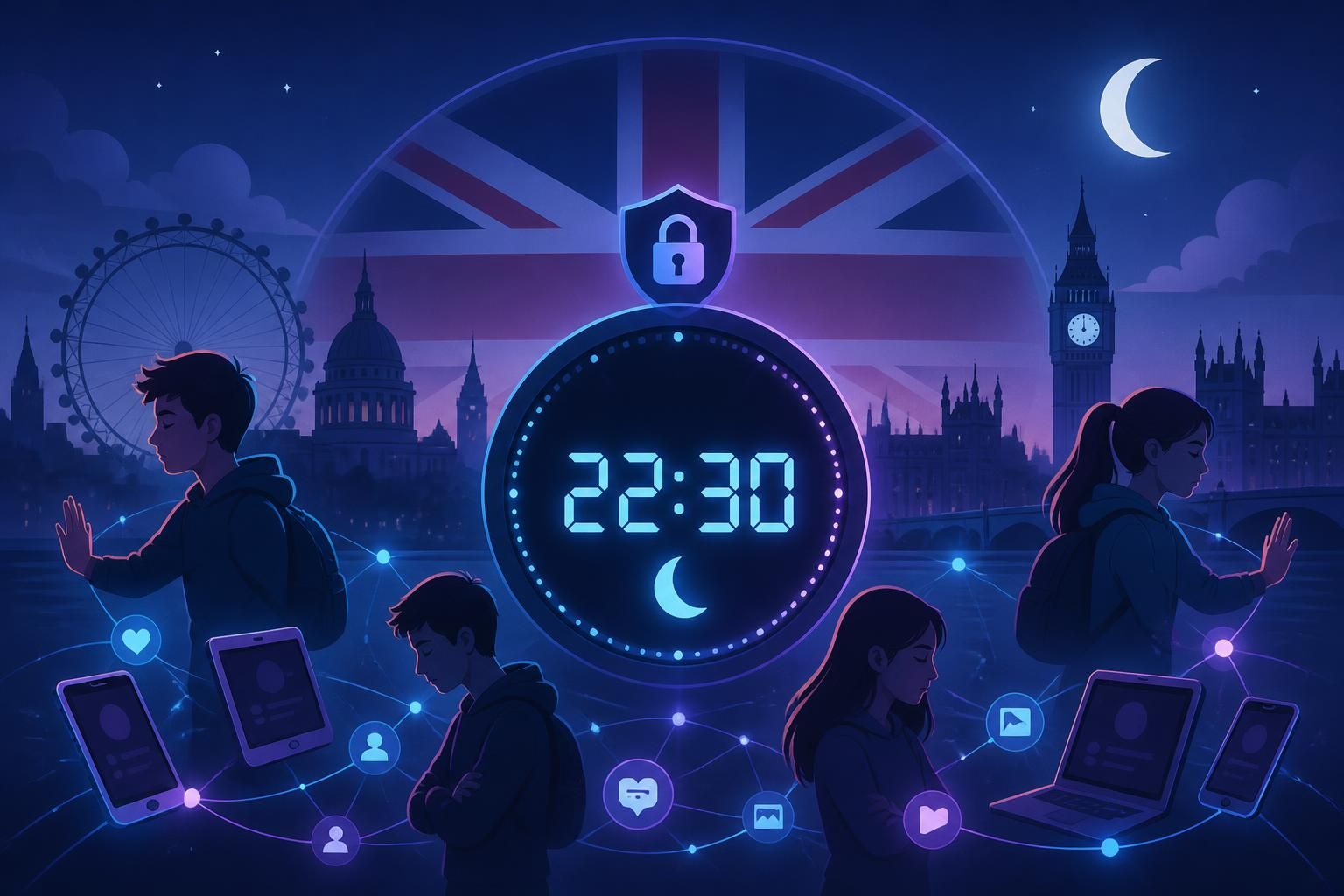
United Kingdom: establishment of a digital curfew aimed at teenagers on social networks
On July 14, 2026, the United Kingdom government detailed a new wave of measures aimed at protecting minors online, with a stated objective: to reduce nighttime social media use among teenagers. The most discussed measure focuses on a very specific time slot: a curfew between midnight and 6 a.m. for 16-17 year-olds, which would limit access to platforms during the hours when parents are asleep and the temptation of “just one last video” becomes an Olympic sport. At the same time, London is maintaining its June-announced ban for those under 16, expected to take effect in early 2027, which means treating two age categories separately: the younger excluded; the older supervised. The targeted networks are everyday platforms—TikTok, Instagram, Snapchat, Facebook, YouTube—and the idea is not only to lock the door but also to change the interior layout, by requesting default settings against so-called “addictive” features like infinite scrolling. The project even goes beyond social networks: internet use via AI chatbots by minors could be regulated with regular breaks, indicating that digital regulation now addresses the digital life as a whole.
In Brief
- Announcement of a digital curfew in the UK for 16- and 17-year-olds, between midnight and 6 a.m., with limited access hours to social networks.
- Measure presented as complementary to the ban on social networks for under 16s, announced in June, with entry into force planned for early 2027.
- Directly concerned platforms: TikTok, Instagram, Snapchat, Facebook, and YouTube, with “anti-addiction” settings requested by default (infinite scrolling in the crosshairs).
- Planned extension to internet use via AI chatbots, with regular breaks for under 18s to limit intensive use.
- The UK fits into an international trend: Australia (under-16 ban from end 2025), discussions and similar measures in Indonesia, France, and at the European level.
United Kingdom: how the social network digital curfew between midnight and 6 a.m. would work
The announced principle is simple to explain, much harder to apply properly: block access to social networks for 16- and 17-year-olds during a nighttime window, from midnight to 6 a.m. The logic resembles that of a classic curfew, with a modern detail: instead of forbidding going out on the street, it is about preventing connection to online services. Concretely, the measure targets platforms, not just the phone. A teenager could keep their smartphone but find access suspended to certain applications and certain functions, depending on what the regulation will actually impose.
This point matters because digital life is not limited to “opening an app.” A typical evening mixes private messages, short videos, comments, live streams, sharing, and sometimes multiple accounts or multiple devices. If the rule targets only the official app, a web browser could become a backup entry point. If it targets an account, creating new profiles can become a workaround sport. The issue is therefore both technical and legal: defining what is blocked (connection, viewing, posting, messaging), how age is verified, and what sanctions or obligations weigh on the platforms.
Which platforms are within the scope, and why they are mentioned
The names come up because they concentrate most of the social screen time: TikTok for short videos, Instagram for the mix of stories/reels/messages, Snapchat for ephemeral messaging, Facebook for more family-oriented but still present uses, YouTube for long videos and algorithmic recommendation. The project puts them in the same “social networks” basket, even if their uses differ. A digital curfew may seem easier on a platform focused on the feed, and more delicate on hybrid services like YouTube, also used for homework, tutorials, or educational content.
The measure therefore opens a very concrete debate on the boundary between social network and video platform. Is a teenager watching a math video at 12:30 a.m. on YouTube entertainment or learning? The answer will not be philosophical: it will depend on the categories retained by digital regulation and the exceptions planned or not. In many families, the critical hour is not midnight, but earlier. Yet, this time slot has a political advantage: it targets the moment when fatigue is maximal and concentration declines.
What an hour limit changes: from “always available” to “not now”
A total ban has a clear symbolism, but an hour limit establishes a routine. At home, it can turn endless disputes into an external rule: “the app doesn’t work anymore,” period. The risk is the “happy hour” effect: if access is blocked at night, some teenagers may intensify use just before midnight. To avoid this phenomenon, the announced default settings against certain mechanisms (infinite scrolling, endless recommendations) become a second pillar, intended to reduce escalation rather than rely solely on a time barrier.
From an online safety standpoint, the interest of a nighttime cutoff is also to keep teenagers away from risky interactions at hours when reporting, help, and parental support are often weaker. Cyberbullying situations, exposure to shocking content, or unwanted solicitations do not wait for the morning, and a forced pause window can reduce some episodes. The measure does not eliminate the problem, but it reduces the likelihood of facing it at the time when one is most vulnerable.
To measure the real impact, the implementation will need to be observed: blocking by account, device, geolocation, operator, or a combination. Each option has side effects. Too lenient a block invites circumvention; too strict a block penalizes legitimate uses. The promise lies in balance: protect without turning daily life into a digital obstacle course.
Protection of minors and sleep: what the British government says it wants to correct
The British government presents the nighttime restriction as a health and well-being measure: less screen time during sleeping hours, better concentration, better mood, and lowered digital social pressure. UK Digital Minister Liz Kendall stated that even at 16, an age of increasing autonomy, teenagers still need protection from online features deemed particularly catchy. This position emphasizes “design patterns” that push to stay: autoplay, chaining of recommendations, notifications, and especially infinite scrolling, which removes the natural end signal.
On the ground, the effect of digital on sleep is not limited to bedtime. There is excitement linked to exchanges, fear of missing a conversation, and difficulty in disengaging when content “delivers” an immediate reward. In a bedroom, the phone sometimes becomes a modern bedside light: it is turned off, turned back on, “check something,” then it is 1:20 a.m. The digital curfew seeks to break this loop, by removing the permanent availability of social networks at the heart of the night.
Default settings: the battle of invisible controls
London also wants to force platforms to activate by default settings that limit some mechanisms considered the most addictive. This detail matters because most users never change settings. If minor protection relies only on options buried behind six menus, it mostly exists on paper. Settings activated upfront change the “temperature” of the app: less autoplay, fewer aggressive recommendations, more visible pause reminders.
The project plans that teenagers can disable these protections. The choice is consistent with the growing autonomy idea at 16-17, but it raises a question of effectiveness: is an optional setting protection, or a “yes, I understood” checkbox clicked in two seconds? The answer will depend on how deactivation is designed: a simple switch, an educational path, or a graduated system. A graduated approach can limit the “all or nothing” effect and make the gesture more conscious.
Concrete examples: what “less addictive” might mean
An hour limit is readable: at midnight, it cuts off. Reducing addictive mechanisms is subtler, but it can be measurable. For example, stopping infinite scrolling after a certain number of contents, replacing automatic chaining by a pause screen, or limiting some notifications at night. Another often discussed example is the default disabling of personalized recommendations for younger users, which reduces the “tunnel” effect where the algorithm always serves more of the same content.
These adjustments do not make a platform boring; they make it less “sticky.” In a family setting, this can resemble those little changes that defuse conflicts: fewer alerts, fewer solicitations, less urgency. In terms of online safety, a less aggressively personalized feed can also reduce rapid exposure to problematic content, even if access is never totally neutralized.
This approach assumes active cooperation from platforms, with specific obligations and means of control. If rules remain vague, they risk resulting in symbolic settings. If they are precise, they can create a precedent exportable to other countries seeking to strengthen their digital regulation without relying solely on prohibition.
Ban on social media before 16 and curfew for 16-17: a schedule that changes family digital life
The British project organizes two levels. On one side, a ban on social networks for under 16s, announced in June, with entry into force planned for early 2027. On the other, a digital curfew for 16-17 year-olds, announced July 14, conceived as an extension of minor protection into late adolescence. This division is not trivial: it makes age a central parameter in internet use and transforms platform registration into a supervised act.
In practice, families already live with rules about schedules, homework, and sleep. The novelty is that the state proposes an external, potentially uniform rule that changes negotiation at home. When access is technically prevented, the argument “just five more minutes” loses part of its force. A teenager can still try to circumvent, but the effort increases, which sometimes suffices to make the desire drop.
Age verification: the technical and political knot
A ban before 16 necessarily implies a verification mechanism. Without this, the rule relies on honesty via a form where everyone is born on January 1. The difficulty is known: verifying age without collecting too much data, without creating new risks, and without excluding people. Possible systems range from documentary control to digital identity systems, including estimation solutions. Each option has a cost, friction, and online security implications.
In the case of a digital curfew for 16-17 year-olds, verification becomes even more complex: it is not enough to know if the user is under 16, one must know their exact age and update it. An account created at 15 becomes eligible at 16, then at 18. Platforms will therefore have to manage an “age clock,” with transitions and adapted rules. This requires reliable data and the ability to respond to disputes.
Table: comparison of announced measures and their measurable parameters
| Measure | Age range | Time slot concerned | Announcement date (first full occurrence) | Entry into force mentioned |
|---|---|---|---|---|
| Ban on social networks | Under 16 years old | Not applicable | June 2026 | Early 2027 |
| Digital curfew on social networks | 16-17 years old | Midnight to 6 a.m. | July 14, 2026 | To be specified |
| “Anti-addiction” default settings (e.g. infinite scrolling) | Teenagers (scope to be specified) | Not applicable | July 14 | To be specified |
| Regular breaks for AI chatbot use | Under 18 years old | Not applicable | July 14 | To be specified |
This table highlights one point: several parameters remain to be specified, particularly the entry into force of the digital curfew and the technical details of default settings. As long as these elements are not decided, public discussion oscillates between the simple image (a cutoff at midnight) and the reality of implementation (who blocks what, how, and with which exceptions). For parents, this uncertainty has an immediate effect: it is hard to tell a teenager “it’s coming” when one does not know “when” or “how.”
The most likely scenario is a transition phase where platforms progressively adapt their systems, since overnight implementation on global services is rarely realistic. This timing can also create a trial period, with adjustments based on feedback. For households, this means a gradual change of digital life rather than an instantaneous switch.
Platforms, settings, and circumventions: the practical reality of a digital curfew for teenagers
A digital curfew is not a magic barrier; it is a rule that must survive day-to-day tests. In real life, a motivated teen already knows the basics tricks: changing accounts, using a browser, using another device, or switching to less supervised services. Associations supporting minor protection often acknowledge: a useful measure can also shift the problem. If TikTok becomes hard to access at night, some may migrate to forums or marginal apps where moderation is weaker.
The central question then becomes: does the measure reduce overall exposure to risks, even if a minority circumvents? An imperfect system can be effective at a population level because it increases friction and reduces “automatic” use. Not all teenagers are cybersecurity engineers; many follow inertia. Cutting inertia already changes the usage curve.
What platforms will have to adjust, beyond a simple “off” button
If the curfew targets access, platforms will at minimum have to manage: authentication, age management, time zone, and error messages. The time zone seems trivial but is decisive. A global service must decide whether it applies the user’s local time, the declared country’s time, or a single reference. Each choice creates blind spots, especially for travel, vacations, or differently configured devices.
Social interactions also pose concrete cases. If a 17-year-old account cannot connect, do received messages remain visible in the morning? Are notifications silent or deleted? Are groups frozen? Online safety also depends on managing signals: if the platform continues sending notifications, the teen may be tempted to reopen the app, then go to another accessible platform. An effective curfew must act on behavior, not just the entrance door.
List: family practices that align well with an hour limit
- Define a phone charging point outside the bedroom to reduce nocturnal temptation even if an app circumvents the rule.
- Activate “do not disturb” modes and silent hours for notifications to avoid micro-awakenings.
- Plan a transition activity before bedtime (reading, music, preparing the bag) to replace automatic scrolling.
- Discuss the reasons for the measure (sleep, concentration, cyberbullying) with concrete examples rather than a simple “it’s like that.”
- Agree as a family on rare exceptions (e.g. travel, emergency) to avoid constant bargaining.
This list does not replace the law; it makes it livable. Public measures work better when they meet consistent private routines. An important detail: a teenager who understands the link between sleep and internet use is more likely to accept a constraint than one who undergoes it without explanation.
In the debate, the risk of circumvention is real, but it should not serve as an excuse for inaction. A seatbelt does not prevent all accidents, yet it reduces consequences. Here, the goal is comparable: reduce nighttime exposure, make some uses less compulsive, and move part of digital life to hours when supervision is easier.
AI chatbots, mandatory breaks, and online safety: the other part of British digital regulation
The British plan is not limited to social networks. The government plans to further regulate the use of AI chatbots by minors, with a simple idea: impose regular breaks for under 18s to limit intensive use. This proposal comes from field observations: chatbots are no longer just gadgets. They serve to chat, write, revise, “vent,” and sometimes seek sensitive advice. In teenagers’ digital lives, these tools become interlocutors available 24/7.
The mandatory break targets several risks. The first is duration: a conversation with a chatbot can stretch like a binge-watching series. The second is emotional dependency when a conversational tool becomes a stress reflex. The third is information quality: even when a chatbot is useful, it can be wrong. Protecting minors therefore also involves education about doubt, verification, and reasonable usage.
Why AI is included in the same package as social networks
The two worlds share one engine: attention. Social networks capture it via endless feeds and notifications. Chatbots retain it through exchange, personalization, and the feeling of being heard. In both cases, internet use can spill over into sleep time. A teen may leave Instagram at midnight, then turn to a chatbot “to talk a bit” and end up at 2 a.m. If digital regulation only addresses networks, it leaves a parallel route open.
The issue also concerns sensitive content. A chatbot can be asked about health, sexuality, drugs, or violence. Platforms have safeguards, but responses vary depending on the tool, language, and settings. Regulation by breaks does not solve everything but limits the spiral of late requests when fatigue heightens suggestibility.
Break measures: what this may imply technically
A “regular break” can take several forms: timer, breathing screen, temporary block after a duration, or message limitations. The choice is far from neutral. A gentle reminder is easy to ignore; a hard block can provoke frustration and push to unregulated tools. Frequency and duration will therefore have to be calibrated. Consequently, success will depend on the degree of harmonization between services; otherwise, users migrate to the most permissive.
This AI aspect reinforces a political message: protecting minors is no longer about a single type of app. The boundary between social, entertainment, and personal assistance fades. A coherent framework must cover the ecosystem; otherwise, it creates regulatory gaps where teenagers fall as nimbly as a cat.
In this context, online safety is not reduced to blocking. It involves organizing disconnection times, making fatigue signals visible, and limiting internet use when it replaces sleep. The “pause” approach has the advantage of being compatible with educational uses: one can use it, but not without limits.
Global trend: Australia, Indonesia, France, European Union and the ripple effect on minor protection
The UK fits into an international dynamic where states seek to regain control over social networks and teenagers’ digital lives. A striking example is Australia, which plans to ban social networks for under 16s from the end of 2025. This deadline is often cited as a milestone because it gives a clear date and a potentially exportable model, even though each country has its legal tools and technical constraints.
Indonesia has also announced measures moving in the direction of restrictions for minors, illustrating a movement beyond Europe. In France, the government intends to ban access to social networks for under 15s, with mandatory age verification. At the EU level, the European Commission is working on a common framework evoking a ban before 13, while allowing member states to adopt stricter rules. These elements outline a scale: 13 years as the discussed European base, 15 as the French target, 16 as the British and Australian threshold.
What these models have in common: age as a digital key
The common point is age, which becomes a digital “key.” This choice has a direct consequence: identity and verification become central infrastructures. The stricter the rule, the more verification must be reliable, and the greater data concerns rise. A system that is too intrusive can provoke social resistance. A system too light does not enforce the rule. The success of digital regulation thus depends on solutions that prove age without turning each connection into heavy identity control.
Child protection associations often welcome the principle of regulation because it responds to concrete concerns: sleep, cyberbullying, inappropriate content. Other actors warn about a perverse effect: teenagers may turn to less regulated platforms, sometimes hosted outside the strictest jurisdictions, with weaker moderation and higher risks. The problem is not theoretical: migration to obscure services can degrade online safety.
Possible effects: shifting uses and pressure on platforms
National regulation may also create economic pressure. Large platforms have the means to deploy controls, compliance teams, and adapted settings. Smaller players may struggle to keep up. The result can be a more concentrated market, which is not necessarily the initial goal. Conversely, clear rules can push major platforms to improve their design for everyone, as they often prefer a single solution to a mosaic of country-by-country constraints.
In this framework, the British digital curfew has strategic interest: it shows an intermediate path between total ban and no regulation. It introduces a time limit, a concept easy to communicate, and potentially more socially acceptable for 16-17 year-olds. The test will be in the details: exact scope, exceptions, controls, and ability to reduce circumvention without punishing legitimate uses.
What Do We Say?
The announced digital curfew in the UK has a good chance to take hold because it targets a simple objective to understand and narrate: recover sleep and reduce nighttime exposure to risks. Effectiveness will mainly depend on age verification and platforms’ ability to limit circumvention without blocking legitimate uses, especially on YouTube. The AI chatbot aspect is the most relevant in the long term because it addresses internet use beyond social networks and anticipates new teenage habits. For families, the most concrete impact will come from default settings and evening routines, which can reduce conflicts and stabilize daily digital life.
Does the digital curfew also block private messaging on Snapchat or Instagram?
The announced principle targets access to social networks between midnight and 6 a.m. for 16-17 year-olds, but the exact modalities (feed, messages, posting) will need to be specified. Technically, a platform can block the full connection or only certain functions. The outcome will depend on the final text and the obligations imposed on the services concerned.
Why does the hour restriction start at midnight and not at 10 p.m.?
The midnight-6 a.m. slot targets the heart of the night, a time when the impact on sleep is direct and parental supervision is weaker. An earlier hour would be more ambitious but also more intrusive and more contested, especially for 16-17 year-olds. The final choice often reflects a compromise between public health and acceptability.
Can a teenager bypass the digital curfew using a VPN or web browser?
Circumvention remains possible depending on how the blocking is designed. A simple app block can be avoided via browser or alternate accounts. A mechanism linked to the account, with verified age and server-side controls, is more robust. Rules will also need to limit “backdoor” routes without pushing users toward less secure platforms.
Do the chatbot breaks apply to school uses?
The principle targets limiting intensive use for under 18s, not banning the tool. A break can also apply to school use if designed generally. The balance will depend on settings: frequency, duration, and options to resume. The stated goal is to avoid endless sessions, especially at night.