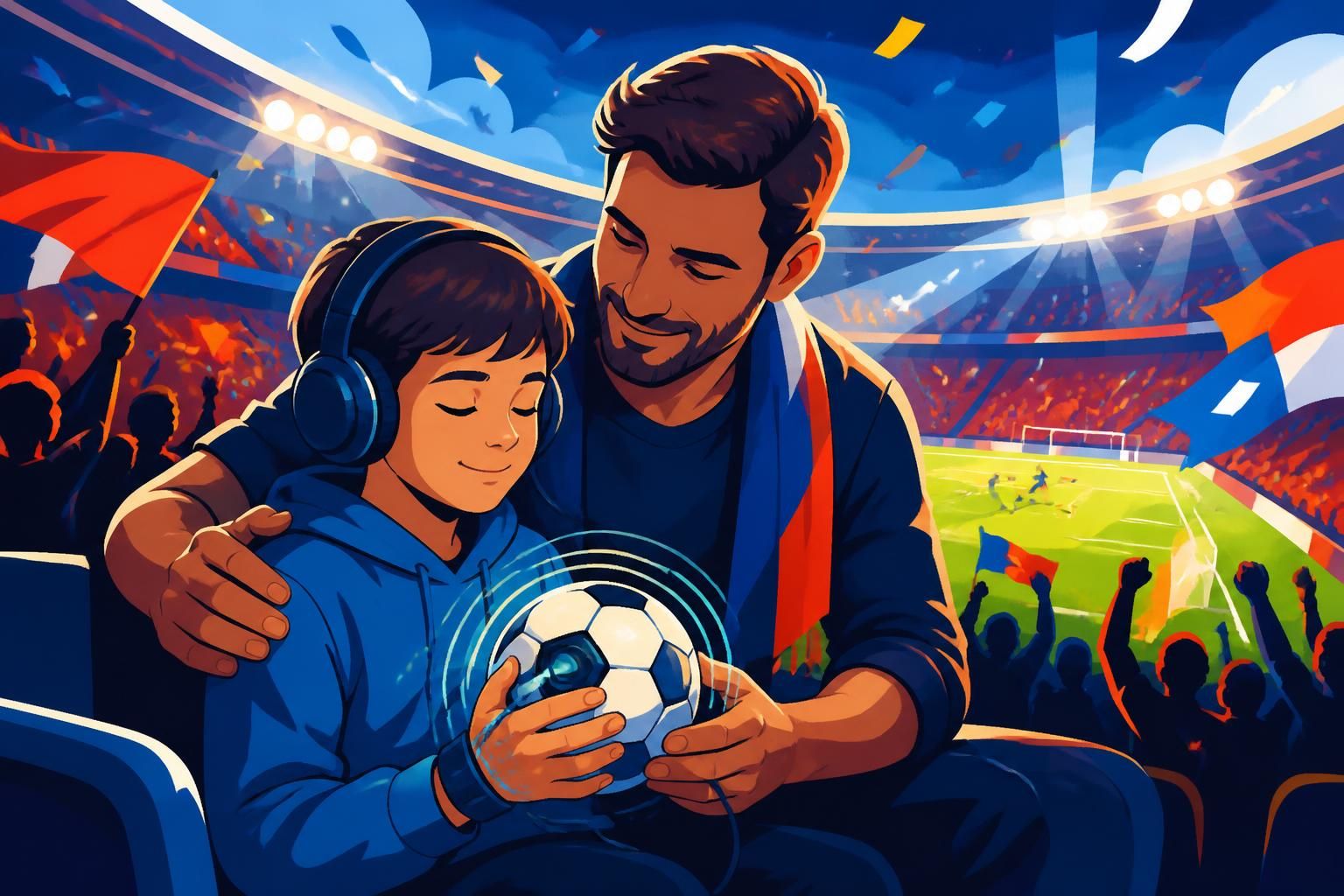
World Cup: A Father’s Ingenious Idea to Make His Blind Son Feel the Matches
In Brief
- On December 12, 2026, in Borujen (Iran), a video shows a father helping his 9-year-old blind son follow World Cup matches through a tactile model.
- The device is based on a cardboard board, two improvised goals (straws), and a marble representing the ball, moved under the child’s hand in synchronization with the television.
- According to CNN (report aired on December 12, 2026), the idea was born from a simple observation: TV commentary alone does not convey the geography of the game, nor the trajectories.
- The sequence of Argentina’s second goal in the semi-final against England triggered massive reactions online, highlighting family sharing and accessibility.
- This method illustrates a concrete approach for visual impairment: turning football actions into sensations, without expensive technology.
On December 12, 2026, footage shot in Borujen, Iran, circulated widely: a father and his child, in front of the television, but with a third “screen” placed between them, made of cardboard. On this small miniature pitch, a marble plays the role of the ball, straws draw the goals, and an adult’s hand guides the hand of a 9-year-old boy to have him follow the movements, passes, and attacking phases. The boy’s name is Alireza Babajani and he lives with a visual impairment; on the video, he reacts to the rhythm of the match, bursting with joy at the moment when Argentina scores their second goal in the semi-final against England. The mechanism is simple but powerful: replace the image with a tactile mapping, and turn a sometimes confusing TV stream into understandable sensations.
Beyond the “stroke of genius” that social networks love to label hastily, the story highlights very concrete things: what the sports commentary does not say, what the radio describes better than television, and what families put together when accessibility remains unequal. Here, the ingenious idea is not seeking a technological wow effect. It seeks connection, precision, synchronization, and sharing that leaves no one on the sidelines.
World Cup and visual impairment: why watching a match on TV can be excluding
A football match on television seems “easy” to follow because the image does a large part of the work: team positioning, block height, off-the-ball runs, wing changes. For a person with visual impairment, even with good sound, a large part of this information becomes blurred or nonexistent. The commentary, often very emotional, favors intensity and proper nouns. It regularly forgets the exact position of the ball, the distance to the goal, or the area of the pitch, even though these are basic landmarks to feel the game.
This difficulty is reinforced by modern TV production. Close-ups on faces, slow-motion replays, crowd shots, and graphic animations sometimes cut the action or poorly contextualize it. For a sighted audience, this remains “compensable.” For a blind or visually impaired son, the loss of landmarks adds up: audio does not explain everything, and the image is not available to complement. The result is not just a lack of information, it is a lack of continuity. Yet, continuity is precisely what creates the tension of a match: feeling that the team is advancing, retreating, suffering, projecting.
In Alireza Babajani’s case, the stake is even clearer: a child is not just looking to “know who scored.” He wants to follow the thread, anticipate, vibrate with others. Accessibility in sport is not limited to the score, nor even to the highlights. It concerns the right to understand what happens between two chances.
What sound poorly transmits: distances, zones, and trajectories
A commentator can say “it combines,” “it passes,” “it comes back behind.” Without visual reference, these verbs become impressions. The difference between a lateral pass 40 meters from goal and a layoff inside the box totally changes the level of stress and hope. Television does not always help: some stadium microphones provide atmosphere, not information.
To make football readable by touch, simple equivalents are needed: where the ball is, at what speed it moves forward, in which corridor, and whether there is pressure. These are spatial notions. The brain can integrate them, but it needs a “map.” This is exactly where cardboard tinkering becomes an accessibility tool rather than a gadget.
The social dimension: vibrating together or remaining a spectator of noise
The World Cup is often a moment of family gathering. Discussions, shouts, debates about refereeing create a collective experience. When a person cannot follow the action, they end up listening to reactions without being able to link them to a precise sequence. The emotion is then out of sync, as if everyone laughed at a joke whose context is missing.
Alireza’s father’s device answers this gap. It does not “sum up” the match: it accompanies it live. This synchronization is central because it allows sharing without delay, and thus a real presence during matches.
Alireza’s father’s tactile model: an ingenious, simple, and reproducible idea
The heart of the story lies in one object: a handmade mini-pitch, made of cardboard, placed on a mat. The principle is clear on the video shared by Storyful: a marble represents the ball; the father moves it on the surface and guides his son’s hand so he can feel the path, changes of direction, and accelerations. The goals are materialized by everyday items like straws. The child then “sees” the action by touch, while the television sets the pace and the father ensures the translation.
The system has a rare strength: it requires no app, no sensors, no specialized equipment. It requires time, attention, and an adult capable of following the match while playing the role of “tactile director.” This is not a detail: accessibility often depends on human support, especially for children.
According to CNN (same report), Ardashir Babajani had the idea after realizing that TV commentary was not enough. This rationale aligns with the experience of many families: understanding football is not just hearing it, it is representing space. Here, representation becomes physical.
What the device is made of: materials, landmarks, gestures
The model has three essential ingredients: a rectangular surface with perceptible borders, two recognizable goal zones, and a mobile object easy to feel. Cardboard checks many boxes: light, stable, easy to cut. A marble rolls and gives a continuous movement sensation, unlike a token that would have to be lifted each time.
The accompanying gesture matters as much as the material. The father does not simply send his son’s hand “at random”: he guides it like a cursor. He imposes a rhythm, marks stops, reproduces passes, then accelerates near the goal. For a child, these variations become a grammar. Over time, they can even allow anticipating an attack without waiting for the goal to be announced.
The role of speech: commenting without drowning information
The father’s commentary serves as spatial subtitling: “we’re on the right,” “we’re moving up,” “we’re entering the box,” “shot.” Words can remain simple, as long as they are consistent. A stable vocabulary helps the child associate a tactile sensation with an area of the pitch.
The trap would be to talk too much, or to narrate the match like a novel. Here, the effectiveness comes from precision: explaining what happens, not what it “means.” The meaning, the child builds by feeling the danger or relief, second after second.
Table: example of “tactile translation” of common actions
| Football action | Tactile gesture on the model | Useful sound cue | Sequence duration (approximate) |
|---|---|---|---|
| Goalkeeper restart | Start from goal area, slow movement toward the axis | Announcement “goalkeeper restarts” + sound of the foot kick | 3 to 6 seconds |
| Defensive passes | Small lateral movements, backward returns | Defenders’ names mentioned on air | 5 to 15 seconds |
| Counterattack | Sharp acceleration forward, diagonal toward a corridor | Increase in crowd volume | 4 to 10 seconds |
| Clear chance / shot | Quick entry into the box, brief stop, movement toward the goal | Commentator getting excited + crowd reaction | 2 to 5 seconds |
A device of this type does not pretend to reproduce every duel down to the millimeter. It aims for a global reading faithful enough for emotions to arrive at the right moment, and for the World Cup to remain a shared spectacle.
Feeling the matches: how to turn football into sensations without overwhelming the child
For a child, overload comes quickly: too much information, too many gestures, too many changes. Football is already a sport of flow, with slow phases and sudden accelerations. Adding a tactile layer can become confusing if the method is not framed. The Borujen video shows a pragmatic approach: the father doesn’t mimic everything. He selects what structures understanding: main trajectories, proximity to goal, stoppage, goal.
This selection is an accessibility choice. To feel a match, a blind son doesn’t need the exact position of every full-back every second. He needs a stable mental map, a rhythm, and a connection between the action and the stadium reactions. Once these three elements are in place, the child can experience the matches with an intensity comparable to other fans, even if the representation remains simplified.
Simple routines: fixed landmarks that reassure
A tactile pitch works better with invariant landmarks. The touch lines must be easy to feel. The two penalty areas must be distinguishable from the rest by relief, a change of texture, or a border. Coherence matters: if the goal “moves” from one match to another, the child must relearn.
A useful routine is to “go around the pitch” at the start, for 20 to 30 seconds, to recall the zones. This tactile warm-up saves time when the match speeds up. In a family context, this resembles a pre-match ritual, and the ritual has real stabilizing power for children.
Managing accelerations: slowing the gesture without breaking the emotion
When the game goes too fast, the temptation is to move the marble at actual speed, which turns the sequence into an incomprehensible slide. A common adaptation is to “sample” the action: one movement for progression, a stop for the key pass, one movement for the shot. The important thing is to keep the logic, not the speed.
The father then becomes a translator. He must make decisions in a fraction of a second: which elements are essential for the child to understand the rise of danger. On the Argentine goal sequence, the burst of joy comes at the right timing, showing that the tactile translation stayed synchronized with the decisive moment.
List: concrete tips to improve the accessibility of a match at home
- Choose a marble at least 12 to 16 mm in diameter for better grip, especially if the child has small hands.
- Mark important zones with a thick ribbon or glued string to prevent the hand from “leaving the pitch” without realizing it.
- Keep a stable vocabulary for the zones: “right corridor,” “axis,” “box,” “goal,” and stick to it throughout the World Cup.
- Mark stoppages (foul, corner, offside) with a clear tactile pause, so the child does not think the action continues.
- Plan a halftime break to redo a mini-tour of the pitch, especially if the match was very choppy.
- Reduce sound distractions in the room so the child can exploit crowd reactions and the commentator’s voice.
When these adjustments are in place, the match ceases to be background noise. It becomes a structured experience, where sensations replace the image without demanding excessive effort.
Buzz, social networks and family sharing: what this story says about accessibility in 2026
The virality of the video owes to a very contemporary cocktail: a moment of sporting emotion (the goal), a concrete parental gesture (the guided hand), and an everyday object (the cardboard). This is not a laboratory demonstration. It is a domestic scene. Football, often presented as entertainment, becomes literally an accessibility field.
Storyful relayed the sequence, which partly explains its rapid circulation: the platform is known for distributing verified content picked up by media. In the flow of networks, this mediation matters, because it provides a narrative framework and some credibility to the images. The rest happens on its own: millions of people identify with the desire to share a match as a family, even if few directly experience visual impairment reality.
This type of buzz has an advantage: it makes a solution visible. It also has a limit: it can make people believe that a good individual idea is enough to compensate for a collective lack. Yet, accessibility should not depend solely on a tinkering and available father for 90 minutes.
What the public remembers: emotion, but also the method
The scene of Argentina’s second goal works as “proof by the moment”: the child reacts at the right time. This detail is important because it shows that the method is not just touching. It is operational live, despite football’s speed.
In online comments, many reactions highlight creativity. The real interest is also in transmissibility: other families can reproduce the idea without budget. A cardboard pitch, a marble, tactile landmarks, and an attentive adult. The recipe is simple, even if its implementation requires energy.
The parenting angle: a skill that is learned
Guiding a hand, synchronizing action, speaking without saturating, managing excitement: these are skills. They don’t fall from the sky. The video shows fine coordination between father and son, resembling a ritual built during the tournament.
A secondary benefit appears: the child learns football as a spatial language. He can memorize the pitch’s structure, understand pressing, feel what a ball run is. This acquisition can then be useful in other contexts, like games, talks with peers, or adapted training.
What this story points out to broadcasters
Broadcasters know how to produce audio options, but the reality on the ground is variable. A more descriptive commentary, an alternative audio feed, or systematic landmarks (“zone,” “distance,” “corridor”) would change the game. The need exists, and the Babajani episode makes it visible because it puts faces on an abstract difficulty.
This story does not solve everything, but it raises a requirement: to allow everyone to follow matches without relying exclusively on artisanal solutions.
From home tinkering to sustainable solutions: concrete paths to generalize the experience
Tinkering works because it is immediate and adaptable. To scale up, simplicity must be kept while reducing the burden on families. One path is to standardize inexpensive tactile supports, sold or distributed via associations, with robust textures and clear landmarks. A foldable pitch in thin foam, with raised lines, would cost more than cardboard but remain accessible if mass-produced.
Another path relies on audio description, inspired by what exists for some audiovisual programs. An “enhanced radio” stream could systematically describe the ball’s zone and phase of play, with disciplined language. The goal is not to replace classic commentary but to offer a parallel channel for accessibility, usable alone or combined with a tactile model.
The most realistic approach combines the two: a tactile support at home and more descriptive commentary. The father keeps the role of emotional mediator but no longer must translate everything constantly. The child gains autonomy because he can link audio to a stable map.
Adapt without infantilizing: what the device does well
The miniature pitch respects the child’s intelligence. It does not “play baby.” It proposes an abstract representation, like a map. This abstraction is a strength: it corresponds to how many people understand football, visualizing schemes and movements.
Handling a marble adds an active dimension. The child is not passive. His hand is in the action, even if the father guides. This activity reduces boredom, especially during slow phases, and helps stay connected to the match.
What is still missing: autonomy and continuity
The main limit is the energy required of the adult. For 90 minutes, following a match and doing tactile translation demands continuous attention. In a family, this may be possible for a special match, less so for a whole tournament. A sustainable solution must consider fatigue, work, other children, and normal life.
The second limit concerns autonomy: if the child entirely depends on the adult to “see” the game, he remains dependent on goodwill and availability. Accessibility also aims to allow following a match alone, like any supporter on their couch, without having to recruit a home commentator.
A simple framework for safety and comfort
For a 9-year-old child, the objects used must be safe: avoid pieces that are too small if a younger sibling is around, check that straws or rods do not cause injury, stabilize the board so it doesn’t slip. The goal is not to transform the living room into a permanent workshop. It is about making the session comfortable and repeatable.
The Babajani case shows a concrete direction: when accessibility is thought of as a complete sensory experience, football becomes a sharing field again, not a show to endure.
What do we say about it?
This ingenious idea deserves to be copied because it costs almost nothing and truly transforms matches into understandable sensations for a blind son. The strong point is synchronization: the child experiences the action at the same moment as everyone else, and family sharing becomes immediate. The weak point is the effort required from the father, difficult to sustain throughout a tournament without backup. The logical next step for broadcasters is to offer more descriptive and constant commentary so that these home tinkering solutions are no longer the only bridge to the World Cup.
What simple materials allow making a tactile pitch to follow a match?
A rigid cardboard or a light board is enough, with raised lines (string, thick ribbon) and two goals easy to recognize by touch. A marble is useful to simulate the ball thanks to its rolling. The important thing is the stability of the base and the clarity of the landmarks, more than the aesthetics.
How to keep synchronization between television and the tactile model?
Synchronization is based on real-time but simplified translation. It is better to reproduce the main trajectories and mark clear pauses during stoppages. A consistent vocabulary for pitch zones also helps reposition the child quickly when the TV production chains shots and slow-motions.
Can a child follow alone with this type of device?
With regular support, the child can learn the pitch map and understand more autonomous sequences, especially if the audio is descriptive. In practice, for a whole match, adult presence is often necessary to translate rapid changes. More precise audio streams would greatly improve autonomy.
Are there alternatives without tinkering to improve match accessibility?
Yes: listening to a sports radio in parallel can offer more descriptive narration than some TV broadcasts depending on the stations. Audio-description options, when available, also provide spatial landmarks. At home, reducing sound distractions and establishing consistent verbal landmarks already improve the experience.