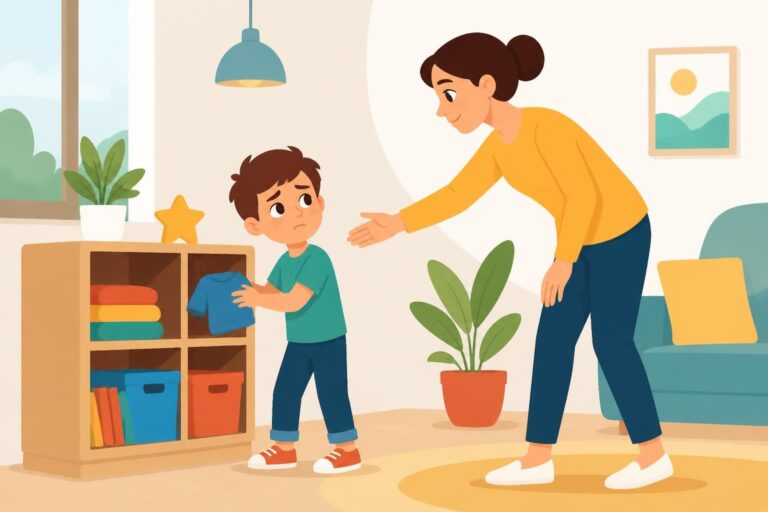
Dreamy Child Moon: The dreamy child, often daydreaming: understanding this behavior (5-8 years).
| Short on time? Here’s the essentials 🌙 |
|---|
| Between 5-8 years, attention and concentration are still developing, so daydreaming is common 😊 |
| A dreamy child does not necessarily have ADHD; observe the duration, intensity, and school impact 🧭 |
| Preserve imagination while setting short, clear, and motivating markers 🎯 |
| Routine, active breaks, visual supports, and creative games structure escape without restricting it 🔁 |
| In case of doubt, proceed step-by-step towards a professional evaluation, without hasty labels 🩺 |
| Family and school benefit from co-constructing simple and coherent accommodations 🤝 |
Sometimes silent, often expansive, the dreamy child can give the impression of floating between two worlds. At 5-8 years old, the brain refines its attention and concentration circuits, which makes daydreaming more visible daily. An instruction is delayed, a schoolbag is lost, an answer goes in all directions. Yet, these signs tell less of a problem than of ongoing development. Imagination abounds, escape sometimes serves as a valve, and a rich inner world accompanies learning. The key question is not to eliminate these moments, but to understand their function. Thus, support becomes fairer and gentler. Effective strategies combine a clear framework, creative breathing, and cooperation among adults. When well orchestrated, this dynamic transforms the “moon” into a wonderful springboard for learning, organizing, and opening up to others.
My child is always in the clouds: decoding behavior at 5-8 years old
In this 5-8 years range, the child moves from the sensory world to the world of rules. This demanding shift shakes attention and can amplify daydreaming. When they stare out the window during homework, it can indicate fatigue, boredom, or a simple need for escape. The “in the clouds” behavior is often temporary, especially when imagination overflows.
Should you worry if forgetting things becomes systematic? The important thing is the daily impact. If instructions are only understood after several reminders, if homework remains unfinished despite a calm environment, vigilance is necessary. However, an isolated episode after a bad night doesn’t have the same meaning as a persistent difficulty.
Concrete markers to understand the signs
Manifestations cluster around three axes. First, fluctuating attention: the child wanders in thought, answers off-topic, is slow to start. Next, time management: they get stuck at the start of a task. Finally, organization: lost belongings, forgotten notebook, mixed instructions. These elements only pose problems if they last and truly hinder learning.
An example illustrates this point. Nino, 7 years old, collects offbeat answers in class. He laughs at his own ideas, then forgets the question asked. His teacher then breaks down instructions into very short steps, with one pictogram per step. Within two weeks, errors drop and confidence improves. The cloud has turned into a recharge point, not an escape.
- 🌟 Offer “minute” tasks to kickstart action.
- 🧩 Use simple visual aids to structure.
- ⏱️ Add a visible timer to pace effort.
- 🎨 Provide a creative break before focused attention.
- 🗣️ Check understanding by paraphrasing together.
To nurture this dynamic, playful supports help. You can pick up creative board games that train listening, memory, and turn-taking, without moralizing. In a short time, the child discovers that staying grounded can also be enjoyable. This first step opens the way to finer adjustments in the next section.

Attention and concentration: what happens in the brain of a dreamy child
At 5-8 years, executive functions consolidate. They drive attention, inhibition, and planning. A dreamy child is still exploring these mechanisms, hence moments of spontaneous escape. Rather than fighting this imagination, it is more effective to channel it.
Executive functions under development
Filtering distractions and sustaining effort depend on a circuit that matures slowly. Noisy environments quickly overwhelm the child. Conversely, a calm room promotes concentration. Active breaks support vigilance. The goal is not perfection, but steady progress.
Imagination: engine or parasite?
It can drive learning when it serves as a support point. For example, linking a grammar rule to a short story facilitates memorization. But when the story invades the exercise, the thread is lost. The right balance transforms the cloud into a radar, not a fog.
Léa’s case, 8 years old, illustrates this. She creates entire universes while reading. Her teacher offers her an “idea notebook” to jot down her mental images. After two minutes of writing, she returns to the text. Escape has become a step, not an exit.
| Trigger 🌪️ | Observable sign 👀 | Quick action ✅ |
|---|---|---|
| Lack of sleep | Slowness, attention mistakes | Move bedtime earlier, soft lighting |
| Task too complex | Blockage, prolonged daydreaming | Break into micro-steps |
| Boredom | Agitation, wandering gaze | Minute goal + playful challenge |
| Stress | Withdrawal, sighs, avoidance | 3-3-3 breathing, emotional validation |
To stimulate without overwhelming, short and motivating activities remain the golden path. Resources of artistic activity ideas help vary the formats. The more training slips into play, the more the child accepts to train.
In summary, the brain learns better when alternating effort, break, and pleasure. This fine rhythm anchors concentration over time.
Child in the clouds and ADHD: nuances, criteria, and evaluation steps
The term “child in the clouds” describes a state, not a diagnosis. ADHD is a neurodevelopmental disorder defined by specific criteria. Confusing the two can delay useful help or cause unnecessary worry. The key lies in persistence, intensity, and functional impact.
Three ADHD presentations
The inattentive form manifests as repeated forgetfulness, fragile organization, and labile attention, without hyperactivity. The hyperactive-impulsive form adds agitation and reckless acts. The combined form includes both. These profiles must be observed in different contexts, including school and home.
When to consider an evaluation
Long-lasting difficulties that hinder schooling, relationships, or autonomy justify an approach. Professionals will analyze developmental history, family context, and emotional experience. The goal is not to label, but to clarify for better adaptation.
A step-by-step approach reassures the family.
- 🧭 Observation journal over 3-4 weeks, with concrete examples.
- 📨 Regular exchanges with the teacher to compare perspectives.
- 🧪 Targeted assessments if needed, per medical advice.
- 📚 Implementation of simple aids before any medication.
- 🤝 Reevaluation of effects and gradual adjustments.
In the meantime, keep levers within reach. Fun exercises to do at home can support attention without overloading the day. The message remains the same: support, structure, and value strengths.
This gradual approach avoids shortcuts. It protects the child by focusing on their real needs, here and now.
Concrete strategies to channel escape without restricting imagination
Success rests on a subtle balance: preserving imagination while consolidating concentration. Predictable routines reassure, while brief challenges maintain motivation. Together, these levers transform daydreaming into a resource.
Daily routine architecture
An “before-during-after” clarifies each sequence. Before, a two-minute ritual aligns body and mind: breathing, stretching, micro-game. During, a short task with a measurable goal. After, quick feedback on what worked, followed by a pleasant activity. This cycle nourishes engagement.
Visual tools, such as a pictogram schedule, reduce mental load. The timer makes time concrete. And the environment matters: tidy desk, soft light, limited distractions. A quality framework avoids exhausting attention too quickly.
Games that strengthen attention without moralizing
- 🎲 Team memory games, for social motivation.
- 🃏 “Stop or go” cards, to work on inhibition.
- 🎯 Timed observation challenges, for precision.
- 🎨 Story in 5 images, for planning and narration.
- 🧠 Thematic “search and find,” for targeted exploration.
To vary without boredom, a selection of games that stimulate attention allows adjusting the level. Pleasure speeds learning. When the child smiles, effort becomes possible.
Encouragement and feedback
Well-targeted reinforcement makes a difference. Emphasize the precise action, not the personality: “You kept your eyes on the line for a minute, well done.” Such phrases feed self-efficacy. Gradually, the child seeks these micro-successes.
To support creativity, allow “idea notebook” times. Two minutes to note or draw what crosses the mind. Escape is welcomed, then stored in a safe space. You can also offer creative materials for children to fix ideas in images, without cluttering the main task.
This simple orchestration creates a solid bridge between the inner world and the demands of reality.
Creating a favorable ecosystem at 5-8 years: family, school, activities
Harmonious development arises from a coherent trio: family, school, and free time. If messages contradict, attention scatters. When they respond to each other, progress accelerates. Adaptations don’t need to be heavy to be effective.
Cooperating with the school
Regular communication with the teacher clarifies priorities. A seat away from distractions, written instructions, and discreet scaffolding change the game. Active breaks and micro-dosed goals help sustain longer attention. Successes should be shared with the family to strengthen the positive loop.
Family rituals and quality time
At home, a predictable framework soothes the attentional system. Evening routines prepare sleep, a true cognitive ally. Parent-child play moments, even short, have a powerful impact. They create a solid emotional base from which the child can focus.
To nourish this synergy, draw inspiration from ready-to-use fun ideas that train without guilt. Suitable resources avoid constant tinkering and preserve adult energy.
Physical activity and arts: two pillars
Movement regulates cerebral arousal. Precision sports, dance, or motor courses support inhibition and planning. The arts channel imagination while refining perseverance. This tandem strengthens the attentional foundation, without stiffening the child.
Over weeks, the coherent ecosystem makes the “cloud” less distant. It becomes a beacon. The inner world remains vibrant, but the path is clearer.
To go further, also explore complementary paths through creative and educational resources that keep curiosity awake while respecting the child’s pace.
How to distinguish normal daydreaming from a warning sign?
Observe the duration, intensity, and impact. If attention difficulties persist across several contexts and hinder learning despite simple accommodations, professional advice is necessary.
Which routines help the most between 5 and 8 years?
Short “before-during-after” sequences, a visible timer, pictogram instructions, and active breaks. Add a brief creative time to channel imagination without restricting it.
Can games really improve concentration?
Yes, if they target memory, inhibition, and observation. Daily, carefully chosen games train attention while keeping pleasure at the heart of learning.
When to talk about ADHD with a specialist?
When distraction, impulsivity, or hyperactivity are long-lasting, marked, and present both at school and at home, despite well-conducted adaptations.
Should a child in the clouds be corrected immediately?
It’s better to gently bring them back, clarify the instruction, and propose a winnable micro-step. Autonomous repair, guided without judgment, strengthens confidence and attention.
“Preserve the cloud, mark the path: imagination shines brighter when attention knows where it’s going.”