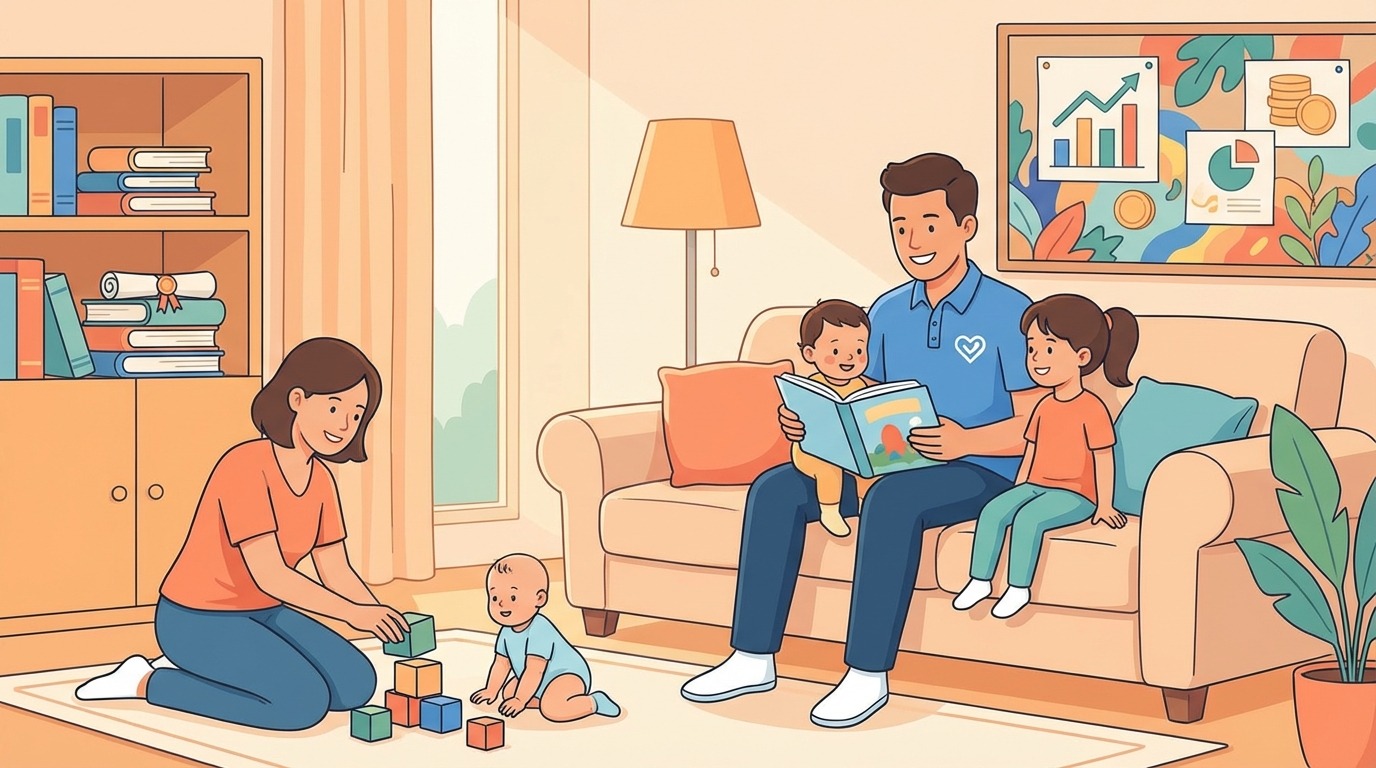
All about the profession of parental assistant: missions, training, and salary
| In Brief ✅ |
|---|
| The job of a parental assistant involves looking after children at the parents’ home 👶 |
| Various tasks: safety, care, meals, trips, stimulation, homework help 🧩 |
| No PMI approval required, but training reassures and enhances value 💼 |
| Key trainings: CAP AEPE, Bac pro ASSP/SAPAT, RNCP Childcare Certificate 🎓 |
| Salary close to the minimum wage, increasing with experience and diplomas 💶 |
| Two working modes: direct employment or through a childcare agency 🤝 |
| Possible career developments: childminder, ATSEM, collective reception structures 🚀 |
In many families, the parental assistant makes mornings smoother and evenings gentler. This trusted profession is at the heart of domestic life, playing a discreet but decisive role in children’s safety, stimulation, and emotional stability. It appeals to those retraining as well as profiles already rooted in early childhood, as it combines autonomy, a sense of service, and an educational relationship.
Demand remains strong, especially in large cities where extended hours complicate parental organization. Between shared care, direct employment, and agency solutions, several paths coexist, each with its advantages. Parents, increasingly informed, prefer professionals trained in child development and home safety, who can design age-appropriate activities.
On a daily basis, simple gestures make a difference: checking a Baby Stroller, preparing an Avent bottle, choosing a Mustela liniment, offering a Fisher-Price baby toy, or dressing comfortably with Petit Bateau and Vertbaudet. These well-thought-out details contribute to quality care. The following sections explore the tasks, training, and salary, to help make informed choices.
Becoming a parental assistant: daily tasks and a typical day at home
The core of the job is welcoming the child into their home and ensuring a safe and stimulating environment. A parental assistant provides regular cues, whether for a three-month-old infant or an eight-year-old schoolchild. These reference points offer comfort, reduce stress, and support autonomy.
The distinction with other related professions counts from the start. Unlike the childminder, who cares for children at their own home, the assistant works at the family’s home. To clarify the statuses, a detour via the difference between nanny and childminder helps understand the obligations and benefits of each care mode.
A well-paced typical day, from waking up to bedtime
In the morning, the routine starts with waking up, dressing, and a filling breakfast. The caregiver then prepares for school or daycare departure, checks the Baby Stroller, and anticipates the weather. During the day, she follows care, naps, and stimulation activities according to parental instructions. Late afternoon involves managing older children’s return, snacks, and homework. The evening routine of bath and dinner gently concludes the day.
Common brands naturally appear, without being mandatory. For example, an Avent bottle, a Dodie pacifier, a Mustela cleansing gel, or a Plein air sleeping bag by Petit Bateau. Fisher-Price toys can enrich stimulation times, while Vertbaudet clothes or a selection from Natalys ease outings. The Birth Book helps record major milestones, reassuring parents.
Varied tasks serving safety and stimulation
The assistant’s scope goes beyond simple care. It combines vigilance, pedagogy, and logistics. Hygiene gestures are rigorous, as is preparing balanced meals. Trips are organized with extra attention to road safety and outings to the park. Above all, each activity serves an educational purpose.
- Ensure children’s safety at all times 🛡️
- Prepare and provide meals, adapting textures based on age 🍽️
- Perform hygiene care and diaper changes gently 🧴
- Offer varied and sensory stimulation activities 🎨
- Accompany to school and extracurricular activities 🎒
- Help with homework and organizing the school bag ✏️
- Maintain child-related spaces: bedroom, kitchen, living room 🧹
Shared care requires fine coordination. Overlapping schedules and doubled trips must be anticipated. Communication remains key to avoid misunderstandings and respect each family’s habits.
To close this section, a simple principle applies: clear rituals and age-adjusted activities make the day smooth and secure.
Key skills, parental relationship, and working framework of the parental assistant
Beyond know-how, human qualities support the relationship. Parents seek someone organized, punctual, and caring. Patience helps get through a separation crisis, and autonomy sustains managing daily unforeseen events.
Expectations increase over time. Short trainings in home safety, first aid, or psychomotor stimulation reassure. Meanwhile, good communication with parents prevents most tensions. Preparing a logbook, sending a quick update at day’s end, and highlighting the child’s achievements show a high level of professionalism.
The trust relationship, pillar of the child’s well-being
An effective assistant establishes rituals, respects rhythm, and explains transitions. When separation becomes difficult, using a comfort toy, lullaby, or visual coding soothes. Carefully chosen words help secure the child, while stable cues promote emotional regulation.
On the parents’ side, transparency nourishes the alliance. Presenting a sample activity program, reminding nap rules, and suggesting adapted toys strengthen the framework. Concrete supports like a sleep tracking chart or meal schedule create a shared language.
Working in direct employment or through an agency
Two main frameworks predominate. Direct employment places parents as employers and the assistant as a declared employee. Procedures are through URSSAF. The relationship is direct, with pay negotiated case by case. Conversely, the agency manages the contract and ensures replacements. To compare, this guide on nanny vs childcare agency explains practical and financial differences.
The market evolves according to family needs. To gauge demand and trends, recent early childhood statistics provide useful references. They show the growth of home care and persistent pressure in some urban areas.
For a broader overview, a look at young children’s care modes helps evaluate alternatives: nurseries, childminders, mini-nurseries, and hybrid solutions. This vision enlightens families and candidates about the overall ecosystem.
Ultimately, the attitude mixes professionalism and human warmth. An assistant who listens, adjusts practices, and documents choices creates an environment conducive to flourishing.
Training to become a parental assistant: CAP AEPE, RNCP titles, and advanced courses
Many work without specific diplomas, but training strengthens employability. Parents, increasingly quality-conscious, value a CAP Accompanying Educational Early Childhood (formerly CAP Petite Enfance). This diploma covers child development, safety, hygiene, and educational relationships. It can be prepared onsite or remotely, depending on project and availability.
Other paths exist. The Bac pro ASSP and Bac pro SAPAT deepen the helping relationship and understanding of target groups. The RNCP Certificate Childminder / Childcare provides a short and professionalizing alternative. In retraining, the Professional Title Family Life Assistant strengthens autonomy skills and risk prevention at home.
First aid modules, certifications in stroller road safety, and accident prevention complement the base. For an updated overview, consulting sector data, such as early childhood statistics, helps guide training choices according to needs.
Recommended paths and selection criteria
Before choosing, it is useful to assess one’s project: caring for an infant, siblings of different ages, or shared care. The CAP AEPE remains the best-known route, especially to then apply for positions in nurseries or for ATSEM via competitive exams. The Bac pro opens other prospects, including animation, support in structures, or medico-social fields.
Continuing education offers flexibility. Alongside working, one can prepare a diploma or a certified title. Some centers offer support, and funding schemes exist depending on the situation. The aim remains the same: secure practice and enhance pay.
| Path 🎓 | Access 🧭 | Duration ⏳ | Advantages ⭐ |
|---|---|---|---|
| CAP AEPE | All audiences, ideal for retraining | 1 to 2 years | Comprehensive early childhood syllabus |
| RNCP Childcare Certificate | Low entry requirements | Few months | Professionalizing, quick to validate |
| Bac pro ASSP / SAPAT | Middle school/10th grade level | 3 years | Versatility, further studies |
| Family Life Assistant | Adult retraining | Variable | Home skills, prevention |
Internships and immersions remain decisive. They confront field realities: crying, shifted naps, dynamic siblings. A well-trained assistant manages these challenges calmly and methodically, relying on clear routines and concrete supports.
To close this section, a core idea stands out: training means gaining confidence, relational quality, and bargaining power.
Salary, contracts, and time management: everything you need to know
A parental assistant’s salary often aligns with the minimum wage, varying by city, experience, and diplomas. Shared care can boost the hourly rate, as responsibility increases. Split hours, common in after-school care, also affect overall pay.
The legal framework requires declaration via URSSAF and a clear work contract. Clauses detail working hours, trips, cleaning child-related spaces, and terms for unforeseen events. In direct employment, parents handle payment; through an agency, the company acts as employer.
Each year’s start updates the minimum wage and applicable agreements. Social oversight protects against surprises. To better position oneself among other options, a look at childcare modes sheds light on cost and organization comparisons.
Concrete examples of schedules and care options
An urban couple chooses full-time 45 hours over five days, with two daily naps for the youngest. A suburban family opts for after-school care from 4 pm to 7 pm, four days a week, plus full Wednesdays. Shared care involves coordinating two households to split trips and optimize quiet times.
Trips are central. The agreement may provide for using a sturdy Baby Stroller (e.g., Bébé Confort) for daily outings. Parents can reimburse transport subscriptions per contract. A basic kit, with Avent bottles, Dodie pacifiers, Mustela liniment, and Fisher-Price toys, eases logistics and limits forgetfulness.
Salary grows with expertise. A CAP AEPE, solid references, and infant specialization strengthen negotiations. In shared care, legal vigilance matters, as two employers coexist. To navigate, comparative resources like this nanny/agency options analysis help determine the best setup.
The key message is succinct: a clear contract and regular follow-up protect the relationship and quality of care.
Career developments, shared care, and medium-term orientation choices
The profession opens several paths. After a few years, some professionals turn towards becoming a childminder, welcoming children at their home. This requires adapted housing, mandatory training, and approval by PMI. This evolution answers the desire for stability and control over the care environment.
Others choose collective structures. With a CAP AEPE and experience, positions in nurseries or daycare centres arise. The ATSEM exam attracts those who enjoy supporting in kindergarten. The pedagogical advance gained in home care becomes a recognized asset.
Shared care: organization, benefits, and precautions
Shared care optimizes costs while maintaining a family environment. It involves two household employers and requires very precise coordination. Rules for moving between homes, holiday sharing, and equipment must be anticipated. A double kit (clothes from Petit Bateau or Vertbaudet, Mustela hygiene products, base Fisher-Price toys) avoids transporting items.
It is useful to write a common protocol, with screen time rules, food preferences, and nap organization. Families benefit from comparing educational frameworks. A shared document reduces differences and secures the assistant’s position.
For those hesitating between direct employment and agency, the summary here on the difference between direct employment and agency shows the options. The agency reassures on replacements and HR management, while direct employment strengthens autonomy and co-construction.
In the medium term, skill development matters. Modules on caring for children with special needs, parental guidance, or nutrition enrich the profile. Families quickly notice these additions as they transform daily life.
In short, thinking about one’s trajectory today helps align training, experience, and supported family projects.
Safety, equipment, and stimulation activities: methods and concrete ideas to succeed
A safe environment prevents most incidents. Rooms are tidy, cleaning products out of reach, and cords away. Basic actions repeat relentlessly: check bath temperature, secure the high chair, check Baby Stroller harnesses. This rigor pairs with the softness needed to welcome the young child.
Equipment doesn’t need to be luxurious to be suitable. A sturdy stroller (Bébé Confort), a few Avent or Dodie bottles, a Mustela liniment, Petit Bateau bodysuits, and a Fisher-Price playmat suffice. A book like The Birth Book logs progress, with a photo per month and some selected anecdotes.
Games and activities by age: ideas that hit the mark
Before one year, sensory stimulation mobilizes sight, hearing, and touch. Contrasts, soft textures, and lullabies invite exploration. Between one and three years, pouring activities, simple puzzles, and picture reading foster language and fine motor skills. From four years, symbolic games and small missions cultivate autonomy.
Holidays and seasons inspire projects. In autumn, a leaf collection feeds a collage workshop. In spring, a mini balcony garden promotes patience. When rainy, a blanket fort with Vertbaudet covers turns the living room into an imaginary world.
To deepen the idea box, a regular glance at resources on childcare modes provides inspirations and educational references. And to clarify professional frameworks, this guide on legal distinction nanny/childminder remains a practical reference.
One compass remains: offer simple, adapted, and joyful activities. The child learns better when they feel understood and encouraged.
Is approval required to be a parental assistant ?
No, PMI approval is not required. The parental assistant is an employee at the parents’ home. A work contract and URSSAF declaration are essential.
Which training should be preferred to start ?
CAP AEPE is the clearest path. Alternatives exist: RNCP Childcare Certificate, Bac pro ASSP/SAPAT, or Family Life Assistant, depending on the project.
How to evolve after a few years of experience ?
Two main paths: obtain approval to become a childminder, or aim for positions in structures (nursery, kindergarten via ATSEM exam).
What is the average salary ?
The salary is around the minimum wage, with increases linked to experience, diplomas, and complexity (infants, shared care, siblings).