Autism Spectrum Disorder: Understanding the Autism Spectrum Disorder (ASD).
The Autism Spectrum Disorder (ASD) is not a fixed label but a set of profiles that express themselves differently according to age, context, and environment. In early childhood, signs often emerge around 2 years old, between singular Social Communication, restricted interests, and marked Sensory Sensitivity. However, each child charts their own path: some speak early, others do not, many like routine, others explore at their own pace. The key challenge is to identify these specific needs and build tailored support to promote Neurodevelopment without suppressing personality.
Today, families are better informed, and society is progressing towards greater Inclusion. Professionals refine the Diagnosis and prescribe adapted plans, where Early Intervention opens valuable learning windows. It remains essential to avoid myths, highlight talents, organize calming environments, and provide concrete tools to relatives. Because the crucial question is not “what is missing?”, but “how can Behavior, strengths, and sensory preferences be understood to foster confidence?”. This perspective changes everything, from daily life to school, up to entering adulthood.
| Short on time? Here’s the essentials ⏱️ |
|---|
| ASD is a neurodevelopmental disorder present from birth, with signs varying according to the child. 🧠 |
| Early detection of particularities in social communication, interests, and sensory sensitivity helps to act quickly. 👀 |
| Early intervention improves autonomy, regulation, and daily learning. 🚀 |
| Diagnosis is clinical, made by trained professionals, following a multidisciplinary assessment. 🩺 |
| Inclusion becomes more effective with simple adaptations: visual routines, quiet spaces, guided choices. 🌈 |
ASD Definition: Understanding Autism Spectrum Disorder and the Shift from PDD to ASD
Talking about Autism in the modern sense is to recognize a spectrum that brings together several profiles. ASD has grouped since the DSM-5 entities formerly separated, such as infantile autism or Asperger’s syndrome. The aim is not to dilute differences but to reflect the diversity of manifestations, strengths, and support needs.
The term “spectrum” reminds us that we do not evaluate in “more or less autistic.” We rather map abilities along several axes: language, motor skills, social understanding, sensory management, flexibility. One child may speak well but experience difficulties with social implicitness. Another may be very comfortable with logic and get tired during transitions.
Historically, PDD (pervasive developmental disorders) served as an umbrella term. The classification has evolved because the boundaries between categories proved porous. Thus, Rett syndrome was removed from the spectrum due to its particular genetic nature. Childhood disintegrative disorder, very rare, followed the same path.
This terminological evolution has concrete benefits. Pathways become more coherent, assessments highlight skills, and recommendations consider profiles. At the core of the assessment remains the dyad: social communication on one hand, repetitive behaviors and restricted interests on the other.
Why does this precision matter daily? Because interventions are not applied wholesale. They adjust to strengths. A child captivated by letters may learn via written materials. Another, more sensitive to gestures, will progress with motor routines and pictograms.
A common thread runs through the literature: Neurodevelopment remains plastic throughout life. Although the first years are conducive to foundational learning, progress occurs at all ages. This finding gives renewed hope to families and educational teams.
Final decisive point: at the population level, recent estimates place Autism around 1 person in 100 to 1 in 127 depending on studies. This variation reflects the diversity of methods and better detection. It is thus a public health issue concerning school, city life, and employment.
In short, shifting from “rigid categories” to a spectrum fosters a nuanced reading of needs and personalized education. This is the foundation on which detection and targeted support rely.

Signs and Manifestations of ASD: Social Communication, Behaviors, and Sensoryity
Early signs often appear before age 3. Some children respond little to their name. Others rarely point or avoid prolonged eye contact. In terms of social communication, interaction may seem asymmetrical: few shared facial expressions, limited imitation play, difficulties decoding implicit cues.
Language particularities vary. Sometimes words arrive late. Sometimes the child speaks but repeats phrases (echolalia) or uses a monotone voice. Content can be precise, even encyclopedic, while struggling with two-way conversation. The intention is not absent; it is expressed differently.
Restricted interests form another pillar. Some line up cars, endlessly observe spinning objects, or focus on a specific theme. Routines reassure and structure. A sudden change can trigger real distress because anticipation remains difficult.
Sensory Sensitivity plays a central role. A humming fluorescent light can be unbearable. A clothing tag may irritate. Conversely, other children seek intense sensations like squeezing cushions or jumping. Understanding these needs avoids misunderstandings.
In daily life, here are useful warning signs:
- 👂 Does not react when called, without identified hearing disorder.
- 🧩 Difficulties with novelty, transitions, or too bright lighting.
- 🍽️ Food rigidity and intolerance to certain textures.
- 😴 Difficulties falling asleep, repeated very early wakings.
- 🤝 Few initiatives for shared play or “pretend” play.
For illustration, let’s imagine Samir, 2 and a half years old. He loves magnetic letters but gets upset by sudden changes. Structuring his day with a visual schedule and announcing transitions reduces crying. The behavior is not a tantrum; it signals a need for anticipation.
“Unexplained” tantrums often find a sensory or interactional trigger. Noise-cancelling headphones, a quiet corner, a binary choice (“do you prefer the book or the modeling clay?”) transform the experience. Prevention takes precedence over reaction.
Finally, a crucial reminder: attachment and ASD do not oppose each other. A child may love deeply without tolerating hugs. They express differently. Observing approach gestures, proximity rituals, furtive looks illuminates this bond. The goal remains to create a shared channel, not to impose a single code.
Early identification of these signals guides support that soothes, secures, and opens the path to functional learning.
This video selection helps to identify early markers in a nuanced way, emphasizing kind observation and environment adjustment.
ASD Diagnostic Pathway: Steps, Waiting Times, and Multidisciplinary Assessment
The Diagnosis relies on thorough clinical evaluation. The family doctor, pediatrics, or child psychiatry direct towards standardized assessments. The goal is to objectify behaviors and social communication across different contexts and to understand the sensory profile.
Several professionals usually participate: psychologist, speech therapist, occupational therapist, sometimes audiologist or neurologist. Structured observation tools are used. Short videos filmed at home, when taken respectfully, illustrate key situations difficult to reproduce in the office.
Families often face waiting times. In the public sector, the wait can last from 12 to 24 months depending on regions. The private sector shortens these delays but costs remain high. Some insurances cover part of the fees. Checking beforehand avoids surprises.
The diagnostic process also examines associated conditions: sleep disorders, anxiety, ADHD, motor or feeding particularities. This overall view prevents neglecting major needs that affect daily life. A frequent recommendation is to structure routines and set up a sensory space.
International data indicates a prevalence close to 1% to 1.2% of the population. The increase in diagnoses is mainly explained by finer detection and better access to information. In other words, visibility is improving, allowing earlier and more precise action.
It is essential to remind that no link exists between MMR vaccination and ASD. The historical controversy has been invalidated, and the professional behind the fraudulent study was condemned. Maintaining good vaccination coverage protects the most vulnerable.
Once the evaluation is completed, a detailed report presents strengths, challenges, and recommendations. It is not an end, it is a starting point. The first weeks serve to implement quick adaptations, even before more specific care is provided.
The central axis remains cooperation with the family and school. When a team understands the sensory profile, interest intensity, and comprehension level, communication becomes smoother and crises decrease. The diagnosis, well explained, provides keys to act, not barriers.
In brief, a quality diagnosis maps the profile and opens coherent support paths from home to classroom.
Early Intervention and Effective Support: From Home to Classroom
Early Intervention is one of the most powerful levers. It is not reduced to a single method. It combines complementary approaches according to the child’s priorities and living contexts. At the core are functional learning, sensory regulation, and shared enjoyment.
Classic axes include speech therapy, supporting oral and alternative language (gestures, pictograms, AAC), occupational therapy, which adjusts Sensory Sensitivity and everyday life skills, and psychoeducation, which structures routines and prevents crises. Developmental programs (ESDM), structured approaches (TEACCH), or behavioral methods often combine.
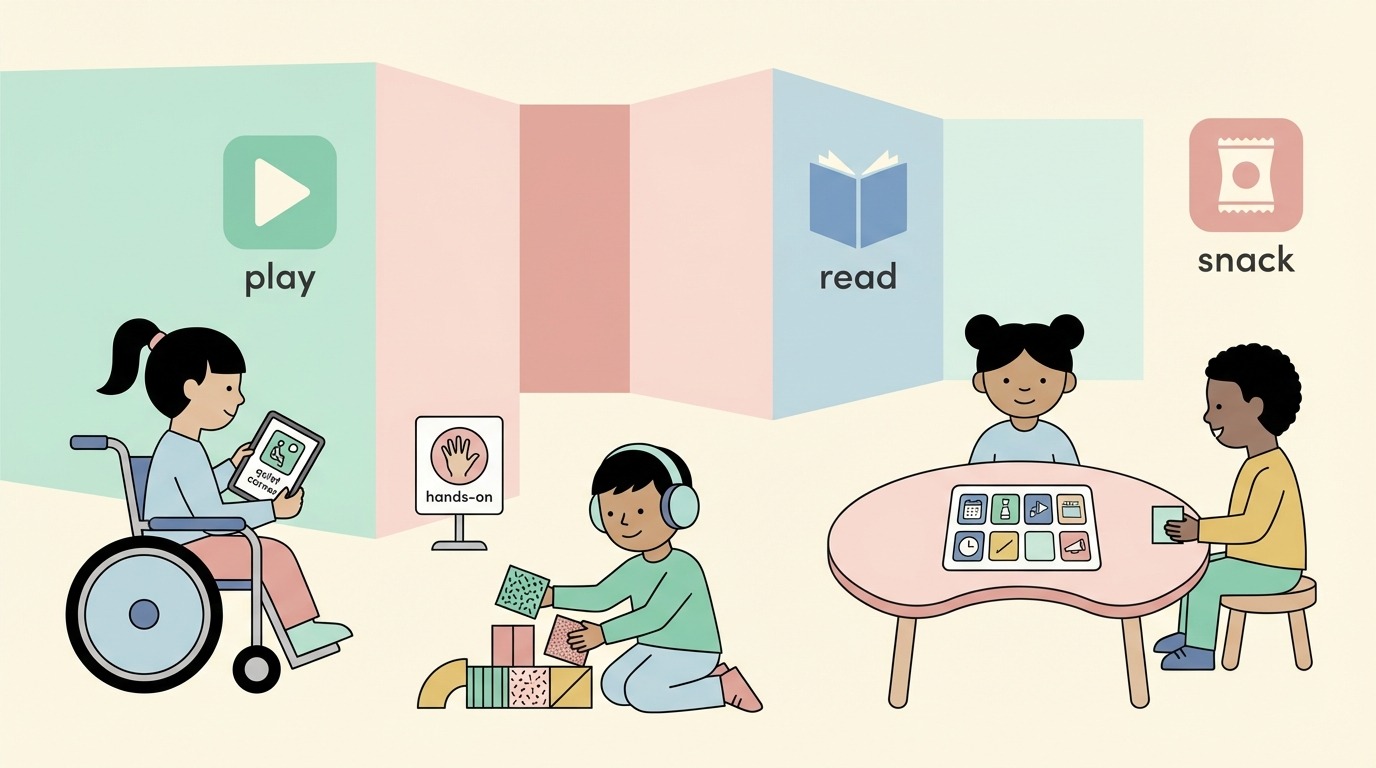
At home, visual routines help anticipate. A morning chart with three clear steps (washing, dressing, breakfast) reduces cognitive load. At school, a quiet corner, announced transitions, and a choice system support Inclusion in regular classrooms.
Here are some adjustments that make a difference:
- 🗓️ Simple visual agenda, updated daily, with photos or icons.
- 🔊 Noise reduction (noise-cancelling headphones, soft materials, quiet time scheduling).
- 🧺 Tolerated textiles and cut labels to limit discomfort.
- 🧩 Time dedicated to special interests as a learning lever.
- 🤝 Welcome and separation rituals to secure transitions.
A telling case: Chloé, 4 years old, loves puzzles. Educators turn this passion into a language tool: at each piece, a keyword. Sentences come, frustration decreases. Behavior calms when expectations become clear and motivating.
Parents play a crucial role. Professionals co-construct modest and measurable goals. Three minutes of quality exchanges are better than an hour of difficult exercises. Kind alliance produces lasting progress.
In some regions, rehabilitation centers and associations offer respite, workshops, and peer groups. These networks support family resilience and avoid isolation. Asking for help is not an admission of failure; it is an efficiency strategy.
Finally, measuring impact matters. A notebook “what works / what blocks” guides adjustments. When the environment is calibrated to the profile, the child gains autonomy and confidence, and the whole group breathes better.
These resources show how small adjustments, repeated consistently, consolidate joint attention, shared play, and functional communication.
Strengths, Inclusion, and Life Strategies: Growing with Autism at Every Stage
The Autism Spectrum Disorder does not prevent flourishing. Many develop remarkable skills: visual memory, attention to detail, consistency, creativity. The challenge is to turn these strengths into support points to learn, work, and live together.
Successful Inclusion relies on predictable environments, clear communication, and explicit expectations. Brief instructions, writing or pictograms, and sensory moderation favor engagement. Peers play a key role: when the class learns to decode, misunderstandings decrease.
In middle school, a support plan specifies adaptations and assessments. In adulthood, job integration improves when tasks match cognitive preferences. A position with structured instructions and few interruptions can enhance precision and perseverance.
Emotion management deserves a whole chapter. Crises do not signal willful opposition. They indicate overload. Building a self-calming repertoire (guided breathing, sensory corner, movement) reduces their frequency. Adults trained to detect early signals intervene before the peak.
Family life calms with evening routines, limited choices, and regular movement times. Meals become more peaceful when textures are separated, novelty introduced gradually, and preferences respected while offering options.
To organize daily life, this practical guide helps prioritize:
- 🎯 Clear functional goal (e.g., dress oneself up to the coat).
- 🧭 Adapted supports (pictograms, visual timer, short video model).
- 🔁 Brief, pleasant repetition at the same moment every day.
- 📈 Simple monitoring (two columns: “what helps / to review”).
- 🌟 Social reinforcement and special interest as drivers.
On the citizenship side, public places progress: quiet hours, softened lighting, fast routes. This sensory hospitality benefits everyone, including anxious or hypersensitive persons.
One last word on the culture of perspective. Valuing talents does not erase necessary efforts. But this changes the stance: we cooperate with the profile rather than go against it. This long-term alliance brings about positive, unique, and solid trajectories.
When strengths guide support, Autism becomes a way of being in the world that finds its place among others.
Quels sont les premiers signes à surveiller avant 3 ans ?
Moins de réponses au prénom, peu de pointage, contact visuel fuyant, intérêts restreints, besoin de routines, sensibilités sensorielles (bruits, textures). Ces indices ne suffisent pas seuls, mais leur regroupement justifie une évaluation.
Comment se déroule un diagnostic de TSA ?
Après un entretien initial, une équipe pluridisciplinaire observe la communication sociale et les comportements en s’appuyant sur des outils standardisés. Seuls médecins et psychologues formés posent le diagnostic, qui débouche sur des recommandations personnalisées.
Pourquoi l’intervention précoce est-elle si importante ?
Elle profite de la grande plasticité du neurodéveloppement. Des ajustements simples et réguliers accélèrent l’autonomie, la régulation et les apprentissages, en s’appuyant sur les intérêts de l’enfant.
L’autisme est-il lié aux vaccins ?
Non. Les études ont invalidé cette hypothèse. La vaccination RRO n’est pas associée au TSA, et la controverse historique provenait d’une fraude.
Comment favoriser l’inclusion à l’école ?
Clarifier les attentes, utiliser supports visuels, aménager un coin calme, expliciter les règles sociales, et former les pairs à la différence. Des gestes simples, répétés, changent l’ambiance de toute la classe.
“Understanding the profile is opening the door: inclusion is not a favor, it is a promise kept.”