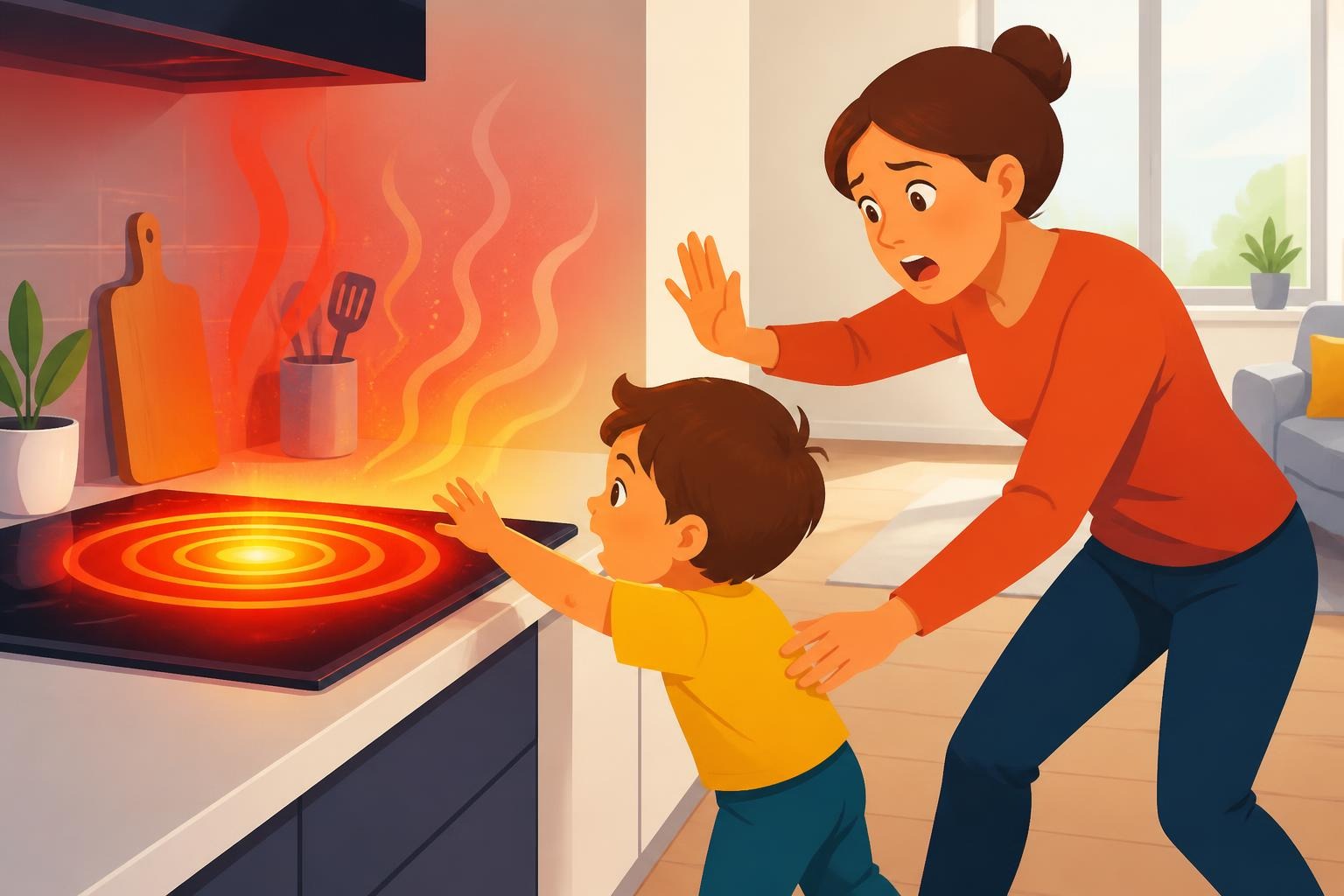
Hot surfaces: a risk often overlooked but formidable for parents
At 82°C, a contact burn can occur within seconds on exposed skin, a rough estimate recalled in public health messages during periods of high heat. The problem for families lies in the gap between the “bearable” air temperature and the burning surfaces that, themselves, overheat in the sun. A plastic slide, a car seat belt buckle, a patio slab, or a dark sidewalk can become real thermal traps, to the point of causing clear and immediate burns. In real life, it rarely looks like a Hollywood scenario: a child sliding “just to see,” a quick outing “just to buy bread,” or a break at the park “just five minutes.” And it is precisely this everyday aspect that makes it an unknown danger.
The difficulty for attentive parents is that it’s not just about monitoring hydration, sun exposure, and sunscreen. You must also identify risk zones and integrate mini children’s safety reflexes: test with the hand, cover, shift schedules, equip little feet, ventilate the car. The goal is not to live under a bell jar but to reduce a domestic and outdoor risk that is often underestimated, with simple and realistic accident prevention.
In brief
- Burning surfaces (plastic, metal, asphalt, sand) can cause burns within seconds during high heat.
- Playgrounds exposed to the sun (slides, swing chains) concentrate risk zones that must be systematically tested by hand.
- In the car, metal buckles, car seat fasteners, and armrests heat up quickly: ventilation, sunshades, and checks before installing the child.
- Floors (concrete, asphalt, slabs) require child foot protection: closed sandals, light shoes, water shoes depending on the location.
- In case of a burn: cool immediately with tap water, remove any clothing not stuck to the skin, and call 15 or 112 if the lesion is extensive, deep, or located on a sensitive area.
Burning surfaces in summer: understanding the unknown danger for child safety
The trap with burning surfaces is that they don’t just “follow” the air temperature. Materials absorb and store the sun’s energy, then release it upon skin contact. An adult often gets away with a reflexive withdrawal and a creative curse. A young child, however, has more delicate skin, a slower reaction, and sometimes an intense emotional attachment to the idea of “sliding again right away.” Result: burns that may seem disproportionate compared to the announced weather.
Attentive parents deal with a risk that changes face depending on the location. At the beach, sand can become harsh on the soles of the feet. In the city, asphalt and slabs store high heat and turn a stroll in a stroller into a “ground lava” course. At home, a composite terrace, a windowsill, a balcony railing or even a gate handle can surprise. This is not an “exotic danger,” it is a domestic risk hiding in plain sight.
Accident prevention is based on a very concrete point: contact burns don’t need long exposure to occur. Prevention messages often cite orders of magnitude where a few seconds are enough when the surface reaches very high temperatures, around 82°C in some public health reminders. This speed changes everything in the strategy: forbidding “after the fact” is useless if the damage is done; you must test beforehand, adapt beforehand, equip beforehand.
This subject also deserves a useful clarification: the sun is not the only culprit. An object can heat simply because it is dark, dense, or poorly ventilated. Dark colors absorb more radiation. Smooth surfaces, like some plastics, give a “harmless” false impression until contact. Even late in the morning, a slide can already be too hot, especially if the playground faces directly south without shade.
To help identify risk areas, a practical rule works well: if an adult’s hand cannot remain on a surface for 5 seconds without discomfort, a child’s skin should not be exposed. This “flat hand” check doesn’t replace an infrared thermometer but fits the field, snack bags, strollers, and real schedules. Effective child safety is often a two-second routine, repeated without negotiation.
Playgrounds, slides, and metal: typical risk zones when high heat sets in
In parks, the classic mistake is believing that “if there’s wind, it’s okay.” Wind cools perceived air but does not necessarily neutralize a surface that has already accumulated energy. Metal and plastic structures are particularly concerned, with very concrete contact points: slides, platforms, handles, steps, swing seats, chains. Risk zones are not always those people look at first: a side bar or a heated handrail can be enough to cause a localized burn.
The slide concentrates all the problem’s conditions: a large surface exposed to the sun, a material that can heat quickly, and a gesture of use that multiplies contact points (thighs, hands, sometimes belly if sliding turns into an “ironing board”). Parental accounts regularly circulate, including in mainstream press, about children burned on the upper legs after passing over an overheated slide. Such accidents are especially tricky because they occur during an activity considered “healthy” and supervised.
Accident prevention here is very practical: choose the schedules. Early morning and late afternoon, the sun hits structures less intensely, and shade progresses. A park may be acceptable at 09:30 but problematic at 12:30, without the official temperature changing radically. Another lever is favoring shaded playgrounds, those equipped with shade sails or located under trees. Shade does not “guarantee” everything but greatly reduces the temperature rise of equipment.
A simple reflex improves child safety: test every contact point before use. An adult’s hand acts as a quick sensor. The test deserves repetition, because a surface heats up over minutes. To avoid a “live drama” at the moment of forbidding, it also helps to offer a concrete alternative: water games, shaded area, ground activities on a towel, or even a snack break in the shade. A child’s brain better accepts frustration when one option replaces another.
The funny yet very real aspect is that some equipment seems designed to test parental patience: metal handles “grill style,” black seats “cooking plate option,” and chains that seem to say “hello, I’ve been in the sun all morning.” The idea is not to turn every outing into a technical inspection but to integrate a quick scan. A vigilant parent does not need to anticipate everything, just avoid the most predictable traps.
To visualize risks in playgrounds and prevention advice, targeted video searches allow viewing concrete demonstrations and feedback.
Car in full sun: car seat, metal buckles, and contact burns
A car parked in the sun combines bad thermal ideas: a closed cabin, windows letting in radiation, materials that heat quickly, then direct contact points with the skin. For young children, the car seat adds a constraint: installation takes time, so contact with a hot buckle or burning fastener can last more than just an extra second. Burns can affect thighs, hands, belly, sometimes back if a seat part overheated.
Risk zones are known but surprising because they are small: metal buckles, anchors, clips, fasteners, harness elements, plastic armrests, accessible dashboard parts, even some handles. A contact burn doesn’t need a “glowing” object to be serious. A child’s skin reacts quickly, and discomfort can become pain in an instant.
The car accident prevention protocol is organized around short actions. First, seek shade when possible, even if it means walking 50 more meters. Then ventilate: open doors a few minutes before installing the child to evacuate the hottest air. A sunshade reduces direct sunlight on the dashboard and limits heating of some surfaces. Testing contact zones by hand before placing the child helps avoid unpleasant surprises when everyone is already buckled and rushed.
Accessories can help, with a simple logic: insert a layer. A light towel on certain exposed parts, adapted covers, or specific harness pads depending on the model. You must remain attentive to child safety: any addition must be compatible with the car seat, as an inappropriate accessory can degrade restraint effectiveness in a crash. For this point, the seat manufacturer’s recommendations and official road safety recalls remain the basis.
The biggest trap, organization-wise, is the “express trip.” The temptation is to prepare nothing because “it’s just 10 minutes.” However, it is precisely on these micro-trips that vigilant parents lower their guard: no sunshade, no test, no ventilation. A ultra-short routine (open, ventilate, touch the buckle, then install) takes less time than a crying child and cooling skin.
For demonstrations on cabin heating and prevention gestures, videos raising awareness about heatwaves and car risks clearly illustrate temperature reality.
Asphalt, terraces, sand: floor risk zones and child protection solutions
The ground is a classic underestimated risk because you don’t “touch it” with the hand before walking. Asphalt, concrete, patio slabs, pool edges: these surfaces strongly store high heat. An adult in shoes doesn’t think about it. A barefoot child or one in very open sandals is fully exposed. Burns then affect the soles of the feet, sometimes toes, and can complicate walking for several days.
The beach brings its own version of the problem. Sand can be burning, especially near dry areas, and the passage “from parasol to water” becomes a sprint. Play areas with wood chips or soft coverings are also concerned: absence of metal doesn’t mean absence of burning surfaces. Dark coverings heat more. Poorly ventilated zones, trapped between structures, heat faster.
Child foot protection is one of the most effective and simplest long-term measures. Light shoes, closed sandals, or water shoes at the beach limit direct contact. For the pool, water shoes also reduce slipping risk, adding a layer of accident prevention. The choice must remain comfortable: if the shoe is annoying, the child will take it off as soon as the parent’s back is turned, with ruthless logic.
Another lever is arrangement. On a terrace, a light outdoor rug or shaded areas (parasols, sails, pergolas) reduce slab heating. For outings, shifting movements to cooler hours remains a robust strategy. Attentive parents already do this to avoid sunburn, but the interest is also to limit contact burns. Good timing protects skin from UV and burning surfaces without adding equipment.
To objectify differences between materials, a comparative table helps prioritize risk zones. Exact temperature figures vary depending on sunlight, color, wind, and latitude, but the caution level can be graded by surface type and exposure.
| Common surface | Heat storage capacity | Speed of temperature rise in the sun | Risk of contact burn | Most useful child protection measure |
|---|---|---|---|---|
| Dark asphalt / bitumen | High | Fast | High (feet, hands in case of fall) | Light shoes, avoid noon, shaded paths |
| Concrete / stone slabs | High | Medium to fast | High (bare feet, sitting on the ground) | Light rug, shade, closed sandals |
| Playground plastic (slide) | Medium | Fast | High (thighs, hands) | Hand test, morning/evening schedules, shaded area |
| Metal (chains, handles, bars) | Variable | Very fast | High (hands, thin skin) | Hand test, temporary cover, avoid full sun |
| Dry sand | Medium | Fast | Medium to high (feet) | Water shoes, wet zones, shaded walkways |
The daily-changing point is fall management. A child who stumbles on hot ground instinctively puts hands down, then knees. The risk concerns not only walking but the typical “hands-knees-thighs” cascade during play. Preventing falls is impossible, but limiting exposure (shoes, schedules, terrain choice) reduces consequences when they happen.
First actions in case of burns: what to do and daily accident prevention
When a burn occurs, the first minutes count. French fire and rescue services’ guidelines generally recall a simple logic: cool, protect, assess. Cooling is done with fresh but not icy tap water, pouring over the area for several minutes. This step aims to limit heat progression in tissues, especially for a contact burn caused by a very hot surface.
Removing clothes is useful if easily done and if the fabric is not stuck to the skin. If a garment adheres, removal can worsen the injury. In that case, it is better to keep it in place and continue cooling around it, then seek medical advice. Greasy substances and “home remedies” are not allies: they can trap heat and complicate care. The goal is to keep the area clean and limit further damage.
Assessment is the most stressful part for vigilant parents because it requires deciding quickly. You must call 15 (SAMU) or 112 if the burn is extensive, if it involves the face, hands, genitals, a major joint, or if the child is very young. Large blisters, intense pain, whitish or blackened areas, or unusual behavior (drowsiness, agitation) should also prompt rapid consultation. A burn is not “small” just because it is localized: its depth and location determine severity.
Accident prevention is also built after the event, with a mini domestic investigation. Which surface caused the burn? At what time of day? What object was left in the sun? A bicycle seat, a stroller, a hard plastic toy left outside, a picnic table, a metal railing: the list of risk zones is long, and it is often the most mundane object that wins the “most treacherous” contest. Putting toys away indoors or in a shelter, covering exposed surfaces with a light fabric, and establishing tactile testing before use greatly reduce recurrences.
To make these reflexes sustainable, a short checklist helps more than a long speech. It can be mentally displayed before outings, like a “summer” routine alongside sunscreen.
- Test contact points (slide, handle, chain, bench) by hand before the child settles.
- Dress the feet: light shoes, closed sandals, water shoes depending on terrain.
- Ventilate the car before installation and touch the car seat buckle/fasteners.
- Favor shaded places and morning/evening hours during high heat periods.
- Store or cover objects left outside (stroller, toys, bike seat, tables).
Effective child safety doesn’t require heroic vigilance but repeatable reflexes even when everyone is hot, hungry, and very eager to go home.
What do we say about it?
Burning surfaces must be treated as a full domestic risk, at the same level as power outlets or household products, because a contact burn happens quickly and surprises even attentive parents. Playgrounds and cars concentrate the most frequent risk areas, so these are the two places where “test-ventilate-cover” reflexes have the best yield. The most effective measure remains the simplest: check by hand before contact, then adjust schedules and equipment. If a child is old enough to understand, the learning “touch first with an adult’s hand” greatly reduces repeated accidents. In practice, better to give up a hot slide than manage a burn and several days of dressings.
How long should a burn be cooled under water?
Cooling should last several minutes with fresh tap water, without ice. The goal is to lower the temperature of the tissues after contact with a very hot surface. If the pain persists strongly or blisters appear, medical advice is recommended, especially for a young child.
Is a slide in the shade necessarily safe?
Shade reduces heating but does not guarantee a cold surface. A structure may have accumulated heat before being shaded, or remain hot due to poor ventilation. Testing with the hand before use remains the most reliable and fastest way to decide if the child can play risk-free of burns.
Which shoes should be favored to avoid ground burns in summer?
Closed light shoes or closed sandals better protect the soles than flip-flops. At the beach or around a pool, water shoes limit contact with hot sand or overheated slabs. The ideal model is the one the child wears for a long time without trying to take off.
What signs require calling 15 or 112?
You must call quickly if the burn is extensive, if it affects the face, hands, genitals, or a joint, or if the child is very young. Large blisters, whitish or blackened areas, intense pain, or unusual state (drowsiness, agitation) also justify urgent medical evaluation.