« Sephora Kids »: The surprising number of young girls who discovered nail polish before the age of 10
In Brief
- According to the Flashs survey for the Poderm laboratory conducted from 03/06/2026 to 03/09/2026 among 2,000 adults, 60% of French people say they look at the hands first when meeting someone.
- According to the same survey, 22% of women say they wore nail polish before the age of 10, with a sharp increase among 18-24 year olds (52%).
- The “Sephora Kids” trend is part of a very ritualized childlike beauty, often inspired by routine and “haul” videos, where children’s cosmetics or adult products circulate.
- Esthetic manicure practices come with pressure: 20% of women feel “naked” without polish, 65% feel uncomfortable when the manicure is no longer fresh, and nearly 70% dedicate a monthly budget to it (Flashs x Poderm survey).
- Families can limit risks by favoring appropriate formulas (junior makeup, peelable nail polish, products compliant with European regulations) and reserving application for special occasions.
From 03/06/2026 to 03/09/2026, a survey conducted by the Flashs agency for the Poderm laboratory interviewed 2,000 French men and women aged 18 and over about their manicure habits, and the results provide a strange measure of the times: hands have become a business card, and nail polish a small personal flag. In this representative sample, 60% of respondents say they look at hands first when meeting someone. It’s the kind of statistic that makes you smile… until the moment it shines a spotlight on the rise of “Sephora Kids.”
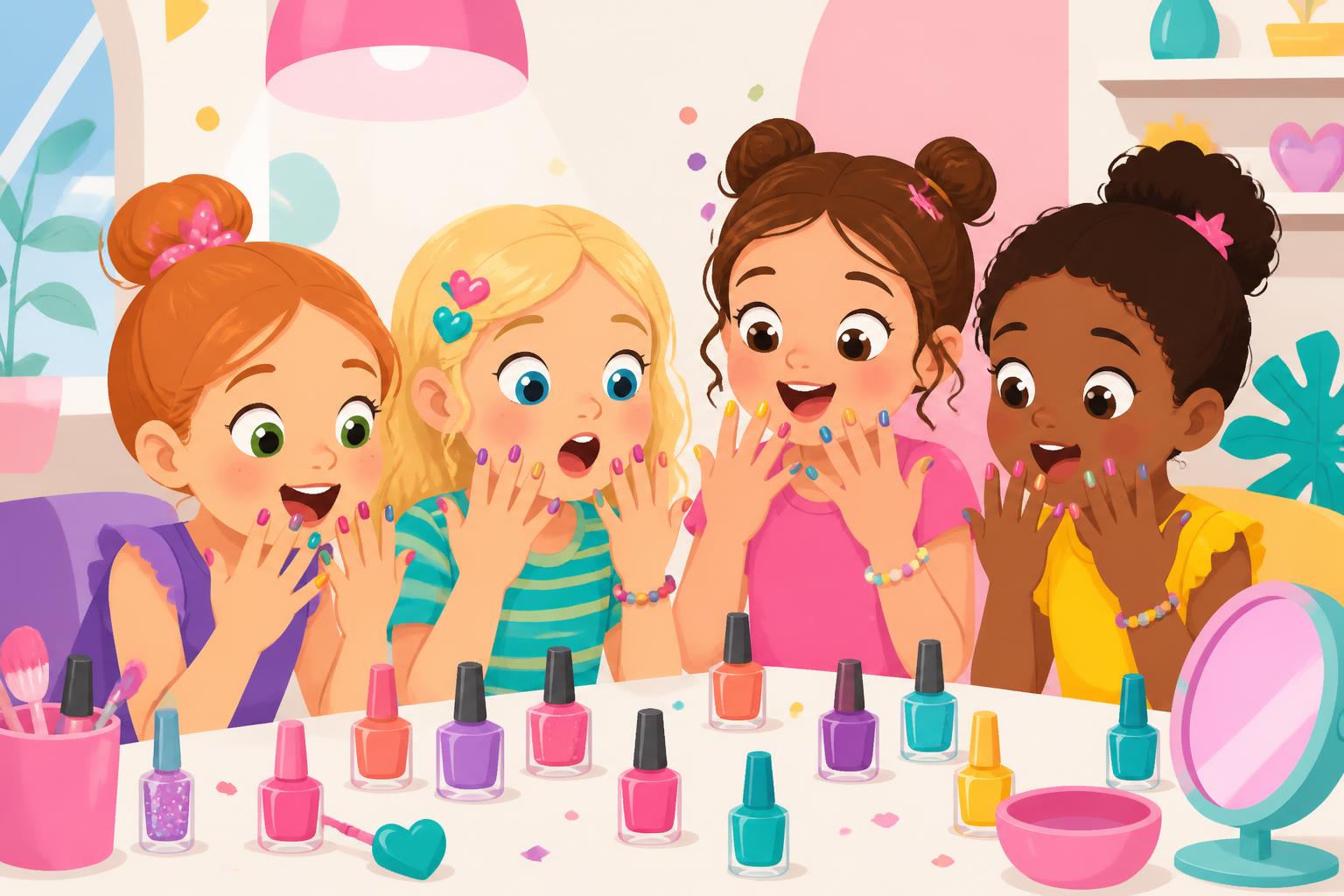
Because beyond adults, beauty initiation happens early. Still according to this survey, 22% of women say they wore nail polish before age 10, and the proportion rises to 52% among 18-24 year olds. This figure hits a reality of everyday life: young girls pick up skincare and manicure gestures seen online, compare textures, comment on shades, and transform discovering children’s cosmetics into a mini social ritual. The issue is not to demonize a color on a nail, but to understand what changes when “playing grown-up” turns into a routine, purchase, and sometimes exposure to poorly chosen products.
“Sephora Kids” and nail polish: what the numbers say about discovery before age 10
The most telling data does not come from a viral video, but from a questionnaire. The Flashs x Poderm survey (fieldwork from 03/06/2026 to 03/09/2026) is based on 2,000 adult respondents, with a sub-sample of 1,041 women. Among them, 843 report practicing manicure for cosmetic purposes, that is maintenance, trimming, and often polishing. The important information is not only that manicure is widely practiced, but that it carries codes: 20% of women feel “naked” without polish, 65% feel embarrassed or neglected when the manicure is no longer fresh, and nearly 70% devote a monthly budget to it.
This aesthetic pressure, even if it remains “adult” on paper, trickles down. Children’s trends are rarely created in the silence of a bathroom. They circulate at school, in families, on social networks, and in aisles where “cute” packaging and the “glow” promise speak to the youngest. In this context, discovering nail polish before age 10 is nothing like a UFO: it becomes another milestone in socialization by appearance, just as choosing sneakers or a bag was yesterday.
The most striking point in the survey remains the generational progression on the age of first polish. Overall, 22% of women say they wore polish before age 10. But when results are broken down by age group, the gap becomes dizzying: 52% among 18-24 year olds, 39% among 25-34 year olds, 15% among 35-49 year olds, 10% among 50-64 year olds, and 1% among 65 and over. The reading is simple: the younger the age, the more early polish becomes commonplace.
An explanation holds in three very concrete elements. First, visibility: beauty gestures are filmed, replayed, commented upon, and “before/after” is a universal grammar. Then, accessibility: nail polish can be found everywhere, is easily given, and often costs less than foundation. Finally, symbolism: on one hand, a color is immediately visible, giving a feeling of “doing like others.” For many young girls, beauty initiation begins with what is most quickly noticed in a group photo.
The “Sephora Kids” phenomenon does not mean all children run to buy sophisticated serums. It rather describes an acceleration of codes, where routine becomes a marker. Nail polish, in this logic, is the gateway product: it does not require complex technique, but gives an “instagrammable” result in a few minutes. The signal sent is clear: appearance is managed, planned, and shown.
Why hands obsess so much: manicure, aesthetic pressure and imitation among young girls
That 60% of French people say they look at hands first (Flashs x Poderm survey, fieldwork 03/06/2026 to 03/09/2026) tells a social fact: the hand is a detail impossible to “mute.” It moves, holds the phone, signs, eats, greets. In an era when many relations are through rapid images, hands are a permanent background. They take the spotlight in stories, on keyboards, and even on vacation photos. Manicure then becomes a way to control a visible element, simpler to “maintain” than full makeup.
Among adults, this logic comes with a widespread discourse: “at least the nails are done.” The Flashs x Poderm survey quantifies this feeling: 65% of women feel embarrassed or neglected when their manicure is no longer fresh. This is not an isolated vanity; it is a mild but tenacious norm. And mild norms are often those children notice fastest, because they slip into daily phrases without needing to be announced.
In the Sephora Kids sphere, this norm is even more paradoxical. On one side, childlike beauty claims play, dressing up, color. On the other, it copies highly coded adult routines: perfect filing, neat cuticles, “nude” shades, shiny top coat. Even the way to hold a bottle or wait for it to dry is mimicked. Young girls do not just imitate a result; they replay a staging, that of beauty influencers explaining their products, steps, and “must-haves.”
Another figure from the survey helps understand the background: nearly 7 out of 10 women devote a monthly budget to manicure. Even if the amount is unspecified, regularity counts. A monthly expense installs a simple idea in a household: nail care is part of the routine, like shampoo or toothpaste. At this point, the child does not need polish to be “sold” to them: they see it, associate it with a habit, and ask to participate.
The funniest (and sometimes most tiring) thing in family life is that childlike demand often comes at the worst time: five minutes before going out, or just when the second shoe needs to be found. Manicure then becomes a negotiation ground. “A quick coat” turns into a complete workshop, and the little discovery is charged with stakes of control, patience, and rules. A beauty routine, even a miniature one, remains a routine: it takes time, material, and organization. When it starts early, it competes with other activities, and that is where the issue becomes educational.
Pressure is not only external. For some children, the idea that a “bare” nail is “unfinished” can take hold, especially if the environment highly values appearance. Polish becomes a sign of belonging, and removing it a kind of “missed update.” The takeaway is that manicure is not neutral: it is a social language, and the youngest learn it quickly.
Video platforms accelerate this dynamic because they turn a technical step into a show. A nail polish application at home looks like a little craft. In video, it becomes a transformation, with a beginning, middle, end, and sometimes a “star” product.
This format encourages reproduction, especially when content is presented as “easy” and “fast.” The consequence is very concrete: demand increases, but supervision does not always follow, and unsuitable products can enter the family bathroom.
Products, ingredients and safety: what childlike beauty can imply on the health side
Nail polish is often seen as “less engaging” than face makeup because it is applied on a hard surface and removed. However, the health issue is not limited to the nail. Solvents, perfumes, colorants, plasticizers, or resins vary according to formulas, and frequency of use changes exposure. The issue becomes more sensitive when beauty initiation starts early, as repetition can last for years, especially if children’s trends encourage collecting shades.
The Flashs x Poderm survey recalls a contextual point: the cosmetics market is crossed by controversial ingredients, sometimes from petrochemicals, and substances that may be or possibly are endocrine disruptors. The survey text also mentions the arrival of low-cost products sold on poorly controlled online platforms, with ingredients that may be banned in France because considered dangerous. In a family, this translates to a simple risk: buying “as seen in video” without checking origin, compliance, or INCI list.
For children’s cosmetics, the question is not to aim for perfect purity but to reduce avoidable risk factors. Some common-sense steps are easy to adopt without turning the bathroom into a lab. Check that the product is indeed intended for children when applicable, avoid “fantasy” nail polishes without clear labeling, beware of cheap kits without safety information, and prioritize peelable water-based formulas for the youngest, which limit solvent use. The remover, specifically, is often the most aggressive part of the story: strong smell, skin contact, and the temptation to “rub quickly.”
The most common and banal risk is also the most frequent: irritation. A child who polishes often may touch their eyes, put fingers in their mouth, or scratch flaking polish. This very down-to-earth reality explains why caution is not a moral panic. The key is to adapt the product to age and keep a reasonable frequency. For a birthday or dance gala, a supervised application does not have the same impact as a weekly routine.
The question of “long routines” like Sephora Kids poses an additional problem: layering. A polish may be added to a scented cream, a glitter spray, a gloss, then a “fun” mask. Taken separately, each product seems harmless. Taken together, the child manipulates many formulas, and the probability of skin reaction increases, especially if skin is sensitive. Here, parental control is not about banning everything but about limiting the number of items and choosing identified products.
The European cosmetics regulation (Regulation (EC) No 1223/2009) imposes a safety framework, notably on banned substances and labeling obligations. The problem arises when products are bought outside reliable circuits, or when counterfeits circulate. The child does not distinguish between a “cute” compliant bottle and a dubious product. The adult does.
Practical purchase checklist for a “children’s” polish or junior makeup
To avoid discovery turning into a headache, a short list helps sort without spending the evening. It does not replace medical advice in case of allergy, but it reduces classic mistakes.
- Complete labeling in French: product name, content, usage precautions, market authorization holder.
- Product clearly intended for children (or failing that, occasional supervised use for a simple adult product).
- Water-based peelable formula for the youngest, to limit remover use.
- Avoid “no-brand” lots or those without information, especially on marketplaces.
- Test on a small skin area when relevant, and stop immediately in case of redness.
- Store out of reach of young children: spilled polish on a couch is hard to clean, and ingestion is a risk.
This practical framework puts adults in control without turning childlike beauty into an anxiety topic. The goal remains for play to stay play, and for the product not to impose its rule in daily life.
“Sephora Kids” routines at home: framing beauty initiation without turning the bathroom into a conflict zone
When a child takes an interest in children’s cosmetics, the temptation is twofold. First option: allow everything because “it’s only nail polish.” Second option: refuse everything because “it’s too early.” In real life, especially on a Wednesday afternoon, neither strategy lasts long. The most effective framework looks more like a traffic rule: occasions, limits, and chosen products.
The Flashs x Poderm survey numbers help understand why the subject quickly becomes emotional. If 20% of women say they feel “naked” without polish, the child picks up this message, even if it has never been voiced in front of them. If 65% feel embarrassed when manicure is no longer fresh, it establishes the idea that a visible detail must remain “perfect.” Yet a child has neither skill, patience, nor motor interest to maintain a perfect polish for several days. The family risk is multiplying touch-ups, thus removers, thus irritations, and ending up angry… over a glitter chip.
A simple framework is to reserve application for events: end-of-year parties, birthdays, shows, weddings, or vacations. Manicure becomes an accessory like a costume. In this format, the child experiences discovery before 10 as an experience, not an obligation. In other words, the product does not organize the family schedule. This exception logic also avoids the race to collect, where every novelty becomes “essential” because seen in a video.
The second pillar is usage education. A polish, even “for children,” requires some rules: do not put fingers in the mouth during application, wait for drying, do not sleep immediately after a thick layer, and wash hands. These micro-skills serve elsewhere. They turn beauty initiation into learning patience, which is much more useful than a top coat.
The budget question also deserves to be raised, as the survey indicates nearly 7 out of 10 women dedicate a monthly manicure budget. In a household, a child may confuse “budget” and “right.” A good compromise is to limit the number of available products and avoid impulsive purchases. A small selection of colors, renewed rarely, suffices. The rest is more about a fashion effect than a need.
There is also a self-esteem dimension. For some young girls, polish is a way to feel “grown-up.” For others, it is a social integration tool. In both cases, the adult can reframe the meaning: polish is for fun, not to be acceptable. The nuance lies in everyday words: complimenting color creativity rather than a “that looks clean” changes the validation axis.
Video content plays a practical role: it shows techniques, routines, and makes you want to try. The point of vigilance is that many videos showcase numerous products, sometimes expensive, and long routines. At home, a “short workshop” format limits frustration and reduces handling.
This type of tutorial, when chosen by the adult, can become an educational support: watch, comment, then adapt to family reality. The result is often calmer than solo viewing, where the child mainly retains the promise of “new products.”
| Measurable indicator | Result | Scope | Source |
|---|---|---|---|
| People saying they look at hands first | 60% | Adults in France, 2,000 respondents | Flashs survey for Poderm (fieldwork 03/06/2026 to 03/09/2026) |
| Women who wore nail polish before age 10 | 22% | Women (sub-sample of 1,041) | Flashs survey for Poderm |
| Polish use before age 10 among 18-24 year olds | 52% | Women 18-24 years old | Flashs survey for Poderm |
| Women feeling embarrassed/neglected when manicure is no longer fresh | 65% | Women | Flashs survey for Poderm |
This table says one very concrete thing: the “small detail” has become a social reference, and precocity is also explained by the environment. When the norm is visible, it ends up being imitated.
What do we say about it?
The figure of 52% of women aged 18-24 having worn nail polish before age 10 (Flashs x Poderm survey) confirms that beauty initiation is happening earlier and earlier, and that the Sephora Kids trend is part of a broader movement. The priority for families is not to ban color but to take back control over frequency and product choice, especially facing low-cost purchases that are hard to trace. Occasional application, with an adapted peelable polish and simple rules, limits exposure and prevents manicure from becoming a social obligation. The weak point of the phenomenon is long routines and the multiplication of products, which increase risks of irritation and install unnecessary aesthetic pressure at this age.
At what age can a child start wearing nail polish?
There is no single age, but caution increases when application becomes frequent. For discovery before age 10, the simplest framework is occasional use (parties, shows) with a water-based peelable polish and supervised application. In case of reactive skin or eczema, it is better to seek medical advice before multiplying trials.
What is the difference between “children’s” nail polish and classic nail polish?
Children’s nail polishes are often formulated to be removed more easily, sometimes without remover, which reduces exposure to solvents. They remain cosmetic products and must be properly labeled and used under supervision. Classic polish can be suitable on occasion for a preteen, but generally involves remover and longer wear, thus more handling.
How to identify a suspicious junior makeup or children’s cosmetic product?
A frequent warning sign is the absence of clear labeling in French (precautions, responsible party, composition). Very cheap lots without identifiable brand, especially on marketplaces, are also to be avoided. Favor recognized channels and check the ingredient list to reduce risk. In case of very strong smell or irritation, stop immediately.
How to manage pressure from children’s trends at school or on social media?
The most effective is to set a stable rule: defined occasions, a limited number of products, and no impulsive “seen in video” purchases. A discussion time about what is shown online helps distinguish play (colors, creativity) from the norm (“you have to be perfect”). The routine must remain short and adapted to daily family life to avoid conflicts and retouches.