PARENTS Survey: Hidden Cameras and Spy Apps, Diving into the Wild West of Nanny Surveillance
In Brief
- According to Global Market Insights, the global market for connected home security cameras reached 7.76 billion dollars in 2024, with a projection of nearly doubling by 2034.
- An Ipsos survey conducted for the Observatory of Parenting and Digital Education (OPEN) and Unaf in 2022 indicated that 41% of parents reported having already used parental control software.
- Kaspersky reported in a survey published in 2021 that 30% of surveyed users had already felt monitored by a partner or close person through surveillance applications.
- The show “Le téléphone sonne,” hosted by Fabienne Sintès on France Inter, dedicated its May 25, 2026 program to PARENTS’ investigation on nanny remote monitoring.
- Hidden cameras, concealed microphones, spy apps: these practices often fall within an illegal framework when targeting an adult without their knowledge, with a real legal risk for parents.
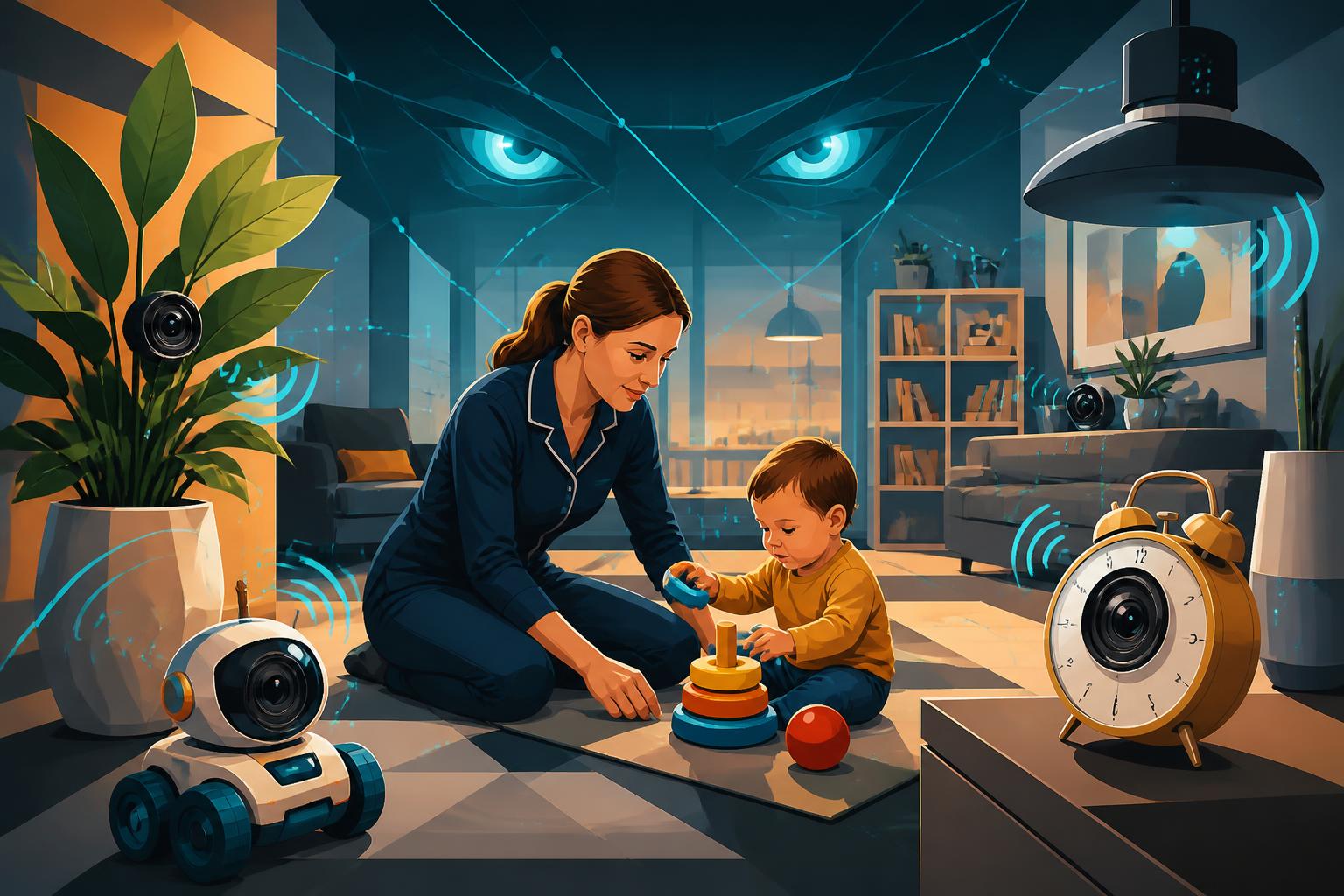
On May 25, 2026, the show “Le téléphone sonne” hosted by Fabienne Sintès on France Inter took on a topic gaining ground in living rooms as well as during school pick-up conversations: the PARENTS investigation into the clandestine surveillance of nannies. Cameras hidden behind a green plant, microphones slipped into a soft toy, spy applications installed “to check”… Technology makes these actions easy, quick, and sometimes almost “too” accessible for adults already overwhelmed between meetings, guilt, and fear of abuse.
The setting is that of a domestic wild west, where child safety serves as a hammer argument, while the private life of the adult who cares for the child becomes an adjustment variable. This shift is not just a gadget story: it is also part of a growing market. Global Market Insights estimated that the global market for connected home security cameras was worth 7.76 billion dollars in 2024 and could almost double by 2034. When supply explodes, uses follow, and the rules are often discovered afterwards… at the worst time.
PARENTS Investigation: how hidden cameras are becoming normalized in childcare
The stated promise is simple: “see to reassure oneself.” In fact, the PARENTS investigation describes a murkier movement, where parents shift from vigilance to surveillance, then to spying. The nuance is not just vocabulary: it changes everything legally and relationally. A camera installed to prevent a burglary does not carry the same meaning as a device aimed at the couch “where the nanny sits,” hoping to catch a phrase, a gesture, an intonation.
What accelerates the tipping point is the technical ease. A Wi‑Fi camera can be installed in five minutes, a mini-camera plugs into a USB port, a video baby monitor is set up via an app. Family life loves what can be configured between two laundry loads. The problem is that the “practical” tool becomes a tool for continuous observation, especially when notifications activate (“motion detected,” “sound detected”). At this stage, the temptation to open the feed during a meeting is no longer a movie scene: it’s a reflex, and sometimes a compulsion.
The market also pushes from behind. Global Market Insights estimates the global market for connected home security cameras at 7.76 billion dollars in 2024, with a near doubling trajectory by 2034. A growing market brings smaller, cheaper, and more “invisible” products. Yet, in a home, the more discreet an object is, the more it is forgotten… including by those who installed it. The camera becomes part of the décor, like the tissue box or the essential oil diffuser.
Everyday objects repurposed: when the “cute camera” becomes a control camera
The investigation mentions devices camouflaged in mundane objects: stuffed animals, alarm clocks, photo frames, fake smoke detectors. The common point is ambiguity: a “normal” object does not arouse suspicion. In a home, the nanny can go weeks without realizing that a lens is aimed at the play corner. This blur fuels a form of unilateral surveillance, where an adult works in a private place without knowing the rules of the place.
The most biting point (in a dark humor way, but real) is that these objects are sometimes installed without even an initial intention to “trap.” Many parents buy a camera to monitor the entrance, then realize the angle also covers the living room. The day worry arises, all it takes is to say “by the way, we have footage.” Technology did not create parental anxiety but gives it a “play” button. The next section then faces the least fun question: the law and privacy.
Nanny surveillance and privacy: what the legal framework makes (really) risky
Monitoring one’s home and filming an adult without their knowledge, that’s not the same story. In childcare, the child safety argument often serves as a “master key.” Yet, the law does not like master keys. When a device captures the image or sound of an identified or identifiable person, the question of privacy and consent becomes central, especially if recording is continuous, if sound is captured, or if images are viewed live remotely.
The first risk is the evidence turning against the person who produced it. A family may believe they are “building a case” and discover that the recording itself is problematic. The second, more everyday risk, lies in the working relationship: trust does not last long with total asymmetry. When the nanny learns of a hidden camera after several weeks, the effect is not a calm discussion about safety. It’s a break, sometimes immediate, sometimes explosive, almost always lasting.
Another high-risk area concerns audio. Many parents think “filming is less serious than listening.” In practice, capturing conversations, even “banal” ones, can expose intimate elements: calls with a doctor, discussions with a partner, confidences with the child. In a home, blind spots are rare. The camera does not need to be intrusive to record what should not be recorded.
Table: comparison of devices and measurable settings that change the scope of recording
The issue is not only the existence of a camera, but its settings and capabilities. Two devices may look alike and produce very different effects depending on resolution, audio, motion detection, and remote access.
| Device type | Video resolution (typical) | Audio | Detection (motion/sound) | Remote access | Storage (typical) |
|---|---|---|---|---|---|
| Indoor Wi‑Fi camera | 1080p to 2K | Often built-in microphone | Motion, sometimes sound | Yes (app) | Cloud and/or microSD card |
| Connected video baby monitor | 720p to 1080p | Microphone + speaker | Sound (crying), sometimes motion | Sometimes (depending on model) | Local, sometimes cloud |
| Hidden mini-camera (object) | 720p to 1080p | Variable, sometimes active | Often motion | Sometimes (Wi‑Fi) or no | Often microSD |
| Hidden audio recorder | Not applicable | Yes (main feature) | Activation by sound (depending on model) | Rare | Internal memory |
This table highlights a concrete point: remote access changes the nature of the use. A recording viewed in real time from the office transforms a home into a monitoring station. And when the tool is always at hand, the temptation for a “quick check” can become a repetitive behavior, wearing down the relationship as much as the parents’ mental balance. The next section is interested in the other face of the phenomenon: spy apps, often even more opaque than cameras.
Spy apps: the smartphone side of the surveillance wild west
When the camera monitors a space, the spy app targets a person via their phone. The symbolic leap is huge. In stories linked to the PARENTS investigation, these tools sometimes appear as a “less visible” solution than the camera. Yet invisibility is precisely what makes the terrain slippery. Installing surveillance software on a device, retrieving messages, tracking a location, or consulting activity history moves control to someone’s pocket.
The spread of control practices in families is by no means anecdotal. The Ipsos survey conducted for the Observatory of Parenting and Digital Education (OPEN) and Unaf in 2022 indicated that 41% of parents claimed to have already used parental control software. This figure does not mean that 41% install spy applications on adults, but it shows a familiarity with the idea of “supervising via an app.” The technical gesture is known, therefore transferable, sometimes without measuring the change in legal and ethical status.
Another useful indicator to understand the climate: Kaspersky reported in a survey published in 2021 that 30% of surveyed users felt monitored by a partner or close person via surveillance apps. Again, the figure does not target only the world of nannies. It shows a context where “close relative” surveillance is no longer marginal. In a home employment relationship, this type of tool adds a layer of vulnerability because the surveilled person also depends on the salary.
What a “sees” an app and why the control/spying boundary is thin
The app store vocabulary reassures: “tracking,” “protection,” “control.” Reality depends on functionalities. A classic parental control, set on a child’s phone, aims to limit certain uses. A spy app, however, is characterized by discretion (background operation), collection (messages, calls, location), and sometimes data exfiltration (sending data to a dashboard).
In the childcare context, the temptation is twofold: to check that the nanny does not spend “too much time” on their phone, or to obtain a record in case of doubt. The first motive quickly leads to intrusive management. The second turns the relationship into a permanent procedure. Even when the initial intention is child safety, the tool creates an atmosphere of suspicion, and the child often ends up picking up on the tension.
A rarely anticipated detail: these tools can also expose the family. A poorly secured device, a shared account, a weak password, and it is not only living room images circulating but scenes of life, habits, sometimes children’s faces. Technology is not neutral: it adds a new risk, that of leakage, which did not exist when trust was the only “system.” The next section gets concrete: how parents can seek safety without turning the home into a control room.
Child safety without spying: concrete methods, clear rules, and assumed tools
The starting point is often healthy: avoid danger, detect a problem, protect a baby. The problem arises when the response is disproportionate or hidden. Yet parents have options that reduce risk without directly attacking privacy. The first measure, very basic and very effective, is to formalize what is expected: routines, safety instructions, screen rules, room access, authorized persons to enter, permitted outings. It’s not glamorous, but it’s clear.
The second measure is to professionalize the relationship. A contract, defined schedules, regular check-ins, a handover sheet (meals, naps, incidents). Many conflicts arise from fuzziness: “we said,” “we thought,” “we believed.” Replacing fuzziness with a written record lowers pressure and reduces the need to “check in secret.” The third lever is organization: reasonable unannounced visits, the relay of a relative, or a gradual adaptation period during which a parent is present at the start.
List: realistic alternatives to clandestine surveillance, tested in real family life
- Set up an adaptation period of 2 to 5 days where a parent remains partly at home (telework or staggered hours).
- Use a daily handover sheet with meal times, nap, diaper changes, outings, and note small incidents.
- Organize a weekly 10 to 15-minute check-in to adjust rules and avoid frustration buildup.
- Clarify child safety instructions in writing: medications out of reach, locked doors, fever protocols.
- Plan a replacement procedure (contact list, agency, family relay) to avoid decisions taken under stress.
- If a camera device already exists for home security, inform explicitly and define the filmed areas, absence of audio, and conditions for image access.
The last point is what changes the atmosphere. An acknowledged, declared camera, limited to a clear objective (for example the entrance) does not have the same impact as a hidden system. A childcare relationship works better when the rules are visible, in the literal sense. Transparency also reduces the risk of a “discovery” conflict, which is often more destructive than the initial problem.
There remains a very 2026 factor: the piling up of technologies at home, from baby monitors to routers, passing through connected objects. The near future of parenting will not only be about more efficient tools but also about families forced to learn domestic cybersecurity reflexes. A unique password for the whole household is the digital equivalent of leaving the key under the doormat, with a neon sign “it’s here.”
Technology and the future: towards what family model when surveillance becomes a reflex
The question is not to demonize technology. Cameras, sensors, applications have legitimate uses, including for child safety. The real issue is the automation of mistrust. When notifications mark the day (“motion detected”), the mind can start looking for signs, interpreting, reconstructing scenarios. In an already rushed family, this mental load adds to others and is not trivial.
A side effect also appears for children. A child growing up in a highly instrumented environment may internalize that adults observe everything, all the time. This can change the perception of intimacy and trust, especially if the child overhears a conversation about footage or understands that the nanny is being “tested.” The triangular parent-child-nanny relationship is fragile: it feeds on alignment and educational coherence, not a hidden eye in a corner.
Practically, the immediate future looks like a more connected home, therefore more exposed. The growing market for connected cameras, estimated by Global Market Insights, anticipates more equipment and more interconnections. More devices mean more accounts, more updates, more blind spots. In this configuration, parents who seek to “control everything” risk wasting time on tools and missing out on the human relationship: recruitment, exchanges, direct observation of the child’s well-being.
The role of media and public debates in normalizing (or not) these practices
The fact that France Inter dedicated a whole show on May 25, 2026, to the PARENTS investigation shows that the subject is no longer confined to obscure forums. When a phenomenon arrives in a mainstream radio debate, it changes status. It becomes debatable, contestable, and potentially regulatable. This visibility can help families understand they are not alone facing their fears, and that the alternative to secrecy exists: talk, frame, verify differently.
The future of connected parenting will also be played out on domestic norms: explaining to the nanny which objects are connected, who has access to what, and how accounts are protected. This feels like a constraint, but it’s also a form of professional respect. Childcare is not a “service like any other” because the space is intimate and the emotional stakes are huge. Bringing technology into this framework requires clearer rules than “we’ll see.”
What do we think?
Clandestine nanny surveillance is a poor response to a valid fear: it weakens the trust relationship and exposes parents to legal troubles without guaranteeing better child safety. A technology that is assumed, declared, and limited to a clear objective (securing an entrance, for example) is defensible, but the hidden device and concealed audio tip into risky territory. Spy apps add an extra opacity and turn home employment into permanent control. The strongest recommendation is to first invest in framing (contract, written rules, regular meetings) and digital security (passwords, updates), before seeking evidence behind an invisible lens.
Is a camera declared to the nanny acceptable in a home?
In practice, a camera announced and limited to a precise purpose (for example the entrance) greatly reduces the risk of conflict, as the person knows of its existence and can adapt their behavior. The crucial point remains proportionality: avoid intimate living areas, limit access to images, and clarify usage rules in writing. Audio, in particular, increases the device’s sensitivity.
What signs should alert to a drift towards compulsive surveillance?
Repeated video feed consultations during work, activation of sound/motion notifications in living areas, or rewatching images to interpret details (tone of voice, ordinary gestures) are frequent signals. Another alert is the disappearance of dialogue: when verification replaces discussion, the relationship becomes tense. In this case, reframing the rules and having regular check-ins is better than a new tool.
How to protect the child’s privacy if the home is equipped with connected objects?
The basis is securing accounts (unique and long passwords, two-factor authentication when available) and keeping updates up to date. It is also useful to limit the number of devices and disable cloud storage if not necessary. Finally, specify who has access to feeds and delete shared accounts to prevent family images from circulating beyond the intended circle.
Is parental control the same as spy apps?
No. Parental control generally targets a minor’s phone with a framing objective (screen time, filters, restrictions), ideally accompanied by an explicit family agreement. Spy apps aim to operate discreetly to collect data on a person, often without clear information. In a nanny context, confusion between the two fuels intrusive uses.