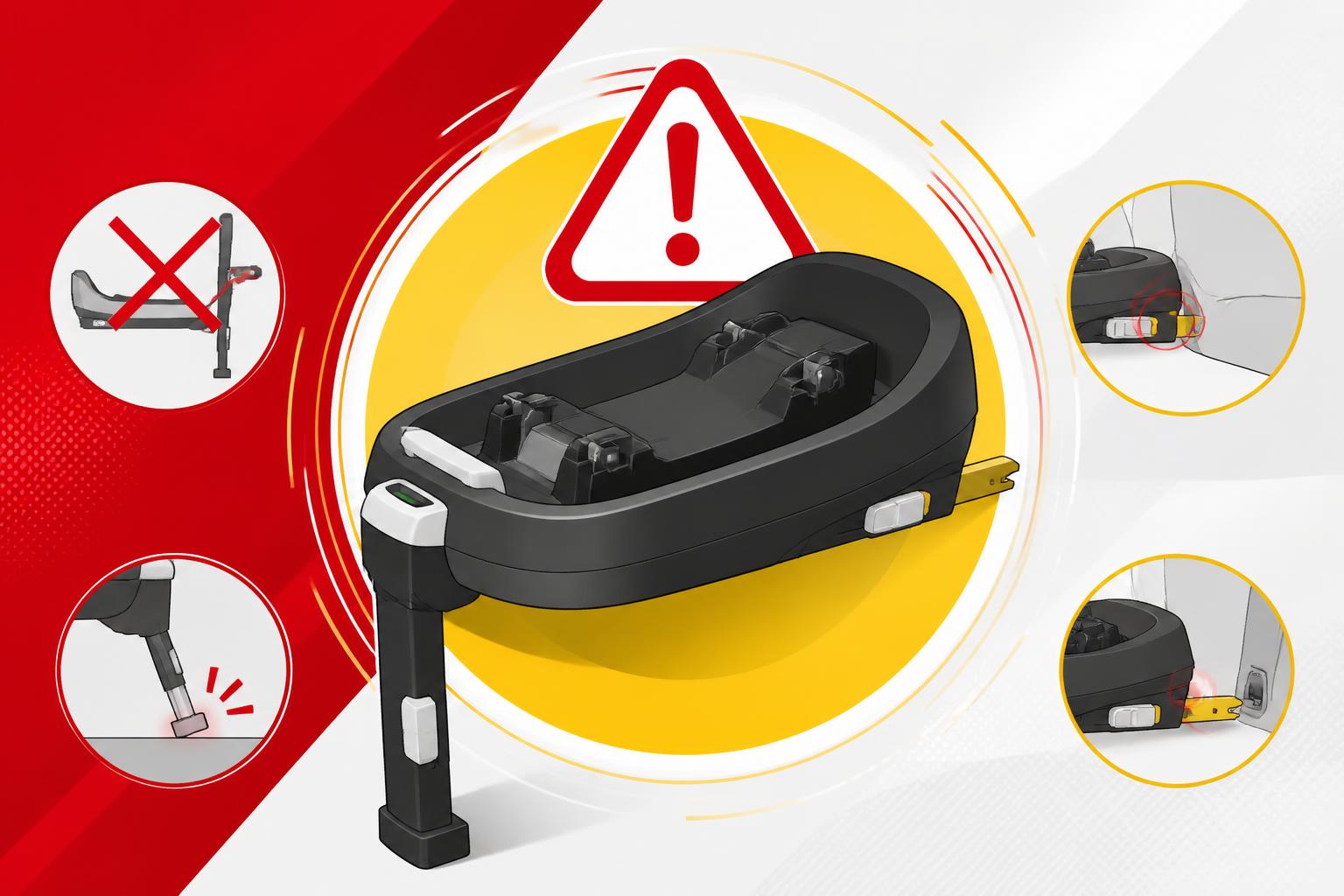
Product alert: caution with the Maxi-Cosi FamilyFix Slide Pro base!
In Brief
- Product alert: the Maxi-Cosi FamilyFix Slide Pro car seat base requires increased vigilance during installation and adjustments.
- Child safety often depends on a very down-to-earth trio: seat/base compatibility, proper locking, and absence of play once clipped.
- A product recall, when it exists, should be verified through official channels (brand, retailer) and public reporting platforms, without relying solely on a shared screenshot.
- Safety standards (R129/i-Size in Europe) govern approval, but do not prevent user errors: car seat installation remains the sensitive point.
- In 2026, the useful reflex remains the same: read the manual, check the indicators, then do a “doors closed” check before each departure.
On June 20, 2023, the European regulation R129 (called i-Size) became the standard for the approval of new car seats sold in the European Union, progressively replacing the former R44/04 logic. This technical framework has improved clarity in terms of sizes and tests, but it does not turn complicated installations into instant magic. In this context, any Product Alert concerning a car seat base should be handled without panic and without minimization, especially when the product aims at baby protection from the very first trips.
The FamilyFix Slide Pro base from Maxi-Cosi is precisely an accessory that promises to make everyday life easier by facilitating seat installation and handling. However, between the promise and real life, there is often a rushed adult, a sloped parking lot, a coat that is too thick, and that little “click” you think you heard. Caution: a base can be compliant with safety standards and still become a risk source if compatibility, locking, or indicators are misunderstood. The goal here is clear: to identify concrete vigilance points, the right checks to perform, and the right places to verify a potential product recall without falling into rumor hunting.
Product Alert on the FamilyFix Slide Pro from Maxi-Cosi: What Should Truly Raise Concern
The first point to clarify is what an “alert” means in everyday language. Among parents, it can mean three different things: an official product recall announced formally, a malfunction report from users, or a confusion linked to incorrect car seat installation. The three do not call for the same reaction, nor the same urgency, and especially not the same information source.
A product recall, strictly speaking, corresponds to a formal action: a manufacturer and/or distributor requests to stop use, verify a batch number, replace a part, or return the item. This type of information must be consultable via the brand, retailer, or a public recall platform. In contrast, an “alert” shared on a discussion group can be useful to spot a frequent difficulty, but does not prove a design defect.
On a car seat base like the FamilyFix Slide Pro, signals that should trigger immediate verification are very concrete: a locking indicator that stays red, a persistent clicking noise once the seat is clipped, a support leg that does not lock onto the floor, or excessive lateral movement. In a car, a “little play” may seem harmless until you realize the play stemmed from an incomplete attachment. Child safety here is a matter of millimeters, not intuition.
Caution also includes compatibility. A base is not a universal charger: a given seat may be designed to clip onto some base models and not others. Mixing “similar” references is a classic error, because partial locking can give an impression of security. A parent might say “it holds, so it’s okay,” while a pull test (firmly pulling upward and forward) would show the lock was not engaged.
Another important point: usage environment. A very thick floor mat, a loaded trunk slightly deforming the bench, or a fully reclined driver seat can interfere with the support leg or the base angle. A product designed to be “plug and play” can turn into “plug and pray” if the car’s configuration imposes compromises. The right reflex is to redo a full installation, calmly, on flat ground, then note what changes when the car is full (stroller, suitcases, passengers).
The key takeaway is that the useful alert is not the one that makes noise: it’s the one that encourages checking, documenting (photos of indicators, exact reference), and asking for official confirmation if a product recall is mentioned. A base is not just an accessory; it is the anchor point of baby protection.
Car Seat Installation with a Car Seat Base: Common Mistakes and How to Avoid Them
On paper, an ISOFIX base simplifies car seat installation: fix the base, then clip the seat. In real life, mistakes often slip in the “automatic” gestures. The first very common mistake is stopping at the first click. Some systems may produce a partial locking sound. It is necessary to check the visual indicators provided by the manufacturer and not trust the ear alone, especially in a noisy parking lot.
The second common mistake: forgetting that the support leg is not an aesthetic detail. It contributes to stability and force management in a crash. A leg poorly positioned on a floor storage compartment (present in some car models) can cause a real problem. Car manufacturers sometimes indicate restrictions or filler accessories for these cases. When the base manual explicitly mentions this point, it is not a “just in case” warning but a child safety condition.
Third trap: thick coats and bulky footmuffs, which concern the seat harness more than the base but directly impact baby protection. A harness too loose because the puffer jacket “inflates” creates an illusion of comfort and a real sliding risk in braking. In 2026, prevention campaigns continue to hammer this point as it remains a repeated source of errors. The right compromise: cover the child after strapping them in, not before.
To make checks more reliable, a simple routine really helps. It’s nothing glamorous but avoids forgetting on tired days:
- Verify exact seat/base compatibility in the manual or on the official manufacturer list.
- Check that ISOFIX connectors are fully engaged and indicators are green.
- Install the support leg on an appropriate floor, without resting on a fragile cover.
- Shake the base and seat (firmly) to detect abnormal play.
- Do a quick check before each departure, especially after moving the base.
There is also a “logistics” error: moving the base between two cars thinking the installation is the same. ISOFIX anchors do not all have the same accessibility; seats do not all have the same angle; and some vehicles have specific features (floor storage, very inclined seats). The FamilyFix Slide Pro, like any car seat base, must be considered an installation to be revalidated with each vehicle change.
One last point causes a smile but it happens: objects stuck under the base (toy, pacifier, parking card) creating uneven support. A base must rest flat and without parasitic constraint. Caution here involves treating the bench as a “zero clutter” zone, at least under and around contact points.
A video demonstration focused on reading indicators and checking play can help spot missing gestures, especially if the manual seems too dense. The goal is not to learn by imitation but to compare one’s own installation to the expected steps.
Safety Standards, i-Size R129 and Child Safety: What the Regulations Guarantee and What They Do Not
The word “standards” reassures, sometimes wrongly. Safety standards govern testing and approval requirements but do not replace correct installation. Since June 20, 2023, the R129 (i-Size) regulation has become the standard for new car seats in the European Union. It notably requires side impact tests and a classification based on child height rather than weight. This evolution has made some choices simpler for families, especially when selecting a model.
For a car seat base, approval means that the set base + compatible seats meets precise criteria under defined test conditions. It does not mean the base is “universal.” Manufacturers publish compatibility lists that are often updated. Ignoring this list risks creating an “almost” correct installation, thus hard to detect by the naked eye.
The second misunderstanding concerns the notion of “slide” or sliding mechanism (when the product offers to bring the seat closer to facilitate access). This type of feature improves usage comfort but adds an additional mechanical zone. A mechanical zone potentially means one more locking step, and one more step is one more chance to make a mistake. The point is not to say it’s bad, but to remind that caution must increase with complexity, especially when parental fatigue turns a simple gesture into an approximate movement.
Child safety also depends on the consistency of the whole. A very high performing base will not compensate a poorly tightened harness, a too reclined seat, or use outside size limits. Manuals specify size ranges and sometimes weight limits, and these figures are not decorative. They ensure baby protection works in the tested zone.
In daily life, “on-site” verification remains the best ally: indicators green, absence of play, support leg properly positioned, and seat not moving abnormally. Safety standards govern design, while installation validates the promise. A family can buy an excellent product and create a fragile assembly in two minutes if steps are skipped.
To put things in a broader context, it is useful to know that regulations evolve stepwise, with transition periods and habits that persist. In 2026, R44/04 seats still circulate because they were bought before the switch and remain authorized for use. This coexistence fosters confusion between systems, sizes, accessories, and compatibilities. In this context, the most useful alert is the one that encourages rereading the product’s exact reference, not the one that settles for “it’s the same”.
Product Recall: How to Verify Information and What to Do Immediately at Home
When the word product recall appears, the temptation is strong to do just one thing: search fast, click fast, share fast. Bad idea. The first step is to verify the info on an official channel because a recall almost always has precise criteria: exact model, commercial reference, batch numbers, manufacturing period, or defect description. A blurry photo of a screen doesn’t allow a conclusion and can even trigger unnecessary callbacks saturating customer services.
The immediate actions can be done without waiting. If a car seat base raises serious doubt (incoherent indicators, unstable locking, part that seems abnormal), use must be suspended. Baby protection is not an experimental field. One must switch back to seat belt if the seat allows and if it complies with the manual or use another approved system. The goal is to eliminate risk during verification.
Second reflex: precisely identify the product. This involves the label, often located under the base, with the reference and sometimes the serial number. Note this information, take clear photos, and keep proof of purchase (email, invoice) to facilitate support in case of a confirmed recall. This preparation saves time and avoids describing “a black base with a button,” which, let’s admit it, also describes half the gadgets in the house.
Then, verification must include the installation context. A base may seem “defective” because it is mounted on an incompatible seat, or because a floor compartment prevents the support leg from working properly. Redoing the installation on the recommended rear seat, on flat ground, then rereading the manual steps allows differentiating a material defect from user error. Caution: the goal is not to “prove oneself right,” but to eliminate the most frequent causes.
This section is also an opportunity to address a rarely discussed topic in “car seat” articles: privacy. When a family searches for a product recall, they often encounter banners asking to accept or refuse cookies, with content and advertising personalization options. The explanations provided by Google indicate cookies may be used to maintain services, measure audience, secure against fraud, and, if the user accepts, personalize content and ads, with a “Reject all” option limiting these additional uses. Google also specifies access to management tools via g.co/privacytools. In a stressful situation, clicking randomly is common, but taking 30 seconds to choose “More options” and adjust settings avoids turning a child safety search into an involuntary subscription to targeted advertising.
Finally, if an official recall concerns the FamilyFix Slide Pro, the brand and retailer generally indicate the procedure: stop use, inspection, replacement, repair, or refund depending on the case. A clear file (reference, photos, proof of purchase) avoids back-and-forth. The time saved becomes peace of mind, and that is already a small logistical victory in a parental day.
| Measurable Check | What is Expected | What Risk it Reduces | When to Do It |
|---|---|---|---|
| Locking Indicators | Indicators in green (base and seat, depending on the model) | Incomplete clipping, disengagement under traction | At every installation and after moving |
| Seat Play Once Clipped | Limited movement, no abnormal “floating” | Instability in braking, loss of alignment | Before the day’s first trip |
| Position of the Support Leg | Firm support on appropriate floor, locking validated | Excessive rotation in impact, poor force distribution | After vehicle or seat change |
| Seat/Base Compatibility | Reference explicitly listed as compatible | Partial locking, use outside approval | Before purchase and initial use |
Everyday Baby Protection: Realistic Practices to Limit Risks Without Becoming a Finished Works Inspector
Baby protection in the car is built with simple, repeated, and above all realistic gestures. Perfect but impossible advice ends up ignored. A good plan is to integrate base control into a routine that already exists: close the door, check the harness, then glance at indicators. Two seconds, not twenty minutes. The goal is to spot gross errors, not reinvent a laboratory.
It is also useful to treat the car as a “place of procedure.” An adult can be very rigorous at home and become approximate on the sidewalk when it’s raining and everyone is hungry. Preparing adjustments calmly reduces improvisations: strap length, handle position if the seat is a shell, and angle adjustment if provided. The FamilyFix Slide Pro base, like other systems, requires a clear understanding of what locks and what moves.
Daily mistakes often concern the harness and clothing. A thick garment hampers tightening, a hat slips over the eyes and encourages loosening “for comfort,” a comforter becomes an improvised headrest. On the road, these compromises come at a cost. Child safety does not rely on cute accessories but on respecting the restraint trajectories provided by the seat. When an accessory is not supplied or validated by the manufacturer, one must double caution.
For families juggling several drivers, a source of concern is “human variation.” One person always installs perfectly, another “more or less.” A simple solution is to display a mini checklist on the phone or stick it in the household’s shared notes app. No military tone needed: just four stable items. In a family, the comedic repetition also works for safety, as long as the repetition focuses on the right gestures.
Another useful practice: have the installation checked by a professional during a prevention event, when locally available, or by a trained retailer. Many specialized stores offer checks and demonstrations. This does not replace reading the manual but helps spot misinterpretations, for example, an ISOFIX connector not fully engaged because the bench hinders access.
Finally, digital has its place but without excess. Searching for a video tutorial, comparing photos of indicators, reading user feedback can help understand a specific point. One must keep a simple rule: the manufacturer’s manual and approval take precedence over a viral video. Popular content can be very well made but does not have the value of an official procedure. Clearly, the internet can help learn but not override safety standards.
This approach avoids paranoia while strengthening baby protection: a short routine, visual checks, and a firm refusal of “it’ll be fine as is” when an indicator says otherwise.
A video focused on routine checks (play, indicators, support leg, harness) helps set a reproducible method, especially when several adults take turns on journeys.
What Do We Say?
The Maxi-Cosi FamilyFix Slide Pro base can be convenient, but it requires rigorous installation and systematic indicator verification for child safety to be at the expected level. In case of doubt about locking, use must be stopped and the exact reference checked, as a “almost clipped” does not offer reliable baby protection. A product recall, if it exists, must be confirmed via an official channel, with model and affected batches, not via a shared rumor. For busy families, the best strategy remains a short and repeatable control routine before each departure.
How to know if the FamilyFix Slide Pro is compatible with a specific Maxi-Cosi seat?
Compatibility is verified on the official list provided by the manufacturer and in the seat manual, using exact references (not just the commercial name). It is also necessary to check the approval (R129/i-Size) and the planned size range. In case of doubt, a specialized retailer can confirm model correspondence before use.
What to do if the base indicators do not turn green?
Installation must be stopped, properly unclipped, then restarted on flat ground following the manual step by step. Check full engagement of the ISOFIX connectors and the support leg position, especially if the floor has a storage compartment. If the problem persists, stop use and contact customer service or the retailer with photos and references.
Is a seat that moves a little on its base necessarily dangerous?
A slight movement can exist depending on the systems, but a marked “floating” or disengagement under traction is not normal. The check consists of pulling the seat firmly (according to the manual recommendations) to ensure the locking is complete. If the play seems abnormal or new, the base must be reinstalled and indicators checked.
How to verify a product recall without being trapped by fake alerts online?
The recall must be searched on the brand or distributor’s site and compare key information: reference, batch number, procedure. Avoid relying on an undated screenshot. When browsing, taking the time to adjust cookie preferences (refusal or options) also limits advertising tracking during a search related to child safety.