Screens and toddlers: a British study reveals a crucial danger before age 2
In Brief
- According to a study published in eBioMedicine on January 7, 2026, screen exposure between 1 and 2 years of age is associated with measurable brain changes and increased anxiety at 13 years old (cohort followed for over ten years, 168 children).
- A parallel survey carried out with 174 British parents describes already very frequent exposure in toddlers, with strong concerns around sleep and attention.
- In the United Kingdom, public health recommendations discourage screens before 2 years of age while allowing certain exceptions such as supervised video calls.
- A concrete point of friction: falling asleep in front of a screen, reported in popular articles, reappears as a marker of a routine that quickly gets out of hand.
- The most effective prevention happens through the environment (screens out of bedrooms, fixed rituals) rather than the “right app” of the moment.
The alert is not abstract: a British study followed 168 children for over ten years and links digital screen exposure between 1 and 2 years with measurable brain markers and higher anxiety levels at 13 years. Published in eBioMedicine on January 7, 2026, it adds to a topic where parents already hear a lot of noise, but not always the same messages. The difficult point here is age: before 2 years, the brain runs a daily marathon of connections, and the screen offers a constant sprint of stimulations that do not resemble the real world.
The United Kingdom is not a “zero screen” country in real life, but its recommendations are clear: avoid before 2 years, with limited tolerances like video calls. Between theory and the living room, there is a TV on “just for background,” a smartphone “two minutes to answer,” a tablet “to finish dinner.” And it is precisely this daily routine, more than the idea of an abstract evil screen, that matters: how many times, at what moment, and at what cost on sleep, attention, and development.
Screens before 2 years: what the British study really says about the danger
The core of the alert is based on three concrete elements: age (between 1 and 2 years), duration of observation (over ten years), and results (observable brain changes and increased anxiety in adolescence). In the study published in eBioMedicine, researchers do not just say “it doesn’t seem crazy”: they establish a statistical link between early exposure and indicators measured later. The message then becomes less comfortable because it does not talk about an immediate effect (an overexcited child) but about a trajectory.
The word “danger” does not imply that each screen episode will “damage” a child. It describes an increased risk that adds to other daily factors. A toddler already experiences roller coasters: teething, language acquisition, frustrations, missed micro-naps. The screen often adds rapid and very predictable stimulation (sounds, colors, rewards), which can shift landmarks: the “slow” world becomes less attractive, especially when the child is tired.
Why the 1–2 year window is so sensitive for development
Between 12 and 24 months, development explodes on several fronts: fine motor skills (stacking, turning), eye-hand coordination, imitation, start of symbolization, understanding simple instructions. Learning relies heavily on interaction: an adult names, waits for a response, prompts, adjusts. A screen, even “educational,” does not respond to the child’s body language or real understanding, and it does not correct course when attention collapses.
In real life, a parent can slow down, repeat, leave a silence, or change the object. The screen advances at its own pace and favors what captures attention. This may seem practical short-term, but the risk is to create a habit: as soon as waiting is needed, the child demands the easiest stimulation to obtain.
What “measurable brain changes” means for a parent
Scientific vocabulary can sound like a fire alarm. In practice, it refers to differences observed by brain measurements (in research settings) and statistically associated with higher anxiety profiles at 13 years. The parent does not have to interpret an MRI at home, nor become a neurologist at bath time. The useful point is elsewhere: repeated exposure during a very early period is a risk factor on which there is room for maneuver.
A family does not control everything: the child’s temperament, stress, childcare constraints. However, it controls the architecture of habits. Removing the screen from the bedtime ritual, limiting “self-service” phone use, and creating simple alternatives (board books, music without images, sensory games) affect the actual frequency of exposure.
Health and sleep of toddlers: when the screen becomes a routine disruptor
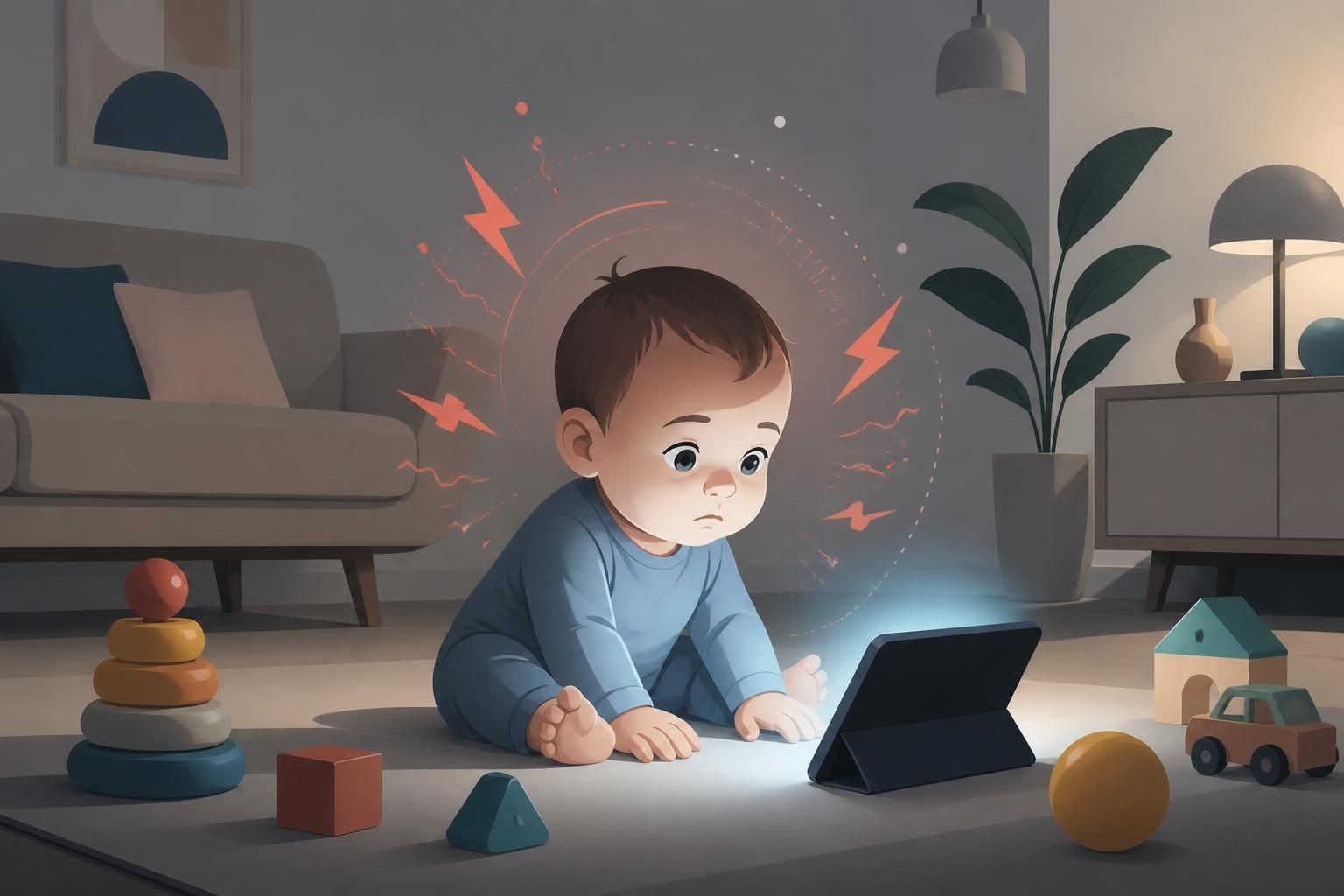
Sleep is where screens often leave visible traces because the problem is counted in minutes and wake-ups. One practice regularly appears in media stories: falling asleep in front of a screen. For example, Ouest-France relayed on February 2, 2026, the idea that about one in ten babies falls asleep in front of a screen, in an article echoing an alert on under-twos. This figure speaks because it refers to a very common scenario: a child who “drops” from fatigue onto a cartoon, and adults who see it as a solution.
The catch is that falling asleep is not the same as good sleep. A toddler may doze off, then wake up later disoriented and request the same crutch to fall back asleep. Over several weeks, the ritual gets established. The brain associates calming with a light, a sound, a narration that plays without interaction. Frequent result: longer bedtimes, more difficult nocturnal wake-ups to resettle, and fatigue that spills over into the day.
Digital screens and attention: the problem of micro-breaks
Short content (videos, clips, autoplay) creates a rhythm of micro-breaks. For an adult, it is already a factory of distraction. For a child, it is training to skip whenever things get a bit complicated. Yet, the development of attention also builds on the ability to tolerate slight frustration: searching for a piece, missing, retrying, waiting one’s turn.
In a living room where a screen remains on “in background noise,” the child is regularly sucked in by movement and sound. This passive exposure is hard to track and thus easy to underestimate. In real life, it is often these small doses that raise the total.
A concrete table to identify daily risk zones
The topic becomes clearer when translated into observable situations, without guilt. The table below offers measurable markers (age, duration, time of day) and realistic alternatives that don’t require an animator diploma.
| Situation | Age concerned | Typical observed duration | Risk moment | Screen-free alternative (measurable) |
|---|---|---|---|---|
| “Comfort screen” to calm a crisis | 0–24 months | 2 to 10 minutes, repeated | End of day | Quiet corner + 1 board book (5 minutes) + adult-guided breathing (10 cycles) |
| Cartoon during meal | 12–24 months | 10 to 20 minutes | Lunch/dinner | Manipulation play at the table (rings, blocks) + meal in 20 minutes without screen |
| Video calls with family | 0–24 months | 3 to 8 minutes | During the day | Short call, adult present, then 5 minutes of “reinforcement” (show a printed photo, mime) |
| Screen before sleeping | 6–24 months | 5 to 30 minutes | Before bedtime | Fixed ritual 20 minutes: bath + story + soft light, no screen in the bedroom |
Recommendations in the United Kingdom: “avoid before 2 years” with framed exceptions
Public messages in the United Kingdom generally align on a simple idea: before 2 years, strongly limit, ideally avoid, because real interaction remains the raw material of development. In formulations reported in the British press and taken up in France, one nuance reappears: some exceptions are allowed, especially video calls, because they imply a relationship and synchronization (an adult speaks, waits, responds). This nuance is useful because it prevents turning the screen into a taboo object, which often ends up making it more “desirable.”
A practical rule in a household consists of distinguishing three categories: relational screen (video call), passive screen (background TV), and distraction screen (video to “hold”). The expected effects are not the same, nor is the effort to provide. Turning off background TV is often the most cost-effective gesture because it removes minutes of exposure without triggering a head-on negotiation.
What parents report: already massive exposure and concrete concerns
In the same set of works around the study, 174 British parents were surveyed about their practices and fears. Beyond the numbers, this kind of survey highlights a classic mechanism: many parents think they “manage” because the child does not watch “that long,” whereas exposures add up (a little in the morning, a little in the car, a little during cooking).
The most frequently cited concerns revolve around sleep, attention, and irritability. Nothing surprising: these are the areas where a toddler “speaks” most clearly, with or without words. A tired child does not explain that they have been overstimulated; they cry, cling, get angry, and wake up at 4:50 a.m. with the energy of a festival DJ.
Practical list: house rules that reduce exposure without permanent battles
For prevention to hold, it must be compatible with real life: meals to prepare, laundry, appointments, transportation. The following list aims for simple, observable rules that are adjustable without redoing everything.
- Screens out of the bedroom: no devices with screens (TV, tablet, phone) in the toddler’s sleeping area.
- No screens during meals: measurable duration, for example 20 minutes “screen-free table,” even if the adult dreams of watching an episode.
- Background TV forbidden: if no one is watching, it is turned off, period.
- Short and accompanied video calls: 3 to 8 minutes, with an adult helping the child understand “who is speaking.”
- Screen-free “emergency kit” reserves: manipulation boxes, books, thick stickers (according to age), brought out only at critical moments.
- Rule of busy hands: when the adult must respond to a message, offer a 2-minute activity to the child, then come back to them.
In a world of cookies: how “free” screens also target families
An often underestimated angle concerns the attention economy. Many digital screen contents, even when they seem harmless, rely on data collection and engagement optimization. Google explains on its page about cookies and data (accessible via g.co/privacytools) that these technologies serve to maintain services, measure engagement, secure against fraud, and, if accepted, personalize content and ads based on settings. For an adult, this is already a comfort and privacy issue. For children, it is also an environmental issue: the more content is optimized to retain, the harder it becomes to interrupt.
In a household, the concrete risk is not that a baby “is targeted” in the advertising sense. It is that a rushed adult opens a platform that automatically offers the next video, then the next. The friction disappears: stopping requires a deliberate act. When a toddler gets used to this continuity, the screen becomes a tap, and turning off the water triggers a logical protest.
Useful settings: reduce exposure without becoming a network engineer
Simple settings have a direct impact on duration: disable autoplay on video apps, avoid notifications on devices used near children, and create an adult profile that does not mix “family” content and personal use. Personalization, when activated, pushes recommendations based on history. If history already contains a lot of children’s content, the offer becomes more aggressive and harder to bypass.
“Reject all” or “More options” settings (depending on services) are not magic formulas but add some resistance back into the machine. A parent who must click more is also a parent who has a chance to say “stop” earlier.
Concrete example: phone left on the table, and involuntary exposure
A classic scenario: the phone serves as a kitchen timer, then a notification arrives, then the adult unlocks it, then a video starts “by accident,” then the child sees a scene. The exposure is not “organized,” but it exists. The most effective solution is not to buy a new device: it is to put simple functions back in place (timer on a device without video, music via speaker, phone out of visual reach).
The common thread here remains the same: the sharpest reduction comes from environments, not from speeches. When the setting changes, the habit changes faster.
Screen alternatives before 2 years: stimulate development without overheating
Avoiding screens before 2 years does not mean occupying a child 12 hours a day with Montessori workshops worthy of a catalog. Activities that support development are often the simplest because they engage the senses, movement, and exchange. For a toddler, repetition is a superpower: doing the same block tower ten times is not “being bored,” it is training a skill.
Parents often look for “effective” solutions. Effectiveness here is measured by two criteria: can the child engage alone for a few minutes, and can the adult offer it without long preparation. A basket of everyday objects (wooden spatula, boxes that open, fabrics with different textures) works because it turns curiosity into exploration. Bonus: no ads appear in the middle.
Low-preparation activities, strong effect on language and motor skills
Language progresses when the adult comments on reality. Naming what the child touches, describing an action, waiting for a reaction, then reformulating creates a loop. On screen, the child receives a narration but does not necessarily produce. “Hide-the-object” games, picture books, and signed nursery rhymes are classics because they combine sound, rhythm, and interaction.
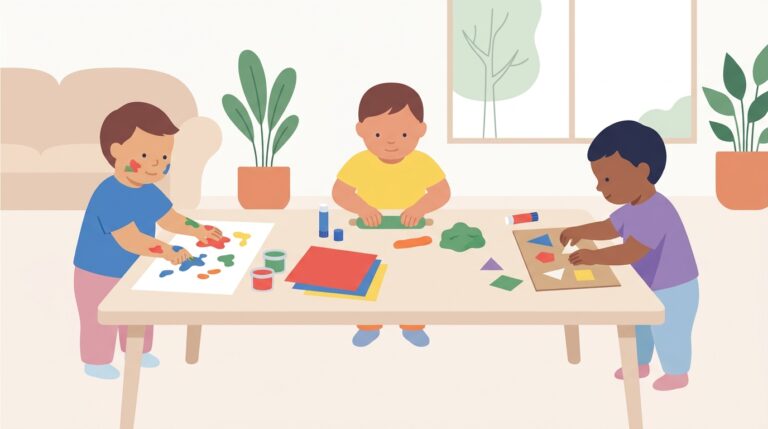
Fine motor skills are worked on with repeated gestures: transferring (large seeds under supervision), fitting, stacking, tearing adapted paper, sticking large stickers. The adult can observe rather than direct, which leaves the child space to solve a simple problem.
A typical 60-minute routine, screen-free, for critical moments
Ends of days are often when the screen invites itself. A “ready-to-roll” routine reduces decisions. Example over an hour: 10 minutes of manipulation play, 10 minutes of shared reading, 15 minutes of motor activity (dance, ball, tunnel), 10 minutes of snack and water, then 15 minutes of calming down (softer light, music without images). This sequence is not a rigid program; it serves as a safety net when fatigue diminishes imagination.
For separated or shared custody parents, consistency helps: if two homes apply the same rules (no screen before bedtime, no background TV), the child adapts faster. In case of divergence, the child mainly learns to negotiate and becomes very good at this sport.
What Do We Say About It?
Before 2 years, the strongest strategy is to aim for near-zero exposure except for supervised video calls, because the study published in eBioMedicine links the 1–2 year window to measurable effects later. Families wanting a simple plan can start by turning off background TV and removing screens from the bedroom, two easy decisions to check daily. The most critical point remains sleep: a screen used for falling asleep quickly creates a routine dependence and complicates night-time awakenings. “Free” content optimized by data and automatic recommendation makes stopping harder, so settings (autoplay, notifications, profiles) really matter.
Do video calls count as screens to avoid before 2 years?
Recommendations often tolerate video calls when accompanied, short, and truly interactive. For a toddler, seeing a face that responds, waits, and reacts resembles social interaction more than passive content. A duration of a few minutes and an adult present reduce the risk of slipping into a “distractive” use.
How to reduce digital screen exposure without daily conflict?
The most effective levers are environmental: TV off if no one is watching, phone out of visual reach, no screen in the bedroom, and disabling autoplay on video apps. These rules decrease exposure opportunities without requiring negotiation each time. An “emergency kit” of short activities helps at critical moments.
Does a child who falls asleep in front of a screen sleep less well?
Falling asleep can happen but does not guarantee stable sleep. The screen sometimes becomes a necessary cue to fall back asleep after a micro-awakening, which multiplies night demands. Gradually replacing the screen with a fixed ritual (story, soft light, music without images) helps rebuild a more lasting cue.
What to do if relatives still give screens to the toddler?
A simple and written rule, shared with all adults, avoids misunderstandings: no screen before 2 years, except short video call, and never before nap or bedtime. Offering ready alternatives (books, manipulation games) facilitates adherence. In case of lapses, returning to the same ritual at home limits habit formation.