Attention parents: why a classic parasol is dangerous for baby’s sleep according to pediatricians
In Brief
- A classic parasol can create misleading shade: trapped heat, reduced ventilation, and discomfort that disrupt the baby’s sleep.
- The risk is not limited to the sun: a poorly secured parasol can topple, and some fabrics allow some UV rays through despite the shade.
- Sleep safety relies on simple bedding: baby on the back, firm surface, nothing in the sleep area, including on vacation.
- Effective sun protection combines real shade, covering clothes, a hat, suitable glasses, and schedules avoiding 12 p.m. to 4 p.m.
- For a nap outside, a stable and ventilated shelter (quality UV-proof tent, fixed shade sail, naturally shaded area) is better than a “standard” beach parasol.
On February 12, 2024, Health Insurance (ameli.fr) reminds, in its recommendations on bedding, that placing an infant on their back contributed to a significant drop in unexpected infant deaths, with a reported decrease of 75% between 1991 and 1997. On paper, this concerns position and bedding. In real parents’ lives, the question quickly expands into daily life: stroller nap, micro-sleep in a baby chair, rest on the beach, or improvised sleep in the shade of a parasol. And this is often where problems start, because shade reassures but guarantees neither coolness, stability, nor good air circulation.
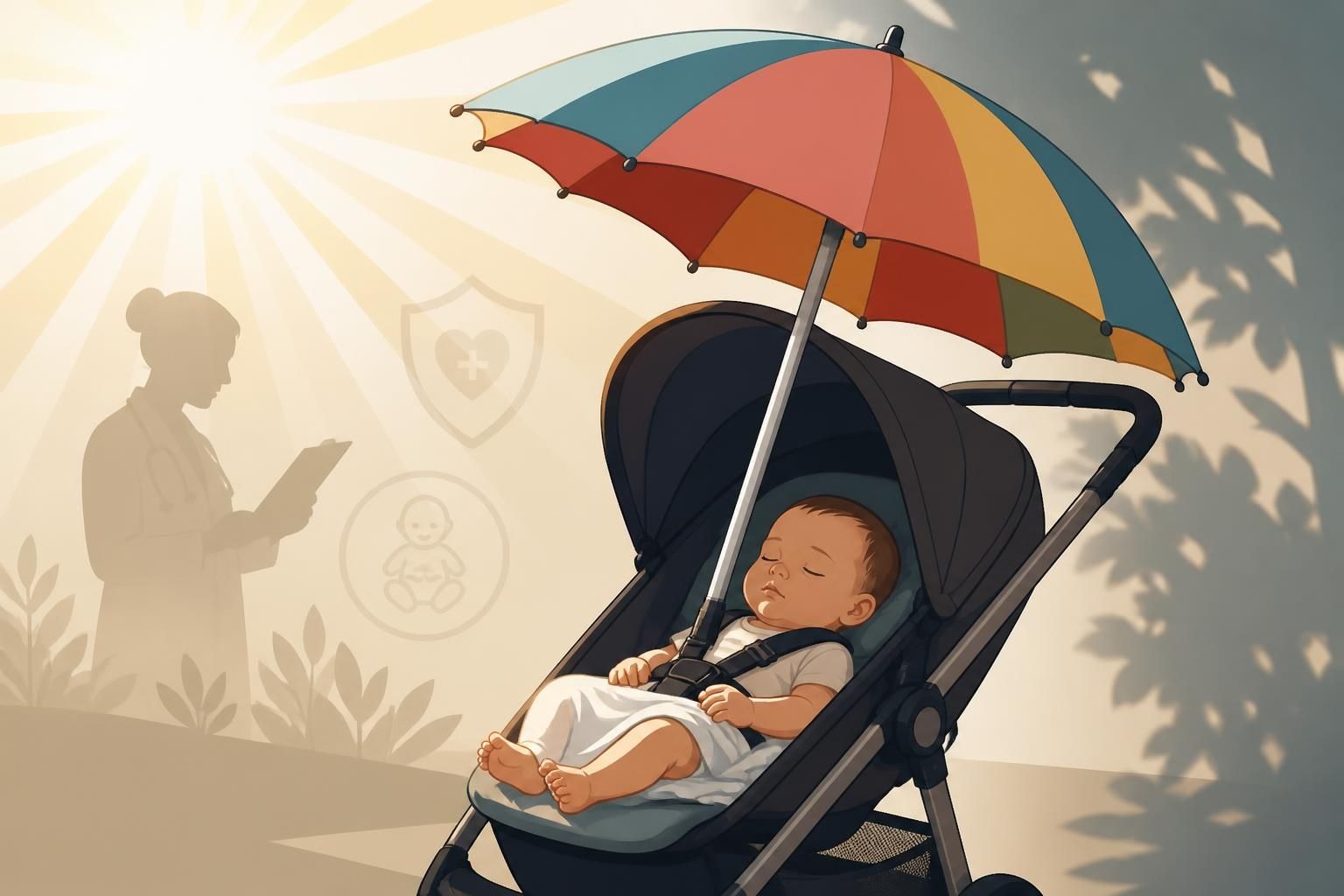
A classic parasol, the kind mainly used to protect an adult reading quietly, is not designed as infant health equipment. It can move with the wind, create a warm spot by limiting ventilation, and give the impression that the baby is “protected” while solar protection remains incomplete. For pediatricians, the issue is simple: a baby’s sleep must remain a safe moment, and both heat and unstable objects increase risks. The objective here is therefore concrete: to explain why the parasol can become a danger, and how to secure a summer nap without turning the beach into an emergency room.
Classic parasol and baby sleep: why shade is not enough according to pediatricians
The parasol reassures because it creates a dark area, and the human brain loves visual solutions. Shade = coolness, it thinks. Except the air didn’t get the memo. A classic parasol can reduce air circulation, especially when it is tilted close to the ground to cover a baby chair, car seat, or carrycot. Result: heat accumulates, the baby sweats, wakes up more often, and may become restless. For an infant, thermal regulation is less effective than in adults, which makes overheating more concerning than “just a bad nap”.
Pediatricians also emphasize a common confusion among parents: parasol shade does not automatically block UV rays. The fabric, its density, weave, and color matter. A thin fabric, often chosen because it’s light to carry, can let part of the radiation through. And reflection works against the nap: sand, water, or even a light-colored ground reflect light under the parasol. The baby can thus receive indirect UVs on the face or legs, even if the adult feels that “everything is covered”.
The third point is mechanical: a parasol is a long, sometimes heavy object, that likes freedom. A gust of wind is enough to rotate it, topple it, or move it, especially if the anchoring is improvised. Yet, near a sleeping baby, an unstable object is an obvious risk. The scene is not heroic: a parasol tips over, the fabric touches the face, or the pole falls nearby. Even without direct impact, stress rises, the nap is over, and the outing turns into a “we’re going home now” episode.
Finally, the parasol sometimes encourages setups not compatible with sleep safety: baby falling asleep in a reclined baby chair, in a car seat placed on the ground, or in a carrycot surrounded by extra fabrics “to make shade.” These additions increase the risk of suffocation or improper airway position. The same ameli.fr article stresses simple and clear bedding, and this principle is not paused because the setting is “vacation.” A safe summer nap is prepared with the same requirements as a nap at home, and this is the point that needs hammering home.
Sun protection and infant health: the concrete risks of a nap under a parasol
Sun protection, when it comes to infant health, is not just about “avoiding sunburn.” There is heat, dehydration, irritability, and fragmented sleep. A baby who sleeps poorly wakes more often, cries more, and sometimes eats less well, which complicates daily management. On a beach, these signals are sometimes attributed to noise or excitement, while thermal discomfort alone can suffice.
Another risk relates to timing management. Public advice recommends avoiding the beach between 12 p.m. and 4 p.m., since this is often the hottest and most exposed period. For many parents, this is also the “practical” schedule: when the baby would nap. The combo “nap + parasol + full afternoon” can so settle in for convenience. Except a baby who falls asleep under a parasol during the heat peak is more exposed to overheating, even without direct sun. The nap then becomes an indicator: if sleep is short, restless, with hot skin and sweating, the setup must be reviewed immediately.
Light must also be taken into account. Under a parasol, there is often diffuse brightness remaining, especially near water. Yet many babies fall asleep better in a darker environment. Parents sometimes compensate by adding a cloth over the stroller. Problem: covering a stroller can quickly raise the internal temperature and reduce ventilation, increasing heat-related risks. This is a classic trap: improving sleep by darkening can degrade safety.
To keep a concrete framework, here is a list of alert signals and quick decisions to take during an outdoor nap:
- Very hot skin, noticeable sweating, damp neck: interrupt the nap, move the baby to a ventilated place, offer a drink if the age allows and if it fits habits.
- Faster breathing than usual, restlessness, repeated waking: check temperature, lighten layers, avoid any covering, move out of “trapped” shade.
- Light coming in from the sides and baby struggling to fall asleep: prefer a ventilated shelter rather than a sheet placed over the stroller.
- Parasol moving, unstable base, pole tilted near the resting space: stop the setup, secure the anchoring or change the solution.
The parasol can still be useful for an adult, but for an infant, safety logic must outweigh perceived comfort. A successful outdoor nap depends on a micro-environment: circulating air, stable shade, hydration, and especially no objects that could hinder breathing or fall. It is the whole setting that protects, not just a simple shadow circle.
Educational videos about heat and baby sleep help spot common mistakes: overdressing, poorly ventilated shelters, or “quickly made” setups that become risks. The essential thing is to draw applicable actions, not to collect checklists.
Sleep safety: what bedding guidelines recommend, even on vacation
Safe sleep is based on simple principles, and this is precisely why they are often neglected outside. A baby must sleep on the back, on a firm surface, in a clear space. These guidelines are repeated by health prevention resources, and ameli.fr highlights the historical impact of these recommendations on the decline of unexpected infant deaths. On vacation, the main enemy is improvisation: a baby chair “just for 20 minutes,” a mattress too soft, a pillow wedged on the side, or makeshift sun protection.
The parasol interferes here by domino effect. To align shade on the baby, the setup tightens: very inclined parasol, stroller stuck to the pole, bags hung to weigh down, towels stretched like a curtain. Each addition can create a new risk: a slipping bag, a fabric coming loose, a cloth moving closer to the face, or a space becoming suffocating. The idea is “clever.” In reality, it’s unstable.
A often-forgotten point concerns sleeping position when the baby falls asleep in a reclined seat. Some equipment holds the torso flexed, which can hinder breathing in the smallest ones. Outdoors increases the likelihood of letting the baby finish their nap where they fell asleep, because moving them wakes them up. Yet, a short nap on an adapted surface is better than long sleep in an unfavorable position. Parents’ fatigue should not dictate the bedding architecture, even if the temptation is very human.
To keep a practical perspective, a table helps compare common sun protection solutions during naps, with measurable criteria. The idea is not to create obsession about gear, but to visualize what concretely makes a difference: stability, ventilation, shade coverage, and room for adjustment.
| Shade solution for nap | Wind stability (low/medium/high) | Ventilation around baby (low/medium/high) | Shade coverage (small/medium/large) | Risk of object near face (low/medium/high) |
|---|---|---|---|---|
| Classic beach parasol | Medium (variable depending on anchoring) | Medium to low (depending on tilt) | Medium | Medium to high (tilted fabric, added accessories) |
| Naturally shaded area (tree, fixed awning) | High | High (if open space) | Variable | Low |
| Stable UV-proof tent (baby/beach model) | Medium to high (if stakes/sandbags) | Medium (depends on openings) | Large | Low to medium (depending on interior setup) |
| Properly fixed shade sail (anchoring points) | High (if solid fixings) | High | Large | Low (if fabric set away) |
This comparison highlights a simple point: stable and ventilated solutions reduce several risks at once, whereas the parasol depends a lot on anchoring and makeshift solutions. Parents benefit from thinking “sleep environment” before thinking “shade,” because safety relies on several parameters simultaneously.
Parasol, wind, and anchoring: the mechanical danger often underestimated by parents
The parasol has a real talent: switching from “nice vacation accessory” to “unidentified flying object” in seconds. The mechanical danger is often minimized because the risk seems rare. Yet, a soft ground, a light base, a side gust, and a tilted parasol are enough for balance to change. For a sleeping baby, the proximity of a pole, frame, and stretched fabric is not trivial. Caution is essential when the object is less than arm’s length from the resting space.
Anchoring mistakes are repetitive: parasol simply stuck in the sand without enough depth, base filled “halfway,” bag hung on the pole to weigh down, or setup too close to water where the ground gives way. The problem is that these tricks give a sense of solidity. When the wind shifts, the stress no longer comes from above but sideways, and resistance drops. The parasol can then tip or slide, particularly if a towel is used as a wedge. On a beach, the space is alive: children run, adults pass by, and an accidental strike on the fabric suffices to amplify instability.
Safety involves concrete and verifiable actions. Anchoring must be deep, the base adapted, and orientation thought out for the prevailing wind rather than perfect shade. Also, avoid placing the baby where the parasol would fall first, which seems obvious but becomes unclear when everyone wants to “enjoy the shade.” Parents benefit from imagining the fall trajectory and setting the resting area outside that path.
Another angle concerns mobile shade. The sun moves, and so does the parasol’s shadow. Parents then find themselves adjusting the tilt regularly. Each manipulation creates a tipping opportunity, and each repositioning can bring fabric closer to the baby’s face. A fixed shading device, or a natural shaded area, avoids this hassle. The time spent moving the parasol is rarely counted, but it weighs on vigilance.
Finally, the parasol sometimes encourages a density of objects around the baby: bags, bottles, towels, toys, sunscreen, glasses. In a nap area, these objects should be kept away to avoid falling or obstructing ventilation. The sleep space must remain clear, and this is a simple rule to apply even on sand, provided an adult agrees to sacrifice some logistical comfort.
Anchoring demonstrations in the wind often show the difference between quick planting and truly stable fixing. For parents, the interest is to transpose these principles to a resting zone: stability, distance, and anticipating movements.
Alternatives to the classic parasol: sun protection solutions compatible with baby sleep
To protect a baby, the best option is often the simplest: choose a time when the heat is bearable, favor an already shaded spot, and limit direct exposure. Sun protection then becomes a coherent whole: light but covering clothing, well-fitted hat, suitable glasses if the baby tolerates them, and real shade. The parasol can remain part of the equation, but must not be the sole pillar, especially for sleep.
Practical alternatives exist. A naturally shaded area (tree, awning, covered terrace) provides more stable shade than a light beach parasol. A quality UV-proof tent, properly anchored with stakes and sandbags, can create a more homogeneous space, provided openings are left for ventilation. A shade sail fixed to solid anchoring points offers a large shaded surface and avoids placing a pole near the baby. The common denominator: stability and air circulation outweigh portability.
Baby sleep is also influenced by noise and agitation. Under a parasol, the zone is often in the middle of foot traffic because shade attracts. For a nap, it’s better to move away from traffic axes, even if it means walking a little more with the “special baby” bag weighing the equivalent of a small fridge. A slightly secluded place reduces stimulation and lowers the risk of accidental impact on shading equipment.
A practical point concerns temperature in the stroller or carrycot. If the baby sleeps inside, maximize ventilation: partially open canopy if possible, no added fabrics blocking air, and regular neck checks. Parents can also use a suitable mosquito net if needed because it allows air flow instead of a thick cloth “making shade.” For shade, it’s better to rely on location (getting into natural shade) rather than turning the stroller into a mini-greenhouse.
Break management often makes all the difference. A successful outing alternates activity phases in shade, hydration, calm times, and retreat indoors if heat rises. Parents who anticipate a plan B (air-conditioned car, nearby rental, shaded café, earlier return) reduce the risk of persisting in an uncomfortable situation. Baby sleep then becomes a comfort indicator overall, not an objective to “make it through” no matter what under a parasol.
What do we say about it?
For a nap, the classic parasol is a fragile compromise: it can give a false impression of sun protection, while adding mechanical and overheating risks. Parents are better off favoring stable and ventilated shade or naturally shaded areas instead of tinkering around a pole near the baby. If the setup requires adding fabrics, sticking the stroller to the parasol, or constantly adjusting the shade, the setting is not safe enough for sleep. The most reliable choice remains to avoid the hottest hours and maintain a simple and clear sleep space, compliant with safety guidelines.
Can a baby sleep in their stroller in the shade of a parasol?
Yes, but safety depends on the environment: ventilation, absence of added fabrics, heat control (warm neck, sweating), and shade stability. A parasol tilted very close can reduce air circulation and increase discomfort. The space around the baby must remain clear, and the setup must be away from any potential parasol fall zones.
Does the fabric of a parasol necessarily block UV rays?
No. Protection depends on the fabric (density, weave, treatment) and surrounding conditions (reflection on sand or water). Even with shade, indirect UV rays can reach the skin. For coherent sun protection, it is necessary to combine stable shade, covering clothes, a hat, and suitable times, rather than relying solely on the parasol.
Should the stroller be covered with a cloth to improve outdoor sleep?
Better to avoid it, as covering the stroller can significantly reduce ventilation and raise the temperature inside. If darkening is necessary, a suitable mosquito net or a sunshade designed to allow air circulation is preferable. The most effective remains moving the stroller into a naturally ventilated shaded area.
What are the signs that it is too hot for the baby’s nap?
Frequent waking, unusual restlessness, very hot skin, damp neck, or marked sweating are alerts. Faster-than-usual breathing and difficulty falling asleep can also appear. In these cases, interrupt the nap, lighten clothing, find a cooler and ventilated place, and reassess sun exposure.