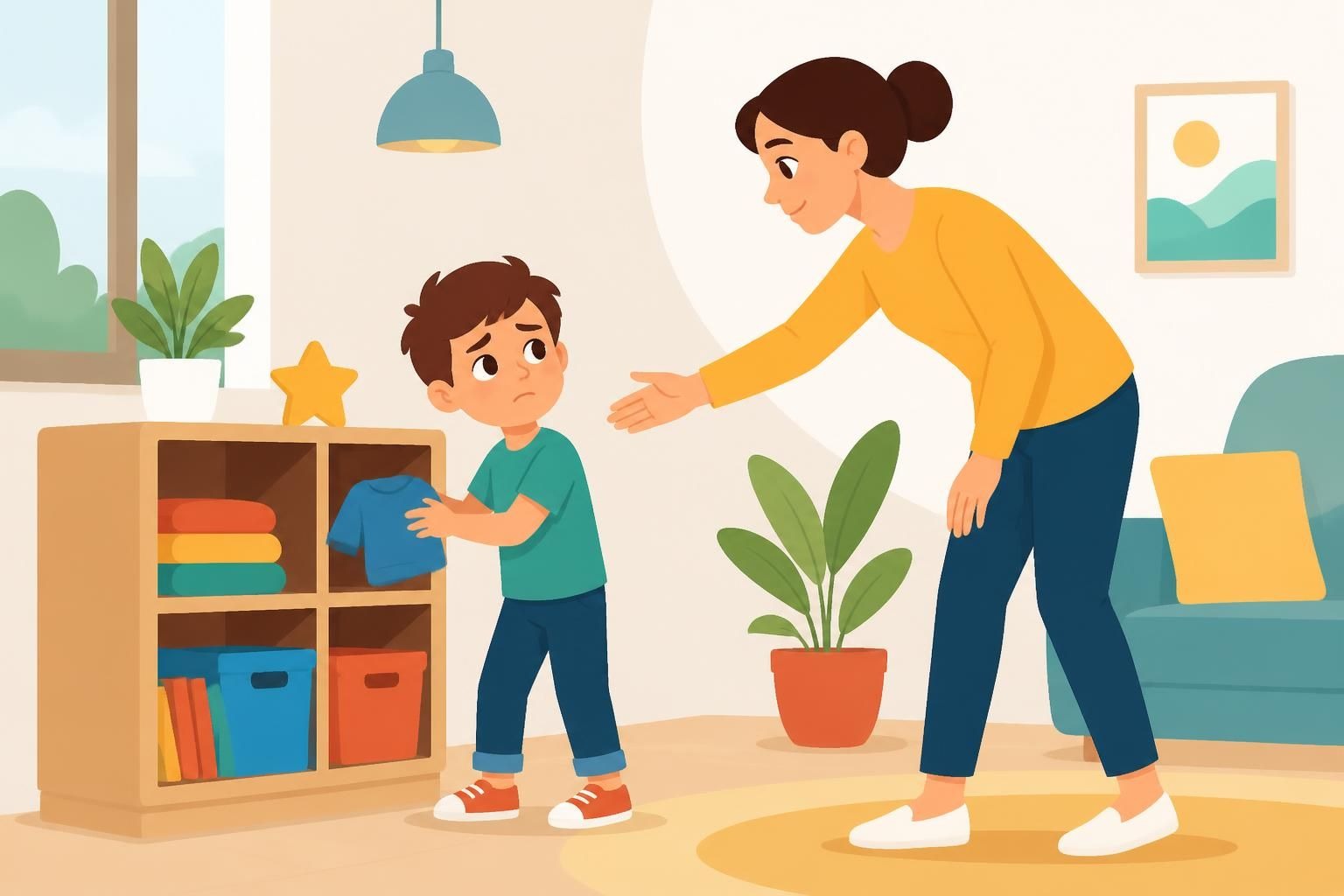
According to experts, this common mistake hinders children’s autonomy
In Brief
- A common mistake noted by many education professionals is intervening too quickly instead of letting children act, which fosters a form of dependency in everyday gestures.
- According to WHO, in its recommendations on physical activity, sedentary behavior, and sleep published on April 24, 2019, children aged 3 to 4 years should accumulate at least 180 minutes of physical activity per day, including 60 minutes of moderate to vigorous intensity, which also implies “free” time without an adult in control-command mode.
- Routines (morning, homework, tidying up) become more effective when the adult shifts from a “pilot on autopilot” role to that of an “air traffic controller” who observes, ensures safety, then lets things happen.
- Screens are not the only issue: over-assistance in small tasks (dressing, preparing their bag, asking the waiter) directly weighs on learning independence.
- A good strategy is to break a task into steps, to gradually reduce help, and to accept an imperfect result as long as it is done by the child.
A child who never has time to make mistakes often ends up waiting for others to do things for them. In families, this common mistake slips into everyday scenes: shoes put on quickly “to avoid being late,” bag zipped at the last minute “to avoid forgetting,” arguments avoided by anticipating every little need. The intention is commendable, the effect less so: autonomy mainly builds when the child tries, fails a little, tries again, then finally succeeds without applause or fanfare.
The subject interests both parents and teachers because it concerns education in the broad sense: how to train children capable of managing a routine, asking for help at the right time, and starting an activity on their own. In this context, one idea comes back: dependency is not always a “weakness” of the child but an overly assisted environment. And yes, sometimes it’s the adult, full of good intentions, who slows down the process.
This common mistake that hinders children’s autonomy: intervening too quickly
The mechanism is simple: when the adult “rescues” the child systematically, the child mainly learns to be rescued. Intervening too quickly means finishing a sentence for them, tidying up for them, carrying for them, deciding for them. It looks like domestic efficiency but can block the learning of independence. A rushed parent gains five minutes this morning but loses fifty over the year repeating the same gestures because the child never had the space to automate them.
In real life, this common mistake rarely expresses itself in grand declarations. It nests in “Leave it, I’ll do it,” in “You’re going to take ten years again,” in “Give it, you’re going to spill.” Over time, the child associates certain tasks with a forbidden zone: too difficult, too risky, too “adult.” The implicit message is heard: trying slows the world down. The child adapts by waiting.
What hinders autonomy is not help itself but help before the attempt. Useful support comes after a try, when the child has identified a concrete obstacle: shoelaces, zipper, backpack organization, understanding an instruction. In this scenario, help becomes a launch ramp, not a taxi that does the entire trip. We are talking about practical education here: letting the child manipulate, plan, correct.
To make this less abstract, here is a frequent scene: in the morning, the family must go out. The adult dresses the child “to go faster.” At the moment, it’s rational. Except that without practice, the child does not improve and speed never comes. Conversely, when a stable slot is planned (for example, 10 minutes dedicated to dressing, even if the result is imperfect), the child gains skills. The adult recovers time later, with a bonus: less tension at waking up.
This logic also applies to school and homework. When the adult immediately corrects, dictates the answer, or erases errors to “neatly return the notebook,” the child understands that the goal is visible performance, not learning. Yet learning needs failed attempts, reformulations, pauses. It’s not glamorous, but that’s how the brain consolidates automatisms. Skills don’t download with an express update.
Last often forgotten point: intervening too quickly can also reduce confidence. If a child hears “you won’t make it” ten times a week, even jokingly, they eventually conform to it. Autonomy feeds on small victories, and these victories require framed “micro-risks.” A child who has the right to try builds a repertoire of actions, and this repertoire serves all day long.
Why experts link over-assistance, dependency, and learning
When experts talk about autonomy, they don’t just mean “doing alone.” They refer to the capacity to initiate an action, persevere, ask for help appropriately, then take back control. It’s a set of executive skills: planning, inhibition, working memory, error management. Over-assistance acts like a permanent treadmill: the child moves forward, but their legs barely work. At the first treadmill failure, panic ensues.
This link between dependency and learning is found in very concrete areas. A child who has never packed their school bag doesn’t learn to anticipate. A child whose conflicts are always resolved by an adult doesn’t learn to negotiate. A child who has never ordered at a restaurant doesn’t learn to formulate a clear request to a stranger. These situations don’t only serve “growing up,” they develop transferable skills. Everyday education is a low-noise training ground.
The tricky point is that over-assistance is often socially rewarded. A perfectly coiffed, perfectly punctual, perfectly quiet child gives the impression of a well-managed household. The cost is invisible: the child did not take control. This can become a cycle: the adult does because the child does not know, and the child does not know because the adult does. Dependency is then a logical consequence, not a “tantrum.”
In an episode of the podcast “Built Different” posted on August 14, 2023, psychiatrist Daniel Amen describes this dynamic in simple terms: when adults systematically cushion consequences, children learn less to adjust their choices. The idea is not to “drop” a child but to allow proportional and repairable consequences: forgetting their water bottle means being thirsty and having to find a solution with the adult, not being humiliated. The brain retains better what it has experienced than what it has been told repeatedly.
Experts also emphasize the importance of unstructured time. WHO, in the document published April 24, 2019, mentions concrete benchmarks: for 3–4-year-olds, the 180 minutes of activity include active play, and the recommended sleep is between 10 and 13 hours (including naps). This framework reminds us that a child is not made for a day in permanent “GPS guidance” mode. Free play and movement offer natural opportunities to decide, try, solve.
There is a modern trap: confusing supervision and piloting. Monitoring is securing. Piloting is doing instead of the child. Between the two, there is a margin: the adult can announce the task, set the time, check a critical step, then let the child produce their solution. This margin is the ground of autonomy. A child who has space develops personal strategies, sometimes quirky, often effective after adjustments.
Another sign of over-assistance shows in language: “Do it like this” replaces “Show me how you want to do it.” The second opens a window of initiative. The first closes the door and keeps the key. Over a whole day, these micro-phrases add up. Autonomy is not a big speech; it is an accumulation of permitted micro-choices.
Concrete signs that the mistake is established at home (and at school)
Over-assistance is not measured by love but by the frequency of adult “takeovers.” Some signs are striking because they seem trivial. The child waits for instructions for tasks they have already seen a hundred times. They ask for validation at every step, even for simple choices. They freeze as soon as a difficulty appears, then look for an adult as one looks for a lost remote control. None of this is a diagnosis, but these are useful signals.
Another sign: the child refuses to try saying “it’s too hard” before even touching the object. It’s not always laziness; it’s often a lack of experience. When attempts are rarely valued, the child protects themselves. They have learned that trying leads to immediate correction. The brain then prefers to avoid the situation.
In school learning, the same dynamic is seen when the child asks “what’s the answer?” instead of “what am I stuck on?” If the adult habitually provides the solution, the child becomes dependent on external validation. School autonomy assumes tolerating a zone of uncertainty. It’s uncomfortable, so the child looks for a quick way out: the adult. It’s effective short-term, costly long-term.
To objectify the situation without turning the living room into an audit room, a simple exercise is to count interventions on a specific task. Example: “pack the bag.” If, over five minutes, the adult touches objects more often than the child, it’s a sign. If the adult talks without pause, that’s also a sign. A child needs silence to act, not a continuous sports commentator. “Timeout” is a processing time, not an empty time to fill.
Here is a list of typical behaviors that maintain this common mistake, with their effect on autonomy:
- Doing things for them “to go faster”: the child does not acquire the sequence of gestures and remains dependent on the routine.
- Correcting errors immediately: the child learns to avoid trying, so learning slows down.
- Anticipating all needs (water, coat, materials): the child does not practice verifying and organizing.
- Giving long, multi-step instructions: the child tunes out, then waits for step-by-step guidance.
- Replacing the child’s words (“Say hello properly”): the child participates less in social interactions.
- Forbidding any reasonable risk-taking (pouring, cutting a banana, going to pay): the child does not build practical skills.
The school world adds a layer: some children no longer dare to ask questions in class because they have mainly learned to get answers at home. Others wait to be told “what to do next” even when the instruction is visible. Autonomy is built through small regular responsibilities, not through a big leap the day the adult decides “that’s enough.”
To avoid caricature, one must also consider context: fatigue, overload, siblings, time constraints. Over-assistance is sometimes a family survival strategy. The problem is not to help, it’s to help without an exit plan. Help without gradual withdrawal ends up looking like a subscription service, renewed automatically every morning.
Educational tools to develop independence without compromising safety
Developing autonomy does not mean dropping the child in the middle of the living room with “good luck.” It means creating conditions for success: an adapted task, a prepared environment, and an adult available but not intrusive. The first lever is material. A coat rack at child height, easy-to-put-on shoes, an accessible laundry basket, an easy-to-open water bottle: these are details that turn intention into action.
The second lever is structure. A stable routine helps the child anticipate. An effective example: display (or simply repeat) a short sequence of 3 steps for the morning. “Get dressed, breakfast, brush teeth.” Three steps, not ten. The child executes, the adult checks at the end. An overly detailed routine pushes the adult to micro-manage and nurtures dependency.
A technique often used in pedagogy is to “break down” the task. The child starts with one part, the adult keeps one part, then the adult withdraws. Example: for shoelaces, the child does the first loop, the adult shows the second, then the following week the child tries both. This respects the rhythm without turning the adult into an automatic solution. Learning becomes observable: you see what is acquired and what is not.
The third lever is the way of speaking. Saying “What do you need?” is more effective than “You forgot again.” Saying “Show what you’ve already done” reduces panic and puts the child back into action. Humor also helps: announcing “snail mode allowed, but autonomous snail” relaxes the atmosphere and avoids tension. The goal is to reduce pressure, not increase it.
Time management is a tough point. Many families intervene too quickly because they are late. The most realistic solution is to create a margin. Setting the alarm 10 minutes earlier is sometimes more effective than a thousand reminders. Preparing the night before (clothes, bag, snack) reduces decisions to make in the morning. The child can participate in this preparation, which strengthens independence instead of hindering it.
Practical table: gradually withdrawing help according to age and task
| Daily Task | Indicative Starting Age | Training Time (order of magnitude) | Level of Help at Start |
|---|---|---|---|
| Put away 5 objects in a bin | 2–3 years | 2 to 6 weeks | Show once, then guide verbally |
| Get dressed (excluding complex buttons) | 3–5 years | 1 to 3 months | Prepare clothes, let do, help on 1 step |
| Prepare school bag | 6–8 years | 1 to 2 months | Short checklist, adult final check |
| Manage homework routine (20–30 min) | 8–11 years | 2 to 8 weeks | Timer, help with method, not with answers |
This table gives benchmarks, not verdicts. Some children will move faster, others will need more time depending on motor skills, attention, or fatigue. The key point is gradualness: help decreases as skill increases. In a household, this is planned like meals: otherwise, help returns by default, and the common mistake reinstalls itself.
One last surprisingly powerful tool is to let the child fix things. They spilled water: they wipe it up. They forgot a notebook: they find a solution with the school. Repairing is not punishing; it’s linking the action to a realistic consequence. The child learns to manage, which is exactly the heart of autonomy.
The useful parallel with the “cookie window”: consent, control, and autonomy
Digital life provides a surprisingly practical metaphor to talk about education. On many online services, a window asks if you want to “accept all” or “reject all,” with a “more options” choice to finely adjust privacy. In Google’s standard text, it explains that some cookies serve to “provide and maintain services,” “measure engagement,” or “protect against spam, fraud, and abuse,” while others serve content and ad personalization, and that dedicated tools exist via g.co/privacytools. This logic of graduated choice helps understand an educational principle: leaving a margin of decision adapted to age.
Translated to the home, “accept all” looks like the parent who lets the child decide everything, without a framework. “Reject all” looks like the parent who controls everything, including details. In both cases, autonomy suffers: either the child is overwhelmed, or they are under glass. The “more options” option corresponds to parenting that adjusts: safety for what is risky, freedom for what is trainable.
Concretely, a child can choose the order of some tasks (“teeth then pajamas” or reverse) without negotiating the existence of the routine. They can choose their snack from a set selection, rather than the full supermarket inventory. They can decide how to tidy their room (bins, shelves) as long as the floor becomes walkable again. This “configurable” model reduces dependency while keeping understandable limits.
This approach has another advantage: it avoids turning every moment into endless negotiation. The child knows where the zone of freedom is. The adult knows where the non-negotiable zone is (safety, respect, essential schedules). Daily life becomes smoother, and the child really practices choosing. Autonomy builds within these concrete spaces, not in speeches about “responsibility.”
Experts in education often remind that skill follows practice. The child who regularly chooses, even on details, becomes more able to handle heavier choices later: schoolwork, time management, projects. Conversely, an over-assisted child can get lost facing a simple decision because they haven’t accumulated experience. The choice window must open progressively, with adapted options.
Finally, this parallel reminds an important thing: a clear frame does not prevent freedom, it makes it workable. When the child knows the rules of the game, they play better, and cheat less out of fatigue. The adult no longer needs to micro-manage, limiting the common mistake that hinders autonomy daily.
What Do We Say About It?
The main obstacle to children’s autonomy often comes from daily over-assistance: the adult intervenes before an attempt, which fosters dependency and slows learning. The strongest recommendation is to keep the framework and safety, while withdrawing help step by step on very concrete tasks (dressing, bag, tidying). Families who succeed long term invest training time when things are “mostly fine,” rather than waiting for a crisis or major school failure. If only one habit must change, it is this: let the child finish a task, even if imperfect, then adjust.
At what age to start working on daily autonomy?
From early childhood, with very simple and safe tasks: putting away a few objects, washing hands, choosing between two outfits. The goal is not performance but repetition. The earlier the child practices micro-gestures, the more independent they become in routines (dressing, preparation, organization) as they grow.
How to help without creating dependency during homework?
The most effective help focuses on the method: reread the instruction, break down the exercise, manage time with a timer, check steps. Avoid giving the answer or rewriting for the child. A good guideline is to ask what exactly is blocking them, then offer a hint, not the full solution.
What to do if the child refuses to try and says “I can’t do it”?
Reduce the task to a very easy first step, then value the attempt over the result. Revisiting a moment when the child already succeeded in a similar gesture helps restart motivation. If refusal is mainly related to time stress (morning), creating a time buffer and practicing in a calm moment (weekend) often improves cooperation.
Does autonomy mean letting the child decide everything?
No. Autonomy progresses better with a stable framework: safety, respect, essential schedules. However, the child can have real choices within a defined zone: order of tasks, method of tidying, limited selection of clothes or snacks. This balance allows training initiative-taking without turning daily life into endless negotiation.