
3 tips to make a move gentle for our baby
Moving represents a major upheaval for the whole family, but it can become particularly delicate when there is a baby at home. Toddlers need stability and landmarks to feel safe, and changing environments can create stress and disrupt their habits. Fortunately, with proper preparation and the right strategies, it is possible to make the move smooth for our baby while preserving their well-being and serenity.
Key points to remember
- Keep familiar objects : comforter, sheets, and favorite toys to maintain sensory landmarks
- Organize meticulously : prepare an essentials bag and set up the baby’s room as a priority
- Maintain routines : meal times, naps, and bedtime rituals to ensure continuity
First tip: Keep familiar objects and sensory landmarks
The importance of transitional objects for baby
Babies discover the world mainly through their senses: smell, touch, sight, and hearing. The loss of sensory landmarks can be particularly unsettling for a child, especially for toddlers whose sense of smell is very developed. To reassure your baby during the move, you should therefore preserve as much as possible everything that can remind them of their daily life: the comforter, of course, and the bottle, but also the bed and even the furniture.
Transitional objects, like the comforter, play a crucial role in the baby’s adaptation. These familiar companions help the baby feel safe and comfortable when separated from their parents or faced with a new environment. The comforter acts as a “bridge” between the known (parents, home) and the unknown. It allows a transition between the baby’s fusion relationship with their parents and the stage where they become fully aware that they are an individual in their own right.
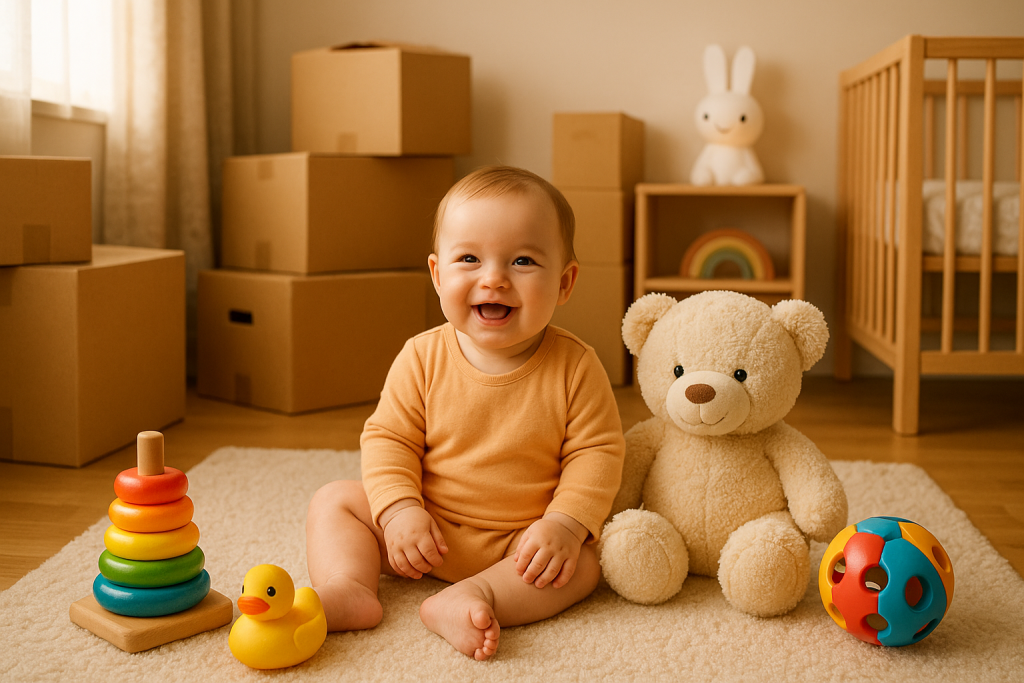
Baby with familiar objects in his new environment
Preserving the olfactory and tactile environment
Smell being particularly sensitive in infants, it is essential to keep your baby’s unwashed belongings. Bring their sheets, sleeping bag, comforter, and pajamas without washing them so they can find their familiar smells. These elements reassure your child by allowing them to recognize their usual sleeping environment.
If possible, keep the same bedding for your baby’s new room. The familiar smell of their sheets and blankets will reassure them considerably. If you have to change their bedding, buy it in advance so it has time to take on the family’s scent.
Maintaining the continuity of everyday objects
When packing boxes, be careful to keep a few toys close by so your child has them by their side that very evening. They will be able to fall asleep more easily with objects that remind them of their old environment. This continuity is crucial because it allows the child to maintain the link between the old home and the new one more easily.
Familiar objects are not limited to comforters and toys. Also keep their usual bottles, favorite pacifier, and even their mobile if they have one above their bed. Resist the temptation to completely transform their world in the new house. By keeping a few objects they especially love, they will be reassured when they find them again.
Second tip: Organize the move meticulously
Establish a detailed baby plan
At least one week before the move, establish a specific plan to ensure that your newborn will be comfortable and safe throughout the day. This prior organization is crucial to minimize the stress for the whole family.
Prepare a 24-hour essentials bag containing all the necessities: diapers, wipes, towels, toys, bottles, and creams. Set this bag aside, away from the boxes, so that it is not accidentally taken away with the things to be moved. The day before the move, also prepare enough bottles for the next 24 hours and keep them in the refrigerator.
Designate a person responsible for baby
In your plan, you must designate the person who will be responsible for taking care of the baby during the move. This person can be the baby’s mother or father, or a family member, a friend, or a babysitter. Whatever the case, this person must not be involved in the moving tasks; they must be able to fully care for the baby and look after their well-being throughout the day.
If you have your baby cared for during the preparations and on moving day, call on someone your baby knows well. This reassures them and limits the changes they have to adapt to. Ask your relatives, such as grandparents, who will surely be happy to help you.

Family move organization with baby
Create a secure environment
Creating a no-move zone is essential. Your child must have a safe space where they can play or sleep without danger. If your baby is old enough to move around, you can delimit this zone with safety barriers.
Watch out for dangerous objects so that your baby does not play with them. During moves, you cannot constantly watch your little one’s face, so place dangerous objects high or lock them in boxes. Also prioritize packing fragile objects within the reach of your toddler, such as dishes, glasses, or decorative items.
Plan the logistics for the big day
Prepare a family bag containing the essentials for the day: clothes for everyone, snacks, your child’s favorite toys, your little one’s comforter, toilet paper, soap, towels, a first aid kit. This preparation will save you from frantically searching for these essential items among the boxes.
If possible, plan your move during school holidays or the least stressful periods for your family. Avoid moving during peak times (May to October) because moving services are more in demand and more expensive.
Third tip: Maintain routines and set up baby’s space as a priority
Preserve daily habits
Although it is difficult to have a “normal” day on the big day, try as much as possible to maintain habits with your infant, especially on that day. Concretely, this means your baby should wake up at the usual time, nap as usual, and eat at the same times.
Routines provide children with stability and security. A stable routine is key to a successful transition. Maintain usual meal and sleep schedules, even during the first days in your new home. Try, despite unforeseen events, to keep their routines (meals, bath, and bedtime) as stable as possible. These familiar landmarks are comforting and help your child cope with the transition more easily.
Maintain the bedtime ritual
By keeping their bedtime ritual, you will help ease your baby’s adaptation to the new home. You must therefore keep consistency regardless of the situation. If you usually tell them stories, cuddle them, or sing a lullaby at specific times, don’t hesitate to do so. This prevents your baby from feeling confused.
When the comforter is associated with a warm and secure bedtime routine, it also helps the child fall back asleep alone if they wake up during the night. This continuity in rituals is particularly important during the adaptation period to the new home.
Set up the baby’s room as a priority
Set up your child’s room as a priority, so they quickly find their toys, stuffed animals, and the familiar smell of their comforter. With a toddler, it is best to keep the same furniture and similar decoration as much as possible from their previous room so they retain their landmarks.
To ease adaptation, recreate the baby’s world as faithfully as possible. Make their bed again with the sheets and duvet from the day before. They will thus find their familiar smell, at least for the first nights. Set up the baby’s new room identically: furniture, sheets, curtains, pictures — everything should be the same to facilitate their adaptation.
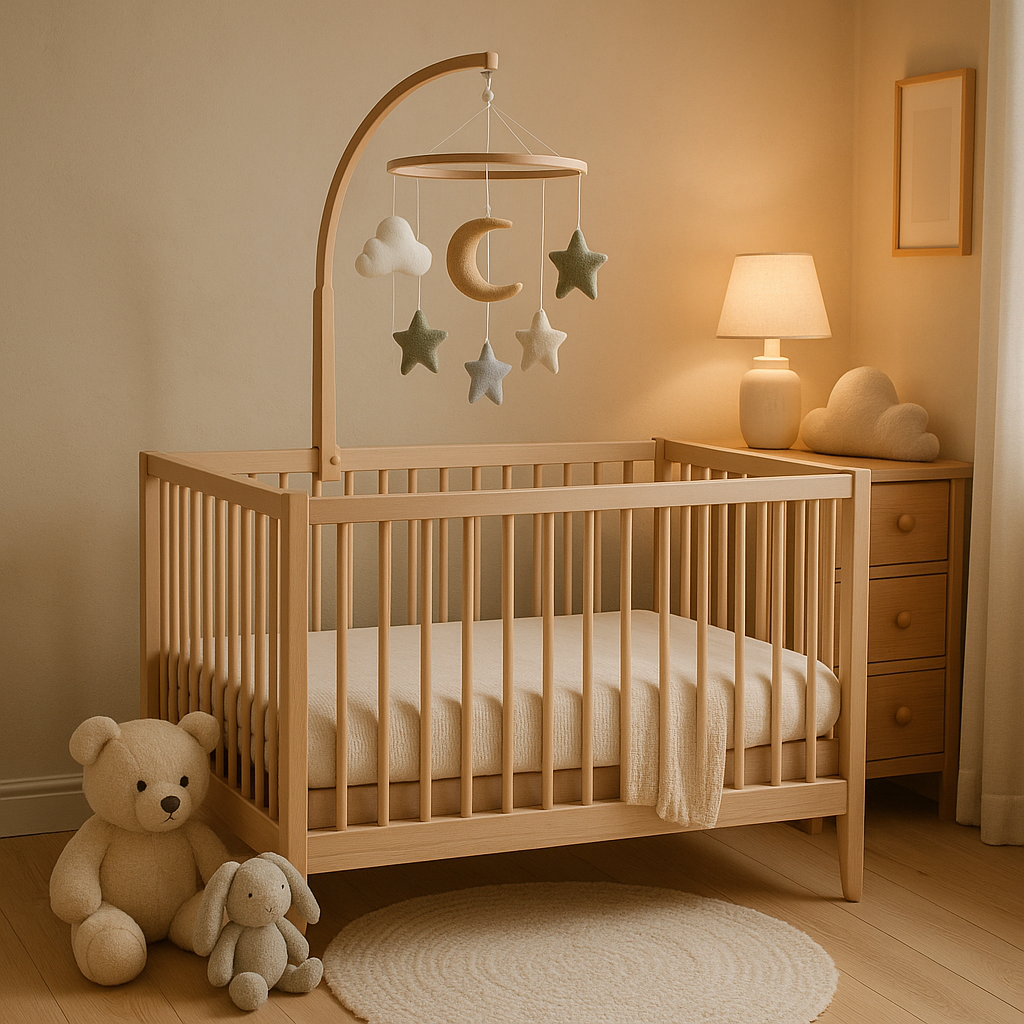
Baby’s room set up as a priority to maintain their landmarks
Quickly recreate a familiar environment
Quickly install their play and sleep spaces identical to the old house. Talk to them with simple words about this change, even if they don’t understand everything. Your soothing voice and cuddles will naturally reassure them during the moving preparations.
It is recommended to prioritize setting up the baby’s room so they keep their landmarks. By finding their toys and comforters, it helps the child maintain the link between the old home and the new one more easily. Keep their room tidy during the move to provide a quality sleeping environment. Try to tidy books and toys, for example by using storage bins to simplify organization.
Managing emotional aspects and post-move adaptation
Understanding baby’s reactions
It is normal for your child to be unsettled after a move. Each child reacts differently: they may be more demanding, wake up more often at night, have stomach aches, or revert to some regressive behaviors. These reactions will disappear on their own when they feel safe.
A child under 2 years old can feel stressed due to a move, especially if you are stressed by the event. To reduce this reaction, you can take some slow, deep breaths before taking your baby in your arms. This way, they will feel less of your stress.
Show patience and listen
Be patient and listen even if you have a lot to do. Your child needs time to grieve their old home. Temporarily reduce your demands on them, as it may take several weeks for them to fully adapt.
Babies show great adaptability when we know how to listen to and surround them. The whole world is new for a baby, so they are ultimately prepared to discover all this novelty. It is therefore often harder for the parents than for their child.
Create new positive landmarks
Play with them in your new apartment or house so they discover their new environment with pleasure. Visit your new neighborhood with your child and do enjoyable activities together there (play in the park, go to the pool or the library). This allows them to quickly associate the move with positive things.
Spend quality moments in their room (playing, reading). Give them time to become familiar with the new places. Show them around, show where they will sleep. These special moments will help them tame their new environment gently.
Preparation in advance and communication
Talk about the move to the baby
Even if your baby is very young, talk to them a lot to explain that you are going to change house. Also communicate with your baby; they understand more than they verbalize. Explain the reasons for this move using simple words.
Your child will find it easier to adapt to their new environment if you talk to them in advance about the project. Even if they don’t understand everything yet, your reassuring voice and presence will help them accept the upcoming changes.
Prepare the visit to the new places
If possible, take your baby to visit your future home before the move. Introduce your new house to your baby so they can start getting used to the new places. This pre-visit helps the child tame their new living environment and reduce their fears.
Before moving, you should have identified everything your baby will need in the new neighborhood: the park for walks, the pediatrician, the pharmacy, the supermarket selling the “right” milk, your brand of wipes, diapers, pacifiers, the hospital. This logistical preparation will save you additional stress once you are settled in.
Avoid multiple changes
With the little ones, it’s better to wait a little longer to start weaning or potty training. Don’t pile too many changes at once to avoid further destabilizing your child.
Try to make the changes gradually. For example, it can be hard for a toddler to move on a Saturday and go to a new daycare the following Monday. If possible, wait a week after the move before taking your child to their new daycare.
Practical and safety aspects
Arrange care during the move
Have your child cared for to make this day easier when you won’t have a minute to yourself. However, know that it may be useful for them to partly witness the move (seeing the old home being emptied or the new one being filled), as it is probably then that they will realize what is happening.
The best is to entrust your baby to someone the baby knows well during the preparations. Grandmother, for example, or an aunt. This solution reassures your child while freeing you to focus on the logistical aspects of the move.
Secure the environment
Make sure to stack your boxes stably to avoid any risk of them falling on your baby. During the move, since constant supervision is impossible, anticipate potential dangers by securing the environment as much as possible.
Ensure that the location chosen for your baby’s bed in the new home is far from any dangerous objects (window or French door, lamp, electrical outlet, power strip, curtains and their cords, tablecloth). Safety must remain an absolute priority when setting up their new living space.
Maintain hygiene and comfort
If necessary, change your baby’s mattress to a much more comfortable one before the moving date so they get used to it. You must also ensure that the new mattress meets hygiene standards. For example, it should have a machine-washable cover and not contain chemical solutions to avoid allergies.
Regarding temperature, the ideal room temperature is between 16 and 20°C. For safety, do not put a comforter, pillow, or blanket in their bed if they are a newborn. Always lay them to sleep on their back as well.
Managing parental stress and impact on baby
Reduce your own stress
It is often your own stress that increases the baby’s. In view of the move, ask for help and, if possible, have your toddler cared for on the actual day. Then you will be more available to reassure them and help them discover their new environment.
Moving is stressful, but it is also, in most cases, wonderful. Show them all the advantages of this new place and their new neighborhood. Even if you are overwhelmed, take little moments to play with them in their room and around the house so they can calmly get used to this new place.
Maintain a positive attitude
Being calm and patient is essential because your children feel all your emotions. Try to be calm and serene during your move. Your reassuring attitude will help your child see the move in a positive light.
If you moved during childhood, tell them about your experience. Also talk to them about moving day so they have some idea of what to expect. This communication, even with a toddler, helps create a climate of trust and serenity.
Resources and professional help
Seek help from professionals
If you feel the need to be supported in this stage, do not hesitate to call on professional movers who are used to working with families. In the Paris region, for example, contacting the best movers in IDF guarantees you a service adapted to the constraints of moving with an infant (handling baby room furniture, adapted time slots, etc.). They will be able to advise you and adapt their services to your specific needs with a baby.
For emotional aspects, if your child encounters persistent sleep disorders or if you notice a significant change in their behavior, do not hesitate to consult a professional who can help you. A pediatrician or a psychologist specialized in early childhood will be able to guide you.
Available financial aids
Several aids can financially support you when moving with children. The CAF moving grant is granted to large families (starting from 3 dependent children). Its amount is capped at €978.82 for three dependent children, with €81.57 per additional child.
Other schemes exist depending on your professional situation: Mobili-pass aid from Action Logement, specific aids for civil servants in case of transfer, or agri-mobility for the agricultural sectors. Check with your employer and the competent organizations.
After the move: consolidate the adaptation
Monitor adaptation signs
In the weeks following the move, stay attentive to signs indicating whether your baby is adapting well or, on the contrary, is having difficulties. Behaviors can change over the weeks, and your child will need your support to adapt.
Watch out for signs of distress, such as sleep disorders, unexplained crying, or feeding difficulties. These signs may indicate that your child is still struggling to get used to this new living environment. Generally, full adaptation takes between 2 to 3 weeks.
Create new habits
Remember that every child is unique and has their own temperament. Some children adapt easily, others need a little more time to find their bearings. In that case, reassure your child with patience and kindness.
Once settled, take time to explore your new neighborhood with your baby. Show them the new places they will frequent: the park, local shops, walking areas. These positive discoveries will help them associate their new living environment with pleasant experiences.
Specific advice according to baby’s age
For newborns (0-6 months)
Newborns are particularly sensitive to changes in smell and sound environment. Maintaining their sleep routines is crucial as they sleep on average 16 to 20 hours a day. Absolutely keep the same bedding and the same falling asleep rituals.
For this age group, adaptation essentially depends on your own stress level. The more calm and organized you are, the better your newborn will experience this transition. Don’t hesitate to carry your baby in a sling or baby carrier during preparations to maintain reassuring physical contact.
For babies 6-12 months
At this age, babies begin to recognize their environment and may manifest more clearly their discomfort with changes. They are also more mobile and curious, which requires special attention to securing spaces.
Involve them more by showing them their belongings during packing and unpacking. Their understanding improves, so don’t hesitate to simply explain what is happening. Maintain especially their nap schedules which are often well-established at this age.
For toddlers (12-24 months)
Children of this age begin to develop their autonomy and can participate more in the process. You can entrust them small tasks such as putting their toys in a special box that they will unpack first in the new home.
This is also the age when attachment to the comforter is strongest. Pay particular attention to ensuring that this transitional object is never lost or forgotten in the boxes. Possibly prepare a spare comforter if your child has only one.
Practical organization: specific checklist for families with baby
3 months before the move
- Start talking about the project to your baby, even if very young
- Look for essential services in the new neighborhood (pediatrician, pharmacy, daycare)
- Plan specific administrative procedures (change of attending physician, transfer of medical file)
- Book moving services specifying the presence of a baby
1 month before
- Prepare the essentials bag for baby
- Arrange care for the big day
- Start packing non-essential belongings while keeping the baby’s environment intact as long as possible
- Buy new bedding if needed and let it “take the family’s scent”
1 week before
- Finalize the baby-specific moving plan
- Prepare bottles in advance
- Organize the first setup of the baby’s room
- Plan meals for the whole family for the first days
Moving day
- Maintain the baby’s usual schedules as much as possible
- Set up the baby’s room as a priority
- Keep the essentials bag always accessible
- Preserve calm moments with baby despite the bustle
Conclusion
Making a move smooth for our baby requires meticulous preparation and particular attention to their specific needs. The three main tips – keep familiar objects, organize the move meticulously, and maintain routines – form an essential triptych to ensure a serene transition.
The key to success lies in understanding that babies need continuity and landmarks to feel safe. By preserving their sensory world, maintaining their habits, and setting up their space as a priority, we offer them optimal conditions to adapt to their new living environment.
Don’t forget that your own serenity directly influences your baby’s. By organizing well and seeking help when necessary, you create an environment conducive to a successful transition for the whole family. With patience and kindness, this move can even become a positive experience that will strengthen your child’s confidence in their ability to adapt to life’s changes.