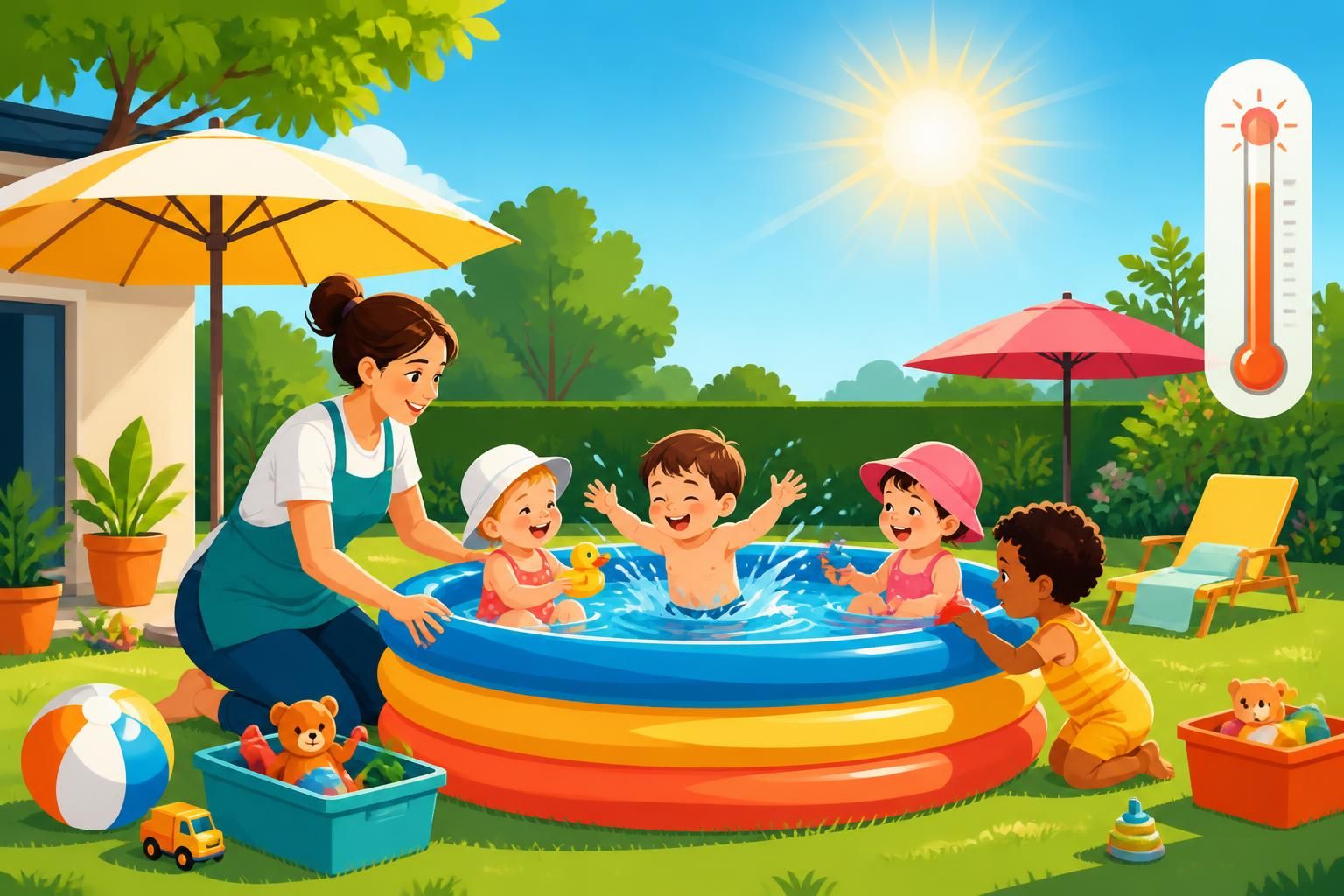
Heatwave: is the installation of an inflatable pool by a childminder for the little children in their care allowed?
In Brief
- In case of a heatwave, an inflatable pool at a childminder’s home is not automatically prohibited, but the issue depends on safety, supervision, and parental agreement.
- The regulations on private pools (barriers, alarms, covers) mainly apply to in-ground or semi-in-ground pools, but the risk of drowning also exists in just a few centimeters of water.
- Without a clear protocol (staff numbers, children’s ages, organization), the childminder’s responsibility can be engaged in case of an accident, even during a “simple refreshment”.
- For safe care, alternatives exist: water games without retention, misting, damp cloths, cooled rooms, and outings limited to cooler hours.
- The good reflex: formalize parental authorization in writing, usage framework, and hygiene measures, then be able to stop immediately if supervision is no longer guaranteed.
On June 30, 2025, 84 departments were placed under orange heatwave alert, a figure that impacted early childhood professionals because it sums up a very concrete problem: when it is very hot, the theory “we adapt” bumps into the reality of caring for several children, sometimes very young, with only one pair of eyes to watch them all. The idea of setting up an inflatable pool in the garden or on a terrace then comes back as a classic summer solution: simple, cheap, and very effective in lowering the temperature… at least in adults’ minds.
But for a childminder, the question “is it allowed?” is not limited to a yes or no. It mixes regulation, responsibility, insurance, parental agreement, and especially supervisory organization. In practice, a 15 cm deep paddling pool can pose more risks than a large perfectly fenced pool because it gives the illusion of safety. The subject deserves a clear framework, without dramatizing, but without telling stories either: with water, children, and a heatwave, improvisation rarely has the last word.
Authorization and regulation: what the framework says (and doesn’t say) about an inflatable pool at a childminder’s
The first common confusion concerns the word “authorization”. Many families imagine a national rule like “pools forbidden at childminder’s homes.” In reality, there is no general and explicit prohibition in commonly known public texts targeting inflatable pools in home care settings. However, the absence of prohibition does not equal an automatic green light because the activity must remain compatible with safety and supervision obligations.
French regulations strongly govern the safety of private pools, notably through drowning prevention devices. In the collective mind, this refers to a barrier, an alarm, a cover, or a shelter. Except these obligations were designed for in-ground or similar pools, not for an inflatable paddling pool that is emptied and stored. Result: the inflatable pool is in a zone where the rule is not “forbidden/allowed” but “demonstrate that care remains safe.”
In this context, the childminder must reason like a professional, not like a fair organizer. The key point is the prevention of drowning risk and the match between the activity and the number of children. A child can slip, panic, swallow water, or bump themselves. And contrary to a persistent idea, danger does not start at 1 meter depth: a few centimeters are enough for a toddler, especially if the adult is distracted elsewhere (changing a diaper, answering the phone, calming a dispute).
According to an article published by Ufnafaam (National Federation Union of Foster Family Associations and Childminders), quoted via its spokesperson in content dated July 2, 2025, there is no official ban on swimming, but the organization strongly advises against the pool due to supervisory difficulties when a childminder is alone with several children. This warning is not a detail: it reminds us that the legal framework and the practical framework do not always overlap.
Parental agreement and documents: the “contract, habits, written” trio
In individual care, employer parents are not spectators. If an inflatable pool is considered, parental authorization benefits from being formalized. Oral agreement may exist, but it poorly resists misunderstandings such as “we thought it was just feet in the water.” A simple, dated written document describing the activity, its frequency, conditions, and limits reduces gray areas.
The employment contract does not list all possible activities, but it sets a trust framework. Adding an amendment is not always necessary; however, an annex document (rules of life, heatwave protocol) can serve as a common reference. The idea is to avoid surprises, especially if a parent finds a “pool party” photo upon return while imagining a water play basin.
Last practical point: insurance. Childminders are generally insured for their activity, but all coverage is not the same. A call to the insurer to verify the “water games/pool” coverage and conditions (supervision, fencing, presence of an adult) avoids discovering the rule at the worst moment.
Safety during a heatwave: supervision, depth, water access, and staff management
In a heatwave period, the temptation is to seek an “immediate” solution. The inflatable pool ticks this box, but it creates a high-risk environment because it combines water, slipping hazards, excitement, and heat. Safety starts even before inflating the ring: one must decide if the place’s configuration and the group of children allow continuous, close, and realistic supervision.
A simple rule, often forgotten when the thermometer rises, is that supervision must be exclusive. That means: no “I’m glancing while preparing bottles.” In care with several children, the adult can be interrupted every thirty seconds. Yet, an incident in water unfolds in seconds, with very little noise. The movie scene with shouting and splashes is not a safety norm.
Concrete risk examples: slipping, fainting, water ingestion
The risk of slipping increases because the surroundings become wet. A child running on a wet terrace can bump their head. Another may trip and fall into the water, even if shallow. Drowning is not the only danger: heat-related fainting can occur, especially if the child was previously exposed or if hydration is insufficient.
Depth deserves a numeric approach. A “small format” self-supporting pool can be about 76 cm high, as often seen in summer. This is not a decorative fact: at that level, a child can lose footing, and access without a ladder does not prevent entry, but mainly makes exit harder if the child is inside. With a lower inflatable pool (15 to 30 cm), the danger remains real for the youngest, especially in case of a head-first fall.
Supervision organization: area, rules, equipment
Effective supervision assumes a dedicated area, without distractions. Phone out of reach, doorbell ignored during the activity, and a clear rule: a child who comes out of the water is dried and dressed before resuming play to avoid uncontrolled comings and goings. A non-slip mat can limit falls, but it does not compensate for an adult who must manage a crying crisis inside.
Staff management is crucial. With only one adult, simultaneous swimming of several children under 3 years multiplies risks. It is also necessary to consider mixed ages: a bigger child splashing can destabilize a smaller one. The “good mood” is often when vigilance drops because everyone is laughing.
To limit incidents, an operational list of rules helps stay concrete:
- Fill the pool with a minimal water height, adapted to children’s ages, then check ground stability.
- Prohibit running around the water zone and enforce entry/exit on only one side.
- Provide one towel per child, a hat, an accessible water bottle, and a real shading spot (fixed parasol, stretched shade sail).
- Limit water games duration and favor several short sessions rather than one “big swim.”
- Empty the pool immediately after use and store it out of reach, even if “we’re coming back soon.”
These measures do not automatically make the activity acceptable, but they show what is expected in a responsibility logic: plan, supervise, and be able to stop the second supervision becomes fragile.
An educational video can help reframe expected gestures and reflexes around a water point, especially when summer tempts relaxing the rules.
Childminder’s responsibility: accident, insurance, and decision traceability
At-home care does not extinguish the childminder’s responsibility because “the parents agreed.” Parental authorization is a piece of the puzzle, but it does not replace the duty of care. In case of an accident, questions always come back to the same themes: was the activity adapted to the children’s ages, was supervision continuous, was the risk anticipated, and were the instructions coherent.
Traceability is often experienced as a somewhat dry administrative chore. In reality, it is a protection tool for everyone, including families. Noting in a liaison book that a “water games” activity took place, when, and with what precautions (shade, hydration, duration) may seem excessive at the moment. The day a child has a fever in the evening, it helps reconstruct the day without random accusations.
Accidents and obligations: most common complaints
In case of a fall or water ingestion, the first criticism generally concerns supervision. The second, the environment: slippery floor, free access to water, lack of rules. The third on “everything was planned except…”, typically a diaper to change or a package to receive. In an inflatable pool, the unexpected is not rare; it is part of everyday life in childcare.
The responsibility topic also touches hygiene. Stagnant water heated by the sun quickly gathers dirt: grass, dust, sunscreen, small accidents. A small pool is sometimes seen as a gadget, so “we leave it for tomorrow.” This is a bad calculation because cloudy water is not only a visual problem: it increases the risk of skin irritations and infections, and complicates supervision (you see less what happens).
Heatwave protocol: a simple yet practical framework
A useful heatwave protocol fits on one page and helps decide quickly. It can specify times when outings are reduced (for example avoiding the hottest time slot of the day), hydration rules (water offered very regularly, not only “when the child asks”), and allowed cooling options. This document can also list contraindications: febrile child, medication whose preservation must be controlled, or particular fragility reported by the family.
The “Heatwave” document distributed on academic channels, such as the PDF published on maternelle27.circonscription.ac-normandie.fr (consulted as guidance resource), stresses especially enhanced attention for people known to be fragile and vigilance when medication is taken (preservation and side effects to verify with health professionals). Even if this type of resource targets schools, the spirit is applicable to individual care: heat complicates everything, including what seemed routine.
The protocol has an immediate benefit: it allows saying no to an inflatable pool on certain days without having to justify for twenty minutes. And it avoids the “we’ll see” phrase that often ends with “we improvised.”
Alternatives to the inflatable pool during a heatwave: cooling without creating a risky water point
The inflatable pool has an advantage: it cools quickly. Its flaw: it creates a water point. Effective alternatives therefore seek the same benefit (temperature drop, water pleasure) while avoiding retention or reducing it to a level where supervision becomes manageable again.
The first lever is organizing the day. During a heatwave, care can be adapted with longer quiet times, early morning outings, and limiting physical activities during hot hours. A darkened, ventilated, and reasonably cooled room (without turning the living room into a freezer) becomes a “refuge zone.” Children recover better there than in a garden in full sun, even with water.
Water games without a basin: the option that avoids big debates
Water games without a basin are often easier to secure. A manual mister, a clean sprayer dedicated to children’s use, or transferring games on a table with very little water limit drowning risk. A basin used only to dip feet, placed stably, is easier to supervise than a “mini-pool” where a child can sit and then slip.
There are also water mats (like “spray pads”) that spray water and do not store a significant volume. They require attention to slipping, but they avoid the “water pocket” effect that remains after play. For the youngest, a damp washcloth on the arms and neck, renewed regularly, brings real comfort without overexcitation.
Hydration, shade, clothing: the often underestimated trio
Hydration is not a slogan: accessible water points, identified cups, and frequent offers are needed. A child absorbed by play does not always ask to drink. Light clothing, a hat, and stable shaded areas count as much as water. A poorly fixed parasol or shade “that moves” in ten minutes creates heat and confusion.
To complete, meals can be adapted: water-rich fruits (watermelon, melon, cucumber), yogurts, compotes. The idea is not to reinvent nutrition but to avoid heavy meals during hot episodes that tire and increase discomfort.
A public resource on protecting children from heat, such as health information content shared online by prevention organizations and media (“heat and heatwave: protecting children” themes), generally reminds of heat’s rapid impact on young bodies and the importance of acting from the first temperature rises. This logic fits on the ground: waiting for the peak to react is chasing the schedule.
Practical advice in videos helps calibrate simple gestures: shading, water, activity rhythm, and spotting warning signs.
Inflatable pool in care at a childminder’s: strict conditions, control chart, and common pitfalls
When an inflatable pool is kept despite the heatwave, it must operate as a supervised activity, not as a “nice bonus.” The goal is to reduce risks by strict conditions: short duration, controlled access, renewed water, and immediate stop if the adult is no longer 100% available. The most frequent pitfall is underestimating the time “around” the activity: dressing, undressing, sunscreen, toilet trips, drying, cleaning. All these consume attention.
Another pitfall is the weather itself. During a hot spell, the ground can become scorching. An exposed terrace can reach uncomfortable temperatures on contact, which pushes children to run to the water faster, thus with less control. Installing the pool in a partially shaded and cool spot is often difficult. On a balcony, the constraint is even greater: load, stability, neighbors, and risk of spillage. In this case, the activity becomes hard to justify if not perfectly controlled.
Control chart: measure before bringing out the water
This chart serves as a quick grid to decide if the activity is reasonable in the day’s configuration. It does not replace professional evaluation but helps avoid the “we’ll see” attitude.
| Point to check | Measurable value/criterion | Immediate stop threshold | Risk reduction action |
|---|---|---|---|
| Water depth | Limited water height (e.g. 5 to 15 cm depending on age) | Child sitting and slipping, water above the navel | Lower the level, prefer water games without basin |
| Available supervision | 1 dedicated adult, no parallel task | Need to walk away (diapers, door, phone) | Stop, empty immediately |
| Activity time | Short sessions (e.g. 10 to 20 minutes) | Tiredness, agitation, chills, repeated crying | End session, return to shade and hydration |
| Surface temperature | Hand/foot test on ground and edges | Ground too hot to touch | Move to shade, put a mat, or cancel |
The unexpected “privacy” point: photos, apps, and cookies
A modern detail slips into the heatwave: photos. Between the desire to share a nice activity and digital uses, there is a real authorization issue. Images of children in swimsuits require enhanced caution, even in a private group. Parental consent, a controlled channel, and a clear dissemination rule are needed.
In the same spirit, online services show consent banners about cookies and data use (audience measurement, personalization, advertising). Without giving a digital law lecture, the idea is simple: if photos or information transit via tools, the choice of settings matters. Official links like g.co/privacytools allow managing some privacy settings, which can prevent unintentional sharing.
When the inflatable pool becomes a “photo” topic, vigilance must increase one level: the risk is no longer only physical, it also involves responsibility related to the children’s image.
What do we say?
In care at a childminder’s, the inflatable pool is only acceptable if exclusive supervision is realistic and if the activity is framed in writing with the parents. On the ground, as soon as several young children are present and a single adult manages all, risks increase faster than the water level. Alternatives without a basin often give the same “phew, it’s cooler” effect with a security load easier to maintain. The strongest scenario remains one where the pool is a very supervised exception, not a heatwave routine.
Does a childminder need to request written authorization for an inflatable pool?
Written authorization is not a universally mandatory text provided for each activity, but it is a useful protection. It clarifies parental agreement, conditions (duration, water level, frequency) and limits. In case of an incident or misunderstanding, this writing prevents the discussion from relying on different memories of the same exchange.
Is a very shallow paddling pool really dangerous for children?
Yes, because risk does not depend only on depth. A fall, slip, or panic can cause water inhalation in seconds, especially in toddlers. Danger increases if the adult must divert attention, even briefly, or if several children move at the same time around the wet area.
Should the inflatable pool be emptied after each use in care?
In practice, this is the simplest measure to reduce risks. A pool left filled remains accessible, even if the activity is over, and water degrades quickly in the sun (dirt, sunscreen, dust). Emptying and storing out of reach also limits situations where a child returns there while the adult is dealing with something else.
What cooling alternatives are the easiest to secure?
Water games without storage (mister, dedicated clean sprayer, water mat that sprays) reduce drowning risk. Pouring with very little water on a table or a basin used only for feet is also easier to supervise. Complementarily, stable shade, light clothing, and very regular hydration make a clear difference during heatwaves.