Animal Games: Game ideas with animals for children aged 1 to 3 years.
| Short on time? Here is the essentials ✨ |
|---|
| Favor simple and sensory animal games for children 1 to 3 years old 🐾 |
| Alternate calm and dynamic playful activities to respect rhythms ⏱️ |
| Promote sensory development with sounds, textures, smells, movements 👂👋 |
| Use educational games that are cooperative and very visual from 2 years old 🧩 |
| Encourage gentle animal-child interaction, with hygiene and respect rules 🐑💧 |
| Support fine motor skills with tweezers, stickers, puzzles ✂️ |
| Dare learning through play daily: stories, songs, picture books 📚 |
| Choose short, varied awakening games that stimulate imagination 🎭 |
Games around animals form an ideal exploration ground for toddlers. Between 12 and 36 months, the brain craves concrete and repeated experiences. Sounds, textures, gestures, and animal stories act as reassuring landmarks that structure language, coordination, and listening. Even better, these familiar worlds encourage curiosity and confidence, two wonderful drivers for autonomy.
A wise approach combines short awakening games, simple rituals, and sensory discoveries. Families favor this theme because it adapts to all seasons: indoors during rain, in the garden, or during a visit to an educational farm. The playful activities presented here combine movement, motor skills, vocabulary, and cooperation. They are inspired by proven ideas (tactile picture books, simplified lotteries, “animal-style” courses), with a clear progression. Underlying it all, one principle stands out: learning through play engages the body, ear, and heart, without overstimulation.
Animal awakening games for children 1 to 3 years: sounds, textures, and discoveries
From one year old, animal sounds open a royal door to language. A useful ritual is to offer a sound box: each small pot contains a material (rice, beads, jingle bells) identified by an animal image. The adult shakes it and the child associates the sound with the visual, then with a cry. This sequence strengthens selective listening and auditory memory. To guide the ear, a resource like this page dedicated to animal cries helps vary tones and enrich the game.
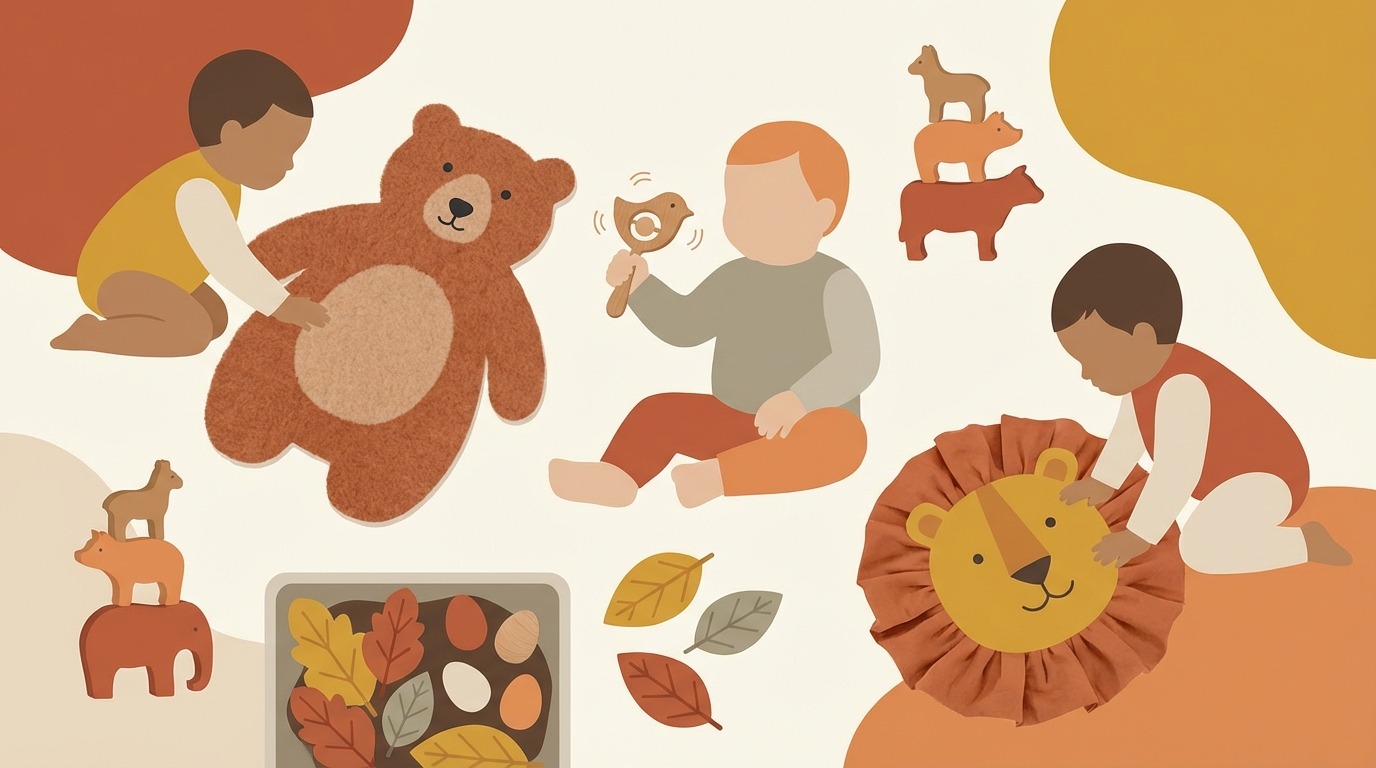
Touch quickly comes into play. A tactile picture book “coats and skins” can be made with scraps of felt, synthetic fur, and corrugated cardboard. Baby explores the “sheep’s wool” or the “fish scales.” Each page invites naming, stroking, comparing. Sensory matching progresses when given a clear instruction: “it’s soft,” “it’s rough,” “it slips.” This vocabulary describing sensations supports emerging thought.
Sound boxes and tactile picture books: back and forth between ear and hand
To solidify acquisition, the hand-ear back-and-forth remains decisive. You shake a box, look for the matching card, then imitate the cry. Three steps suffice at 18 months; at 30 months, you move to four or five boxes and “mom-baby” pairs. The game stays short and joyful to avoid fatigue. Additionally, some self-hardening clay rounds keep the imprint of figurines: the child presses the “dog’s” paw, compares it with the “cow’s,” feeds curiosity, and refines finger pressure.
- 🎶 Associate a sound with an image, then with a cry
- 🧸 Touch textures “coat,” “feathers,” “scale”
- 👣 Press a figurine to leave a print
- 🧠 Repeat often, in very short sequences
One last lever strengthens attention: set out two bins, “forest” and “savannah,” and invite the child to place each figurine in the right spot. Categorization gently begins and structures mental space.
Fine and gross motor skills with animal games: courses, gestures, and coordination
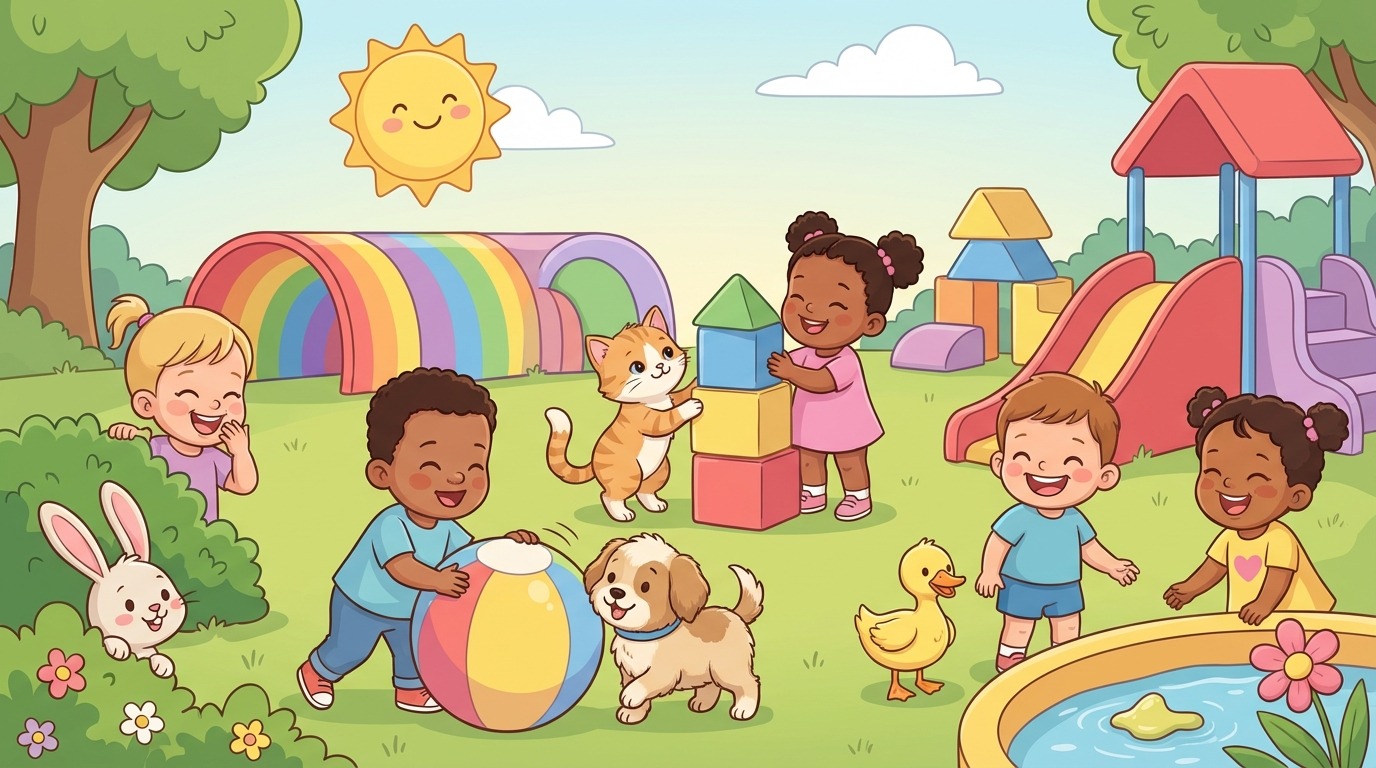
Movement helps the brain organize learning. A mini “animal” course alternates simple movements: walk like a bear (on all fours), jump like a frog (small squats), crawl like a snake (on a mat). Children 1 to 3 years old love these playful invitations that activate balance, cross-coordination, and proprioception. Three stations, thirty seconds each, suffice for an exciting circuit lap.
At the same time, fine motor skills are nurtured by targeted actions. Clothespins become “hedgehog spikes” or “lion’s mane” to attach on a cardboard disc. The child grabs, pinches, releases, then admires their “styled animal.” You can also transfer large pom-poms “bird eggs” with a spoon or thread some “caterpillar” rings onto a stick. These gestures support the emergence of the thumb-index pinch and prepare writing.
Safety and gradualness: adjust effort without breaking momentum
Safety dictates material choice: stable mats, large objects, no small pieces. At 12 months, focus on one motor action at a time. At 24 months, two actions chained; at 36 months, a mini scenario “the cat jumps over the obstacle, then rests in its kennel.” This gradualness maintains engagement without overload. To visualize animal movement variations, a video search can inspire suitable proposals.
The key remains the joy of movement. A child proud to “gallop like a horse” repeats spontaneously, consolidates motor patterns, and regulates energy. The body anchors learning.
Educational games and language: stories, simplified lotteries, and cooperation
Educational games around animals boost language when the adult verbalizes the action. A mat becomes “tropical forest,” two figurines “mom sloth and baby” look for leaves. Naming, pointing, rephrasing put the child in success. From 2 years old, a very simple photo lotto (2 to 3 pairs) stimulates visual attention and memory. You draw, comment “it’s the chick,” celebrate the found pair. Cooperation comes first: playing against card mess, not against each other.
The first board games exist for this age range. A great entry point is to browse this selection of board games from 1 to 3 years or, around 2 years, to compare with this list adapted for 2-year-old babies. These short, illustrated, cooperative formats support turn-taking, mild frustration, and listening to simple instructions. A common question arises: should you let children win? This nuanced reflection is developed here: should you let children win.
Animal reading rituals: sound books, seek-and-find, and nursery rhymes
Daily reading of animal books strengthens oral language and semantic memory. Flap and sound books engage fingers and ears; seek-and-find books train visual exploration. Coupling these rituals with “crying” nursery rhymes encourages imitation and prosody. To learn about the impact of play, this article on the benefits of play sheds light on educational choices.
By combining stories, gestures, and songs, language gains emotional anchorage. Words become alive because they connect to pleasant experiences.
Creative playful activities around animals: arts, crafts, and cooking
Artisan creation transforms the animal into a sensory pretext. A “paper towel tiger” colors by capillarity: you draw stripes with a marker, spray, and the magic happens. A “black and white zebra” learns contrast with masking tape. A “lion mane” is born from paper strips glued like a fan; the child discovers the sticking gesture, presses, then admires the volume effect. These creations exercise fine motor skills and reward effort with very visible results.
Recycling provides infinite supports. A crocodile in corrugated cardboard, a turtle on a cardboard plate, an ostrich with “feathers” in wool: so many chances to handle without risk. Blown paint (straw) creates funny “sea monsters”; ink draws liquid paths that the child observes, comments on, controls in small touches. The joy of making encourages repetition, and repetition consolidates coordination.
Recycling and progressive inspirations: from trace to shape
A clear progression reassures. We start with free tracing (stamps, big dots), then guided collage (strips, stickers), and finally recognizable shape (head, ears, muzzle). Animal photos serve as simple models: “two circles for the eyes, a triangle for the beak.” Colored squares become a “savannah at sunset” populated with silhouettes. This graduated approach channels creative energy while stimulating imagination.
Thematic cooking is also fun: “leopard pancakes” (marbled cocoa batter), fruit cut into “kiwi turtle,” pita bread “rabbit ears.” Smelling, kneading, tasting enrich sensory development. Golden rule: offer few, very clear tools, and value each attempt.
Gentle animal-child interaction: visits, educational farms, and home alternatives
Meeting real animals fascinates toddlers, but preparation is essential. Present images, listen to cries, and recall three rules: observe, ask before touching, wash hands. This framework secures animal-child interaction and avoids sudden fears. On-site, favor short times, calm zones, and peaceful animals. Naming emotions felt (“impressive,” “soft,” “loud”) helps the child orient themselves.
On rainy days or when outings are impossible, simple ideas save the day. This selection of indoor play ideas for rainy days offers quick scenarios to set up. Some well-chosen electronic toys, used sparingly, can vary pleasures; you can draw inspiration from electronic awakening game ideas to support auditory and light self-exploration, while keeping priority on real manipulations.
Respect for life, hygiene, and reassuring environment
Respect for life is cultivated early. Show how to gently hold a ladybug, name a cat’s needs, explain why a dog must be left to sleep. The child learns that each animal has a place, a rhythm, a body language. After each contact, the handwashing ritual becomes a sung game, linked to an animal image “taking its bath.” This coherence establishes a foundation of lasting habits.
“When a child plays with animals, they tame the world; when they learn through playing, the world opens to them.”
How long should an animal activity last at 2 years old?
Eight to ten minutes is sufficient. Multiple varied micro-sessions are better than a long workshop. A clear signal (start and end song) helps frame without rushing.
What simple materials can be used safely?
Thick cardboard, large stickers, felt, cardboard plates, XL pom-poms, wide clothespins, self-hardening clay. Avoid small pieces and favor tools with strong visual contrast.
How to introduce the first animal board games?
Start with a lotto with 2 pairs, cooperatively. Show, verbalize, play very shortly. Then increase to 3 pairs, then add an extra rule (throwing, drawing).
What if the child is afraid of animals?
Return to sound books and figurines. Imitate cries at low volume, look at the animal from afar, value each approach. Respect for personal rhythm is key.
How to avoid overstimulation during motor courses?
Alternate a dynamic station (frog jump) and a calm station (breathe like a purring cat). Lower the music, reduce the number of visible objects.