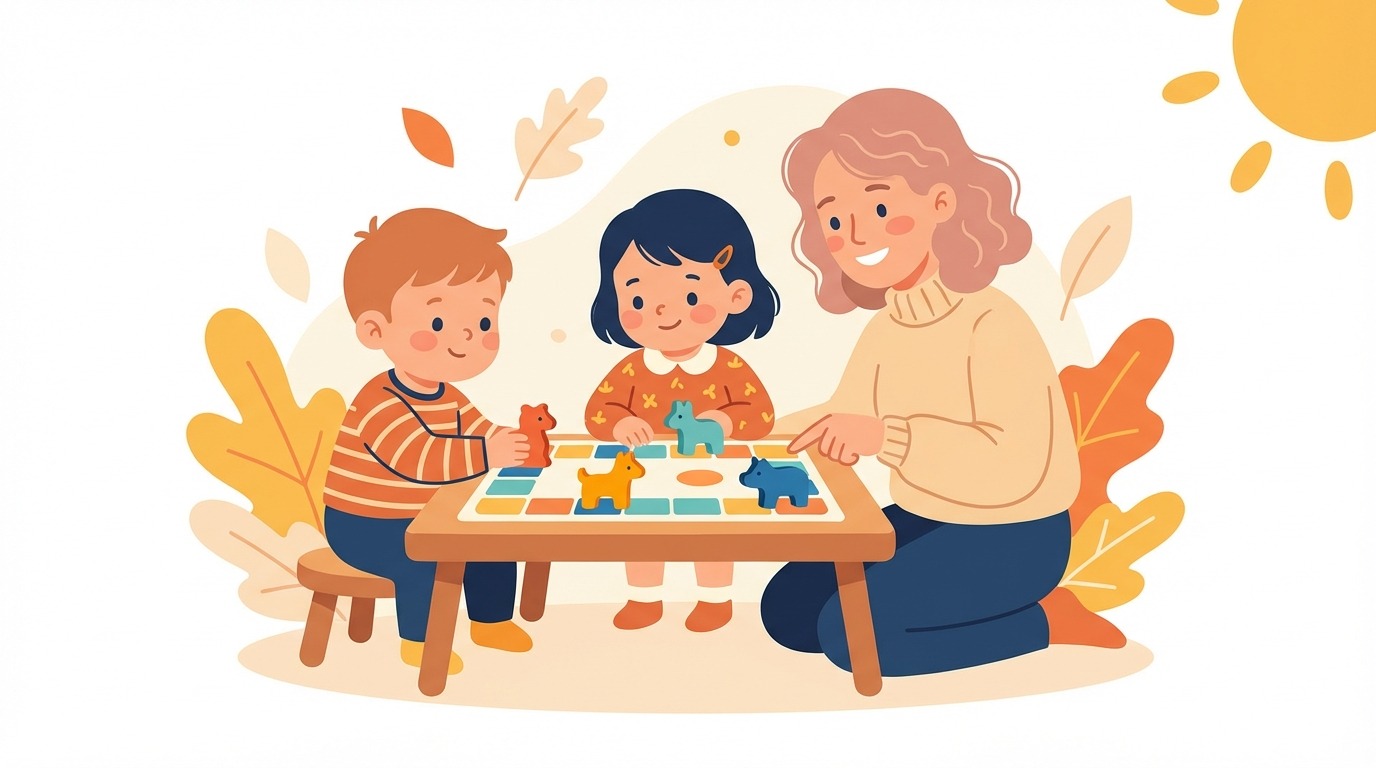
Let Them Win: Should children aged 3 to 5 be allowed to win games?
At daycare, at home, or at the grandparents’, games become emotion laboratories between ages 3 and 5. Should you let them win to preserve joy and self-confidence, or maintain a clear framework to promote learning rules and healthy frustrations? This question stirs both parents and education professionals. At this age, the desire to succeed explodes, but tolerance for failure is still developing. Therefore, the choice between letting victory slip away or playing fair deserves solid, concrete, and nuanced guidelines.
Here is a practical compass. It is based on real situations, easy tips, and points of attention related to socio-emotional development. In the following scenes, Lina (4 years), Sam (5 years), and Hugo (3 years) guide the reflection. Their reactions show how to adjust difficulty, encourage motivation, support social skills, and nurture the desire to play again. This journey mixes kind strategies, clear rules, and small rituals that transform each game into a growth step.
Short on time? Here’s the essentials
| Short on time? Here’s the essentials ✨ |
|---|
| Alternate between “balanced” games and “learning” games to balance challenge and fun 🎯 |
| Name emotions and offer a rematch to relaunch motivation 🔁 |
| Introduce simple, consistent rules, and playful handicaps adapted to the age 🧩 |
| Strengthen self-confidence by valuing effort, not just victory 💪 |
| Plan quiet times, water, and smooth transitions to avoid overloads 🫖 |
Letting children aged 3 to 5 win: emotions, rules, and stages of development
Between 3 and 5 years, children move from self-centered play to cooperative play. They test limits, learn alternation, and tame frustration. Letting them win systematically can reassure, but sometimes freezes the learning of perseverance. Conversely, playing “too hard” quickly demotivates. Balance is built.
For Lina, 4 years old, defeat often triggers tears. Yet, a stable framework helps her progress. An adult can announce the rules, remind the turn order, and plan a rematch. This structure eases stress and supports self-confidence.
Sam, 5 years old, better understands luck and effort. However, he sometimes confuses victory with personal worth. This is where the words matter. Saying “You tried, struggled, then succeeded” strengthens perceived competence. Victory becomes a result, not a label.
Hugo, 3 years old, wants to “win right away.” His brain processes waiting poorly. So, we offer short games, quick turns, and frequent positive reinforcements. He holds up better, self-regulates, and sometimes accepts losing without a crisis.
To set solid milestones, rituals help. Singing an opening or closing rhyme marks game time. Supports like rhymes and early learning smooth emotional transitions. The brain then associates the game with a complete cycle: start, try, finish.
Language plays a key role. At this age, words for “disappointed,” “proud,” “in a hurry” are still developing. Some simple answers to language questions help put feelings into words. When a child expresses better, they control themselves better.
The question of cheating also arises. You can smile but remain clear: “The rule is the same for everyone.” To maintain it, the adult adopts a firm and gentle posture. They value respecting turns. They remind that shared pleasure is the goal.
Sometimes a child refuses to play again after a defeat. In those cases, cooperation against the clock, teaming up, or adding a small handicap for the adult is suggested. The challenge/support balance readjusts without misleading the child about the reality of the game.
Finally, thinking about the environment matters. A table at the right height, visible rules, and a calm time after nap prevent unnecessary tensions. Thus, victory no longer becomes a battle but one stage among others.
Key idea: at 3-5 years, rules are stabilized while access to success is facilitated. This subtle balance nurtures progress.
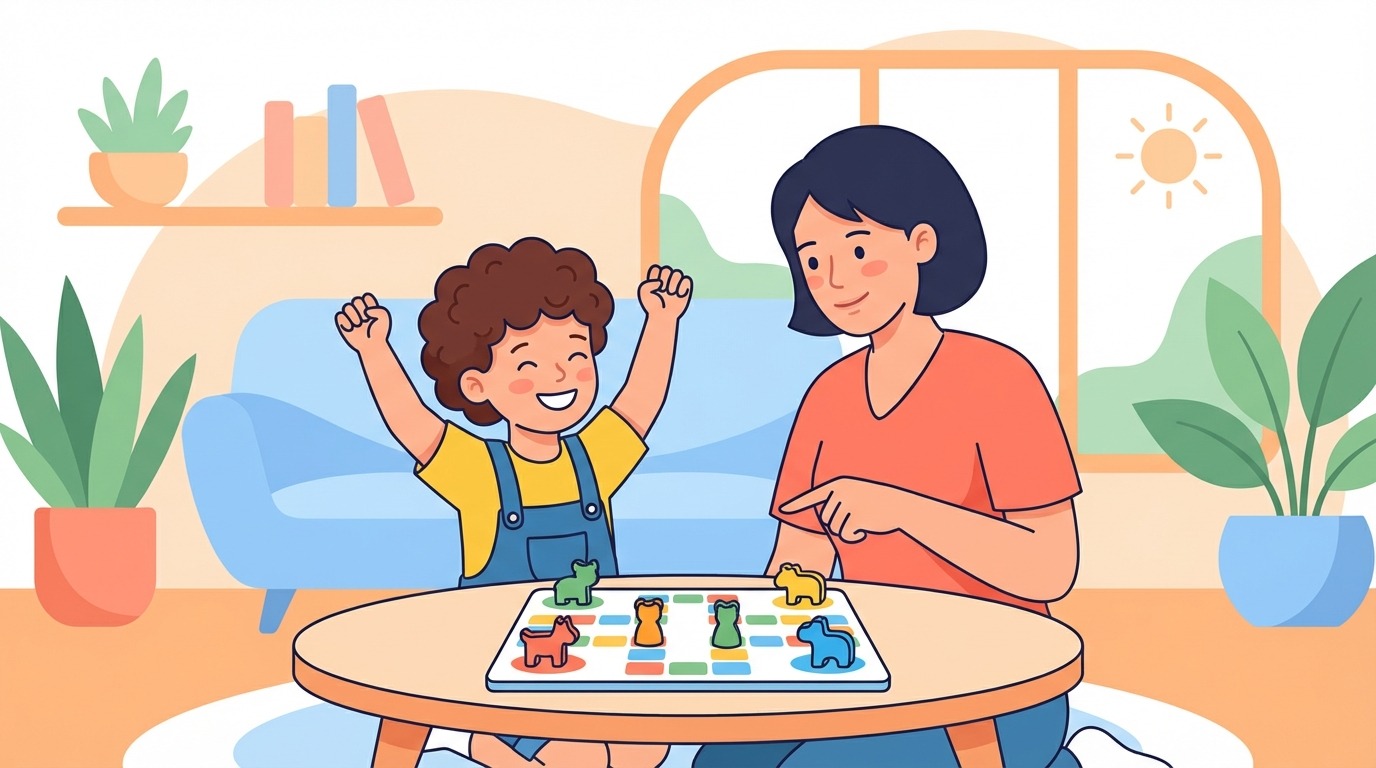
Motivation and self-confidence: when to let win and when not
Motivation comes from a challenge within reach. If the child never wins, they give up. If always let win, they stop trying. The answer lies between the two: calibrate difficulty and vary play formats.
First strategy: the joyful handicap. The adult draws one card less, rolls a smaller die, or starts at square zero. This is not cheating. It balances forces to protect the taste for playing. This handicap is announced before the game.
Second strategy: multiple objectives. Beyond “winning the game,” intermediate goals are valued. Counting without errors. Waiting your turn. Putting pieces away. Thus, the child sees progress even if they lose the game.
Third strategy: alternation. One day, a “learning” game. The next day, a “fair” game. This oscillation avoids routine and builds tolerance. The child mentally prepares for varied outcomes.
In card games, children’s war rules offer a perfect field. Rounds are quick. Chance regulates gaps. And the rematch comes quickly. The adult can comment on luck to relieve the defeat.
Checklist clues to adjust the dial:
- 🧠 Does the child maintain attention? Then you can slightly increase difficulty.
- 💬 Do they verbalize disappointment without an outburst? Keep “fair” games.
- 🧸 Do they tense up as soon as rules are announced? Review the goal and shorten the game.
- ⚖️ Do they become dominant after several easy wins? Reintroduce chance and strict rules.
- 🌟 Do they enjoy cooperating? Mix cooperative and competitive for balance.
This balance feeds self-confidence without fooling the child. They learn that a victory can be prepared and defeat can be endured. This message nurtures overall education: persevere, respect, and try again.
Moreover, the daily context influences play. After school, complex rules are avoided. A light snack or quick meals on play days maintain stable energy. Body and mind progress together.
Practical key: motivating means making success credible, not guaranteed. That’s how play stays a springboard, not a smoke screen.
Social skills and game rules: learning to lose without losing oneself
Playing teaches positioning among others. You listen, wait, comment without hurting, accept the common rule. These social skills are worked like a muscle: often, gently, and step by step. Play becomes an ideal training ground.
To prevent storms, the emotions are named beforehand. “Losing can sting, it’s normal. We breathe together.” This affective language reassures. It allows the child to dare to try without fearing judgment. They gain relational stability.
Then, the ritual of mutual compliments boosts esteem. The winner says what they appreciated in the other: patience, creativity, humor. The loser receives positive feedback. Each progresses without crushing the other. The sportsmanship spirit is nurtured.
Faced with shyness or withdrawal, adjustments are made. Some children pull back at rule time. Tips to overcome shyness help free speech and posture. Play becomes inclusive again, not threatening.
Some simple “scripts” support the relationship:
- 🙂 “You can be disappointed and remain respectful.”
- 🤝 “We shake hands and suggest a rematch.”
- 🗣️ “I describe what I saw, not who you are.”
- 🧭 “Rules are our compass, not a punishment.”
- 🌈 “You lost the game, but you gained patience.”
In the playroom, a quiet corner avoids outbursts. An hourglass timer and a calming cushion help return to oneself. The child learns that a break is not a failure. It is a tool for emotional autonomy.
Body care matters too. After active play, skin may redden. Advice on baby skin redness enlightens hygiene and comfort. A child comfortable in their body remains more socially available.
Finally, telling the fair-play story inspires. “Today you helped your friend, that’s a team victory.” This narration strengthens prosocial identity. It infuses game ethics into daily life.
Final message of this sequence: you don’t let them win to avoid tears; you structure to grow relationships.
At 5 years and in kindergarten: concrete scenarios, adapted games, and smart adjustments
On the ground, the method plays out in detail. Lina (4 years) loves Memo. We first reduce the number of cards. Then add the rule “I name the picture out loud.” It consolidates memory and language. The adult does not “give in” pairs; they guide attention.
Sam, 5 years old, discovers counting down. A race track with a starting handicap balances the duel. The adult starts two squares behind. Sam measures his trajectory: throw, move forward, breathe. If he loses, a cooperative “relay race” is offered to end on a shared success.
Hugo, 3 years old, prefers quick turns. Animal dominos or a 9-piece puzzle keep him busy. The goal remains to multiply micro-successes. We announce at the start: “Three rounds then tidy up.” The framework reassures and prevents emotional escalation.
Cards offer an excellent laboratory. The children’s version of war trains number comparison, waiting, and chance management. The idea that luck varies is reinforced. The child detaches from the label “I’m bad/I’m good.”
To enrich language and learning rules, singing together energizes attention. Early learning rhymes mark transitions. They code moments “we play,” “we change,” “we tidy up.” Coherence grows, tensions decrease.
Express checklist for adjustments:
- 🎲 Shorten the game without changing the rules.
- 🏁 Offer a clear handicap to the adult.
- 🧩 Propose a parallel objective (count, name, wait).
- 🔁 Plan an announced rematch from the start.
- 🧃 Insert a water/breathing break to keep fun.
These micro-levers make sometimes “too hard” games accessible. The child advances by successive approximations. They understand the meaning of rules and the taste of challenge. They no longer confuse “winning” with “being loved.”
Conclusion of this practice: play fair, but arrange the access path. Pleasure remains the engine, rules remain the framework.
Emotional balance and overall health: hydration, breaks, and signals to watch
Play mobilizes the body as much as the mind. But a dehydrated or tired child quickly loses patience. Anticipating these needs changes the course of the game. Planning a water bottle and regular breaks reduces conflicts. Resources on thirst and hydration in toddlers shed light on this often underestimated aspect.
Blood sugar affects mood. A simple snack stabilizes energy. Ideas for quick meals on game days help when timing is tight. Avoid fast sugars just before a game requiring attention.
Sometimes irritability hides bodily discomfort. Redness, a tense belly, or a restless night weaken availability for play. A glance at baby skin redness or digestive signals helps sort causes. A simple rhythm adjustment often suffices.
In rare cases, recurring abdominal pain warrants medical advice. Staying aware of trends in pediatric digestive diseases sensitizes to warning signs. Playing shouldn’t mask a health problem. The goal remains overall well-being.
Finally, duration matters. At 5, many children last 15 to 20 minutes in a structured game. This can be extended with ritual breaks. A deep breath, a sip of water, a shared smile, then restart. This micro-emotional hygiene prevents the spiral.
Over weeks, the adult observes and adjusts. The child gains social endurance. They better tolerate uncertainty. They understand that the game stops, then resumes. And that defeat is a passage, not an identity.
The essence to remember: taking care of the body supports the spirit of play. One protects curiosity and the desire to restart.
Video benchmarks to enrich play sessions
For further exploration, some video resources show concrete implementations at home or in class. Searching for short and practical formats guarantees immediate use with children.
After watching, select two tips and test them in the next game. A small regular change often produces big effects.
Ethical boundaries: truth of the game, supportive gestures, and respect for differences
The question “Should we let win?” engages an ethical compass. You don’t deceive. You don’t pretend to lose. However, you arrange the field and accompany. This clear line preserves trust. The child feels the respect given to them.
Each child progresses at their own pace. For some, losing triggers an emotional tsunami. For others, the outcome matters less than complicity. The adult stays observant. They regulate challenge level and name the rule at the right moment. Thus, the bond is protected.
Language remains a safeguard. Avoid “See, it’s easy” when the child struggles. Prefer “You found another strategy” or “You hung in there.” These phrases anchor the value of effort. They cultivate a growth mindset.
Then comes tolerance for diversity. Some children need visual signals. Others prefer to move between rounds. We prepare varied supports: rule pictograms, visual timer, tactile paths. The game personalizes without overly individualizing.
Finally, victory is not fetishized. The game’s trajectory stretches over time. The child remembers a burst of laughter, a great idea, a fair-play gesture. They build an affective memory of shared success. This memory becomes a landmark at school and in life.
Cardinal point: the game’s truth remains intact, and the adult supports. This subtle agreement is the heart of a joyful and demanding education.
{“@context”:”https://schema.org”,”@type”:”FAQPage”,”mainEntity”:[{“@type”:”Question”,”name”:”u00c0 quel u00e2ge peut-on arru00eater du2019amu00e9nager les ru00e8gles ?”,”acceptedAnswer”:{“@type”:”Answer”,”text”:”Vers 5-6 ans, beaucoup du2019enfants gu00e8rent mieux la du00e9faite. On ru00e9duit alors les handicaps, mais on garde les rituels de fair-play et les objectifs du2019effort. Lu2019important reste lu2019observation individuelle.”}},{“@type”:”Question”,”name”:”Comment ru00e9agir si mon enfant triche ?”,”acceptedAnswer”:{“@type”:”Answer”,”text”:”Rappeler la ru00e8gle calmement, montrer lu2019effet sur le plaisir partagu00e9, et proposer une revanche avec la mu00eame ru00e8gle pour tous. On valorise lu2019honnu00eatetu00e9 en action, pas les reproches.”}},{“@type”:”Question”,”name”:”Faut-il interdire les jeux compu00e9titifs ?”,”acceptedAnswer”:{“@type”:”Answer”,”text”:”Non. Les jeux compu00e9titifs apprennent le cadre, la patience et la gestion des u00e9motions. On les alterne avec des jeux coopu00e9ratifs pour maintenir lu2019u00e9quilibre.”}},{“@type”:”Question”,”name”:”Que faire si mon enfant refuse systu00e9matiquement de rejouer ?”,”acceptedAnswer”:{“@type”:”Answer”,”text”:”Raccourcir les parties, introduire des objectifs parallu00e8les et pru00e9voir une victoire coopu00e9rative finale. On protu00e8ge la motivation avec des du00e9fis cru00e9dibles.”}}]}At what age can you stop adjusting the rules?
Around 5-6 years, many children manage defeat better. Then handicaps are reduced, but fair-play rituals and effort goals are kept. Individual observation remains important.
How to react if my child cheats?
Calmly remind the rule, show the effect on shared pleasure, and propose a rematch with the same rule for everyone. Honesty in action is valued, not reproaches.
Should competitive games be banned?
No. Competitive games teach framework, patience, and emotional management. They are alternated with cooperative games to maintain balance.
What to do if my child systematically refuses to play again?
Shorten games, introduce parallel goals, and plan a final cooperative victory. Motivation is protected with credible challenges.
“Don’t produce victories, build players.” 💫