Dyscalculia School: Dyscalculia at school: recognizing and helping 5-8 year olds.
| Short on time? Here’s the essentials ⚡ |
|---|
| ✅ Dyscalculia affects about 2 to 5% of children and is not due to lack of effort. |
| 🔎 Between 5-8 years, it is necessary to recognize the signals: counting remains difficult, sign confusion, non-automated tables. |
| 🧠 An assessment by a speech therapist and support from the school establish the diagnosis within learning disorders. |
| 🧰 Educational adaptation and educational intervention: calculator, extended time, visual aids, hands-on manipulation. |
| 🤝 Rights: MDPH, PPS/PAI, AESH; associations and resources like Le Cartable Fantastique. |
| 🌟 Goal: help the child learn mathematics differently and preserve self-esteem. |
At school, a 7-year-old student who confuses 14 and 41, struggles to tell time or gets stuck in front of dice constellations is not necessarily “bad with numbers.” Often, it is a learning disorder called dyscalculia. Between 5 and 8 years, this reality plays out in everyday classroom details: reciting number rhymes, moving to tens, understanding operations. Without identification, the gap widens and anxiety sets in. Yet, with simple accommodations, progress quickly takes root.
The experience of families, like that popularized by the story of a mother who made this “invisible disability” visible, highlights the urgency of a shared culture. On one hand, clumsy remarks hurt; on the other, tools exist and reassure. The goal is clear: recognize early, help better, and combine educational adaptation and educational intervention. Mathematics then becomes a possible adventure, not a wall to climb alone.
Dyscalculia in primary school: spotting between 5 and 8 years without stigmatizing
Observing a CP-CE1-CE2 child requires close attention to number milestones. The first signal concerns counting. Despite training, the student recounts one by one, loses cardinality, and forgets to associate the last number word with the quantity. Then, difficulty recognizing small quantities rapidly (subitizing) hinders reading dice or fingers constellations. This complicates games designed to ease mathematics anxiety.
Sign confusions (+, −, ×, =) also appear. The child may write 3=5−2, but reverse it the next line. Exchanges in base 10 raise questions: 12 can dissolve into “1 and 2,” without relation to “one ten and two units.” Finally, automation remains fragile: tables, doubles, complements to 10. This is not laziness. The brain struggles to stabilize number representation and oral/Arabic codes.
Differentiating ordinary development from a dyscalculia alert
All students stumble sometimes. What alerts is the durability of difficulties, their resistance to standard help, and extension to multiple areas: counting, number reading, problem solving, written and mental calculation. A child with a simple delay catches up when pedagogy adjusts. In case of dyscalculia, the gap persists, even with good will.
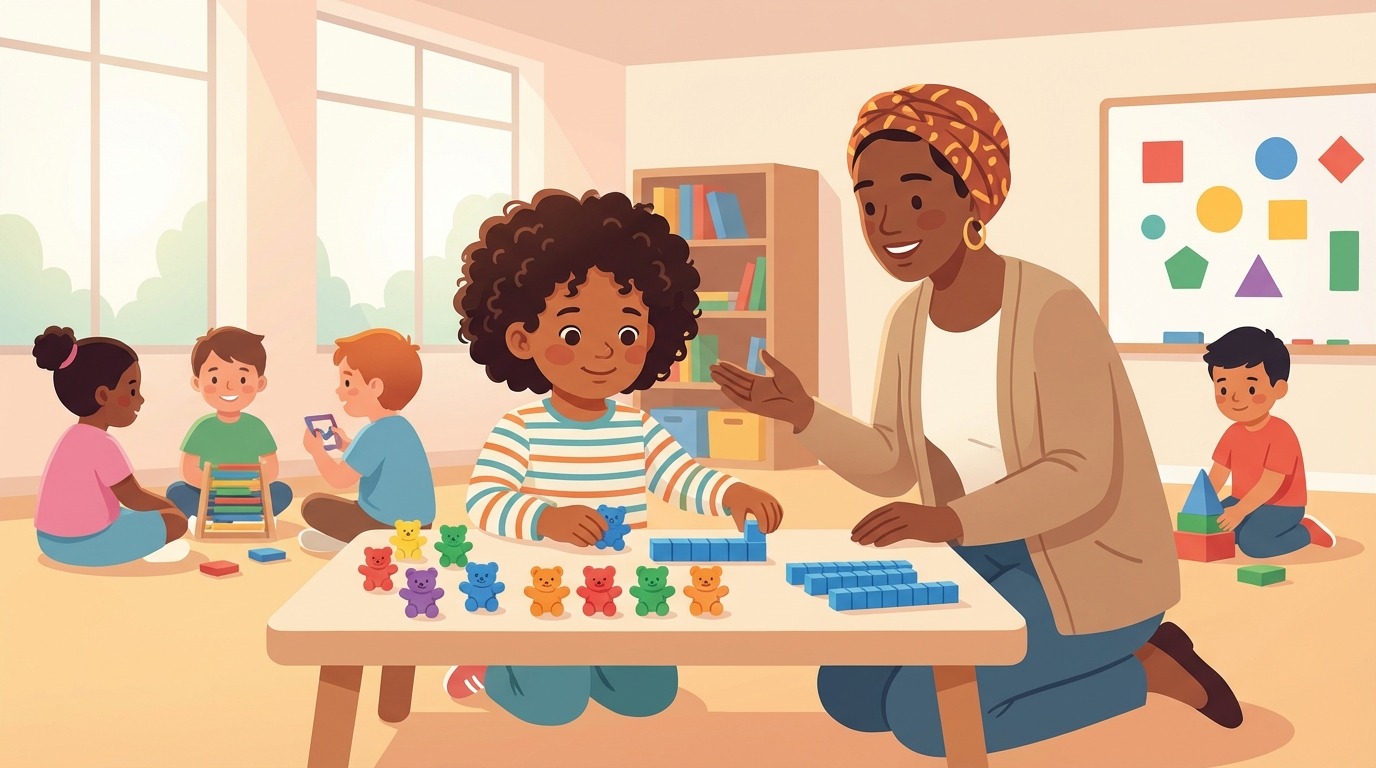
A concrete example helps decide. Lina, 6 years, progresses in reading but gets stuck on 8 objects placed. She recounts 3 times without trusting the overall look. With tokens and an abacus, she follows. Without support, everything collapses. This dependence on concrete aids, combined with lasting confusions, calls for structured identification. This is where targeted educational intervention begins.
Associated signs to watch for better recognition
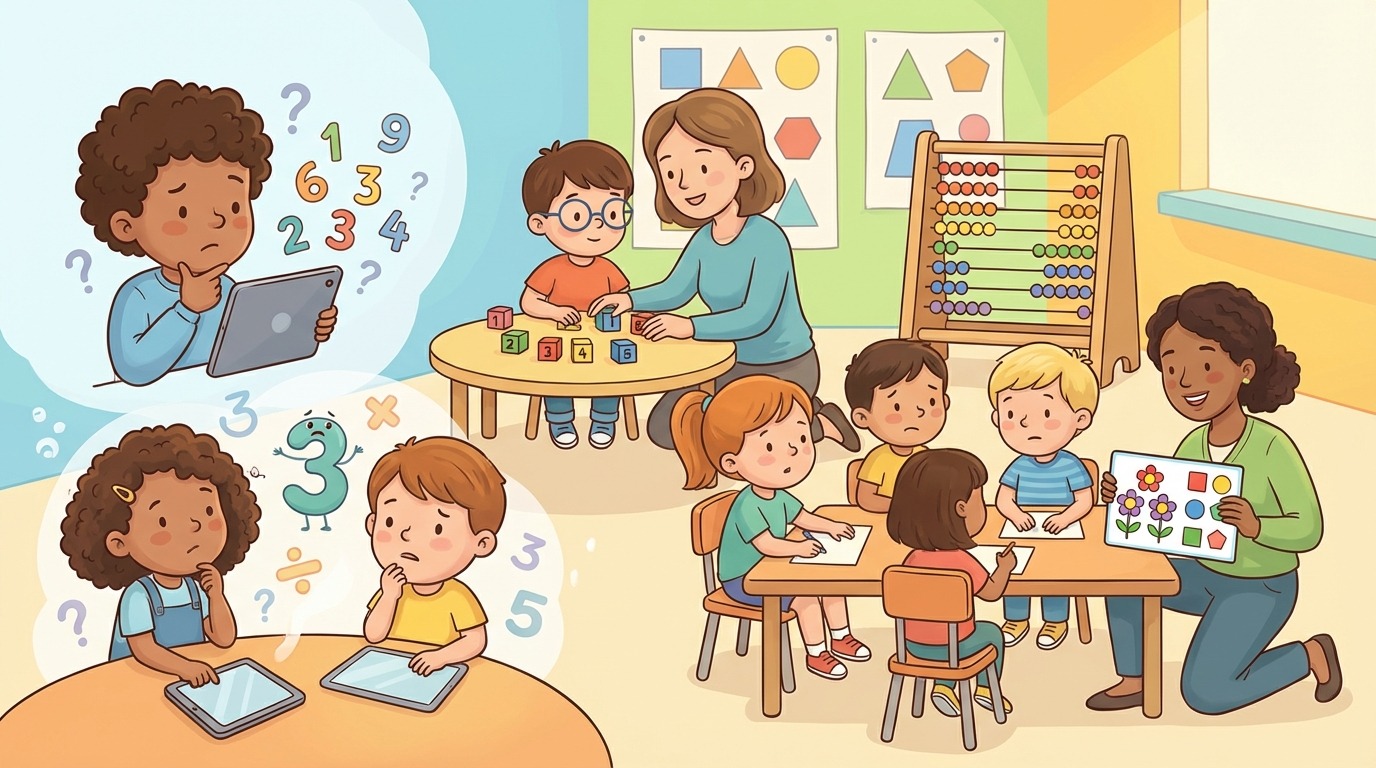
Temporal and spatial difficulties often appear: reading analog clocks, understanding the order of days, organizing a page of written calculation. Written problems become labyrinthine. The child knows the words but cannot choose the operation or form an equation. Stress rises, and working memory falters. However, strengths exist: creativity, rich language, scientific curiosity. Clear framing allows activating them in service of numbers.
Without stigmatization, the key message is imposed: recognizing early protects self-esteem. The adult then explains that the brain learns differently and has tools. This new reading of errors transforms the classroom: we move from judgment to analysis. This is the first step to truly help.
From reporting to diagnosis: a clear path for families and school
At the first suspicion, the teacher records observations in a grid: frequent errors, successful tasks, overload moments. This approach avoids premature labeling and prepares orientation for assessments. Family-team dialogue remains central. It frames expectations and soothes. Everyone then knows who does what, when, and with which tools.
The diagnosis is made by a speech therapist trained in learning disorders. Depending on the region, a neuropsychologist may complete the evaluation. The goal is not to classify the child but to understand their numerical profile: number codes, operation sense, fact memory, reasoning, praxies. Conclusions guide educational adaptation and educational intervention.
Key role of school in structured identification
The school does not diagnose but knows how to objectify. With simple situations, it photographs the relationship to numbers. Example: ask for 23 in ten-unit cubes, then write, then read it. Then move to 32. Fluctuations reveal representation stability. A short task sequence isolates what the child knows when the load is lightened.
A synthetic report, without jargon, accompanies the family to assessments. It describes persistent difficulties despite attempts at help. This proof of effort protects the child from judgment and facilitates access to official provisions.
Delays, MDPH and practical levers to avoid waiting
Delays sometimes exist. However, several levers limit damage. First, implement accommodations as soon as identification occurs. No need to wait for the label to ease evaluations or allow the calculator. Then, contact associative care centers and aid networks. Specialized associations direct families to available professionals.
- 🗂️ Build a clear file: typical errors, successful tasks, observed needs.
- 📞 Contact several speech therapy offices and request an active waiting list.
- 📚 Set up a provisional educational adaptation in the classroom.
- 🧩 Activate AESH if a PPS is possible, in connection with MDPH.
- 🤝 Rely on FFDys and local associations for resources.
When access to care is delayed, “intensive workshops” exist during school time or holidays. Well conducted, they provide a boost. Classroom follow-up then takes over. Ultimately, the important thing is to keep the student moving.
Quality educational videos also help parents identify without guilt. This media support complements fieldwork and reassures about good practices.
Helping in class: educational adaptation and intervention that change everything
An inclusive class makes mathematics possible for all. With concrete supports, varied representations and flexible progression, the dyscalculic child hangs on and moves forward. The challenge is not to “do it for them,” but to make the path doable. Evidence accumulates: manipulating, verbalizing, visualizing and spacing learning accelerates anchoring.
Practically, the manipulation–schematization–symbolization triptych serves as a compass. We start by experiencing quantity with tokens, cubes, a balance. Then, we draw bars, part-whole diagrams, number lines. Finally, we code in numbers and symbols. This back-and-forth stabilizes base 10, gives meaning to exchanges, and defuses mechanical routines.
Effective classroom tools and routines
Recurring visual cues reassure. A vertical number line prevents left/right confusion. Numeric fact tables displayed by families (doubles, complements to 10, neighbors) reduce cognitive load. A personal reference binder gathers the “anti-panic” items: calculation gestures, layout models, problem lexicon.
“Mathematical reading aloud” strengthens understanding. The student explains each step of their reasoning while the adult reformulates. This dialogue, advised by practitioners, reveals knots and installs robust procedures. It is an authentic educational intervention, focused on meaning rather than raw performance.
Adapted assessments and assistive technologies
Accommodating does not reduce the requirement. The objective remains the same, but the path adapts. Extra time is planned, instructions are segmented, and the calculator is allowed when the task is problem-solving or modeling. On paper, a layout template avoids alignment errors. Visual blockers limit distractions. Geometry or numeracy software offer immediate feedback.
From an equity perspective, these tools do not cheat. They make invisible skills visible. When the child can finally show their reasoning, confidence returns. And with it, the desire to learn. This is precisely the goal of a well-thought-out educational adaptation.
Ultimately, successful inclusion rests on a simple rule: explain, vary, repeat without tiring, and value every progress. The rest follows.
At home: playful routines, emotion management and family-school partnership
Home can become a supportive laboratory. Board games, cooking recipes and small tasks give meaning to numbers. Measuring 200 ml of water, dividing 12 cookies for 3 people, or reading minutes on a digital timer build bridges with school. These everyday gestures transmit meaning before calculation.
The key is lightness. Anxiety is transformed into a cooperative challenge. The adult speaks positively, avoids hurtful phrases, and celebrates effort. Remarks like “You’re not trying” or “It’s easy” undermine self-esteem. Conversely, “You found a strategy,” “Let’s try a different way” stimulate engagement. Over time, this posture changes the trajectory.
Games and mini-challenges that work
Dominoes with constellations strengthen quick recognition. An abacus and ten-unit cubes consolidating base 10 help explain exchanges. “Real-life problem” cards invite telling the situation before posing it. And a number hunt in the street (reading numbers, comparing, sorting) maintains the fun-learning link.
A short daily ritual is better than a long weekly session. Five minutes of spaced review of numeric facts suffice. Reminders are interspersed, contexts varied, and testing done without punishment. This consistent practice encourages automation without pressure.
Emotions and everyday neuroscience
Anxiety blocks working memory. Before a test, guided breathing or calm visualization frees resources. A visual timer structures the task. Start and finish are announced. A choice between two activities is offered. This little margin of control reduces emotional load. The child feels empowered.
The link with teachers remains essential. A logbook notes successes, strategies and needs. By keeping the same vocabulary between home and class, slippages are avoided. Adult alignment becomes a powerful lever. In the end, the student knows they are not alone. This sense of security accelerates learning.
Basically, the alliance makes the difference: when family and school agree, the child dares to persevere.
Rights, resources and sustainable pathways: MDPH, AESH, associations and tools
Recognizing dyscalculia opens rights. The Departmental House for Disabled Persons (MDPH) may propose a PPS, AESH support, and evaluation accommodations. Over time, an RQTH may become useful in some contexts. The goal is not labeling. The goal is to compensate a lasting disorder so skills can be expressed.
Associations structure the ecosystem. They offer guides, webinars, support groups. They also help formalize requests. Between appointments, these networks avoid isolation. They share quality resources: templates, adapted exercise banks, and classroom advice.
Key resources and educational continuity
Dedicated platforms offer modifiable supports: base 10 sheets, operation templates, and graduated problem generators. Le Cartable Fantastique, well known for dyspraxia, provides tools transferable to numeracy. Meanwhile, video channels break down procedures into clear steps.
These media extend educational intervention in class. They allow families to find the same gestures and language at home. This coherence increases session effectiveness.
Looking beyond CE2: orientations and confidence
Dyscalculia does not prevent success. It encourages choosing paths where mathematics are equipped. With accommodations, some students shine in humanities, arts, digital, or languages. The important thing is to build a foundation: number sense, data reading, and step-by-step problem solving. Raw calculations pass through assumed and authorized tools.
The final message to children aged 5 to 8 years is hopeful. Their brain learns differently. Thanks to coherent educational adaptation, they become able to recognize structures, help peers by explaining differently, and rely on solid strategies. Perseverance makes the difference.
In short, rights guarantee the course, resources trace the route, and cooperation pushes the bike. The student moves forward, step by step, in balance.
Immediate action plan for school and family
Because taking action reassures, a concise plan helps start as soon as tomorrow. It combines observation, tools, and relational gestures. This trio triggers a virtuous circle: fewer errors, more meaning, more confidence.
- 📝 The teacher formalizes three benchmark tasks and notes typical errors.
- 🧮 The family introduces 5 minutes of spaced review of numeric facts every evening.
- 📐 The class adopts a template for setup and a common number line for all.
- ⏱️ Assessments are segmented with additional time from now on.
- 📲 The calculator is allowed when the objective is not raw calculation.
- 🤗 Adults ban hurtful phrases and value the strategy used.
This minimal plan creates momentum. Then, assessments will refine needs. But the child will have already regained confidence, and that is decisive.
What are the first signs of dyscalculia between 5 and 8 years?
Persistent difficulties counting, confusions of digits and signs, poor immediate recognition of small quantities, and non-automation of numeric facts despite training.
Should one wait for a diagnosis to implement accommodations at school?
No. Adaptations can begin immediately: extended time, segmentation, visual supports, calculator depending on the objective. The diagnosis then refines the support plan.
Who makes the diagnosis of dyscalculia?
A speech therapist trained in learning disorders performs the assessment. A neuropsychologist may complement the evaluation depending on needs.
What official aids exist at school?
PPS, PAI, support by AESH, accommodation of assessments, digital tools. The MDPH can recognize the need for compensation.
How to help at home without creating conflict?
Offer short playful rituals, use concrete objects, avoid judgments, value strategies, and maintain regular contact with the teacher to keep the same approach.
“The right method does not erase difficulty, it reveals ability.”