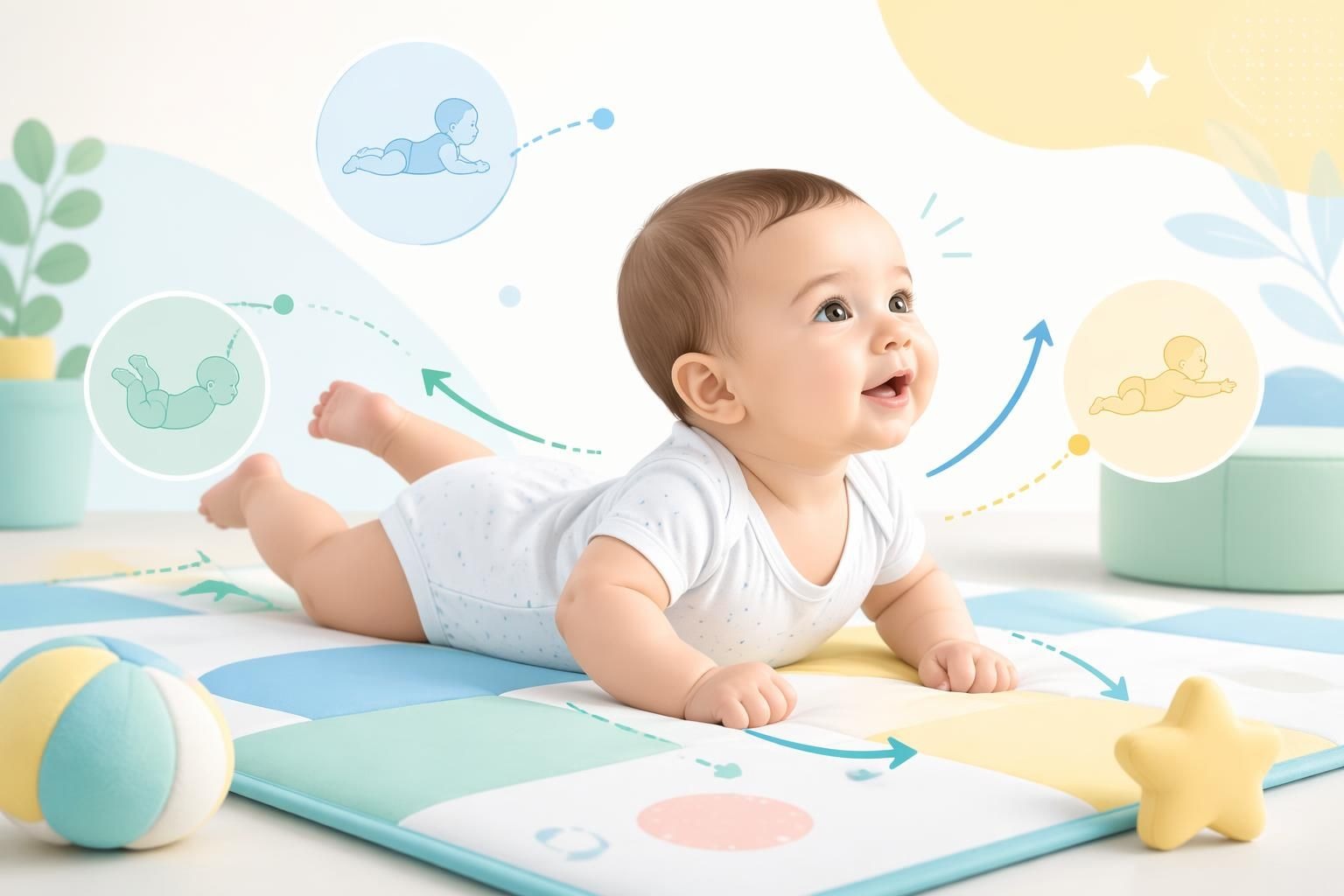
Gross Motor Skills Baby: The development of the baby’s gross motor skills at 3 months.
| Short on time? Here’s the essentials ⚡ |
|---|
| At 3 months, gross motor skills explode: better head control, support on forearms while prone, more symmetrical movements 💪 |
| Strengthening postural control involves daily tummy time and varied carrying positions 🧸 |
| Coordination becomes more precise: 90° visual tracking, hands coming together, feet explored with curiosity 👀👣 |
| Good motor stimulation alternates play, rest, and comfort; avoid excessive devices that immobilize ⏱️ |
| Prevent flat head by varying positions, supports and gaze directions; consult if asymmetry persists 🛏️ |
| Next milestone: rolling to the side, grabbing feet, gaining muscle tone and endurance 🌀 |
Between naps and a bottle, a 3-month-old baby experiences a decisive turning point. Their motor development accelerates, their gaze sharpens, and their body discovers new supports. Each day brings a micro-progress: the head holds more steady, the torso lifts slightly higher, movements become less jerky. This stage not only prepares for rolling in the months to come but already lays the foundations for future balance, walking, and even fine motor skills. With simple rituals and an adapted environment, daily life transforms into a joyful, safe, and rich exploration ground.
Should we then accelerate motor stimulation? Unnecessary. The secret lies in a nuanced alternation: propose, observe, adjust. Thanks to a variety of positions, carrying methods, and sensory games, postural control is built without forcing, while primitive reflexes fade to make way for voluntary action. The ambition is not performance; rather, it is a fine relationship to the child’s rhythm. This approach protects baby growth, strengthens coordination, and invites the body to interact with space, one movement at a time.

Gross motor skills in babies: essential benchmarks at 3 months
At this age, gross motor skills reveal their first major markers. On their back, the infant better aligns their head centrally and follows a toy 90° from left to right. This ocular motor tracking is coupled with more symmetrical arm and leg movements. Hips bend, feet lift in the air, the child experiments with aerial kicks. These simple gestures stimulate the muscle tone of the pelvic and shoulder girdles, essential for upcoming stages.
On the tummy, progress is striking. The baby supports on their forearms and can lift the head and chest between 45° and 90° depending on their condition that day. This prone support nourishes postural control thanks to work on the trunk and neck extensors. It prepares for rolling to the side, then rolling back onto the back. The key is to respect progression: frequent short minutes are better than one long imposed session. This routine also encourages thoracic breathing and frees the neck.
From reflex to voluntary: what changes
Primitive reflexes gradually give way to controlled movements. The grasp reflex fades, hands open, meet in the center, then move towards the mouth. This hand-mouth, hand-hand, then hand-foot sequence contributes to bilateral coordination and feeds the body map: baby learns where their body starts and ends. At 3 months, they already touch their belly and knees, and sometimes rub their feet against each other.
This shift to voluntary engagement involves the gaze. Looking, following, anticipating an object’s movement activates networks connecting vision, posture, and arms. Each micro-success maintains motivation and, by ripple effect, functional muscle strengthening. The body awakens because the brain gives meaning to movements. That’s why a simple but high-contrast toy can make all the difference.
Example of daily progression
Imagine Naël, born at term, with a calm temperament. In the morning, after a diaper change, five minutes of tummy time suffice for him to lift his head well. After the nap, a front-facing carry with gentle neck support encourages postural control without fatigue. At day’s end, a floor mirror catches his attention: hands come together, gaze brightens, the torso tilts slightly to the side. This alternation sets a virtuous circle: more solid supports, more curiosity, thus better-coordinated movements. Key insight: at 3 months, quality of support is worth more than quantity of “exercise time.”
Safe motor stimulation: positions and games adapted to the 3-month-old baby
A wise motor stimulation is anchored in varied positions and gentle transitions. Goal: enrich supports, awaken curiosity and strengthen muscle tone without exhaustion. Each proposal should remain short, joyful, and reversible. The environment should be simple: firm mat, clear surface, soothing light, some visual contrasts. An attentive parent, a soft song, and that’s all it takes.
Winning positions and key gestures
- 🧘 On the tummy, forehead turned to the side, sound toy at eye level: the child lifts the head, supports on forearms, and stretches the spine.
- 🤱 Prone carrying with gentle lateral tilt: postural control refines, the head becomes increasingly steady.
- 🪞 On the back, secured mirror on the floor: baby centers head, joins hands, discovers feet, strengthens coordination.
- 🎶 Gym to music: moving arms and legs to the rhythm of a nursery rhyme encourages rhythmic and pleasant muscle strengthening.
- 🧩 Firm mat + sensory roller under the chest (short sequences): facilitated torso elevation, without excess.
These proposals combine with micro-breaks. Signs of fatigue? Jerky movements, yawning, wandering gaze. Stop before overheating. Better to have several 2-3 minute sessions spread through the day than one long session. This pace respects baby growth and protects joints in maturation.
For simple and safe play ideas, resources like activities and games for babies provide concrete suggestions. And to equip a play corner without excess, consulting a selection of useful toys for toddlers helps make informed choices centered on supports, gaze, and exploration.
One last safety point: limit time spent in immobilizing devices (inclined bouncer, car seat outside transport). These tools are helpful, but the child needs floor time to learn to turn, push, pivot. A useful rule of thumb works well: as much flat time on the floor as time in containment. This ratio nurtures freedom of movement and overall motor development. The key angle to remember: vary, observe, adjust, and keep play at the heart of the process.
From reflex to voluntary movement: neuro-motor trajectory and coordination at 3 months
Why does the passage from reflex to voluntary matter so much? Because it reprograms the relationship between brain, eyes, and trunk. When a 3-month-old baby joins their hands in the center or follows a rattle, they synchronize vision and posture. This synchrony stabilizes gaze, then the head; finally, it frees the arms. It’s a logical sequence: see better, hold better, move better. Posture then becomes the springboard for action.
On the neurodevelopmental level, myelination advances from sensory areas towards motor pathways. Result: primitive reflexes give way to controlled synergies. Neck-back extension in prone gains endurance, abdominals activate when the baby lifts legs on their back. This front-back co-activation refines postural control and stabilizes the pelvis, essential to rolling to the side in the weeks ahead.
A body mapping itself
By touching tummy, knees, then feet repeatedly, the child rebuilds their body map. This “everyday proprioception” is nourished by repeated self-contacts. Hands joining, fingers brushing toes, mouth exploring: all these micro-events feed bilateral coordination. Sounds of toys, visual contrasts, familiar voice guide the gaze, then the posture, then the movement. All form an effective sensorimotor loop.
This loop also connects broad motor skills and future precision. By strengthening the trunk and girdles, gross motor skills later support pincer grip, writing, or cutting. To understand these long-term bridges, a detour through resources on psychomotor development enlightens families about continuity between body, hand, and attention. Even better, dedicated benchmarks on baby gross motor skills help locate key stages without getting lost in anxiety-inducing comparisons.
Practical case: minute by minute
Common scene: Soline, 12:15 pm, on her back. She lifts legs, kicks in the air, then grabs the bodysuit fabric. Pelvis activates, abs contract, breathing adjusts. At 12:16, a rattle sounding on the right attracts gaze; the head turns, then returns to center. The trunk manages these mini postural waves. At 12:18, on the tummy, she better supports on the left forearm, and the chest lifts more. This invisible film documents rising muscle tone and fine coordination. Key insight: posture is not fixed, it updates with each intention.
Preventing imbalances: flat head, overstimulation and daily equipment
Prevention starts with variety. To limit positional plagiocephaly (flat head), alternate supports: turn the crib every other day, place visual stimuli on left then right, regularly change carrying arms. On the floor, alternate tummy, back, and safe side times. These daily gestures redistribute cranial pressures and encourage balanced cervical mobility.
Another point: control exposure to content. Visual overstimulation tires, disrupts postural control and weakens regulation. Prefer few well-chosen objects over a wall of toys. Soft sounds, dimmed light, and post-play rest support baby growth. Screens have no place; the face of a loved one and a live voice remain the best shared attention supports.
Equipment: sorting useful from superfluous
A firm mat, an unbreakable mirror, a few light rattles, a sensory roller: the list suffices for 3 months. The bouncer, used sparingly, is helpful during calm times. Equipment that suspends or stiffens the body limits free exploration; if used, balance with floor time. The strong point to remember: value free movement, hand support, and face-to-face exploration.
When to consult? If one side is systematically favored both in gaze and support, if the head turns with difficulty to one side, or if skull asymmetry persists, a doctor’s or trained therapist’s opinion is required. The earlier the intervention, the lighter it is. Postural guidance combined with targeted games often rebalances within a few weeks.
Finally, energy management is a pillar. Three-quarters of an hour of quality wakefulness is better than one long period broken by fatigue signals. Observe, breathe, restart. This tempo respects sleep biology, supports memory of movements, and prevents exhaustion cries. Key phrase: prevention is variety, gentleness, and well-paced floor time.
3-4 month roadmap: focus on upcoming motor achievements
In the coming weeks, several skills will emerge. The baby will spend more time on their tummy, turn to one side from their back, grab their feet with their hands, and sometimes surprise-roll from tummy to back. These stages validate the solidity of supports and the trunk’s ability to organize diagonal coordination. Each success builds confidence, feeds curiosity, and prepares sitting, still distant but already in progress.
Concrete rituals to accompany without forcing
Think in short, frequent sequences. “Five times two minutes” on the tummy scattered through the day is better than “once for ten.” Sing, place a sound toy slightly off-center, invite a slight head turn, then have a cuddle break. This motor development pedagogy rests on three pillars: propose, secure, allow time to try. Successful days mix rich wake periods and restorative naps.
To extend the overall vision, some readings on developmental stages provide a long-term focus, like benchmarks on 3-4 year development. They remind that a good base of gross motor skills resonates well beyond the first year, into bodily confidence at school and in sports play.
Later, balance, power, and sense of movement will allow daring iconic learning, like pedaling without help. In this regard, a look at long-term milestones, such as the stage of removing training wheels, shows how the body base is built patiently, from these foundational weeks.
Useful reminder: each child progresses at their own pace. Ages vary between sources. If doubt persists, medical evaluation reassures and guides. The final message of this section fits in one line: today’s supports are tomorrow’s boldness, and the proud smile that goes with it.
Play, music and interactions: when emotional bonding propels motor skills
The most powerful engine remains the relationship. A face that lights up, a repeated nursery rhyme, a supporting hand: confidence grows, and the body follows. By synchronizing voice with gestures (lifting, tilting, rocking), the adult provides a postural metronome. The baby anticipates the sequence, modulates muscle tone, and exercises coordination. This sensory dialogue activates vestibular system, vision, and proprioception simultaneously.
Playful rituals guide muscle strengthening without noticing it. “Gentle airplane” on a parent’s forearm, “human rocking horse” in controlled tilts, “windshield wiper” arm movements in rhythm: all these games shape head stability and back endurance. Music structures time, thus the movement. A slow tempo facilitates clean chest lifts during tummy time; a more marked rhythm energizes kicks and lateral rolls.
Practical ideas anchored in daily life
Three playful sessions suffice to boost gross motor skills without overwhelming. Morning: tummy wake-up, mirror and contrasting toy. Afternoon: carrying with lateral tilts, soft song. Evening: on the back, hand play, feet discovery, then relaxing massage. These ritualized scenes support internal balance, ease falling asleep, and offer simple reference points for adults to follow.
To enrich ideas while keeping an evolving perspective, exploring cross-content, like journeys on gross motor skills month by month, offers a coherent thread. As the body gains confidence, cognitive curiosity ignites, and the child seeks cause and effect: push here, it moves there. It’s pure scientific awakening, serving a posture ever more solid.
Ultimately, it is joyful micro-encounters with movement that build the foundation: a shared laugh, a caught foot, a chest proudly lifting. Final insight: enthusiasm spreads; a confident, calm, playful adult becomes the best coach for postural control… without ever mentioning coaching.
Playlist of simple actions to recycle daily
- 🎯 4 to 6 short tummy time sessions per day, adjusted to mood.
- 🎵 Nursery rhyme + slow movements to rhythm arms and legs.
- 🪞 Low mirror to center the head and invite hands in the middle.
- 📦 Less devices, more firm and safe floor.
- 🔄 Vary left/right side throughout: carrying, bed, games.
Key phrase: when emotional bonding leads the dance, baby growth flourishes, and motor skills become a shared celebration.
How long on the tummy at 3 months?
Aim for several short sequences (2 to 5 minutes), spread throughout the day. Observe fatigue signals and stop before irritation. Regularity matters more than duration.
My baby prefers turning the head to one side, is it serious?
A temporary preference is common. Vary positions, move stimuli to the other side, and alternate carrying arms. If preference persists or skull asymmetry appears, seek medical advice.
Which toys to favor for gross motor skills?
Light, contrasting objects easy to grasp with two hands: fine rattles, fabric books, unbreakable mirror. A firm mat remains the number one “toy” for free movement.
Should a 3-month-old baby be seated with cushions?
No. Independent sitting is not ready. Favor ground supports and neck-supporting carrying. Forced sitting overloads the spine and hinders essential supports.
Does gross motor skills help fine motor skills?
Yes. A stable trunk frees the hands. Postural strengthening and bilateral coordination open the way to effective grips and precise gestures.
“Each support conquered today becomes tomorrow’s bold momentum.”