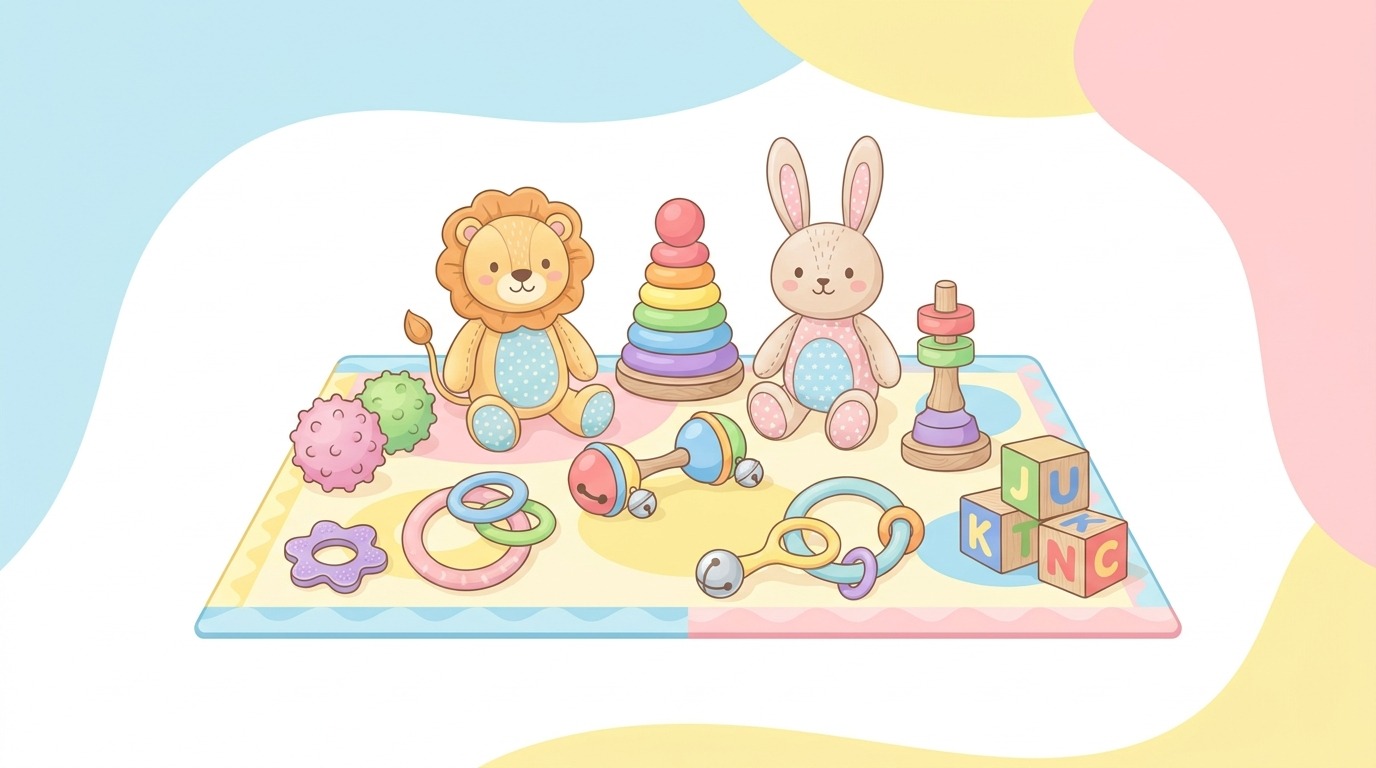
Best Baby Toys: What are the best toys for babies (0-12 months).
The first months transform a room into a sensory laboratory. The best ideas are often hidden in simple, well-designed developmental toys that guide without pushing. Babies learn through repetition, surprise, and emotional security. Hence the importance of choosing baby toys 0-12 months adapted to each stage, from highly contrasting first months toys to cause-and-effect activities. The right toy is never just an accessory: it becomes a shared attention support, a reason to talk, sing, touch, and move. The 2026 recommendations converge: lighten stimuli, secure every detail, establish short rituals, and alternate calm times with active explorations.
In this guide, the goal is clear: help compose a coherent, durable, and joyful set. You’ll find precise mobilizations for motor development, concrete markers in baby toy safety, and tips to avoid luminous and sound overkill. Parents discover how to anchor progress in daily life: a well-chosen play mat, a textured rattle, a soothing nightlight, a cloth book… Every choice matters, and every play moment becomes a micro-adventure where the child gains confidence. And if the golden rule lay in a simple triptych? Respect for rhythm, sensory variety, impeccable safety. 🎯
| Short on time? Here’s the essentials ⏱️ |
|---|
| 0-3 months: contrasting visuals, soft sounds, plush textures. Light mobiles and rattles. 🍼 |
| 4-6 months: play mat + daily tummy time; teething rattles, cloth books. 🧸 |
| 7-9 months: cause-and-effect games, soft balls, nesting cups, sensory toys. 🧠 |
| 10-12 months: simple stacking, level 1 shape sorters, push/pull toys. 🚶♂️ |
| Safety: CE standards, large parts, no accessible button batteries, washable. ✅ |
Developmental toys 0-3 months: contrasts, softness, and first harmonies
During this first trimester, baby’s vision is blurry and developing. Effective first months toys rely on strong contrasts (black/white/red), soft sounds, and soft textures. A mobile with geometric patterns attracts the gaze and extends attention without overwhelming. Ultra-light rattles, easy to grip, already stimulate eye-hand coordination. A discreet bell reinforces the notion of cause and effect: I shake, I hear.
The ideal sensory cradle revolves around a few markers: a comfortable play mat for floor time, a warm light nightlight to soften falling asleep, and two or three soft textured toys to explore with fingertips. Sound stacking is avoided. Better one source of soothing music than three electronic toys at once. Baby toy safety guides selection: reinforced seams, no small parts, washable materials.
Parents often wonder if luminous toys are needed from birth. The answer balances. Yes, if the light is dim, stable, and the child can easily look away. No, if flashing effects dominate. A mechanical music box or a musical mobile calms the heartbeat and prepares for sleep. Short, repeated melodies are preferred as comforting signals.
Regarding hygiene, a simple protocol makes the difference: washing soft toys weekly, wiping rattles after every mouth contact, daily airing of the play area. In the first days, other care demands parents’ attention. To keep a clear mind during playtime, reading a clear guide such as this article on umbilical cord care offers reassuring framing.
Field example: Louna’s “0-3 sensory box” includes a soft teething rattle, a muslin square, a small fabric ball with bell, and a black-and-white card. Everything fits into a basket, cleans quickly, and covers sight, hearing, touch. Result: 5 to 8-minute sequences of focused exploration several times per day, without overstimulation. The quality of the moment outweighs the quantity of objects.
Key message for 0-3 months: less, but better. Sobriety in developmental toys, soft light, and repeated rituals create an attachment ground conducive to everything else. 🌙
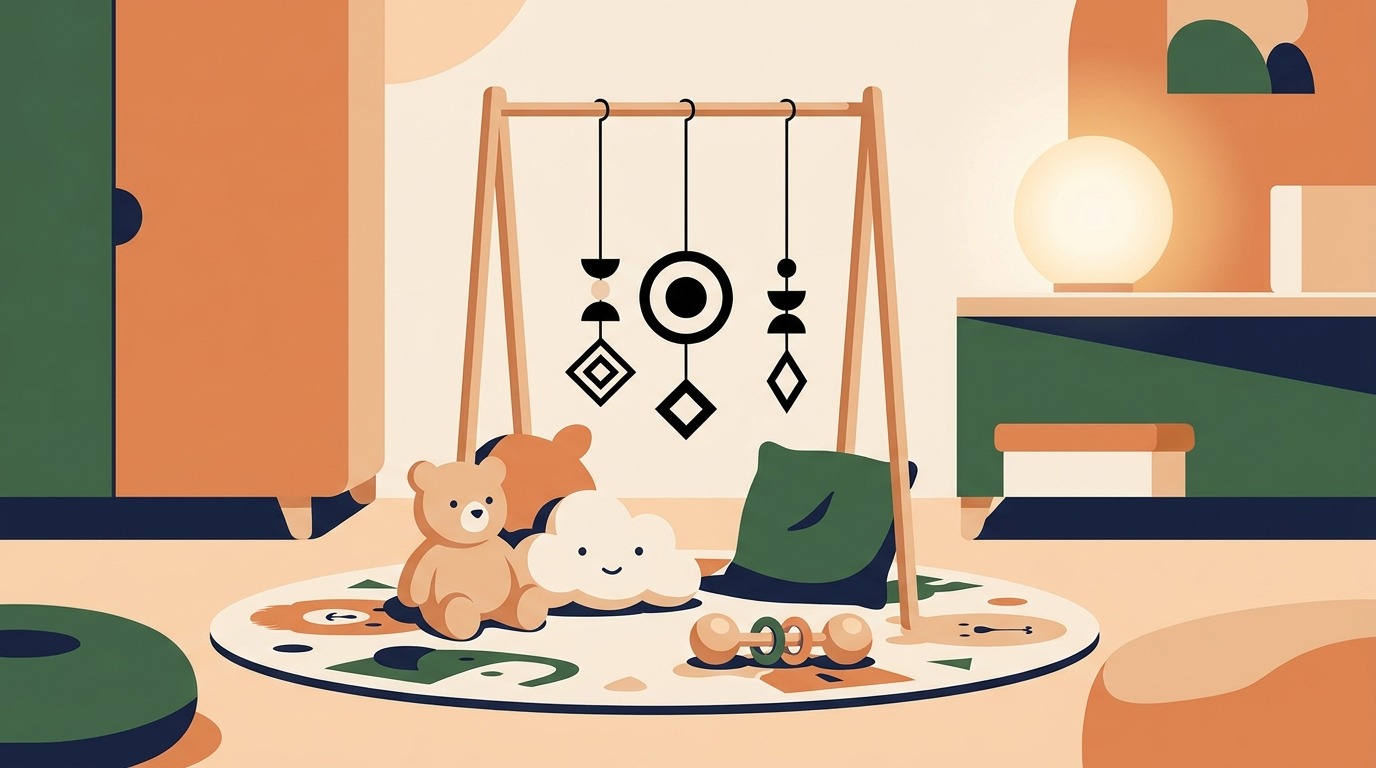
4-6 months: play mat, tummy time, and first manipulations
From 4 months, voluntary grasping asserts itself. The winning tandem consists of a thick, non-slip play mat, a minimalist arch with two or three hanging toys, and multi-texture teething rattles. The goal is clear: encourage rolling over, strengthen neck/shoulders, and vary grips. Easy-to-clip rings for the stroller go everywhere. A cloth book with flaps and crinkly sounds adds a dose of curiosity.
“Tummy time” becomes a daily, short but regular appointment. Start with 3 to 5 minutes several times a day, increasing if the child shows enthusiasm. This ventral time improves core strength, prepares crawling, and prevents plagiocephaly. To anchor the routine, keep a bell or unbreakable mirror at eye level. A helpful guide details positions and errors to avoid: the importance of tummy time.
How to choose a relevant mat? Three criteria make the difference: foam dense enough to insulate from the floor, detachable activities (to avoid excess), and a machine-washable cover. 2026 comparisons have highlighted evolutive and hygienic models. To save time, this top of best play mats helps arbitrate between comfort, accessories, and maintenance.
Regarding sensory toys, texture variety is key: food-grade rubber, soft silicone, corduroy velvet, muslin. Create a simple tactile path: right hand on velvet, left hand on rubber, then reverse. Soft balls with light spikes energize proprioception. Nesting cups come in from 6 months: manipulate, stack, tap, make noise… so many experiences that nourish bilateral coordination and sense of rhythm.
A word on sound: rattles with internal beads or rustling paper suffice. Electronic toys are not essential at this age. If present, set the volume low and limit activation time. The adult narrates the action: “You grab, you pull, it crunches!” This joint narration feeds emerging language.
Case study: at 5 months, Nino refused the ventral position for more than 60 seconds. By adding a cylindrical cushion under the chest, placing a soft luminous ball within reach, and singing a repetitive chorus, tummy time went to 4 minutes in a week. Motor progress follows a zigzag path. Kind consistency always pays off.
To deepen gestures, a short video demonstration of playful routines helps visualize body placements and play dynamics.
Operational conclusion for 4-6 months: alternate baby mobility on the floor, varied manipulations, and cuddle breaks. Textural diversity, dosed calmly, sparks the desire to act. 💪
7-9 months: cause and effect, active exploration, and advanced safety
The time of intensive experiments comes: drop, throw, retrieve, repeat. Educational toys gain relevance if they remain simple: level 1 open shape sorters, soft balls that roll little, cubes and nesting cups, dampened tambourines. Mechanical activity boards (turning wheels, flaps, sliders) strengthen finger dissociation and eye-hand coordination.
Sitting posture becomes more stable, crawling sometimes starts. To support this baby mobility, space is organized in islands: a soft reading corner, a motor corner with cushions and soft tunnel, a manipulation corner. The child chooses, crosses, returns. Transitions develop attention endurance and motor planning. For concrete markers on gross motor skills, this guide synthesizes key milestones and suitable activities.
Sensory toys gain detail: more contrasting textures, surfaces to squeeze that emit a soft puff, soft mirrors of various sizes. Cloth books with “windows” strengthen anticipation: what’s behind the flap? Discovery is accompanied by simple words and marked intonation. This co-exploration solidifies the socio-emotional foundation.
Safety becomes more technical. Three points of vigilance prevail: no accessible button batteries, no powerful magnets, and firm fastening of elements. Weekly check of seams, ring seams, and the state of soft plastics is done. The weekly “toy tour” reflex is established: check, clean, rotate the selection to avoid boredom and stimulate interest.
Field example: at 8 months, Léna loves knocking down a tower of cups. We transform habit into educational game. Build together, name “up-down,” then drop on signal: “ready, go!” The fall becomes the highlight moment, but spatial vocabulary sticks to pleasure. Learning is born in repeated joy.
Some interactive toys attract with their lights. The trap: multiplying stimuli until initiative fades out. The rule: 1 luminous sound toy at a time, always paired with a non-electronic object (ball, book, cube). This coexistence keeps the child in charge. They press, observe, then reproduce the pattern with a mute object. That’s where functional autonomy is born.
A video search on 6-12 months sensory activities provides simple demonstrations to diversify the week without overloading the toy basket.
Key line for 7-9 months: orchestrate loops “I try—I understand—I replay,” under high baby toy safety, to anchor cause and effect with pleasure. 🔁
10-12 months: fine coordination, first supported steps, and push toys
Approaching the first birthday, the child refines thumb-index pincer and multiplies object transfers. Progressive shape sorters, with large openings then simple shapes (circle, square), stimulate both visual discrimination and perseverance. Light pull toys are also introduced, which accompany walking as balance stabilizes. Well-weighted walking carts can be offered, but only if the child stands independently and already moves sideways along support.
Beware of confusing walking carts and wheeled “sitting” walkers. Classic walkers are discouraged by many professionals: they promote falls and disrupt natural motor patterns. Better a motor course on the floor: cushions, small foam slopes, tunnel, and balls to push. Deep ball pools are reserved for well-seated children under close supervision. Always set up on a non-slip floor.
Baby mobility is also fueled by outdoors. When weather permits, a park outing multiplies sensory markers: grass, gravel, wind blow. Some practical ideas and advice are gathered in this clear guide: playing outside with baby. Simple scenarios alternate assisted walking, seated exploration, and looking into the distance, which stabilizes balance.
Regarding coordination, “large button” insertions and 2-piece puzzles lay problem-solving foundations. The adult verbalizes the process: “You turn, you adjust, it fits.” The word “again!” appears often. This is used to ritualize a calm time after a motor challenge. This breathing avoids over-activation and eases the nap.
Safety steps up a notch: protected furniture corners, stair gates at the top, and systematic control of wheeled baby toys. Avoid too-long cords. A simple wrist knot or gripping ring suffices. Toy rotation remains relevant: 6 to 8 visible toys, the rest in reserve. This alternation rekindles interest and nurtures curiosity, the foundation for durable learning.
Field example: at 11 months, Nour crosses the room with a cube in each hand. An empty crate is placed halfway. Challenge: deposit without dropping, come back to fetch. The activity works anticipation and braking. Two minutes suffice. The game becomes “the treasure shuttle.” The next day, same scenario, but with a soft ball and a cup. Variation without overload: the art of consolidating without tiring.
To follow motor progress at the end of the first year, complement your markers with this resource on gross motor skills. You’ll find useful markers to adjust challenges while maintaining a high level of safety.
Final highlight 10-12 months: aim for short, concrete challenges where each success calls for a new desire to try. Autonomy awakens in small steps. 🚶♀️
Books, music, and softness: language, emotions, and soothing rituals
Cloth and cardboard books form the backbone of a rich awakening. Images are commented on, sounds imitated, the child encouraged to turn pages. Textured and flap books cultivate joint attention. Each reading ends with a small ritual gesture: stroking a soft page, saying “good night bunny.” These emotional markers reassure and structure the day.
Music connects body and voice. Simple musical toys are favored: light maracas, rain stick, dampened tambourine. The idea is not to make a concert but to enrich the rhythmic palette. A 3-minute routine each day suffices to root the tempo. To expand the repertoire and understand how music supports attention, explore this file on baby’s musical awakening.
Soft toys remain major allies. A certified flat fabric comforter, a favorite swaddle, a small textured plush: these self-soothing supports help the child shift from activity time to rest time. A regular washing protocol is established. If possible, buy a double comforter to prevent sadness in case of loss. The familiar smell contributes to comfort.
At bedtime, a projection nightlight with slow images and a short lullaby reduce activation. Moving images guide the gaze without speeding up the rhythm. The adult keeps a soft voice, sparsely comments. Daily repetition conditions the brain to anticipate sleep. Screens and very bright toys are avoided in the hour before night.
Building a “heart basket” for the week helps stay the course without overload. Here’s a concrete suggestion, designed to balance senses and movement:
- 📘 2 books (1 textured cloth + 1 cardboard with realistic images)
- 🎵 2 instruments (maracas + rain stick)
- 🧸 1 washable comforter + 1 soft swaddle
- 🟣 1 soft textured ball
- 🧩 1 cause/effect activity suitable for age (flap, large insertion)
- 🌙 1 calm nightlight for the evening ritual
Field example: every late afternoon, Malik enjoys a “musical quarter hour.” Maracas and hand taps alternate on a cardboard box. Then move to the favorite book. In 15 minutes, the body calms, attention refocuses, and sleep comes faster. Rituals are bridges between two shores: play and rest.
Final cap of this section: blend language, music, and softness to connect doing, listening, and feeling. This is how baby toys become lasting emotional landmarks. ✨
How many toys to offer at the same time ?
Between 6 and 8 visible toys suffice. Store the rest and rotate weekly. This rotation maintains curiosity and avoids overstimulation.
Which safety criteria to check first ?
CE standard, large enough parts, solid seams, zero accessible button batteries, washable and non-toxic materials. Check the condition of toys weekly.
Are electronic toys needed before 1 year ?
They are not essential. If present, only one at a time, low volume, short durations. Pair them with non-electronic objects to encourage initiative.
How to support motor skills without a walker ?
Choose the floor: firm mat, cushions, small foam slopes, balls to push, and pull toys when standing. Stable carts are introduced only after first autonomous movements.
Where to start if quick equipment is needed ?
A washable play mat, two textured rattles, a cloth book, a certified comforter, and a soft nightlight cover 80% of the needs for 0-6 months.
“A good toy never does too much: it invites, reassures, reveals baby’s drive.” 💫