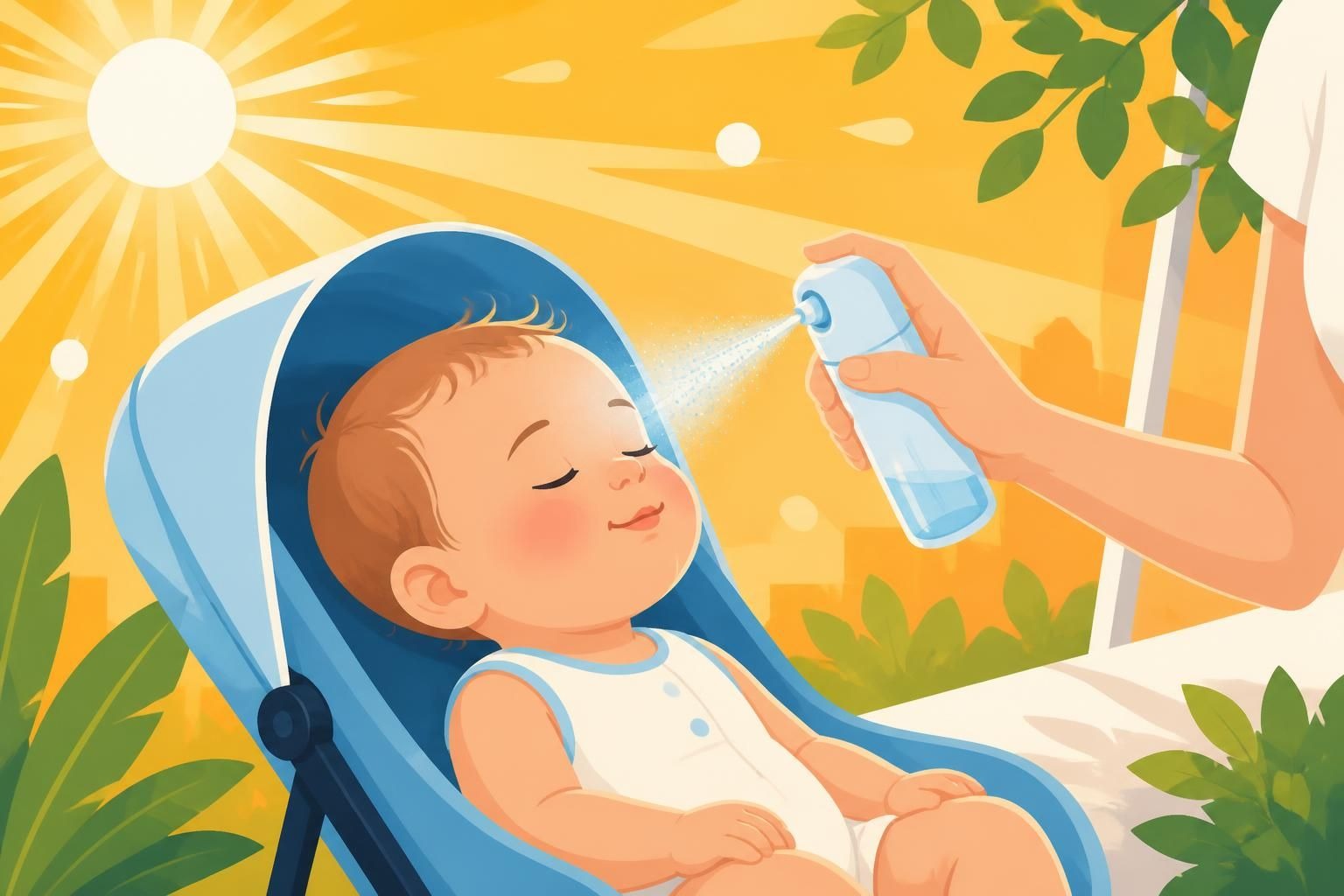
Heatwave: is it safe to use a mister on babies’ faces?
In Brief
- According to Santé publique France, during a heatwave, the primary goal for a baby remains a cool environment, frequent hydration, and monitoring for warning signs.
- A mister can help with cooling, but safety requires avoiding direct spraying on the face and favoring the neck, limbs, or a lightly moistened cloth.
- A mister that is too cold (taken out of the fridge) increases the risk of discomfort and thermal shock in an infant, especially during extreme heat.
- The microdroplets that evaporate provide immediate cooling, but they can also dry out the delicate skin if the gesture is repeated without proper baby care.
- The real “anti-heatwave” solution for a baby mainly involves controlling the room temperature (aiming for below 25 °C when possible), hydration, and shade.
The mister is often brought out as soon as the heatwave sets in because the action is simple, quick, and gives the impression of “doing something” immediately. However, for babies, this reflex deserves a slight parental slowdown, a technical check version: the skin is thinner, temperature regulation is less efficient, and the surprise of a spray on the face can turn a cooling attempt into a noisy protest session. The point is not to ban water spray but to understand when it brings real benefit, when it is useless, and in which cases it can hinder breathing, irritate the skin, or favor skin dehydration if repeated without strategy.
The question “mister on the face: yes or no?” should be treated like an instruction manual: type of water, bottle temperature, distance, body area, context (outdoor, indoor, car, stroller), and especially clinical signs to watch for. There are also simple alternatives, often more effective: ventilated room, lukewarm bath, damp cloth, suitable clothing, and more frequent hydration. The mister can be part of the toolbox, but safety depends on how it is used, not the slogan “it cools.”
Heatwave and baby: what temperature regulation changes for safety
A baby does not manage heat like an adult. Their body produces heat, loses it, but adjusts the internal thermostat less well. Sweating is less effective, the body surface area relative to weight is greater, and discomfort can rise quickly without the infant being able to compensate alone. In this context, safety during a heatwave is not about gadgets but about environment and close monitoring.
According to Santé publique France (section advice “heatwave and infants,” available online), the priority during high heat is to keep the baby cool, aim for a room below 25 °C when possible, offer the breast or bottle more often, and watch for signs that should alert (unusual drowsiness, very hot skin, difficulty drinking). These markers serve as a framework: the mister can help with comfort but does not replace hydration or an adapted ambient temperature.
Cooling: what works, what “just gets wet”
Cooling by misting relies on evaporation: when water changes from liquid to vapor, it “takes” heat. On skin exposed to air, this can cool. On a baby seated in a stroller with UV protection, a light cover, and little air circulation, evaporation may be limited. The result then is mainly wet skin, potentially irritated if the area stays damp.
Indoors, a fan can improve evaporation if it does not blow continuously on the baby’s face. In a room that is too hot, misting without lowering the temperature may give a temporary sensation, then give way to identical heat a few minutes later. The benefit is therefore contextual: air circulation, light humidification, then natural drying.
Dehydration: the common confusion between “water on the skin” and hydration
A confusion arises every summer: water on the skin does not hydrate a baby. Useful hydration happens through feeding (breast, bottle) and preventing excessive loss. A mister can even increase a feeling of tightness if misting is repeated and the water evaporates quickly, especially on the face. Proper baby care (barrier cream if needed, gentle cleansing) has its place if the skin reacts.
A typical example: an outing to the park in full heat, baby misted every five minutes “to relieve them,” then redness on the cheeks and agitation. The problem is not the water itself but the repetition, exposure to hot air, and sometimes the fact that the face is a fragile area. The most effective strategy is often to shorten exposure, seek shade, and offer to drink more often.
Misting the baby’s face: benefits, limits, and concrete safety rules
Spraying on a baby’s face raises two very concrete safety questions: breathing and skin. An infant already does not like having their “program blocked” in the middle of exploring the world. A mist sent too close, too hard, or at the wrong moment can provoke an apnea reflex, coughing, or agitation that increases body heat. For effective cooling, the gesture must be discreet and predictable, not a surprise effect.
Dr. Andreas Werner, pediatrician and president of the French Association of Ambulatory Pediatrics, explained in Doctissimo on July 12, 2023, that it is preferable to avoid directing the mister directly at the face of an infant and to favor less sensitive areas, while remaining vigilant about the product’s temperature. The idea is simple: limit discomfort and abrupt reactions while seeking real refreshment.
Areas to favor and distance to respect
For a calmer use, the areas often better tolerated are the neck, back of the head (if the baby is not lying down), forearms, and legs. Spraying at 20–30 cm, lightly, is generally sufficient. The goal is not to “wash” but to lightly moisten so the air can do its work afterwards.
On the face, if really necessary (baby very red, obvious discomfort, no other immediate solution), it is better to avoid the eyes, mouth, and nose, spray above to let some microdroplets fall, then gently wipe. This approach reduces the risk of inhalation and limits stagnant water on the skin.
Mister temperature: the fridge and “cool blast” trap
The common mistake is to keep the mister cold. At the moment, adults find this “incredible.” The baby, however, may experience a harsh contrast between heated skin and very cold water. Doctissimo also recalls that spraying a mister that is too cold can promote thermal shock in infants, especially when the temperature difference is significant.
In practice, water at room temperature, stored in the shade, is gentler. If the bottle has heated in the sun, it can also be unpleasant: lukewarm water does not refresh and can irritate. The useful rule: no fridge, no direct sun, and a bottle stored safely in a bag.
Choice of water: thermal, tap, mineral
The marketing of “thermal water mister” promises a spa experience, even on a highway rest area. For a baby’s safety, the main criterion remains the cleanliness of the product and good usage. A sealed spray water bottle is convenient when traveling. At home, a refillable mister requires strict maintenance: rinsing, drying, and frequent renewal; otherwise, stagnant water becomes a bad idea.
In all cases, if the skin reacts (redness, patches, dryness), misting should be reduced, then replaced by more suitable baby care: gentle cleaning, sun protection adapted to age if recommended by a professional, and especially reduced heat exposure.