
Helicopter Parent: The helicopter parent: advantages and disadvantages.
The debate on the helicopter parent is now spreading everywhere, from school gates to pediatric waiting rooms. The term hits the mark because it describes an excessive surveillance that hovers, ready to intervene at the slightest sign of turbulence. This approach to parenting stems from a sincere desire for protection, but it can also stifle child autonomy and weaken independence. Experts point out a paradox: the more the adult controls, the less the child learns to self-regulate. Yet, practices are evolving. In 2026, digital tools for parental control and school messaging groups have reshaped the parent-child relationship. Balance thus becomes strategic, almost artisanal.
This reading offers a comprehensive overview, grounded in the educational field and enriched with concrete examples. Why has this trend taken hold? What real benefits does it bring when finely calibrated? What abuses are observed when it becomes rigid? Above all, how to arrange a daily life that secures without capturing? A fictional family, the Dumas tribe, will serve as a thread to illustrate clear choices, hesitations, and successful adjustments. Throughout the sections, practical benchmarks, operational lists, and a table of age-guides will help act with confidence. Because in education, the right setting is better than good intention.
| Short on time? Here’s the essentials ✨ |
|---|
| The helicopter parent reassures but can hinder child autonomy 🤝 |
| Excessive surveillance quickly turns into dependence 😬 |
| Calibrate protection according to age and real risk 🔎 |
| Favor clear rules rather than permanent parental control 📏 |
| Encourage independence through progressive tasks 🚀 |
| The quality of the parent-child relationship takes precedence over performance ❤️ |
| Debrief mistakes without dramatizing: education is training 🧠 |
Helicopter parent, definitions and origins: understanding the driving forces of an educational style
The helicopter parent refers to an adult who anticipates, supervises, and continuously corrects. They want to avoid any mishap and stand ready to intervene. The heart of the model is based on control rather than trust. This logic then extends to homework, social relationships, and leisure activities.
Historically, the expression appeared as early as the 1960s, then gained popularity in the 1990s. The rise of extracurricular activities and school competition reinforced the trend. Gradually, intensive parenting took root and became normalized.
In 2026, GPS alerts, online grade books, and real-time messaging amplify these reflexes. The tool itself is not to blame. However, it increases the temptation to check constantly. Notifications, meanwhile, feed anxiety.
In the Dumas family, the parents activate every alert on their daughter Lina’s phone. They know everything immediately. Their intention is positive. The result, however, looks like an invisible chain. Lina takes fewer initiatives and waits for validation before acting.
Why is this style so widespread? Because uncertainty worries. Threats circulate fast. Every current event becomes an emotional argument. Once parental anxiety sets in, it feeds the need to act. And acting is soothing in the short term.
There is also confusion between success and safety. The adult thinks they are saving the child from difficulties, while sometimes preventing them from learning through experience. The intention is noble. The effect can be contradictory.
Concrete signs are visible: regular intervention with teachers, agenda controlled by the adult, systematic negotiation of grades, arbitration of children’s disputes. At home, peers’ words are reinterpreted, filtered, then reported back.
With the Dumas, every detail becomes a file. Lina forgets a notebook? This leads to three messages to the teacher and a nightly checklist. Stress decreases for the parents but rises for the child. What if the goal shifted: teaching Lina to prepare her bag?
Understanding these drivers helps shift the dial. One guiding question for this shift: what is the minimum help needed for the child to do the maximum possible? Here is the compass.
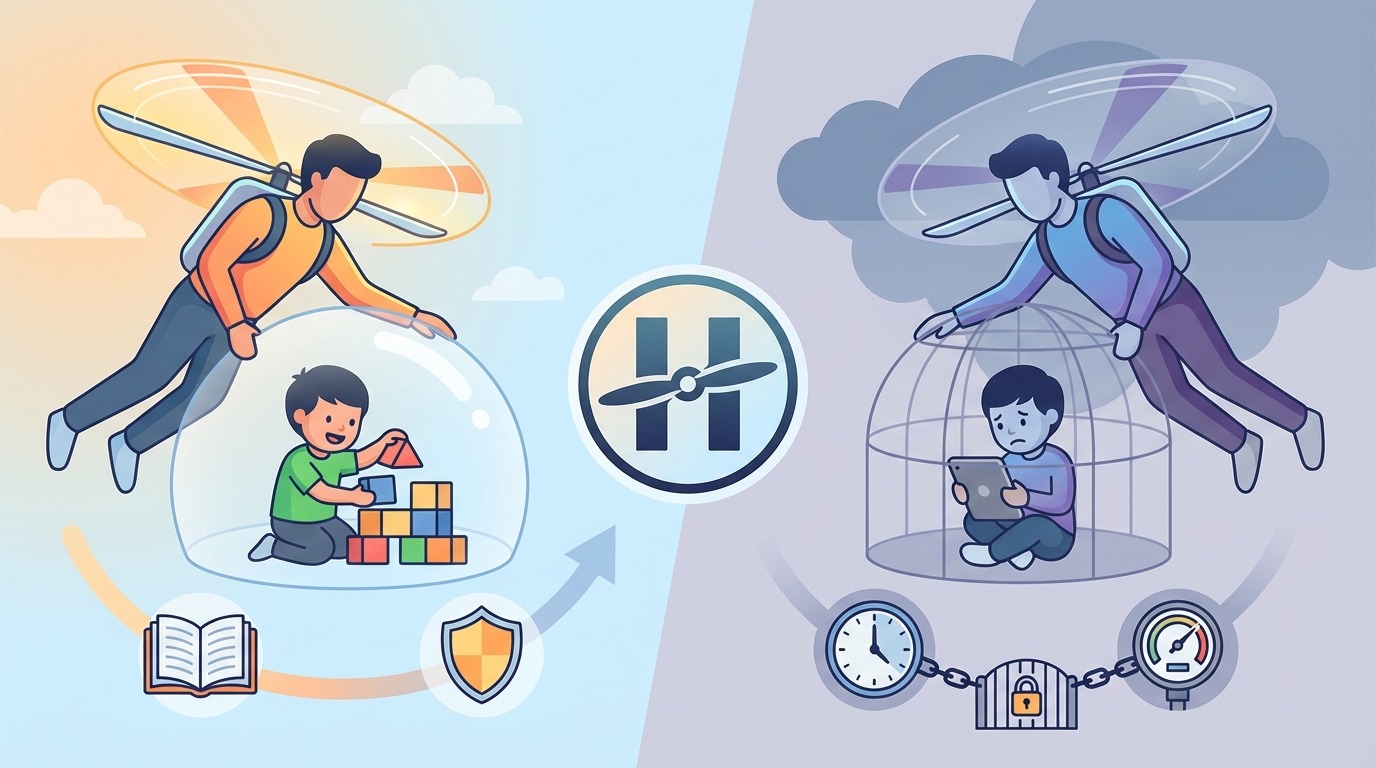
Real advantages of well-calibrated vigilance: when parental attention protects and stimulates
Careful protection reduces immediate risks. Young children gain in road safety. Teens feel supported. The framework also protects from bullying, as the adult can spot discreet signals earlier.
Academically, structured support can create useful routines. A clear homework ritual promotes consistency. Method reminders establish lasting habits. Attention can therefore become a launching pad.
Proximity also nurtures the parent-child relationship. Exchanges are frequent, emotions are named. The child speaks more willingly when they know they are listened to. This trust capital becomes a strong protective factor.
In the Dumas family, a beneficial effect appears: parental presence calms Lina before tests. She verbalizes her fears and receives tactical coaching. Result: she dares to try. The psychological safety net makes a difference.
Still, one must avoid shifting into full control. Help should be proportionate to the challenge. Asking an open question is better than giving the answer. Supporting learning does not mean doing it for the other.
Benefits endure especially when the adult accepts progression. You start by guiding closely. Then loosen up. Finally, you let the child test their own solutions. This rhythm protects the flame of independence.
To reinforce these strengths without trapping, three levers work well. First, set specific, observable goals that are time-limited. Second, provide a trial zone where mistakes are allowed. Third, organize a brief factual debrief without overall judgment.
Communication also plays a role. Reminding what is non-negotiable reassures. Explaining what is debatable engages. Asking what the child proposes empowers. This trio clarifies daily education.
- ✅ Define the day’s mission (e.g., “prepare the bag alone”) 🎒
- 🕒 Set a measured trial time (e.g., 10 minutes) ⏱️
- 🧭 Only offer help upon explicit request 🙋
- 🔁 Debrief with 3 questions: “What worked? Why? What to change tomorrow?” 💡
- 🎯 Celebrate effort rather than immediate result 🥳
Vigilance can thus protect and propel, provided it remains evolving. The key: secure without doing it for them.
To broaden the perspective, a useful resource on developmental language benchmarks can clarify expectations and soothe certain fears. Questions about children’s language often underlie educational concerns.
Disadvantages and perverse effects: when excessive surveillance undermines autonomy
The downside of permanent parental control first shows as increased parental anxiety. The more you observe, the more you suspect a problem. This climate then infuses the child. They internalize doubt.
Excessive surveillance impairs judgment development. The child learns to seek validation instead of assessing the situation. Decision-making dulls. Courage, experienced step by step, no longer develops.
Schools also feel the impact. Teachers become arbiters of everything. Complaints multiply. The team tightens and defends itself. The educational partnership loses quality, even though it remains essential.
In the Dumas family, the drift is observed when Lina waits for a parental message before submitting homework. Her attention wanders. She risks procrastination. Her brain works less in anticipation, more in avoidance.
Trust erodes if the child perceives every move is tracked. At home, the atmosphere tensifies. Discussions turn into control of the smallest detail. The relationship shrinks to one frontier: verify or be verified.
With digital tools, the trap intensifies. Apps promise total visibility. Yet, full transparency teaches neither self-control nor personal ethics. It installs an omnipresent gaze, not an inner compass.
Developmentally, collateral effects exist. Language, for example, suffers when the adult corrects everything, all the time. By constantly correcting, momentum is cut off. A simple resource helps situate what is normal and what requires advice: here are clear answers on language to better sort signals.
In adolescence, the need for independence asserts itself. Too tight control then pushes toward opposition. The teen hides or lies. It is a self-protection mechanism. Less control, more understandable rules: the formula soothes.
The hidden cost, finally, lies in long-term child autonomy. Young people who have not learned to solve simple problems struggle in their first job or studies. Practical maturity is not improvised.
Without guilt, it is thus useful to realize that too much help can hinder. Overprotection sometimes ends up disarming.
From hovering to adjusted support: concrete methods to regulate parental control
Getting out of helicopter mode does not happen in a day. It is a progressive and assumed transition. Each step aims for a bit more freedom, with clear guardrails.
First method: the “autonomy zone.” Define areas where the child decides alone. They manage their clothing, desk order, or snack. Parents intervene only in case of objective risk.
Second method: the “risk ladder.” Classify a situation from 1 to 5. From 1 to 2, the child acts without help. At 3, advise. At 4, coach. At 5, intervene. This protocol soothes tensions and prevents panic.
Third method: the “waiting contract.” Before homework or an outing, write what is expected. Criteria are visible. Afterwards, debrief calmly. Note progress, difficulty, and adjustment.
For the Dumas, the shift began with an evening ritual. Lina prepares her bag with a timer. Parents observe without commenting. Then they ask two questions: “What helped you?” and “What will you do differently tomorrow?”
Fourth method: the “emotion airlock.” Welcome fear or anger but don’t let the emotion decide alone. Name it, breathe, then choose a realistic action. The brain regains control.
| Age 🧒 | Autonomy task 🧰 | Acceptable mistakes ✅ | Support tools 🛠️ |
|---|---|---|---|
| 6-8 years | Prepare the bag | Minor forgetfulness (pencil) 😉 | Pictograms, timer |
| 9-11 years | Planned homework | Time exceeded by 10 min ⌛ | Agenda, checklist |
| 12-14 years | Screen management | 1 reminder max 🔔 | Visible rules, timer |
| 15-17 years | Local outings | 10 min delay ⏳ | Prearranged call point |
Digital tools can help, provided they don’t replace trust. Settings are adjusted together, then re-evaluated each quarter. Follow the spirit, not just the letter.
The most lasting progress remains the one the child co-constructs. They propose their own goals. The adult checks safety and feasibility. Adjust together. Support means sharing the wheel, not confiscating the road.
To strengthen the alliance with the school, a short video on good school-family communication practices may also inspire simple and effective rituals.
Reinventing the parent-child relationship and the educational alliance with the school
The parent-child relationship improves in quality when everyone knows their role. The adult guarantees values and safety. The child experiments, errs, then learns. This sharing reduces chronic conflicts.
A good partnership with the school relies on clarity. Parents present facts, not assumptions. Teachers clarify their expectations. Misunderstandings fade. Exchanges become constructive.
In the Dumas family, transformation begins with a brief meeting with Lina’s teacher. Each describes their commitments. Parents focus on evening routines. The school handles classroom methods.
Practically, three rituals strengthen the bond. First, a monthly child progress report, written by the child. Second, a targeted parent-teacher meeting on a single goal. Finally, a quarterly gratitude message, as recognizing effort opens doors.
The social environment also influences parenting. Comparisons on social networks feed pressure. Limiting unnecessary exposures reduces unrealistic expectations. Family energy is protected.
For extracurricular activities, moderation is necessary. Children need unscheduled free time. Creativity sometimes arises from boredom. One hour without a schedule is an hour to innovate.
To discern the essential, a checklist of guardrails acts as a peaceful memo. It reminds that autonomy is built through small daily responsibilities. Courage strengthens gently.
- 🧩 Distinguish real danger and normal discomfort
- 📌 Write non-negotiable rules, explain the rest
- 🗣️ Ask open-ended questions rather than correcting immediately
- 🛟 Provide a backup plan but keep it in reserve
- 🌱 Value progress, not perfection
When the alliance is clear, the child moves forward with a stronger inner compass. Less alarm, more alignment.
How to know if attention becomes excessive surveillance?
Spot three signals: you intervene before any request, you check more than you explain, and your child hesitates to act without validation. If two criteria accumulate over a week, you have a dial to adjust.
Which digital tools to recommend without strengthening permanent parental control?
Choose co-constructed settings: visible screen time slots, timers, and weekly reports consulted together. Disable continuous alerts. The tool serves discussion, not surveillance.
How to encourage child autonomy without putting them in danger?
Break down the task, define the acceptable risk threshold, and plan a contact point. Let the child try, then debrief. The safety net exists but does not fall at the first doubt.
What to say to the school if you want to intervene less?
Explain your approach: you aim for self-regulation skills. Request targeted observation and monthly feedback. Position yourself as a partner, not a supervisor.
Should every language or spelling mistake be corrected?
No. Target one priority at a time. The rest can wait for a dedicated learning moment. Correcting everything all the time hinders speaking out and confidence.
“To raise is to learn to step back just enough for the child to appear.”