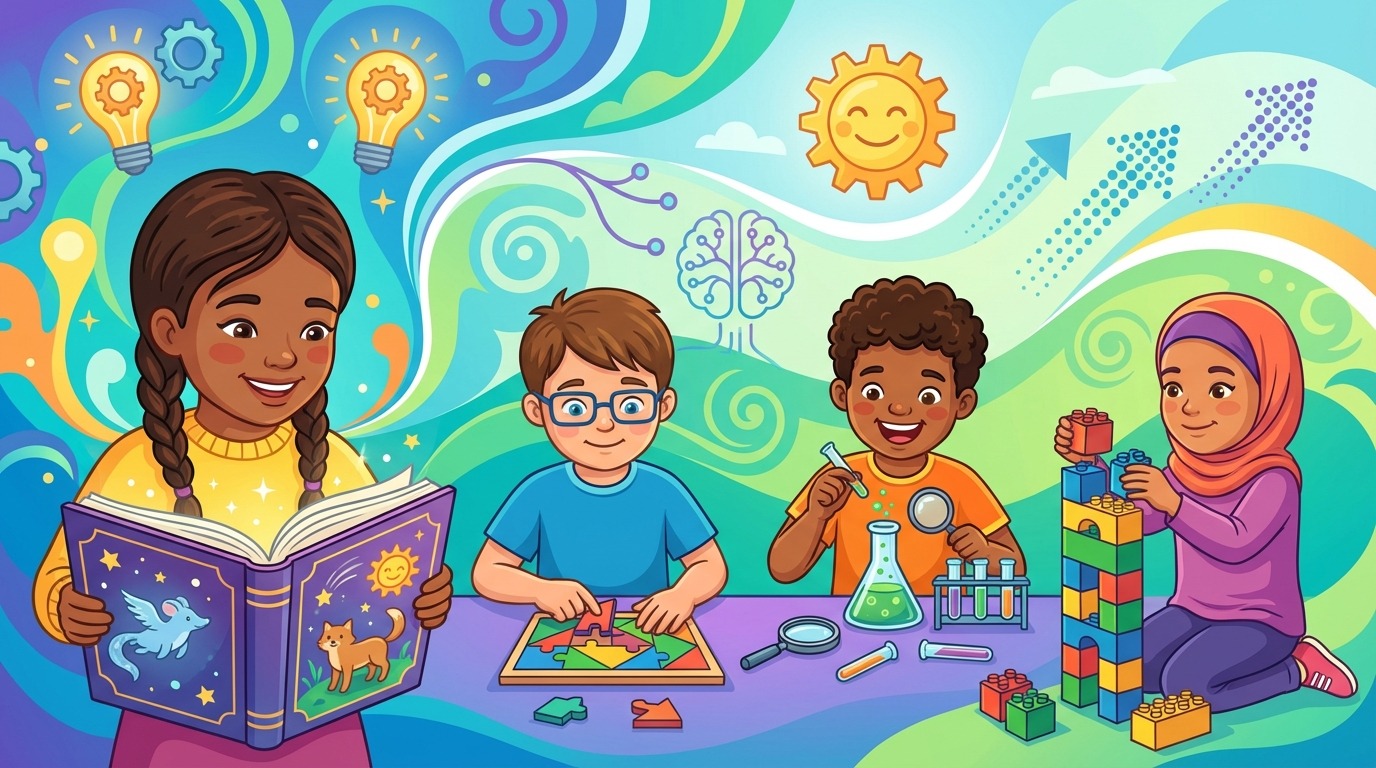
Intellectual Development: The intellectual development of children aged 6-7 years.
| Short on time? Here is the essentials ✨ |
|---|
| 🧠 Between 6 and 7 years old, the child enters the stage of concrete operations: logic is asserted with real objects. |
| 🗣️ Language and vocabulary enrich significantly, strengthening comprehension and argumentation. |
| 🎯 Attention improves with short, rhythmic, and meaningful activities for the child. |
| 📚 Memory is optimized through active recall, stories, and spaced repetition. |
| 🧩 Reasoning and problem solving develop thanks to concrete and guided challenges. |
| 🎨 Creativity remains a major driver of learning; it feeds curiosity and motivation. |
| ✍️ Fine motor skills support reading-writing and confidence in school tasks. |
At 6-7 years old, a shift occurs in children’s minds: ideas get organized, questions sharpen, and the world becomes decodable. This pivotal moment, described by research on cognitive development, sees logic materialize through contact with objects and experienced situations. Teachers then notice an appetite for challenges, while families observe more reasoned exchanges. Yet, this progress remains fragile without a stimulating, stable, and warm environment.
Recent benchmarks, including updates to guides for detecting atypical signs before age 7, encourage attentive kindness. Because learning unfolds when the child feels safe and when achievements are visible. In this perspective, primary school becomes a field for mental games, collaborative projects, and language experiments. The concrete examples below show how reasoning, focusing, storytelling, and creating intertwine to build confident schooling.
6-7 years: cognitive and language development — heading towards concrete logic
At this age, children gradually move from pretending to manipulating to understand. According to the usual progression, they enter the stage of concrete operations, where they classify, compare, and order. They succeed better when they touch, move, and directly observe objects.
This transition transforms the way they speak. Language becomes more precise, with longer sentences, but always anchored in experience. Consequently, explanations gain clarity, and argumentation begins to appear in daily exchanges.
Concrete logic: from sorting to first inferences
Sorting activities by size, color, or shape are not just games. They enter the heart of reasoning by making relationships between elements visible. Then, the child deduces simple rules and begins to generalize.
To anchor this logic, the sequences “I manipulate, I explain, I represent” are decisive. Moreover, teachers in CP-CE1 alternate material, diagrams, and words to align action and thought. This weaving stabilizes understanding.
Expanding language and vocabulary precision
The lexicon broadens quickly, especially when reading picture books and oral exchanges are frequent. Then the words “because,” “so,” “if” settle in, marking a leap in causality. The child then tries to explain their choices with logical connectors.
Language development also influences confidence. When words are missing, thought stumbles. Conversely, a rich vocabulary allows asking questions and making bold hypotheses. Classroom debates play this role.
Working memory and sustained attention
At 6-7 years, working memory grows but remains limited. Thus, broken-down instructions and visual reminders help keep on task. Short periods of activity, paced by bodily transitions, reinforce attention.
Structured routines reduce cognitive load. A “daily card” or a visual timer prevents scattering. Thanks to these supports, the child better sequences steps and gains autonomy.
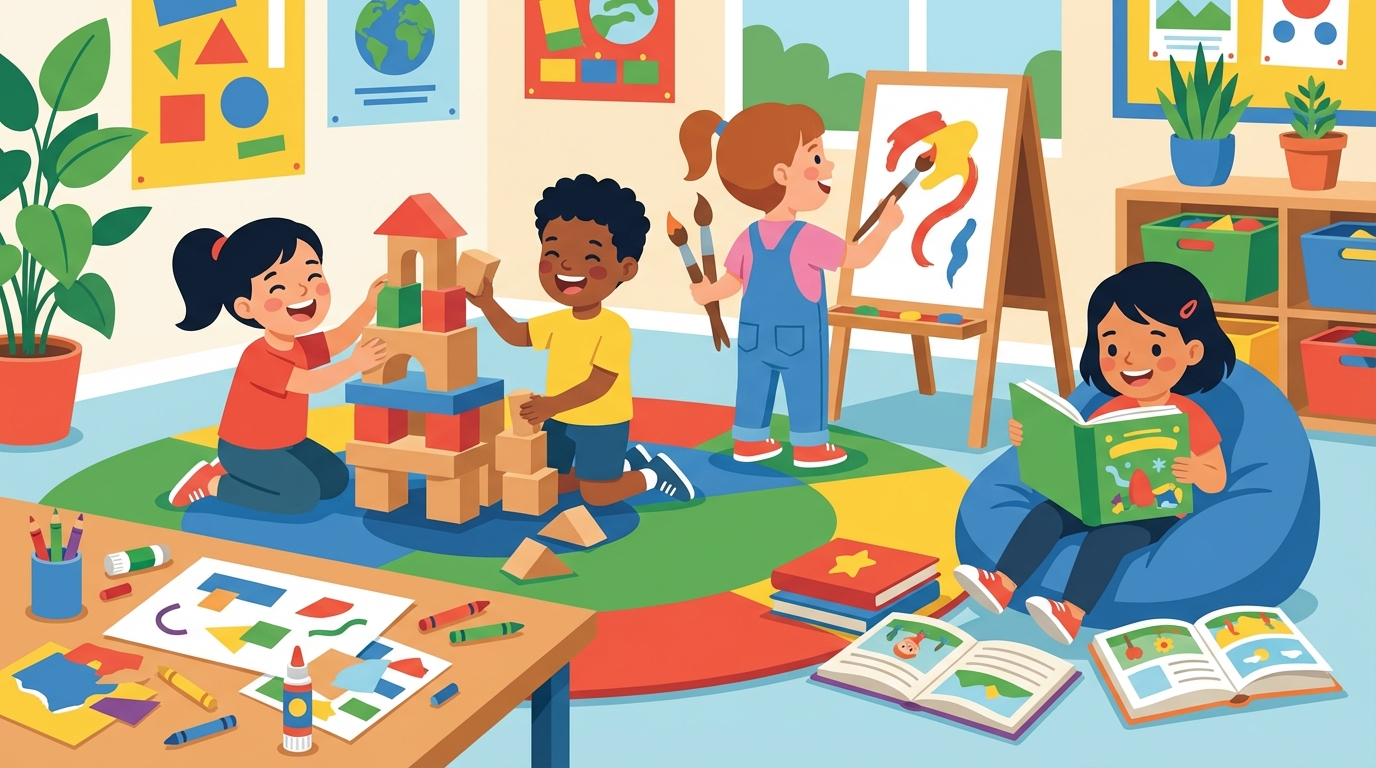
Learning and memory: effective strategies at school and at home
When learning becomes a ritual, it consolidates. Practices combining active recall, spaced repetition, and immediate feedback serve as a springboard. They fit well with the rhythm of 6-7 years.
A ten-minute evening routine is enough if regular and pleasant. It can mix reading aloud, flashcards, and rhyme games. This variety prevents boredom.
Active recall: better than rereading, testing yourself
Questioning the child about what they just learned improves memory. For example, one can ask “What happened next…?” or “How did you do this calculation?”. This small challenge strengthens encoding.
Then, spaced repetition revives the trace at the right time. Picture cards or Leitner boxes make the method playful. These tools fit well into busy schedules.
Fine motor skills and multisensory anchoring
At this age, fine motor skills support reading-writing and numeracy. Tracing, cutting, modeling, and lacing train fingers and calm the mind. The body anchors the idea, facilitating retention.
Multisensory materials provide a clear advantage. Writing letters in sand, counting with tokens, or miming sounds promote consolidation. Thus, attention remains lively and fatigue decreases.
Case study: Lina and stepwise addition
Lina, 7 years old, struggles to set up her addition. Her teacher breaks down the procedure and introduces colored cubes. Quickly, Lina verbalizes each step, then diagrams them.
After two weeks, her errors significantly decrease. Because the manipulation-language-active recall combination aligns with her cognitive development. Progress stabilizes when the family adopts the same ritual at home.
Reasoning and problem solving: thinking methodically
Reasoning at 6-7 years gains rigor as soon as the child can manipulate. Concrete problems, posed as riddles, stimulate curiosity and boldness. This framework secures trial and error.
A classic illustrates this: two identical balls of dough, one flattened. Before 6 years, the child often thinks the quantity changes. Around 7-8 years, they affirm conservation. Logic consolidates.
Modeling the approach: observe, deduce, verify
Adults benefit by making their thinking steps visible. Saying “I observe,” “I suppose,” “I verify” offers a simple mental map. Then, the child takes up this structure alone or in groups.
Classroom displays help, but oral remains key. Through guided questioning, the child puts words on their strategy. Thus, problem solving becomes training in method.
Playful heuristics and creativity
Offering multiple paths to the solution nurtures creativity. One can try by trial and error, by analogy, or by simplifying the question. The important thing is to dare to explore.
Practical projects consolidate these reflexes. A stick bridge, a mini garden, or coding with pictograms all engage hand and mind. The child then sees what “thinking” produces.
- 🧩 Break the problem into clear small steps
- 🔍 Look for a similar example from experience
- 🧪 Test a quick idea, then adjust
- 🗣️ Explain the approach with connectors
- 🎉 Celebrate effort before result
This mental discipline carries beyond math. It applies to disputes, rule-based games, and daily tasks. The essential: a visible and repeated method.
Language, reading, and creativity: from decoding to storytelling
Entering reading changes the game. Decoding opens a world of stories, information, and ideas. Motivation rises when texts echo daily life.
Creativity unfolds in stories, dialogues, and mind maps. By associating images and words, the child structures thought. Comprehension benefits.
Phonological awareness and fluent decoding
Mastering sounds favors decoding precision. Rhyme games, sorting syllables, and symbolic gestures give landmarks. Thus, reading speed gradually increases.
Varied supports maintain appetite. Songs, picture books, and documentaries respond to interests. Consequently, learning lasts longer.
Comprehension: questioning, reformulating, linking
Understanding requires explicit strategies. Asking questions, making predictions, and summarizing in two sentences help a lot. The child learns to justify answers with the text.
Thematic vocabulary cards reinforce language precision. By adding a drawing and gesture, memory activates on several channels. Progress becomes visible.
Creative productions: writing to be read
Inviting the child to write a real message boosts engagement. A birthday card, an exhibition panel, or an email to the class give meaning. The project guides effort.
Constraints inspire. Telling a story without the letter “e,” or in three images, pushes exploring the lexicon. The student enjoys the challenge and strengthens syntax.
Curiosity, emotions, and socialization: nurturing the desire to learn
Curiosity is a powerful driver at 6-7 years. Questions fly, comparisons multiply, and discussions become lively. When the adult welcomes these impulses, attention extends.
This age is also one of intense emotions. A clear, predictable, and warm framework soothes outbursts. The child learns to name what they feel.
Emotional regulation and affective security
Putting words on emotion lessens its intensity. An “emotion thermometer” and active breaks help regain calm. Then, the task resumes better.
Class rituals encourage cooperation. Talking circles, peer mediators, and role-playing reduce conflicts. Socialization enriches.
Motivation, near goals, and clear feedback
Short objectives keep the course. Saying “Today, I spot three verbs” makes success measurable. Feedback must be immediate and specific.
Recognition of effort maintains desire. By valuing strategy, perseverance is cultivated. The child then dares to try more.
Spotting what’s out of the ordinary, without alarming
Markers recently shared with general practitioners and schools invite early detection of atypical signals. Persistent delays in language, major inattention, or coordination difficulties require advice. Early detection opens solutions.
This vigilance remains kind. The goal is not to label but to support learning. A discussion with the teacher and, if needed, a professional, often suffices to readjust.
{“@context”:”https://schema.org”,”@type”:”FAQPage”,”mainEntity”:[{“@type”:”Question”,”name”:”How to strengthen the attention of a 6-7 year old child?”,”acceptedAnswer”:{“@type”:”Answer”,”text”:”Offer short activities, with physical transitions and visual supports. Break down instructions, use a timer, and vary modalities (oral, gesture, image) to maintain engagement.”}},{“@type”:”Question”,”name”:”Which activities develop fine motor skills?”,”acceptedAnswer”:{“@type”:”Answer”,”text”:”Modeling, cutting, lacing, beads, folding, and finger writing on textured surfaces. These actions support reading-writing and confidence.”}},{“@type”:”Question”,”name”:”How to boost memory without overload?”,”acceptedAnswer”:{“@type”:”Answer”,”text”:”Prioritize active recall, spaced repetition, and task mixing. Reading aloud, asking comprehension questions, and using picture cards help consolidate.”}},{“@type”:”Question”,”name”:”My child confuses quantity and shape: is it normal?”,”acceptedAnswer”:{“@type”:”Answer”,”text”:”At 6 years, it is frequent. Around 7-8 years, quantity conservation establishes. Concrete manipulations and guided explanations ease the transition.”}},{“@type”:”Question”,”name”:”Which signs should alert on language?”,”acceptedAnswer”:{“@type”:”Answer”,”text”:”A very limited vocabulary, very short sentences, poor comprehension of instructions, or frequently distorted sounds after 6 years. A professional opinion allows adjusting support.”}}]}How to strengthen the attention of a 6-7 year old child?
Offer short activities, with physical transitions and visual supports. Break down instructions, use a timer, and vary modalities (oral, gesture, image) to maintain engagement.
Which activities develop fine motor skills?
Modeling, cutting, lacing, beads, folding, and finger writing on textured surfaces. These actions support reading-writing and confidence.
How to boost memory without overload?
Prioritize active recall, spaced repetition, and task mixing. Reading aloud, asking comprehension questions, and using picture cards help consolidate.
My child confuses quantity and shape: is it normal?
At 6 years, it is frequent. Around 7-8 years, quantity conservation establishes. Concrete manipulations and guided explanations ease the transition.
Which signs should alert on language?
A very limited vocabulary, very short sentences, poor comprehension of instructions, or frequently distorted sounds after 6 years. A professional opinion allows adjusting support.
“Between 6 and 7 years, every question is a key: let’s open doors, not boxes.”