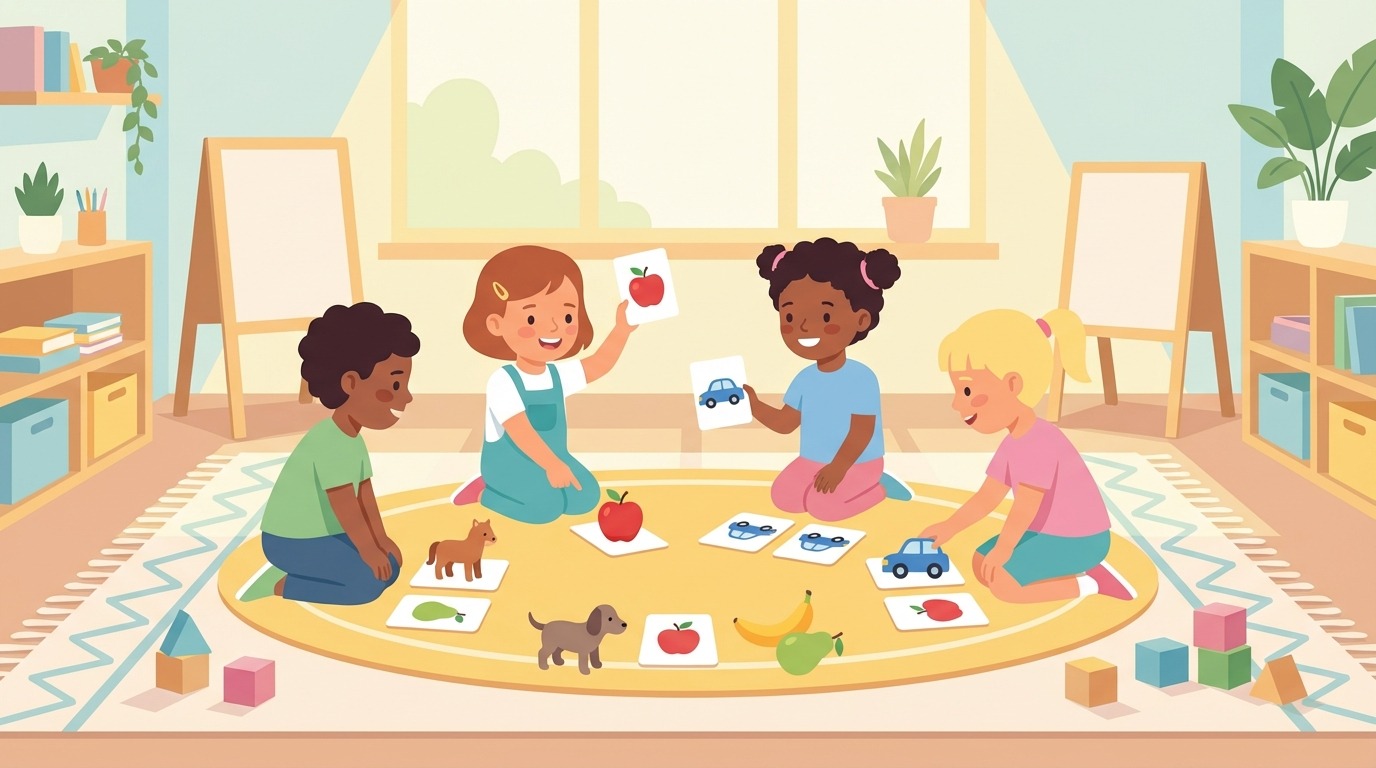
Match Object Pairs: Game: match object pairs for ages 3-5.
| Short on time? Here’s the essentials ⏱️ |
|---|
| 🎯 Key objective: match pairs of objects to train visual memory, attention, and language. |
| 👶 Target age: 3–5 years, with progression from simple to complex. |
| 🧩 Clever formats: cards, real socks, images of candies, means of transport, or playful online versions. |
| 🧠 Golden rule: initially limit to 3–6 pairs, then increase according to ease. |
| 🤝 Social skills: wait your turn, accept randomness, cooperate with a partner. |
| 🚀 Pro tip: alternate analog games and digital games to vary sensory inputs. |
At the age of first independence, a simple game can open surprising doors to learning. Matching pairs of real or illustrated objects provides an accessible setting to exercise association, memory, and curiosity. From age 3, the child observes, points, names, then rejoices in finding “the two that match.” Smiles say it all: understanding the world comes through right, repeated, and delightfully playful pairings.
The principle is well-known in nurseries, kindergartens, and family gatherings. Yet, contemporary variations renew interest. Card games like memory, “matching doubles” around the house, digital versions with only one pair to find per turn: each format stimulates attention differently. Even better, these mechanics lay the foundations of emerging logic, without pressure. Because the pleasure of discovering always precedes effort, a common thread is established: search, verify, succeed, repeat.
Matching pairs of objects for 3-5 year olds: cognitive and social benefits
Searching for duplicates activates essential functions. First, visual memory develops through repeated trials. By lifting two cards or handling two small cars, the brain encodes details, then compares them. This back-and-forth nurtures sustained attention and refines spatial landmarks, useful later in reading and writing.
Next, language gains richness. Naming “striped sock,” “blue cap,” “banana” creates mental categories. This verbalization accompanies associations, as the child links words to images, then to sensations. Very quickly, the game promotes descriptive precision, adjective agreement, and even the discovery of opposites.
Memory, inhibition, and strategy from the toddler class
Beyond immediate recall, a key mechanism appears: inhibition. Saying “no, I already saw this card” or “I remember the elephant here” helps control impulse. Thus, strategy gradually develops: memorizing locations, cross-checking information, waiting for a better move. At 3–4 years, strategy remains intuitive, but progress is noticeable.
A very effective online format proposes only one pair per turn among several unique images. This constraint simplifies choice and clarifies the goal. It strengthens selective attention and decreases cognitive load. Attempts are quick, successes frequent, motivation consolidates.
Social skills and emotional self-regulation
The frame of the game encourages valuable behaviors: waiting, listening to instructions, celebrating another’s discovery. In a classroom or among siblings, taking turns calms scattering. And when a bad draw occurs, the adult supports the emotion and reminds that chance is part of the activity. Thus, the child learns to manage frustration, a key step towards autonomy.
Cooperation adds a highly educational dimension. In pairs, each observes an area and shares a clue. One retains animal images, the other colors. Thanks to this task sharing, collective memory becomes a powerful lever for success.
Case study: the “Little Stars class”
In a multi-age group, a teacher first proposed 3 contrasting pairs (banana/car/sock). After two weeks, children better distinguished patterns and shades. Then the set evolved to 6 thematic pairs (fruits, candies, transports). Older kids guided the newcomers, explaining their tips. Vocabulary progress was evident during group times.
A striking result: the capacity to sustain effort increased. Thirty seconds of attentive observation was enough at first. By the end of the cycle, a full minute of quiet exploration became possible. This subtle evolution heralds longer future learning sessions, conducted with pleasure.
Setting up the game step by step: simple rules and effective progressions
A clear start guarantees success. First, place the objects or cards at child height, well spaced. Then, state the rule in a short sentence: “You look for two alike.” Showing an example reassures. Finally, validate the correct action with an agreed signal, like a thumbs up.
The challenge level remains essential. For 3 years, provide 3 to 4 pairs with sharp contrasts. Around 4 years, move to 6 pairs, introduce shape nuances. At 5 years, vary angles, mix materials and silhouettes, and offer a brief silent observation phase before playing.
Recommended progression by age
For the youngest, concrete themes work very well: socks, candies, farm animals. Then, enrich with means of transport (road, rail, air, sea). These families stimulate categorization. For more comfortable children, combining texture and color increases interest without overloading instructions.
In digital version, a model with only one pair to find per turn is perfect for a quick start. It prevents scattering and emphasizes accuracy of look. Two or three turns suffice to keep momentum and move to real material.
Winning rituals and field tips
- 🧠 “Memory” pause of 20 seconds before starting, eyes wide open, steady breathing.
- 🎲 Role rotation: the one who shuffles does not start.
- 🧩 Brief verbal clues: “look for circles,” “remember stripes.”
- ⏱️ 1-minute hourglass to channel waiting between tries.
- 🌈 Gentle rule: only one reminder per game, to maintain autonomy.
These micro-rituals structure the session and reduce conflicts. As they settle quickly, the adult team can observe more and comment on successes.
For completion, concrete ideas inspired by mainstream manufacturers help renew equipment. A useful summary is offered here with game ideas adapted for toddlers. Choosing clear images without overload remains crucial to maintain motivation.
Homemade materials, motivating themes, and complementary digital variants
Daily life is full of free resources. A basket of colorful caps, two identical small bottles, cardboard boxes of the same size: everything can be used. Place five pairs on the floor, then set their twins a few meters away. The instruction is clear: gather what goes together.
Seasonal themes create surprise. In winter, choose mittens, cardboard snowflakes, miniature hats. At Easter, opt for images of decorated eggs. During holiday periods, mischievous elves hide among gifts. These universes feed imagination and anchor vocabulary in concrete contexts.
Printed cards and contrasting images
Printing “fruits/vegetables” or “instruments/animals” series adds variety. Think of wide format, clear outlines, saturated colors. Avoid complex gradients at the start. Laminating some key cards extends their lifespan and facilitates wiping in groups.
Another popular idea is playing with socks. They constantly get mixed in real life. Matching them amuses and naturally trains visual discrimination. To modulate difficulty, mix fine stripes, dots, and close shades.
Online version: “only one pair” per turn
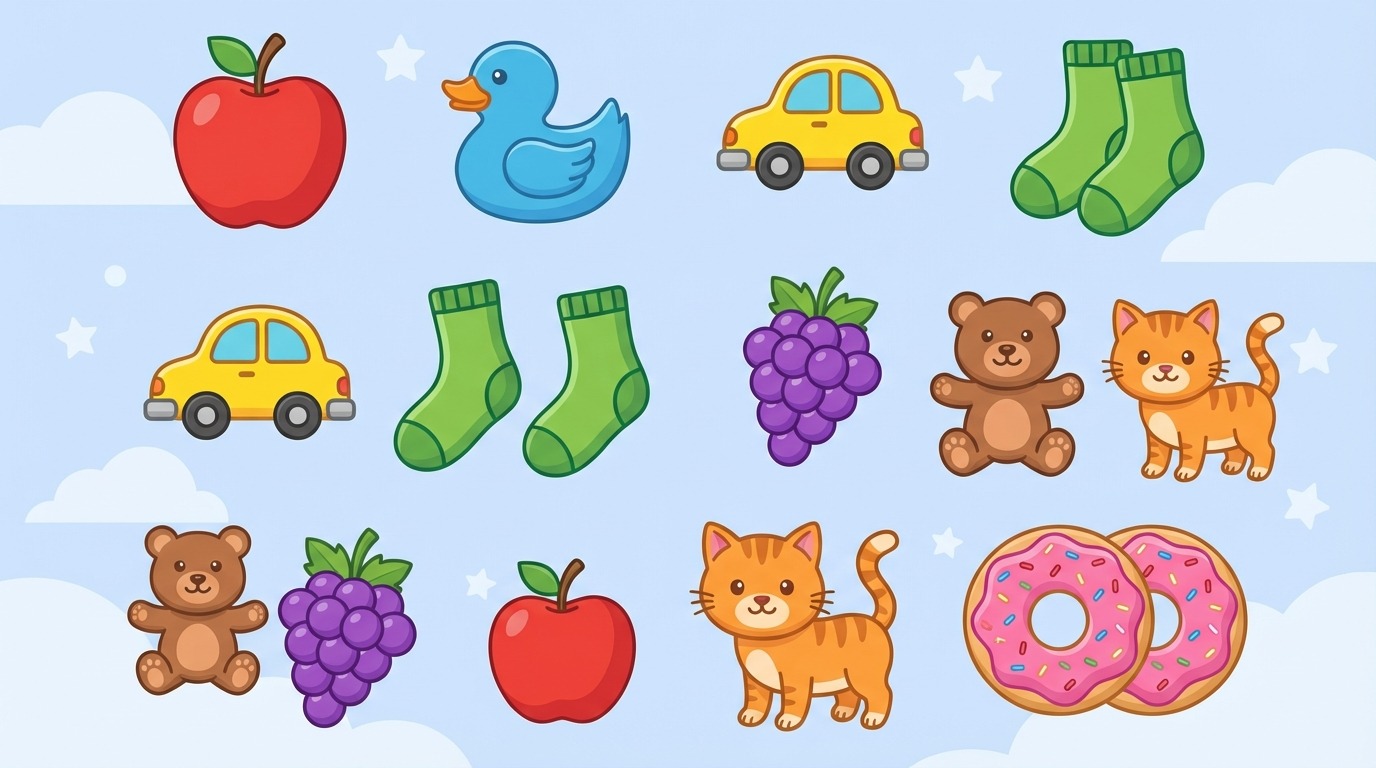
The following digital format has proven effective: a grid of images where only one unique pair is repeated, all others appearing only once. You just have to click on the two identical ones. This mechanic strengthens selective attention and speed of spotting. It suits brief, very effective sessions.
To balance screen time, systematically alternate with tangible activity. Fingers sort, turn, compare. The hand “teaches” as much as the eye. Alternation nurtures procedural memory and avoids cognitive fatigue.
To inspire new game boards, parental guides offer easy-to-implement ideas. These suggestions for playful activities provide useful benchmarks regarding choice of supports and images.
By combining appetizing themes (candies), familiar objects (bottles, boxes), and transport worlds (road, rail, air, sea), the adult maintains the desire to explore. Variety becomes a powerful and lasting pedagogical lever.
Composing a playful learning session in nursery, kindergarten, or at home
A simple but structured sequence ensures everyone’s success. The welcome takes place on a clear mat. Cards or objects are laid out in a checkerboard, face up. A collective ten-second breath centers attention. Then the rule is repeated: “find two identical images.”
For a group of six, creating pairs stimulates mutual aid. One child per duo observes, the other manipulates. After a round, roles reverse. A 30-second hourglass prevents excessively long hesitations. The dynamic remains fluid, satisfaction spreads.
Key steps and differentiations
- 🗺️ Choose a familiar theme (animals, fruits, socks).
- 🔎 Show a short demonstration, without unnecessary commentary.
- 👂 Slip in brief auditory clues to guide the search.
- 👐 Allow only one adult reminder per game to foster autonomy.
- 🧯 Provide a “quiet corner” for breathing out in case of frustration.
To adapt, several levers exist. Reduce the number of pairs, enlarge images, limit color variety. For very energetic children, plan a short motor step: run to the basket, bring a card back, then compare it. Movement channels energy and supports learning.
Shared culture and closing rituals
A closing song or a shared victory shout strengthens group spirit. A brief verbal recap, “today, we found lots of stripes,” helps fix the memory. Then each puts away a card. This act of contribution is learned and celebrated.
Over sessions, regularity creates fertile ground. Two short sessions per week suffice. Repetition builds confidence, while leaving room for theme novelty. The watchword remains: playful, rhythmic, rewarding.
Observing progress, valuing each child, and combining digital and real
Measuring without stressing is possible. A small dashboard can note attention span, number of pairs found, retrieval of a precise word. No grades, just smiling indicators. The idea is to encourage, not rank.
For varied audiences, accessibility is a priority. Enlarge supports, offer strong contrast, add a tactile clue (textured paper) to ease entry into the task. Cooperation in mixed pairs (big/little) creates fruitful mutual support.
Bilingualism, neurodiversity, and personalization
In a bilingual home, saying the image name twice, in both languages, strengthens the sound-image association. For neuroatypical profiles, a clear pictogram, a visual instruction, and a predictable duration secure the session. Success comes from respecting sensory needs.
Technology, when well dosed, supports motivation. An online module with only one pair per turn serves as a quick warm-up. Immediately after, transposing to real material consolidates learning. This alternation limits fatigue and maximizes transfer.
Concrete progress indicators
Three easy-to-observe signals are golden: the child anticipates and says “I know where the other is,” justifies “I see the same dots,” and proposes a theme for next time. These markers show an organizing thought and lasting pleasure.
To vary supports and renew desire, also draw inspiration from mainstream paths. Practical resources gather ideas for association games and manipulations. For example, consider progressive game guides that help choose solid and safe objects.
A final pro tip
Close each session with guaranteed success. Ask the child to choose “their favorite pair” and explain why. This verbalization moment crystallizes experience and nurtures self-esteem. It is the best springboard for the next round.
“When the child matches a pair, they also gather their strengths: seeing, naming, reasoning… and growing in confidence.”
How many pairs to offer at the start?
For 3 years, 3 to 4 pairs with good contrast suffice. Between 4 and 5 years, move to 5–6 pairs, then vary shapes, colors, and textures according to ease. The goal is to keep the challenge motivating, never overwhelming.
Should cards or real objects be preferred?
Both formats complement each other. Cards foster fine observation, while real objects add a sensory and motor dimension. Alternate to support attention and memorization.
How to avoid frustration?
Set the duration, use an hourglass, value each attempt, and remind that chance is part of the game. A quiet corner and only one adult reminder per game help preserve pleasure.
Are screens suitable for this age?
Yes, if they are short, targeted, and followed by a concrete transposition. A module with only one pair to find per turn is ideal as a warm-up before real manipulation.
How to enrich vocabulary during the game?
Name images precisely, use adjectives (striped, smooth, green), and invite the child to describe their choices. The natural repetition throughout sessions consolidates new words.