Night Terror Fear: Fear and night terror in children: managing sleep (1-3 years).
| Short on time? Here is the essential ⏱️ |
|---|
| 🌙 Night terror is a common parasomnia in children aged 1-3 years, different from nightmares and harmless in most cases. |
| ⏰ It occurs 1 to 3 hours after falling asleep, during deep sleep, with screaming, agitation, a “blank” stare, and amnesia upon waking. |
| 🧸 During an episode, do not wake the child, secure the area, and stay calm. Speak little, touch only if the child accepts it. |
| 🧠 Key factors: fatigue, irregular rhythm, screens in the evening, illness, stress, changes, sometimes heredity. |
| 📅 Prevent with a soothing routine, adapted naps, short rituals, listening, and genuine emotional security. |
| 📝 Consult if >1 episode/week, if episodes last >10 min, if there is injury, marked snoring, severe sleep disorders, or after age 6. |
| 📊 Between 18 and 30 months, up to one third of children can be affected. The phenomenon decreases with age. |
| 💡 Consistent sleep management and reassuring landmarks reduce the frequency of night awakenings. |
Night fear and night terror often disrupt family evenings, yet they follow a simple logic of child sleep. Between 1 and 3 years old, the brain learns to navigate between deep rest phases and micro-awakenings. It is precisely in these transitions that the impressive episode occurs: the child screams, struggles, but is still asleep. Faced with this scene, the reflex is to comfort. However, the correct reaction differs from that adopted for nightmares.
Because a clear framework soothes child anxiety, this analysis explores five axes. First, what happens at night. Then, how to recognize a night terror without confusion. Next, the hidden triggering factors. Then, the gestures that reassure without worsening. Finally, proven methods to prevent and when to seek specialist advice. Throughout these pages, one guiding thread remains: emotional security creates the best nights.
Night fear and night terror in children aged 1-3 years: understanding the sleep mechanism
To demystify episodes, it’s useful to open the “black box” of child sleep. At this age, a cycle lasts on average 60 to 80 minutes and consists of light slow sleep, deep slow sleep, then REM sleep. The first cycles of the night are richer in deep sleep. It is a restorative sleep, but also more unstable during transitions.
Between two cycles, short micro-awakenings occur. Usually, they go unnoticed. Sometimes, exiting deep sleep goes awry: the body becomes active while the brain remains in “night mode”. This mismatch explains night terror. The child may suddenly sit up, scream, sweat, with a fixed stare. Yet, they are not awake.
Differentiating nightmare and night terror
A nightmare usually appears in the second half of the night, during REM sleep. The child wakes up, seeks comfort, sometimes remembers the content. Conversely, night terror occurs early in the night, 1 to 3 hours after falling asleep. It is accompanied by amnesia the next day and resistance to contact during the episode. This distinction changes everything, as parental reactions differ.
Let’s imagine Lina, 2 years old. At 9:45 pm, she sits up, screams, pushes her mother away, sweats, then suddenly lies back down and sleeps. In the morning, she plays as if nothing happened. This scene corresponds to a night terror. If Lina had woken up crying at 3 am saying “a wolf in my room”, we would have thought of a nightmare.
Frequency and age: what observations show
Episodes sometimes appear as early as 6 to 7 months, but they are mostly frequent between 2 and 5 years. Several clinical follow-ups estimate that around 18 months, nearly one in three children may experience at least one episode. By 30 months, the proportion already declines. The evolution is reassuring: with nervous system maturity, sleep architecture stabilizes and episodes become less frequent.
This understanding does not minimize the emotional impact. However, it offers a solid basis for acting calmly. Knowing the “when” and “how” of the phenomenon prepares the “what to do” effectively.
Identifying a night terror: symptoms, duration, and signs of confusional arousal
Quickly identifying the episode helps avoid wrong reactions. In a night terror, the child appears awake, but is not. They scream, sit up, sometimes stand. Their heart rate accelerates and breathing becomes erratic. They may sweat, clench fists, have a flushed face and fixed gaze. Language, if any, remains incoherent.
The duration is often short. Many episodes end in less than 10 minutes. Some last a few tens of seconds. In rare cases, they extend up to about fifteen minutes. Then, the child falls asleep alone, with no memory upon waking. This is a key sign.
The role of confusional arousal
Confusional arousal serves as the key explanation. It is a partial activation of the arousal system while the brain remains anchored in deep sleep. Behavior is automatic and perception of the environment is blurred. Hence the difficulty in responding to comfort attempts. Touching or speaking too loudly can increase confusion.
Unlike sleepwalking, the child does not necessarily explore the room. However, they may get up. The priority then becomes safety. A cleared space and protections limit risks.
Observation checklist at home
Building a small observation routine provides useful clues. The goal is not to diagnose alone. It’s about describing precisely to the pediatrician what happens.
- 🕒 Time of occurrence: rather early in the night?
- 🎚️ Intensity: screaming, agitation, sweating?
- 👀 Reactivity: fixed gaze, refuses contact?
- 🔁 Frequency: how many episodes per week?
- 🛏️ Falling asleep: stable routine or late bedtime?
- 📺 Screens: evening exposure?
- 😷 Health: cold, fever, teething?
- 🏠 Context: recent major change?
These points frame the episode and guide toward favouring factors. They also help ensure that it is not confused with other sleep disorders or acute pain. Observing, without over-interpreting, prepares a more accurate action.
Causes and risk factors: fatigue, changes, and emotional security
Triggers revolve around three axes: physiology, environment, and emotional. Biologically, deep sleep in toddlers is very intense. The brain is still learning to coordinate transitions between phases. During this maturation, “misses” are more likely.
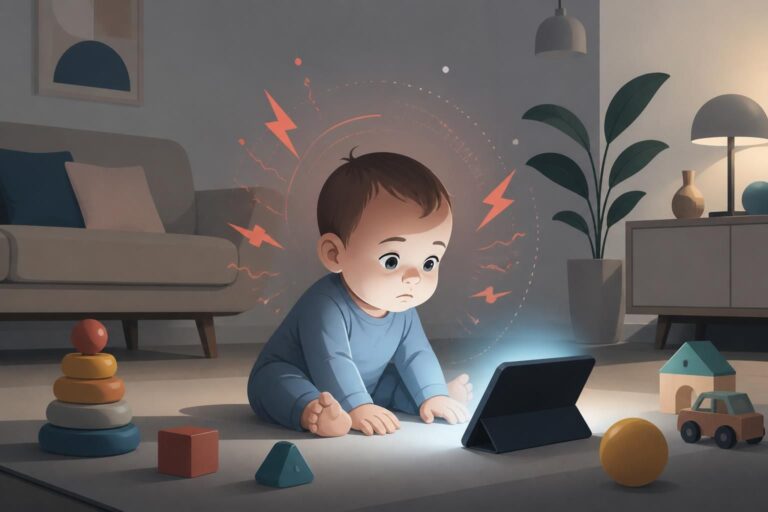
On the environmental side, fatigue plays a major role. Shortened naps, a too-late bedtime, or highly stimulating days increase risk. Evening screens add a barrier, as blue light delays melatonin secretion and sustains hypervigilance. A simple late cartoon can be enough to disrupt rhythm.
Life changes and child anxiety
Significant life events are often triggers: starting daycare, nanny, moving house, arrival of a baby, family tensions. Even if the child does not understand everything, they pick up emotions. Child anxiety expresses itself at night, when the nervous system “discharges” excess activation. Hence the importance of a secure bond and consistent landmarks.
Some clinical observations also mention a hereditary component. When a parent reports a history of parasomnias, the risk increases in the child. This does not imply a predestined fate. However, it motivates prevention even more.
Illness and temporary discomforts
A cold, fever, or toothache disrupt cycles. Deep sleep becomes more fragmented. Transitions then become more fragile, which favors episodes. Conversely, quickly returning to a regular rhythm after illness reduces relapse risk.
For example, let’s imagine Nino, 28 months old. His nap was skipped, he played outside until 7:30 pm, then watched a video before bedtime. At 10 pm, he screams, sweats, refuses to be held. The triggering elements are obvious: fatigue and late stimulation. Adjusting the next day’s program becomes the first “intervention.”
Understanding this dynamic naturally leads to the right actions. Then comes how to act during the episode without increasing distress.
This video can complement the analysis of causes. It does not replace medical advice but supports establishing soothing daily habits.
Reacting during an episode: calm protocol, safety, and mistakes to avoid
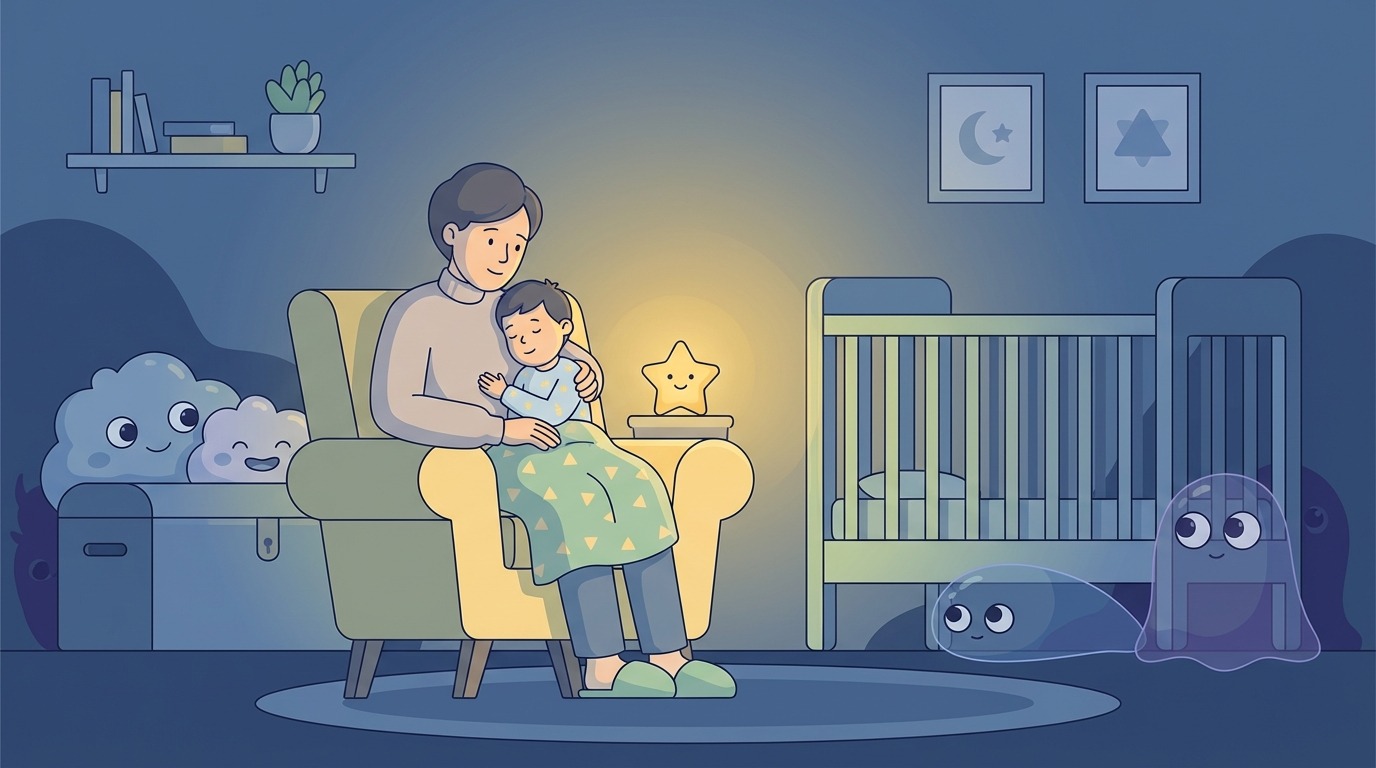
The key to successful intervention lies in three words: calm, proximity, safety. The child is not aware of the environment. Trying to wake them abruptly often prolongs the episode. Conversely, a calm and discreet presence encourages the episode to naturally end.
Approach gently. Position yourself at bed level. Speak little and softly. Avoid bright light. Be ready to cushion a sudden movement. If the child accepts contact, placing a light hand on the belly may help. If this contact triggers agitation, remove it immediately.
Common mistakes to avoid
- 🚨 Waking the child by shaking: this prolongs the episode.
- 🗣️ Asking many questions: they do not understand the meaning.
- 💡 Turning on bright light: the light disrupts rhythm.
- 🧃 Systematically giving a drink: risk of creating anticipation.
- 📣 Talking about the episode the next day: this may sustain bedtime apprehension.
After the episode, gently replace the duvet, check comfort, then leave. Upon waking, do not revisit the event. Offering an ordinary day with stable landmarks reassures more than a lengthy debrief.
Securing the space, a reassuring reflex
Remove sharp objects near the bed. Move furniture with sharp corners away. On a cabin bed, add a mat on the floor. On a crib bed, check fittings. Avoid elevated mattresses and bunk beds for restless profiles. This hygiene of the environment reduces parental anxiety and protects the child if the episode causes them to get up.
A video guide on the evening routine often helps to synchronize the whole family. Simple landmarks do a lot to limit night awakenings linked to parasomnias.
Prevent and soothe: routine, sleep management, emotional tools, and when to consult
Prevention is based on coherence and regularity. A short ritual repeated every evening sends a safety signal to the brain. Ten to fifteen minutes suffice: dimmed light, gentle story, cuddle, lullaby. The important thing is not the duration but the quality of presence. This anchoring nurtures emotional security and calms child anxiety.
Limit screens two hours before bedtime. Favor soothing sleep management activities: warm bath, calm puzzles, coloring. Intense days benefit from a “slow” transition. At nap time, aim for a stable schedule. Around 15 to 18 months, the transition to a single nap requires progressive support.
Concrete tools to implement
A “sleep diary” helps identify triggering links. Note bedtime, nap time, episode, health, screens. Over a week, recurring patterns emerge. In case of high frequency, this tool enlightens the pediatrician.
Light body techniques complement the ritual: foot massage, “candle” breathing (blowing softly), “comfort-breathing” stuffed toy. These are simple gestures but activate relaxation pathways. Many children quickly become attached to them.
Scheduled awakening, a useful strategy
If the episode occurs almost nightly at about the same time, try a “scheduled awakening” for 5 to 7 nights. Fifteen minutes before the usual crisis time, gently wake the child for 2 to 3 minutes, then put back to bed. This micro-interruption sometimes breaks the pattern. The method must remain brief and benevolent.
Also adjust the schedules. Moving bedtime 20 minutes earlier for a few days reduces accumulated fatigue. This is often enough to reduce episode frequency. And if the nap disappeared too early, reintroduce a prolonged quiet time with a book.
When to consult and who to contact
Medical advice is relevant if episodes exceed once per week, last more than 10 minutes, if there is risk of injury, loud snoring with possible breathing pauses. The doctor will check for a sleep apnea syndrome, gastroesophageal reflux, or another associated disorder. They may refer to a pediatric sleep center if necessary.
In the vast majority of cases, no medication is necessary. Treatment lies in daily structure: regular schedules, rituals, a calm environment. In other words, strengthening the base reduces night terror. Night breathes better when day is better organized.
How to know if it is a night terror or a nightmare?
Night terror occurs early in the night, during deep sleep, with screaming and agitation without real awakening and no memory the next day. Nightmare appears rather late in the night, waking the child, who seeks comfort and sometimes remembers the dream.
Should the child be awakened during a crisis?
No. Waking them often prolongs the episode. Stay calm, secure the area, speak little and avoid bright light. The child will fall back asleep when the discharge ends.
What are the most common causes?
Fatigue, irregular wake-sleep rhythm, evening screens, benign illnesses (cold, fever), life changes, and sometimes a hereditary component.
When to consult a doctor?
If episodes occur more than once a week, last more than 10 minutes, if there is injury, loud snoring, breathing pauses, or if it persists after age 6.
“Peaceful nights arise from predictable days, a reassured heart, and a ritual that softly repeats: here, you are safe.”