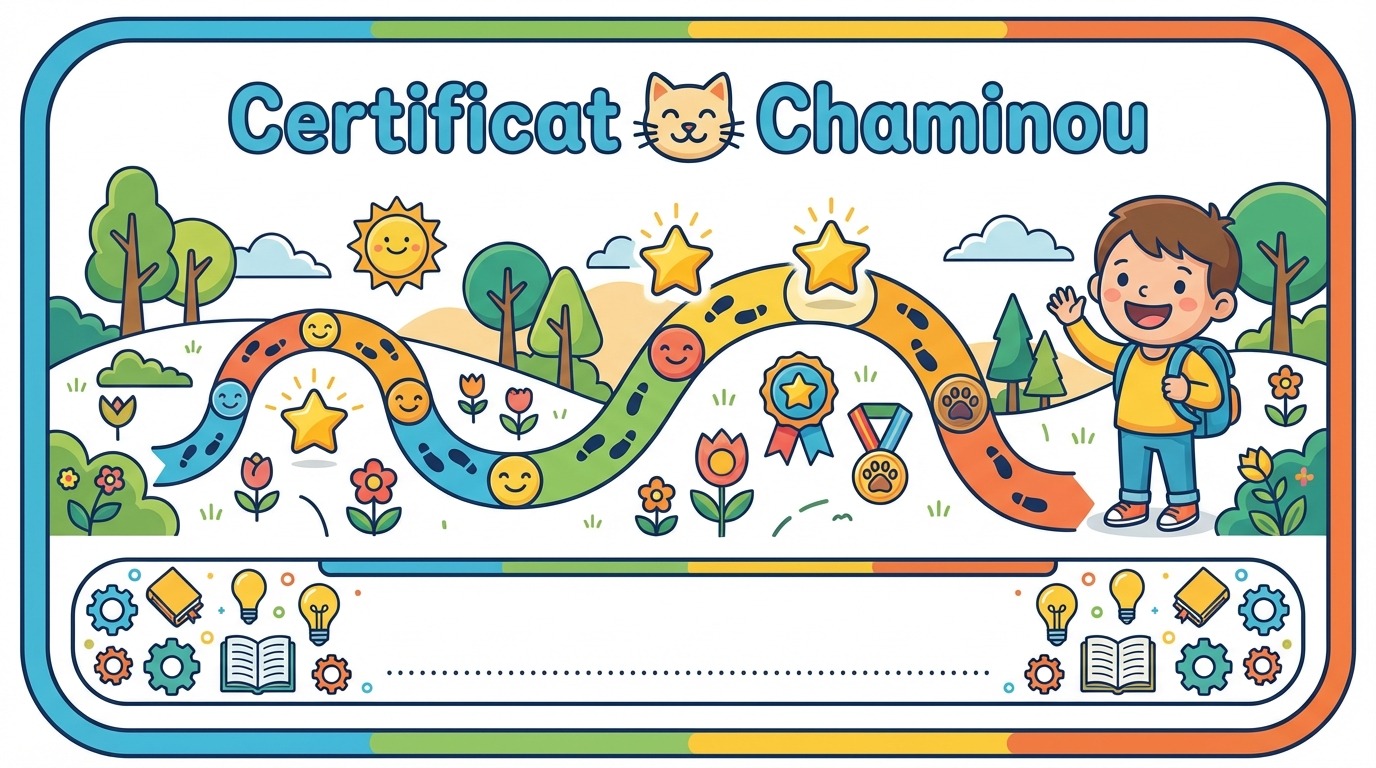
Chaminou Certificate: Chaminou Certificate to encourage autonomy.
| Short on time? Here’s the essentials ⭐ |
|---|
| The Certificat Chaminou makes the child’s efforts visible and nurtures their motivation ✅ |
| A “challenge per week” protocol structures learning and responsibility 🗓️ |
| Favor encouragement of the process, not performance alone 💬 |
| Adapt the environment (heights, routines, tools) for smooth autonomy 🧩 |
| Avoid over-helping, welcome mistakes, and offer guided choices for success 🌱 |
Putting autonomy at the heart of daily life transforms family atmosphere and children’s confidence. The Certificat Chaminou offers a path that is both simple and inspiring: validate concrete progress, ritualize recognition, and celebrate effort. Rather than a bland “stickers system,” this format creates emotional milestones, clear objectives, and a narration of the child’s personal development. Playful themes like “I dress myself” or “I jump rope” rhyme with learning, pleasure, and consistency.
On the ground, a short, intensive protocol paced by weekly themes helps families and early childhood professionals. Each week, a precise goal, micro-steps, and a final validation reinforce motivation and responsibility. The idea is not to impose, but to establish meaningful positive education rituals. This approach, supported by concrete tools and certificates for daily habits, energizes the desire to act and prepares for lasting success.
Certificat Chaminou: a lever for autonomy and self-esteem
A child progresses when they can see, touch, and tell about their advances. The Certificat Chaminou is based on this educational evidence: effort gains value when regularly recognized. By marking small victories, adults nurture autonomy and foster a virtuous loop of encouragement and motivation. Formulas like “I dress myself” or “I jump rope” do more than validate a gesture. They structure progression and support the joy of learning.
Why ritual recognition activates motivation
Motivation cannot be decreed; it is maintained by clear and descriptive recognition. Saying “You buttoned three buttons all by yourself” values a process, not a label. This nuance feeds perseverance and reduces fear of failure. In families’ minds, the Certificat Chaminou is neither a carrot nor a disguised punishment. It is a marker of personal development, anchored in positive education and competence.
The weekly ritual sets an accessible horizon. The child knows where they are going, and adults know how to support them. Versions linked to self-esteem reinforce this framework. They help name efforts, modulate help, and encourage initiative with kindness. This emotional stability increases engagement and prepares for success.
Concrete and motivating progression evidence
Thematic variations create a coherent path. Each certificate becomes a step in the story of learning. Displays at home, memory binders, or dedicated folders materialize progress. This provides a conversation support within the family while reassuring the child about their capacity to try again.
Collective initiatives have popularized these formats. Notably, series of 40 downloadable certificates multiply daily life domains. This diversity helps avoid boredom and adjusts challenges to current skills. The key remains the same: a short, regular, and joyful validation to maintain momentum.
- 🌟 Emphasize effort rather than the final score.
- 🧠 Break the task down into accessible micro-steps.
- 💬 Use descriptive and encouraging language.
- 📌 Make successes visible in a dedicated space.
- 🪄 Allow space for play to amplify curiosity.
Ultimately, the strength of the Certificat Chaminou lies in a clear equation: explicit intention, daily gesture, tangible trace.

Challenge per week: short and intensive protocol to encourage autonomy
The “challenge per week” format structures the desire to do alone, day after day. Each week, a theme guides the action, from simplest to more engaged, with a final validation through the Certificat Chaminou. This approach supports the responsibility of the child and clarifies the adult’s role: show, support, observe, then step back.
A meaningful learning schedule
Here is an example of sequencing over five weeks. Week 1, “I dress myself”: one day for socks, another for the coat, then a timed complete outfit as a game. Week 2, “I brush my teeth”: place the mirror at the right height, offer an hourglass, and celebrate morning and evening consistency. Week 3, “I prepare my bag”: a visual list to avoid forgetting, then a final verification by the adult up to full autonomy.
Week 4, “I clear the table”: organize clear zones, with one tray for cutlery, another for glasses, and a safe route to the sink. Week 5, “I jump rope”: start with two jumps, then five, then ten, up to the final certificate. Motor and domestic challenges complement each other and maintain motivation through variety.
Concrete and flexible tools for success
For the protocol to stay alive, it’s better to provide easily handled supports. Printable resources facilitate objective displays and visual tracking. And since music supports momentum, a joyful timer turns a routine moment into a small mission.
Play remains a powerful ally. A rhyming game about clothes, toothbrushes, or kitchen utensils paves the way for good humor. Humor demystifies attempts and boosts learning.
Autonomous routine videos also help inspire the whole family. However, the essential is played out at home, in consistency and tenderness.
Ultimately, the “challenge per week” protocol gives adults breathing space and a path to children.
Errors to avoid and decisive pedagogical adjustments
Some pitfalls are common. The first is doing things for the child, out of fear they will fail. Yet, failure is a stage of learning. Adjusted support (showing, doing together, observing, then letting do) enables dosing of help and strengthens autonomy.
Welcome mistakes, dose help, repair together
The famous refrain “You will fall! You will spill!” blocks momentum. By holding back this reflex, the adult sends a message of trust. When an incident happens, the moment becomes a repair workshop. Repairing an object or a relationship is learning about the world and developing responsibility.
The second pitfall lies in evaluative language. Saying “That’s good!” shuts down discussion. Describing the process opens it up: “You organized your bag by yourself, and you checked the water bottle, that’s smart.” A discreet link with emotional management can help. To learn to soothe frustration and bounce back, this article about managing emotions offers practical markers.
Reduce frontal “no” and offer guided choices
Some children hear “no” as a direct attack on their space. Alternatives exist: “Yes, after dinner,” “Yes, when the table is cleared.” This positive grammar makes rules predictable. It encourages initiative and channels energy, without unnecessary battles.
The third pitfall hides in the environment. If coats are too high or the toothbrush is inaccessible, autonomy fades. A simple reorganization suffices: lower, simplify, label. The philosophy is clear: remove obstacles to let each child go solo at their own pace.
- 🚦 Replace “no” with time-bound conditions.
- 🧯 Name the emotion and offer a concrete option.
- 🧰 Prepare materials at child height.
- 🔁 Plan the order of actions with icons.
- 🪙 Value effort with the Certificat Chaminou.
The course remains stable: encourage without overprotecting, guide without controlling.
An environment prepared to make autonomy possible daily
Before talking about will, talk about arrangement. An entrance with low hooks, a bench for shoes, a basket for the hat: here is a smooth routine. In the bathroom, a step stool, a dedicated cup, a colorful hourglass. The house becomes a teammate of the child, and positive education gains fluidity.
Morning and evening rituals, visual supports, and games
In the morning, a visual path of three images suffices: dress, breakfast, brush teeth. In the evening, reverse with a touch of slowing down. Visual supports reassure the youngest and free the words of the older ones. The routine ceases to be a tunnel and becomes a marked learning track.
Play remains the fastest bridge. Dress-up turns into a timed mission, dishwashing into choreography, tidying into a treasure hunt. Rhymes, music, and humor create a positive memory of effort. The link to a rhyming game offers ready-to-use ideas.
Printable resources to accelerate success
Icon cards, laminated lists, and “mission” cards accelerate implementation. To centralize these supports, printable resources can help. A small laminator makes everything durable. You save time, gain autonomy, and above all gain serenity.
The Certificat Chaminou then naturally fits in: a simple, joyful, and well-earned validation. Complete series exist to vary themes and avoid boredom. Coherence trumps quantity, and each validation feeds the child’s trajectory.
When the home cooperates, autonomy ceases to be a mountain. It becomes a marked and luminous path.
Everyday allies: encouragement, emotions, and network around the child
Recognition of effort gains power when supported by a caring ecosystem. Trust is rooted in adults’ gaze, emotional safety, and clear rules. This is where encouragement meets emotional management, and where the home opens to external resources.
The power of language and resource relationships
Precisely naming effort creates a virtuous circle. Some key phrases facilitate educational alignment among adults. For example: “You tried three times, and you found it.” or “You asked for help at the right moment.” This nurtures autonomy without drowning the child in compliments.
Security feeling also passes through strong attachment figure bonds. The reading “a father’s love and trust” sheds light on these familiar dynamics. The more stable the foundation, the more the momentum toward independence expresses itself. Imagination can participate: a detour through the subject of the imaginary friend shows how symbolic play supports inner growth.
Routines that protect energy and health
Autonomous learning relies on a calm life rhythm. Sleep, meals, outings routines: the child orients themselves without effort. Families welcoming a baby or expecting a child juggle multiple priorities. To anticipate serenely, getting informed about the whooping cough vaccine during pregnancy can be part of an overall hygiene of life.
Daily, a “relationship repair” kit remains useful. It contains cards to apologize, a timer to isolate like a champion, and a poster of resource phrases. At the same time, chain material rewards are avoided. The Certificat Chaminou validates effort; it does not “pay” obedience. This stance keeps positive education on the right track: the child acts to learn and surpass themselves, not to collect.
- 💬 “I see your efforts, you persevered.”
- 🧭 “What would help you next time?”
- 🤝 “You can ask for specific help if needed.”
- 🧘 “Breathe, we’ll start again when you’re ready.”
- 🏅 “You earned your Certificat Chaminou, you built your success.”
With precise language, stable markers, and a network of aligned adults, responsibility becomes a reflex and success a habit.
Mini encouragement toolkit for the home
To anchor the dynamic, here is a short toolkit to keep on hand. It mixes rituals, games, and traces that tell the path traveled. The goal is simple: make efforts visible and keep the course steady without tension.
- 📒 Challenge notebook: note the week’s mission and small victories.
- ⏱️ Joyful timer: ritualize the duration of tasks without stress.
- 🖼️ Progress wall: display certificates and “before/after” drawings.
- 🎲 Express game: invent 3 rhymes about the day’s mission to launch the action.
- 🔄 Friday review: ask “What did I learn?” rather than “Did I do everything?”.
This “ritual, game, trace” trio offers a positive and lasting trajectory.
From what age to propose the Certificat Chaminou?
As soon as the child shows a desire to do alone, very simple versions are possible (putting away two toys, putting on slippers). Around ages 3-4, short challenges are structured. Later, it becomes more complex (school bag, sport, organization). Age matters less than adjusting goals to real abilities.
How to avoid the material reward effect?
The Certificat Chaminou does not buy obedience: it tells and values effort. The process is described, perseverance is highlighted, and adding material gifts is avoided. The child acts to learn, progress, and be proud of their journey, not to accumulate.
What to do if the child refuses the week’s challenge?
A guided choice is proposed: same goal, different modalities (morning or evening, kitchen or bathroom, 3 minutes or 5 minutes). Emotion is listened to, the pace is adjusted, then the plan is resumed. The important thing is to maintain trust while keeping the course.
How many certificates to display at home?
It’s better to have a visible and evolving selection. For example, 3 to 5 recent certificates on a progress wall, the others in a memory binder. This way, motivation stays alive and the story of successes remains accessible.
“A certificate does not crown obedience, it lights the path to autonomy.”