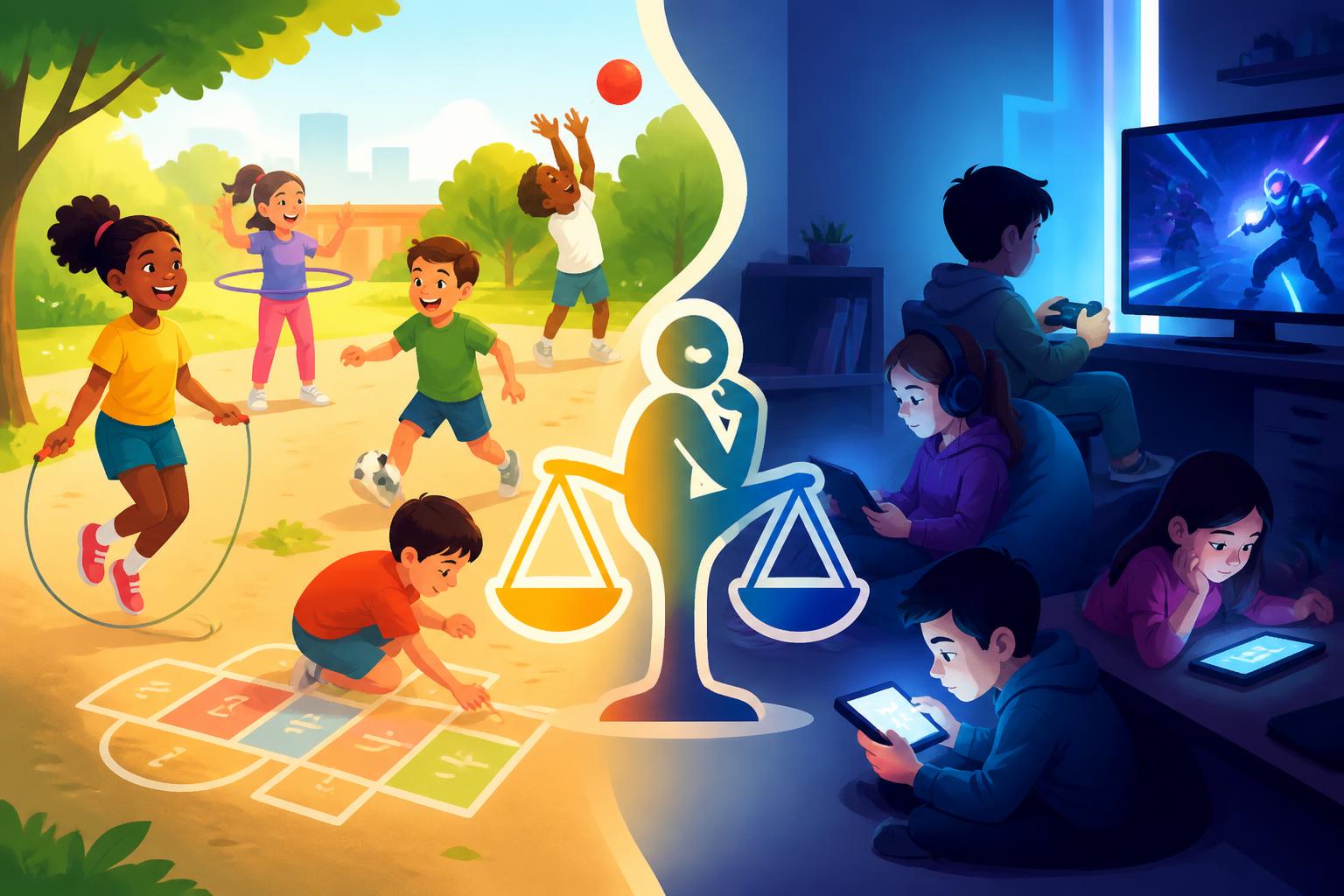
Traditional games vs digital games: What effect on children’s development?
In Brief
- The World Health Organization (WHO), in its guidelines published on April 24, 2019, recommends for children aged 2 to 4 years to limit sedentary screen time to 1 hour per day (less is better), and to prioritize active play.
- Public Health France, in its Digital Barometer published on March 10, 2023, indicates that 83% of 12–17 year-olds own a smartphone, which concretely changes the place of digital games at home.
- ARCOM, in its annual activity report published on June 24, 2024, reminds that online content regulation aims notably to better protect minors but does not replace a family framework on usage.
- The CNIL, in its recommendations on cookies and other trackers updated on September 17, 2020, emphasizes the “accept/refuse” choice and the fact that personalization (content, advertising) relies on browsing data.
- Between traditional games and digital games, the most useful difference to observe for child development especially concerns motor skills, the quality of social interaction, and the attention mobilized, not the “medium” itself.
Traditional games have not disappeared, they just had to learn to coexist with a tablet that knows how to sing, count, tell stories, and… capture attention like a robot vacuum on a fringed rug. In real life, the competition often takes place in the living room, between a puzzle missing a piece (a mystery never solved) and a screen that offers “just one game”. The point is not to demonize digital games nor to sanctify marbles and hopscotch, but to look at what each format brings to the body and mind: cognition, motor skills, creativity, and especially socialization.
Families are looking for concrete guidelines: what to offer, at what age, with what rules, and how to prevent play from becoming a negotiation battle. Developmental science research reminds us that learning feeds on varied experiences, repetitions, and human connections. A screen can support certain skills, but physical and shared play remains a social interaction accelerator. To make useful judgments, real situations must be compared: free play, rule-based play, cooperative play, solo digital play, multiplayer digital play, and even the “personal data” aspect that sneaks into children’s rooms.
Traditional games and child development: motor skills, rules, and everyday socialization
Traditional games have a discreet talent: they train the body without needing to market it as a “premium option”. When a child jumps rope, throws a ball, stacks Kapla blocks, or plays hide-and-seek, gross and fine motor skills work continuously. Movement, balance, hand-eye coordination, and spatial management are built through action. This physical foundation is not a “sports bonus”: it also supports attention, emotional regulation, and confidence because the body learns to anticipate and correct.
Socialization is the other major strength of screen-free games. In a game of Uno, Dobble, Sorry!, or charades, the child practices waiting their turn, tolerating frustration, reading reactions, negotiating a rule (“let’s play again, but without cheating this time”). Social interaction is not decorative: it is a skill that strengthens. Micro-conflicts are frequent, and that’s precisely what makes the exercise useful because the child learns to repair after disagreement. Traditional play puts language at the center: explaining, contesting, convincing, teaming up.
In terms of cognition, construction and assembly games (puzzles, LEGO, tangrams, nesting games) develop spatial visualization, planning, and perseverance. The benefit often comes from the pace: objects do not blink, do not give automatic “hints”, and the child must hold an intention longer. It looks like old-school learning, but it is mostly training concentration. The WHO, in its April 24, 2019 recommendations, moreover insists on the importance of active play and quality screen-free time for little ones, which supports a daily routine filled with physical activities and exchanges.
Symbolic play also deserves a spot front and center. Toy tea sets, figurines, costumes, or role play turn a sofa into a spaceship and a sock into a snake. This creativity has a very concrete effect: the child handles scenarios, tests social roles, explores emotions, and learns to tell stories. Vocabulary broadens, stories get structured, and adults sometimes get dialogues of rare intensity (“no, the comforter is a doctor, not a patient”). “Pretending” serves as an emotional laboratory, with flexible but real rules.
Traditional games also allow difficulty to be calibrated by hand. A tower of cubes can start at three levels and go up to twenty. A card game can be played cooperatively with an adult who adjusts the rules. This progression helps the child stay in a zone where they learn without getting discouraged. The useful insight here is that screen-free play builds competence based on physical and social constraints that are easy to perceive.
Digital games: cognition, attention, learning, and screen traps in real life
Digital games have an obvious advantage: they know how to offer graded challenges, immediate feedback, and rich worlds. In cognition, this can help certain learning, notably when the game is designed to train a specific skill: shape recognition, working memory, logic, spatial orientation, or even automation of numeric facts. A good educational game can become repetitive… without the child feeling like they are “doing exercises”. The medium can also be useful for children who like to explore at their own pace, try again without being judged, and get hints.
The downside starts when the screen imposes its tempo and rewards. Gratification mechanisms (sounds, badges, levels) make stopping harder, especially for younger children who regulate their impulsivity less easily. It is not about moralizing but observing a practical phenomenon: a screen game can occupy the entire mental space, whereas a traditional game more often leaves room for creative boredom and bifurcations (“we end up changing the rules and inventing a new game”). The main risk lies in fragmented attention, when the child goes from one stimulation to another without downtime.
Equipment data explain why the issue has become domestic, not theoretical. Public Health France, in the Digital Barometer published March 10, 2023, indicates that 83% of 12–17 year-olds own a smartphone. With a personal device, digital play becomes available everywhere, all the time, and the line between game, video, and social network blurs. Parents do not necessarily “turn on” the screen anymore: it’s already there, in the pocket. Younger children do not all have a phone, but they see sibling usage, which influences their desires and habits.
The social dimension of digital games exists and can be solid: cooperation, strategies, remote coordination, specialized language, mutual aid among players. But social interaction is mediated: you do not always see expressions, subtle signals, moments when someone checks out. For some children, this can reduce training in emotional reading, especially if most exchanges happen via text or quick audio. ARCOM, in its activity report published June 24, 2024, recalls that protecting minors online is a structural issue; in family practice, this refers to concrete parameters (parental control, age rating, usage time, discussion about content).
Another often overlooked angle concerns data collection. On online services, the choices “accept all” or “reject all” are not decorative details. The CNIL, in its recommendation updated September 17, 2020 on cookies and other trackers, explains that content and advertising personalization can rely on past activity and identifiers. For a family, this means a game or platform can adapt what is offered, thus influencing the type of content seen by the child. The question is not a Hollywood-style spying scenario but understanding that a digital environment is not neutral and that it can be configured.
The useful takeaway: digital games can support learning when chosen, framed, and discussed, but the screen can also capture attention at the expense of movement, face-to-face interactions, and a variety of experiences.
A concrete guideline is to compare situations, not opinions. The table below puts measurable or observable criteria side by side for families.
| Observable criterion | Traditional games (examples) | Digital games (examples) | Simple indicator at home |
|---|---|---|---|
| Effective movement time | High with ball games, rope, hide-and-seek | Often low in seated screen play | Minutes standing/moving over 30 minutes of play |
| Fine motor skills | Cutting, beads, LEGO, modeling clay | Repetitive gestures (tap/swipe), sometimes precision (stylus) | Variety of gestures (pinching, turning, assembling) |
| Social interaction | Strong in rule-based and symbolic shared games | Variable: solo, online coop, or local | Number of verbal exchanges per game |
| Sustained attention | Progressive, few automatic hints | High stimulation, immediate feedback | Ability to stop without crisis at session end |
| Creativity | Very strong in free play and open construction | Strong on creative sandboxes, more guided on levels | Production: invented story, original construction, drawing |
Comparing effects: motor skills, creativity, and socialization by age and family context
Comparing traditional and digital games requires taking age into account, because needs evolve quickly. Before age 6, child development goes through the body, concrete language, and imitation play. Activities involving manipulation, balance, movement, and direct interactions are particularly profitable. A screen can offer educational content, but it does not replace sensorimotor learning. The developing brain needs to move, touch, fail, try again, and hear human reactions in real time.
Between 6 and 10 years, rule-based games become a life school with a “we stay friends after” version. Children learn to win, lose, argue, cooperate, and manage feelings of injustice when the needed card doesn’t come up. This is also the age when creativity structures: inventing a rule, writing a mini-story, building an object. A digital game may bring solid logical challenges and creative environments (construction, music, drawing), but quality varies tremendously depending on the product and supervision. The most observable is mood change: a game that stimulates without exhausting leaves the child available afterward, while use that overheats attention can make the transition difficult.
From 11 years, the social dimension takes huge space, and digital games sometimes become a platform of belonging. Online play can serve to stay connected, organize a team, develop common strategies. It resembles a team sport, but without the trip to the stadium. The risk is to let the screen become the only place for socialization, especially if physical outings decrease. A family can respond with simple and visible rules: defined screen time, favored common spaces, and alternating with activities where social interaction is face to face.
Family contexts count as much as age. In a household with several children, traditional games can become a conflict ground… or a mediation tool, depending on how the adult sets the framework. In a very busy family, digital games sometimes serve as a logistical “break”. The goal is not to blame but to organize. A useful guideline is to look at the whole week: if the child already has school, homework, travel, and little physical activity, adding another hour sitting in front of a screen weighs more than in a week when they ran outside every day.
The school context adds a layer. Digital learning exists at school (research, exercises, platforms), which can increase screen time without the family having “chosen” digital leisure. This reinforces the interest in balancing at home with traditional games oriented toward movement and manipulation. However, digital educational use can also help children revise, read, practice at their own pace, and feel competent. The key is to maintain format diversity and avoid the “everything happens on a tablet” effect. The final insight: the most effective balance is built over the week, not on an isolated evening.
Choosing and framing games: concrete criteria to support learning without screen wars
An effective family framework looks less like a courtroom and more like a road sign: clear, repeatable, and without negotiation at every turn. For digital games, the first criterion is duration. The WHO recommendations from April 24, 2019, even centered on 2–4 year-olds, provide a useful signal: sedentary screen time must stay limited and leave room for active play. When a child grows, the exact number varies, but the logic remains: the more the screen takes place, the more it must be compensated by movement, exchanges, and non-digital activities.
The second criterion is content and design quality. A learning-oriented game is recognized by its progression, the absence of invasive ads, and the possibility to play without permanent reward loops. Parents can also examine the structure: short and repetitive levels or long missions that require planning. For cognition, a digital puzzle or logic game can be very good, but it is necessary to check if the child thinks or if the system “chews” the solution too much. When the hint is immediate and correction automatic, effort can drop.
The third criterion is social. A digital game played with two on the couch does not have the same effect as a solo game with headphones. Social interaction builds better when an adult or another child can comment, explain, and laugh at mistakes. A simple guideline is to turn a game into a shared activity: ask the child to verbalize their strategy, tell what they are doing, or show a creation. This strengthens language and learning, and reduces the “bubble” effect. A session becomes less passive, even if the screen is present.
The fourth criterion is privacy protection. Cookie consent windows are not reserved for sleepless adults. The typical consent text explains that cookies serve to provide a service, measure audience, fight fraud, and, if accepted, personalize content and advertising. This type of logic is consistent with CNIL recommendations (updated September 17, 2020): a choice must exist, and personalization depends on settings. In a family, this translates into concrete settings: refusing personalization when possible, limiting connected accounts, and checking permissions (microphone, location).
A short list helps decide quickly when buying or downloading, without turning the evening into an IT audit.
- Check age classification (PEGI for video games) before installation.
- Prioritize digital games playable offline if the goal is learning and tranquility.
- Limit notifications and disable autoplay when a platform allows it.
- Alternate during the week: a construction game, a rule-based game, an active game, a creative game.
- Plan a declared end (visible timer) and a physical transition activity (tidying up, walking, ball).
- Keep the screen out of the bedroom at night when possible, to avoid hidden sessions.
The final point of this section lies in an observation: the most stable rules are those that also apply to adults, because example remains an unbeatable learning format.
A useful reading of digital usage also goes through accessible explanations. The video below helps set guidelines without dramatizing.
At school and in groups: when traditional and digital games really complement each other
At school, in leisure centers, or in media libraries, the “traditional games vs digital games” debate often becomes a question of educational goals. A traditional games workshop serves to establish common rules and to work on cooperation. Modern board games, very present in facilitation, are used to reinforce planning, cognitive flexibility, mental calculation, or oral expression. The advantage is that the supervising adult can observe live: who isolates, who dominates, who gives up, who cheats when panicking. This observation allows immediate adjustment, which solo screen use does not provide.
Digital tools, for their part, can be relevant in targeted situations: reading exercises, keyboard training, visual programming activities, or interactive supports to manipulate concepts. The pedagogical interest appears when digital offers something difficult to do otherwise: immediate feedback, level adaptation, accessibility, or simulation. On the other hand, collective digital use works better when it does not turn the group into lined-up spectators. The most effective formats in groups favor exchange: working in pairs, strategy discussion, aloud explanation, joint production.
Content regulation naturally comes into play in spaces frequented by minors. ARCOM, in its activity report published June 24, 2024, places public protection as a central axis, notably on platforms and online content. On the ground, this means that establishments and associations seek practical solutions: filtering, device settings, software choices, usage charters. The most important remains human mediation: explaining why content is inappropriate, how to report, and how to react to problematic interaction.
Complementarity becomes real when combining the strengths of both worlds. A project can start with a traditional cooperative game, continue with a digital creative activity (drawing, music, editing), and end with an oral presentation. Creativity is then supported by varied media, and learning consolidates through restitution. In a media library, a workshop can mix a board games corner and a consoles corner with limited access, which reduces the implicit hierarchy “digital is worth more”. Children move, compare, and discover that they can like several formats.
An often overlooked aspect in groups is attentional fatigue. A day already rich in screens (digital boards, exercises, videos) can make another digital activity less profitable. Traditional games then offer a breather: direct social interaction, movement, group humor, rule management. Children often emerge more available for formal learning because they have freed up energy. The landing point is concrete: structures that intentionally mix formats better support child development than those that let screens occupy all the “quiet” slots.
What Do People Say?
Traditional play should remain the backbone of children’s daily lives because it simultaneously promotes motor skills, socialization, and creativity without depending on a screen. Digital games have their place when they are chosen for a clear objective (learning, creation, cooperation) and when duration is framed. Families benefit from thinking in weekly balance: movement, face-to-face interactions, and sleep first, then screen as a framed bonus. The “data” aspect is not a detail: refusing personalization when possible and limiting connected accounts reduces invisible pressure on offered content.
At what age do digital games really become interesting for learning?
They can support certain learning as early as kindergarten if the content is very simple, without intrusive advertising and used in short accompanied sessions. Interest increases especially when the child can verbalize what they are doing, explain a strategy, and transfer a skill off-screen. Without discussion or physical activity around, the gain is often lower.
How to tell if a child needs to reduce screen time, even if the game seems “educational”?
The most frequent signs are difficulty stopping, irritability during transitions, a decrease in desire for physical games, or disturbed sleep when the screen is used late. Another simple indicator is the loss of pleasure in off-screen activities. In this case, reducing duration and increasing active play often helps quickly.
Which traditional games are most useful for cognition?
Puzzles, construction games, tangrams, and rule-based games engage planning, memory, flexibility, and attention. Cooperative games add a layer of communication and emotional management. The benefit is strengthened when the difficulty is adjusted and the child must explain their choices rather than follow automatic cues.
What to do if digital games are the main topic of discussion among friends at school?
The challenge is not to socially isolate the child while keeping a framework. Allowing certain games, during defined slots, can help share a common culture, then rebalance with physical activities or board games. Offering cooperative local digital games (for two) encourages real social interaction and limits solo isolation.