Pregnant and in a car: nearly 90% of women make this mistake revealed by a study
In Brief
- A study by the University of British Columbia (Canada), published on January 14, 2026, measured the actual positioning of the seatbelt in 333 pregnant participants.
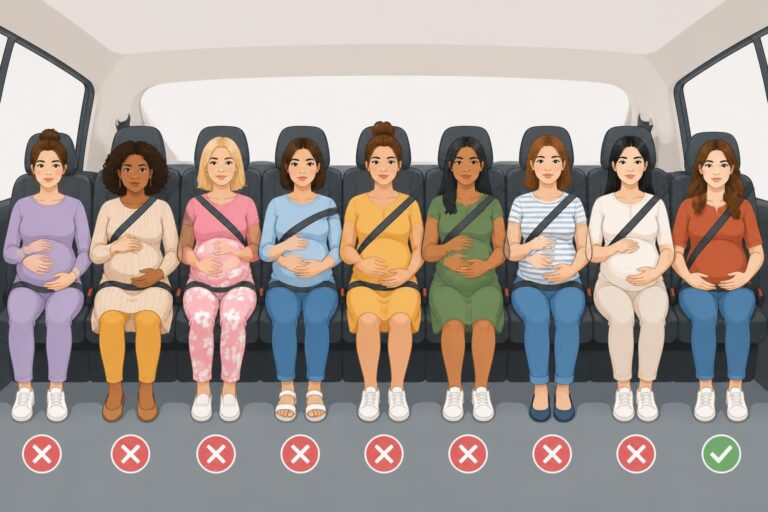
- Only 11.4% manage to correctly place the lap belt and the diagonal belt at the same time, even after explanations and demonstration.
- The most common error concerns the diagonal belt, which slips to the side as the pregnancy progresses.
- A phenomenon observed in nearly one in three participants concerns the lap belt, which folds into the soft tissues under the belly instead of lying flat on the pelvis.
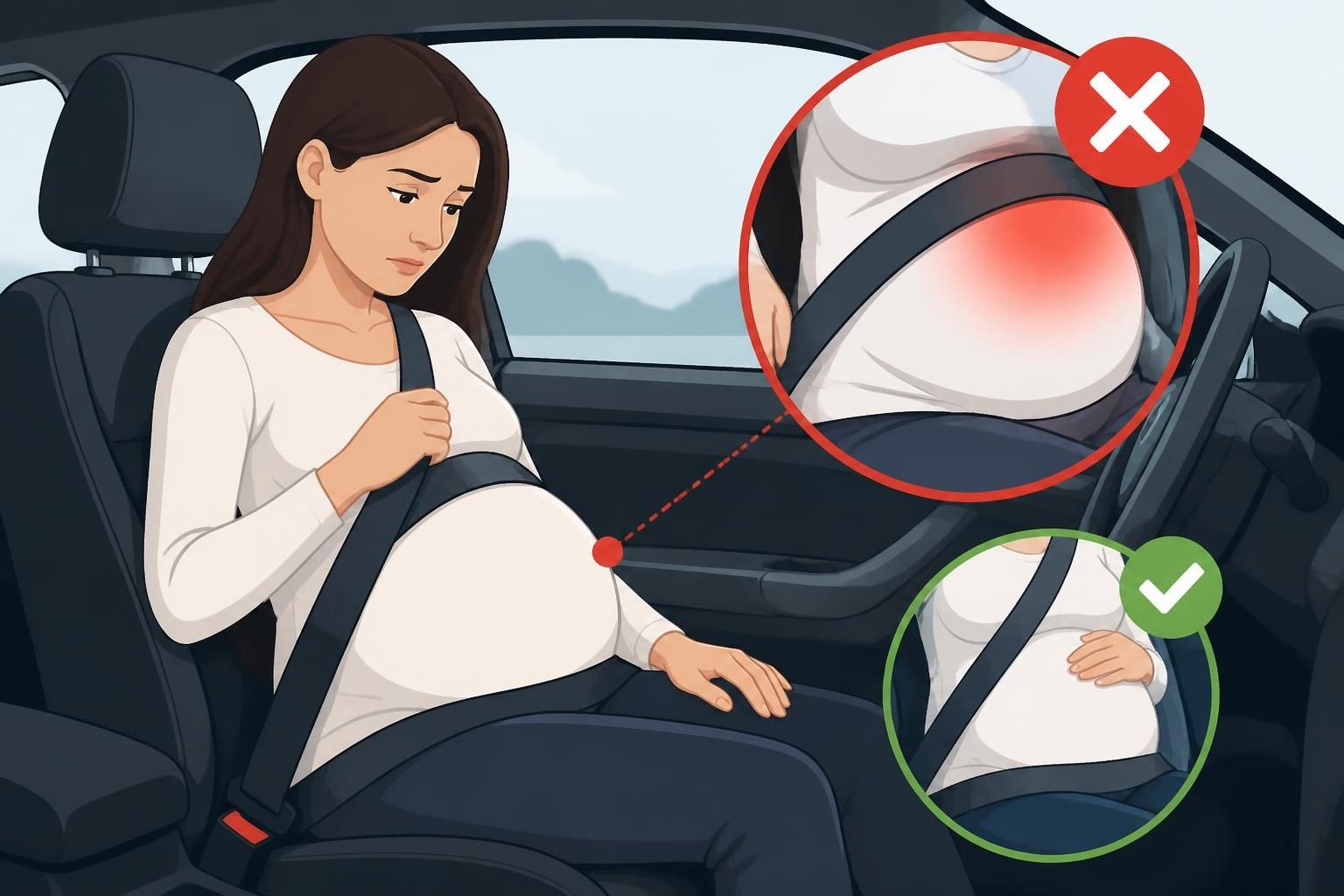
- Prevention remains simple on paper: low belt under the belly, flush with the hips; diagonal belt between the breasts and centered on the shoulder.
11.4%: that is the share of pregnant women who manage to position their seatbelt correctly, according to a study by the University of British Columbia (Canada) published on January 14, 2026. The figure stands out because it is not about a detail of etiquette, but a daily gesture in the car, repeated hundreds of times during a pregnancy. Buckling the seatbelt remains essential, whether as a driver or passenger, but the body changes quickly: belly that protrudes, chest that evolves, posture that shifts, and clothes adding layers. As a result, the error sometimes settles in silently, to the point that nearly 90% of participants do not achieve the positioning deemed optimal, even after explanations. Suffice to say that the problem is not the lack of goodwill, but the mechanical difficulty of the gesture.
The issue is clearly related to safety: a well-placed seatbelt directs the forces of a collision towards solid structures (pelvis, sternum, collarbone) rather than the abdomen. The same article emphasizes a point that deserves to be hammered without dramatizing: these results should not lead to giving up the seatbelt but to better adjust it and to demand more adapted passenger compartments. Between medical appointments, road safety might seem less urgent; yet, it is often in routine that the error sneaks in, the one that ends up seeming “normal.”
Study on Seatbelt Use During Pregnancy: What the Measurements Say
The researchers recruited 333 pregnant participants, at stages ranging from 6 to 38 weeks of pregnancy, with varied body types. After a precise explanation on correct positioning, each was seated in a real car seat equipped with a standard seatbelt. Posture and belt placement were recorded with a portable 3D scanner, which avoids the classic bias of “yes yes, it’s good” during a mannequin demonstration. The central result boils down to one statistic: only 11.4% succeed in placing both the lap belt and the diagonal belt simultaneously as recommended.
In detail, the study also shows something very concrete for daily life: most participants manage rather well to pass the lower belt under the belly. The big battle is played higher, with the diagonal belt. As pregnancy progresses, the abdominal volume can push this belt to the side. It then ends up going over one breast instead of between the breasts, which changes the axis of support and can make the belt more “present” and thus more tempting to reposition incorrectly.
Biomedical engineers also describe a phenomenon called “nesting.” In nearly one in three participants, the lap belt does not remain flat on the pelvis: it folds and sinks into the soft tissues located under the belly. The problem becomes more frequent as the weeks pass, probably because contact points evolve and the belt seeks “the shortest path,” not necessarily the best one. On the road, this configuration can modify how the forces of a collision are distributed, which is exactly what the seatbelt is supposed to prevent.
Another useful finding: existing belt adjustments don’t solve everything. Lowering the upper anchor point can help the diagonal belt pass between the breasts, but it can also move it away from the center of the shoulder. Raising it sometimes improves shoulder support but increases the risk of slipping to the side of the chest. It’s not a “bad setting”; it is an imperfect compromise on some bodies at certain pregnancy moments. The section leaves a clear idea: women are not “doing nonsense,” they are dealing with a device designed for a body that does not change that much in a few months.
Nearly 90% of Pregnant Women: The Most Frequent Car Error
The figure “nearly 90%” summarizes a simple reality: the error is not marginal. It is massive, hence common, and easy to repeat without noticing. The most frequent one in this study concerns the diagonal belt. It shifts laterally, often because the belly pushes it and because the posture changes: tilted pelvis, more arched back, shoulders rounding at certain moments of fatigue. The belt can then rub the neck, press on the breast edge, or give the impression of “cutting” breathing. The reflex becomes to put it under the arm or behind the back, although these placements are explicitly discouraged.
On the ground, the problem worsens with very ordinary situations: a thick coat in winter, a maternity vest that makes the belt slip, or a seat pushed back differently because the expectant mother seeks space. In a car, a two-centimeter change in seat position can be enough to modify the belt’s angle. Add short trips, those “just to go to the bakery”: less time, less attention, more automatic gestures.
Another more discreet error is the low belt riding up. Even when it starts under the belly, it can end up on the abdomen when adjusting the seat, turning the torso to grab a bag, or leaning back to help a child buckle their harness. The belt hasn’t moved “on purpose,” but it moved anyway. It’s the kind of detail that makes you smile until you understand what a lap belt is for: to rest on the pelvic bones and hips, not on soft tissues.
In the study, the nesting of the lap belt brings an important nuance: it is not enough for the belt to pass under the belly; it must also remain flat. A fold, a twist, a passage “into a hollow” can change the contact surface. In daily life, this easily happens when the belt tightens over one thigh or when the seat’s cushion is very enveloping. The brain focuses on the locking click, not on the geometry of the belts.
There is also a fairly well-known psychological effect: when something is uncomfortable, the body seeks an adjustment. Pregnancy already brings its share of discomfort; the belt sometimes becomes “one thing too many.” Road safety here consists of making the adjustment simpler and faster, to prevent discomfort from dictating positioning. The practical phrase to remember: if the belt bothers, the right reflex is to adjust height and tension, not to misdirect the belt.
Road Safety in France recommends a stable placement: low belt under the belly, as low as possible on the pelvic bone; diagonal belt between the breasts and centered on the shoulder. When in doubt, the vehicle manual and professional advice remain the most reliable options, especially if the sensation of discomfort leads to “tinkering” with the belt.
How to Properly Position the Seatbelt When Pregnant: Precise Gestures and Useful Adjustments
The instructions boil down to two lines, but the execution deserves a real step-by-step. The lap belt should pass under the belly, as low as possible, and remain flat on the hips and pelvic bones. It should not be placed on the abdomen. The diagonal belt passes between the breasts, in the middle of the chest, then centers on the shoulder. It should not go under the arm nor behind the back. Said like that, it’s clear; in the car, between a handbag, a car seat to check, and a pressing urge, clarity fades fast.
A simple method is to always proceed in the same order. First, sit back fully in the seat, back supported, and adjust the distance to the steering wheel or dashboard to maintain stable posture. Then, slowly pull the belt, without jerks, and place the lower belt first, very low, checking that it properly touches the pelvis. Once the lap belt is set, place the diagonal between the breasts and adjust the anchor height, if the vehicle allows. This sequence avoids the typical “everything’s fine” then “oh no, it’s pulling on the neck,” ending in placement under the arm.
The diagonal belt height adjustment is a technical point often underused. In many cars, it is located on the door pillar. In practice, one notch lower can limit rubbing on the neck and help the belt stay centered. The risk, already noted in the study, is moving it away from the shoulder if dropped too low. You must therefore try several notches, then move the torso (turn slightly, breathe deeply) to check if the belt stays in place when the body moves.
Clothing also matters. A belt over a thick coat can slip more easily, and a satin fabric can make the diagonal belt “slide” outward. A realistic solution, without everyday heroes, is to clear the contact zone: open the coat, smooth the scarf, avoid big folds. It’s not an aesthetic injunction, it’s mechanics. The belt needs friction and a clear path.
Quick Checklist Before Starting (and After Two Roundabouts)
- Lower belt well under the belly, in contact with the hips, without twisting.
- Diagonal between the breasts, no pressure on the neck, and centered on the shoulder.
- Belt tight but not excessive: no “belly in the void,” no squashing.
- Height adjustment tested: the belt should not move when moving the torso.
- After grabbing an object or helping a child, check that the lower belt has not ridden up.
In a prevention logic, this checklist is concretely useful: it is easy to remember and repeat. The aim is not to turn every trip into a technical check but to avoid risky placements that settle out of habit.
Comparative Table: Common Errors vs Recommended Seatbelt Position During Pregnancy
To make the subject usable in real situations, here is a table putting observed errors face-to-face with recommended positioning. The references are deliberately concrete: where the belt passes, where it presses, and what immediate risk it creates in case of sudden braking or collision.
| Measurable Situation | What Is Observed | Recommended Position | Main Risk in Case of Impact |
|---|---|---|---|
| Height of the lap belt | The belt rides up on the abdomen | Belt under the belly, as low as possible on the pelvis | Forces applied on soft tissues instead of pelvic bones |
| Path of the diagonal belt | The belt passes on the side of the chest | Belt between the breasts, centered on the shoulder | Poor torso guidance, discomfort leading to forbidden placements |
| “Comfort” placement | Diagonal belt under the arm or behind the back | Diagonal belt on the chest, never under the arm | No upper body restraint, increased risk of trauma |
| Flatness of the lap belt | Nesting: belt folded or sunk under the belly | Belt flat on the hips, without twisting | Altered force distribution and localized pressure points |
The table does not replace medical advice but serves as immediate reference. It mainly reminds one thing: the most dangerous error is often the one that “relieves” at the moment by moving the belt where it bothers less.
Prevention and Safety in the Car When Pregnant: Habits, Equipment, and Risk Situations
Road safety during pregnancy plays on three levers: habit, environment, and risk situations. Habit, because repeated trips create automatisms. Environment, because each car has its specifics (enveloping seat, more or less adjustable anchor point, quickly locking belt). Risk situations, because they cause the belt to move without being noticed: maneuvers, braking, torso twisting.
A useful habit is to link the positioning check with an already automatic gesture, like adjusting mirrors or activating the GPS. The idea is not to wait for discomfort. Many expectant mothers adjust the belt when it becomes uncomfortable; the problem is that discomfort sometimes arrives after several kilometers, when the belt has already moved. A micro-check at the start, then after the first minutes, limits this drift.
Typical situations that “work” the belt are easy to identify: helping a child in the back, retrieving a dropped pacifier, leaning down to place a bag on the floor, or checking a blind spot. In these moments, the lap belt can ride up, and the diagonal belt can shift. Prevention can be very down to earth: stop to turn back rather than twisting while driving, or ask another adult to manage the rear if possible. These are concrete safety choices, not moral judgments.
Some equipment exists on the market, like belt guides or accessories that change the belt’s path. Their use deserves caution because they are usually not part of the vehicle’s approved equipment. An accessory can improve comfort but also modify the restraint kinematics. The most prudent approach is to prioritize seat and anchor adjustments first and seek professional advice before adding a third-party device.
The University of British Columbia’s report emphasizes a forward-looking point: the goal is to help manufacturers design systems better adapted to body changes during pregnancy. Researchers work with automotive safety specialists to create digital models representing different pregnant morphologies and test future restraint systems. In short, the burden does not rest solely on women: design must follow real use.
To finish on a useful and very practical note, a reminder works well in real life: transformations are progressive, so the adjustment that worked well in the first trimester may become mediocre in the third. Revisiting seat and anchor adjustments regularly is part of simple prevention, especially if the car is shared with another person and settings change frequently.
What Do We Say About It?
The most useful data from the study is that the error is very frequent even after explanations, so the subject deserves a verification routine, not a simple “we already know.” The priority in the car during pregnancy remains wearing the seatbelt, correctly positioned, because it organizes body restraint in case of impact. Manufacturers should accelerate work on systems better adapted to pregnant morphologies because current settings create compromises. Meanwhile, a check at the start and after torso movements concretely reduces the risk of poor placement.
Can the seatbelt hurt the baby if it is properly positioned?
A correctly positioned seatbelt is designed to reduce risks in a collision, directing forces towards the pelvis and thorax. The lap belt is placed under the belly, as low as possible on the hips, and the diagonal belt between the breasts, centered on the shoulder. If uncomfortable, it is better to adjust the seat and anchor height rather than move the belt under the arm or behind the back.
What to do if the diagonal belt slips towards the neck or side of the chest?
First check posture (back in contact, seat not too reclined) then test the height adjustment of the anchor on the pillar. Pulling the belt smoothly and letting it tension helps. If the belt continues to migrate despite adjustments, checking with a professional or via the vehicle manual is recommended, especially if the displacement leads to prohibited positions.
Is the lap belt under the belly enough, even if it is not perfectly flat?
The study mentions possible nesting: the lower belt can fold into the soft tissues under the belly instead of remaining flat on the pelvis. From a prevention standpoint, one must seek a well-flat, untwisted belt in contact with the hips. After bending or turning, a quick check allows verification that it has not ridden up or folded.
Can you use a pregnancy-specific belt guide accessory in the car?
Accessories exist, often to improve comfort or stabilize the lower belt. Their limitation is that they can modify the belt’s path and how restraint functions according to vehicles. The safest approach is to prioritize seat and anchor adjustments first, then seek professional advice before adding a third-party device.