Seat belt and pregnancy: 9 out of 10 women do not wear it properly, according to a study
In Brief
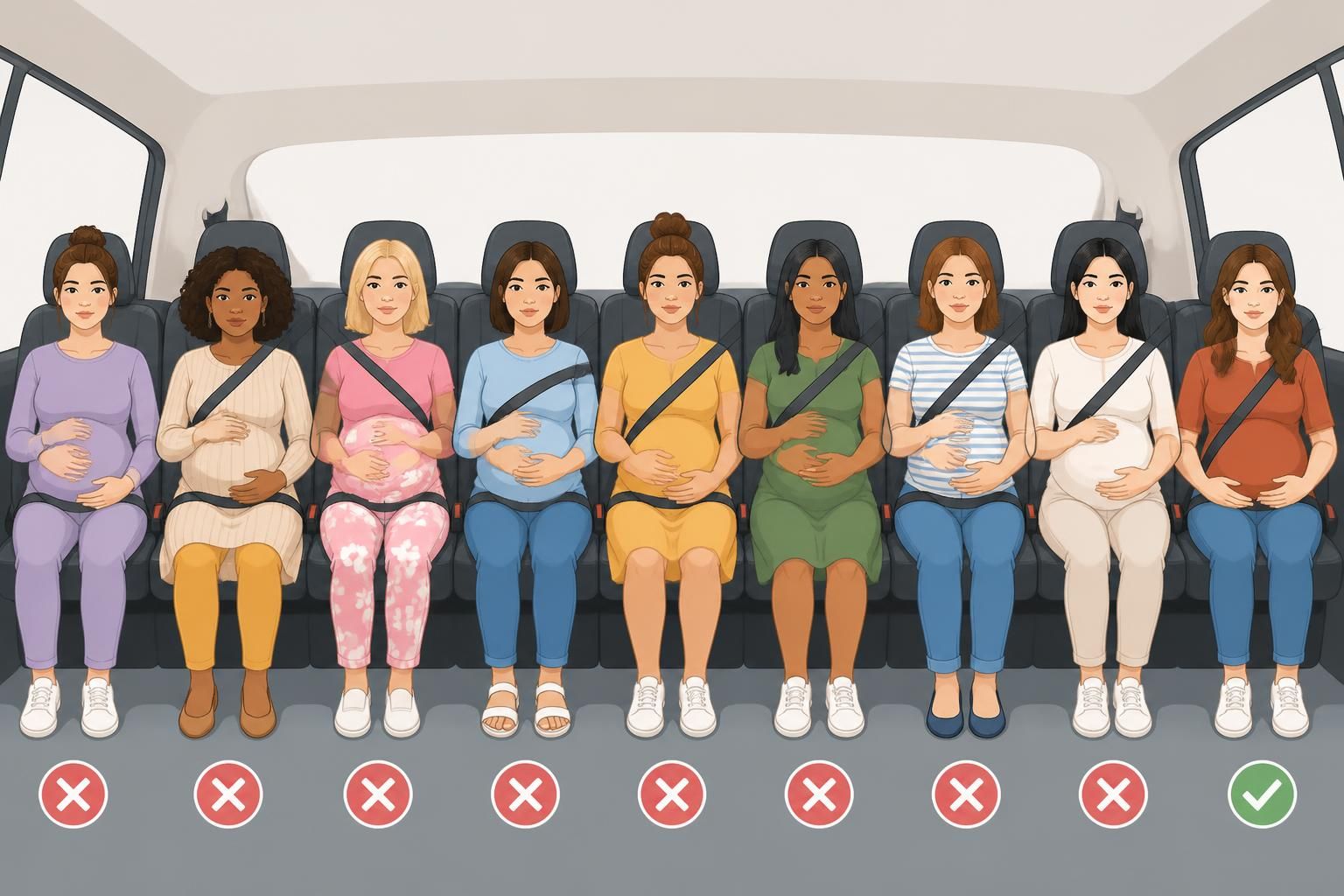
- According to a statistical study published on March 12, 2024, in the Journal of Obstetrics and Gynaecology Canada, about 9 out of 10 pregnant women position the seatbelt in a way that does not comply with recommendations.
- Incorrect wearing increases pressure on the abdomen during a crash and may worsen accident risks for maternal and fetal protection (pain, placental abruption, fetal stress).
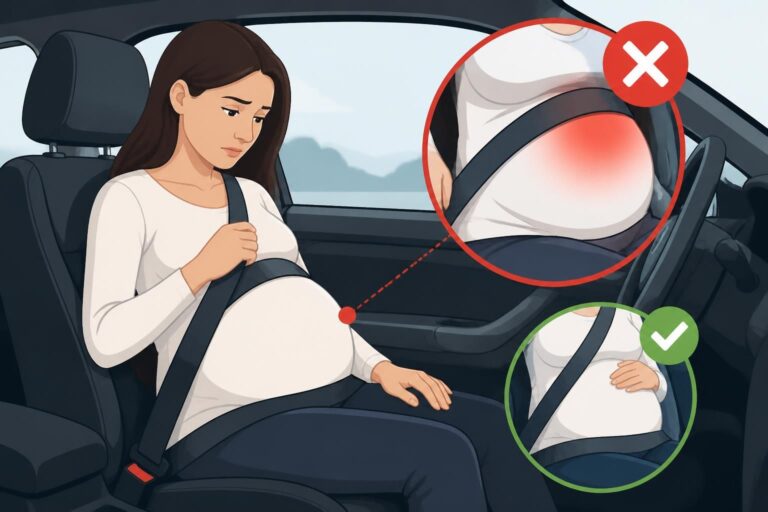
- Proper placement boils down to two practical points: low abdominal strap, under the belly, and diagonal strap between the breasts, never on the belly.
- The law requires seat belts for front and rear passengers, with strictly regulated medical exceptions.
- “Special pregnancy” accessories do not replace the original system, and some can redirect forces to the wrong place.
One figure is enough to raise an eyebrow (and tighten a harness): a Canadian statistical study concludes that the vast majority of pregnant women do not position the seat belt as recommended, even after a standard explanation. The subject is no detail: in a collision, the direction of forces does not negotiate with comfort, and a simple misplaced centimeter can turn protection into a source of injury. In real life, the typical mistake looks like a “makeshift” strap path: abdominal strap placed on the belly “so it won’t slip,” diagonal strap pinned under the arm “because it pulls,” or deliberately loosened belt “because the baby doesn’t like the pressure.”
What complicates the story is that pregnancy changes posture, skin sensitivity, breathing, and even the way of sitting. Advice exists, but repetition is rarely present: you adjust the seat, manage the bag, look for the playlist, and prevention sometimes takes the place of the GPS… in another car. Against a background of road safety, the issue is clear: keep the seat belt useful for maternal protection, while limiting constraints on the abdomen and avoiding incorrect wearing that increases fetal stress during sudden braking or impact.
Statistical study: why 9 out of 10 pregnant women get the seatbelt wrong
The “9 out of 10” finding does not come out of nowhere, nor from a contest of bad habits. According to a statistical study published on March 12, 2024, in the Journal of Obstetrics and Gynaecology Canada (JOGC), the vast majority of pregnant participants did not correctly position the seat belt in regard to road safety instructions, even after receiving explanations. The interest of this kind of work is not to point fingers but to measure a gap between what people think they do and what is actually done.
Several mechanisms explain this gap. First, mental representation: many associate “safety” with avoiding any pressure on the belly. However, the goal is not to eliminate the constraint but to move it to bony areas (pelvis, sternum) that better tolerate loads. Then, mechanical discomfort: over the weeks, the abdominal strap tends to ride up, especially if the seat base is soft or the seat is very reclined. Finally, the gesture: getting in, sitting down, grabbing the strap, pulling it, all often happens automatically, with a high margin of error.
One point regularly returns in field testimonies reported by professionals: the “quick adjustment” before starting, then nothing else. On a 25-minute trip, the strap may slip during the first roundabouts, rise after two brakings, then end exactly where it should not be. It’s not a question of goodwill; it’s an ergonomics and habit problem, like carrying a backpack on one shoulder then wondering why your back hurts.
The confusion between comfort and safety also plays a role. Some expectant mothers deliberately loosen the seat belt (leaving slack) to breathe more easily. The result is counterproductive: in a frontal crash, the body gains speed before being restrained, which increases the load when the strap tightens, with a more abrupt movement. In a prevention logic, the rule is simple: belt adjusted, without excessive compression, but without “comfort” slack that becomes a bad-tempered elastic at the wrong time.
Finally, the social context weighs in. When everyone quickly gets in the car, no one wants to be the person who says “wait, I have to reposition the abdominal strap under the belly.” Yet, it is exactly the kind of micro-ritual that reduces accident risks. The most effective prevention section is often the one that requires neither purchase nor application: two seconds of verification before turning the key.
Incorrect wearing during pregnancy: common errors and why they are risky
Incorrect wearing is not a single error; it is a family of small adjustments. And as often, it’s the “small” adjustments that cause big damage in a crash. To understand, one must visualize the role of the seatbelt: distribute the body’s energy over solid areas, limit projection, and prevent the head and chest from hitting the steering wheel, dashboard, or the seat in front. During pregnancy, this logic does not change, but the abdomen becomes an area that must absolutely be spared.
Error #1: the abdominal strap placed on the belly. It seems to “hold” and sometimes reassures because it doesn’t slip. In a sudden braking, this position can transmit forces directly to the abdomen. Obstetrically, possible complications after abdominal trauma include placental abruption, a cause of fetal distress that may require urgent care.
Error #2: the diagonal strap under the arm or behind the back. It is the classic “it rubs on the chest.” But the diagonal serves to hold back the upper body. Without it, the chest rotates more, the head goes further, and the abdominal strap takes more load. This is bad news for maternal protection: increased risk of chest contusion and greater overall movement.
Error #3: the loose belt. The slack gives the impression of “leaving room”. In reality, it increases relative speed before restraint. The impact becomes sharper when the strap tightens. In a collision, the body has no sense of humor: it moves forward, then stops suddenly. The choice is gradualness (adjusted belt) or harshness (loose belt).
Error #4: improper seat adjustment. Too reclined, too close to the dashboard, or steering wheel too low. An overly reclined seat naturally causes the abdominal strap to rise. A seat pushed too far forward brings the abdomen closer to the dashboard. A low steering wheel can restrict space around the belly. The goal is to maintain a functional distance from hard elements while retaining control of pedals and steering wheel.
Pregnancy adds a factor often underestimated: fatigue. When alertness drops, micro-ergonomics disappear. The seatbelt is buckled “as usual,” except the body is no longer “as usual.” Result: prevention becomes a topic in its own right, not a box checked once and for all.
Quick checklist before starting
- Abdominal strap placed low, on the hips, under the belly.
- Diagonal strap passing through the middle of the shoulder and between the breasts, without touching the neck.
- Belt adjusted: no slack, but no painful compression.
- Seat sufficiently upright to prevent the abdominal strap from rising.
- Distance from steering wheel/dashboard maintained, without driving “stuck” to the controls.
In practice, these points take less time than a voice message sent to say “we’re coming.” They mainly reduce the probability of turning road safety equipment into a source of abdominal constraints, thus fetal stress in case of sudden braking.
An educational video is useful if it clearly shows the path of the straps and typical errors, with still shots and simple landmarks (hips, sternum, shoulder). For daily use, the interest is to be able to compare one’s own position with a correct demonstration and then correct immediately.
Maternal protection and fetal stress: what the mechanics of a car crash tell us
A collision is not a “hard braking.” It is an event where relative speed changes very quickly, putting the body under stress. Restraint systems (seatbelt, pretensioners, airbags) are designed to work together. When the seatbelt is well positioned, it limits projection and distributes the load on the pelvis and chest. During pregnancy, this distribution is precisely what protects the abdomen.
Fetal stress is a broad term in clinical context, and it’s not limited to a “baby who got scared.” After trauma, what worries are indirect consequences: decreased placental exchanges if the placenta is injured, contractions triggered by the crash, or maternal pain masking signs to watch for. In road safety recommendations, priority remains to avoid the initial trauma, then ensure medical evaluation if an accident occurs, even if symptoms seem mild.
The role of the pelvis is central. The abdominal strap is designed to “hook” onto the iliac crests. This is bone, thus a structure that better supports transmitted loads. If the abdominal strap rides onto the abdomen, soft tissues take over. This is exactly what must be avoided during pregnancy. The diagonal completes the system by holding the shoulder and sternum, which stabilizes the torso and reduces rotation.
Another often misunderstood point: the airbag is not a reason to loosen the seatbelt. The airbag is designed to work with a correctly worn seatbelt. Without a belt, the body moves forward, the airbag deploys when the face is already too close, and the impact may be more violent. With the belt, the airbag acts as a complementary cushion for the head and chest.
From a purely mechanical point of view, a frontal crash at 50 km/h corresponds to a sudden deceleration where the belt must “hold back” the mass of the upper body. Even without a detailed g-force number, the idea is simple: the earlier and more correctly the body is restrained, the lower the maximum load. Prevention involves adjustment, seat position, and consistency for every trip, even the shortest, even “just to get bread.” Accidents have a known tendency: they do not warn.
Road safety: concrete recommendations for properly positioning the seatbelt during pregnancy
The most widely shared recommendations, including by road safety organizations, agree on positioning. The abdominal strap is placed under the belly, as low as possible, in contact with the hips. The diagonal passes between the breasts and attaches to the shoulder without cutting the neck. These are instructions easy to write, less easy to maintain when the body changes, when the coat thickens, or when the car seat has a “bucket” shape that poorly guides the strap.
In practice, micro-adjustments often need to be added. The first is pelvis orientation: sitting deep in the seat, buttocks well back, prevents the abdominal strap from riding up. The second is backrest inclination: too reclined, the belt “searches” for its route and ends on the belly. The third is belt height: on some cars, the diagonal strap’s anchor point can be adjusted. A diagonal that is too high rubs the neck and encourages putting it under the arm, which creates another error.
Driving style also matters. Anticipatory driving, with gradual braking, limits jerks and reduces the temptation to loosen the belt. It’s not a zen contest; it’s a logic of mechanical comfort: fewer micro-shocks, fewer repositionings, less strap slipping.
The subject of rear trips also deserves a mention. In France, rear passengers must also wear seat belts. Pregnancy does not change this rule. The back can give a false sense of safety, while forces remain significant in a crash and there is a “rebound” effect against the front seat. If the expectant mother is a passenger, she has the luxury of adjusting her seat more calmly, which helps correct wearing.
Practical table: positions, adjustments, and control points
| Measurable element | Recommended adjustment | Simple indicator to check | Risk if improperly adjusted |
|---|---|---|---|
| Position of the abdominal strap | At hip level, under the belly | The strap touches the pelvic bones | Pressure on the abdomen during impact |
| Path of the diagonal strap | Between the breasts, on the shoulder | No contact with the neck | Torso rotation, increased projection |
| Slack in the belt | Adjusted belt, no slack | Impossible to pinch more than 2 cm of strap | Late restraint, harsher impact |
| Backrest inclination | Rather upright | Pelvis remains firmly against the back of the seat | The abdominal strap rides up during the trip |
This table is not intended to turn the cabin into a control room. It mainly serves to make visible adjustments that otherwise remain “by feel,” whereas road safety rarely works by feel.
Video content provided by public organizations, when available, has an advantage: they show simple and repeated gestures, without selling accessories. For prevention, this neutrality helps focus on the essential: the path of the straps and posture.
“Pregnancy belt” accessories: what ADAC criticizes and how to sort without panicking
Faced with discomfort, the market offers adapters and “guides” for the belt. The stated idea is often to keep the abdominal strap low, under the belly. The problem is that some accessories change the restraint geometry and can move forces to unintended areas or introduce slack. A technical investigation by ADAC (Allgemeiner Deutscher Automobil-Club) published in November 2023 indicated that no tested “pregnancy belt” fully lived up to its protection promises while raising questions about crash dynamics.
This point does not mean that every accessory is automatically dangerous, but it recalls a principle: the seatbelt + seat + anchorage system is homologated in its original configuration. As soon as an addition occurs, uncertainty increases, especially if the accessory imposes a low anchor point, an extra strap, or a hook that changes the angle. Mechanically, a good result depends on how the loads are distributed and the system’s ability to tighten correctly at the right moment.
In real life, the temptation to buy often comes from a concrete irritant: strap cutting into the neck, diagonal rubbing, abdominal strap riding up. Before pulling out the credit card, “zero gadget” corrections exist. Adjusting the belt’s anchor height (when available), removing a thick coat that makes the strap slip, adding a small lumbar cushion to improve posture, adjusting the backrest. These actions have the advantage of not disturbing the device’s homologation.
If an accessory is considered, several factual criteria help sort: explicit compatibility with the vehicle model, no additional strap that creates slack, fastening that does not hinder locking, and presence of clear homologation information. Products that promise “guaranteed safety” without detailed test data pose a trust problem. Prevention also involves reasoned purchasing: what seems “comfortable” when static is not necessarily “protective” in dynamics.
The subject also overlaps another common reflex: using a clip, clamp, or strap lock to loosen. This is rarely a good idea. These manipulations can prevent the pretensioner from working or modify how the belt tightens during impact. Modern seatbelts are precise mechanical systems; home-made fixes sometimes end up creating harder-to-detect incorrect wearing.
The guideline, from the road safety side, is to prioritize correct positioning of the original seatbelt and driver’s seat adjustments. Accessories are a secondary topic, to be considered only if classic adjustments fail and if the product brings measurable improvement without introducing slack or hard points.
What Do We Say About It?
The “9 out of 10” figure deserves to be taken seriously because it describes a usage problem, not a lack of equipment. The priority is to correct incorrect wearing with simple adjustments (low abdominal strap, well-placed diagonal, less inclined seat), as these are the fastest and least risky actions. “Special pregnancy” accessories should remain a cautious option, not an automatic purchase reflex, especially when a technical investigation like ADAC’s highlights limitations. In road safety, the most effective prevention here is to make good positioning an automatic habit for every trip.
After sudden braking during pregnancy, should one consult even without pain?
In case of very violent shock or braking, a medical evaluation is often recommended, especially if there are abdominal pains, contractions, bleeding, decreased fetal movements, or malaise. The seatbelt protects but does not replace medical advice after a potentially traumatic event.
Can the seatbelt hurt the baby if it is correctly positioned?
When worn correctly, the abdominal strap is placed on the hips, under the belly, to limit constraint on the abdomen. The goal is to transfer forces to the pelvis and thorax, which are more resistant areas. Discomfort should lead to adjusting posture and anchorage, not moving the belt onto the belly.
Is it better to be a rear passenger when pregnant?
The rear may seem more comfortable, but the main rule remains correctly wearing the seatbelt. In case of accident, forces remain significant in the rear. If the rear seat allows better adjustment and less discomfort, it can be interesting, provided the belt remains well adjusted and properly positioned.
How to prevent the diagonal strap from touching the neck during pregnancy?
First check whether the vehicle allows adjusting the height of the belt’s anchor. A too reclined backrest or poor seat position can also make the diagonal rise to the neck. The safest solution is to adjust seat and anchor so that the strap passes over the shoulder without putting it under the arm.