
Problem Cause Language: Language problems and their causes in children from 1 to 3 years old.
Between 1 and 3 years old, a toddler’s brain goes through a bubbling period. Sounds turn into syllables, then words, and finally short sentences. However, some children follow a more winding path. A language delay can be worrying, while true language disorders require a rapid and targeted response. In this age group, daily social interaction, the quality of exchanges, symbolic play, and reading weigh more than the raw quantity of words heard. Understanding what is normal variability and what requires professional advice changes everything.
This dossier sheds light on the difference between temporary adaptation and lasting disorder. It explores the share of a neurological cause versus an environmental cause, details key landmarks in language development, and proposes concrete, joyful, and simple strategies to deploy at home. Real situations, like those of Lina, 2 years old, or Noah, 30 months, illustrate possible approaches, from early signs to speech therapy follow-up. Because a word placed at the right time can open a door, each section highlights communication acts that can be applied immediately, without complex material, with enthusiasm and consistency.
| Short on time? Here’s the essentials ⏱️ |
|---|
| At 12-18 months: pointing gestures, first words, intention to communicate 👍 |
| At 24 months: about 50 words, 2-word combinations, simple understanding 🧩 |
| At 36 months: short sentences, questions, rich symbolic play 🎭 |
| Alerts: no babbling, no gestures, no words at 18 months, regression, major misunderstanding 🚩 |
| Causes: possible mix of neurological cause and environmental cause 🧠🏡 |
| Act: face-to-face exchanges, games, reading, puppets, evaluation if in doubt 📚🗣️ |
| Avoid: passive screens, pressures, long instructions, hurtful comparison ❌ |
Language development milestones in children aged 1 to 3 years: reliable signs to act early
The typical trajectory remains steep. Around 12 months, many babies babble in sequences, point at objects, and understand very frequent words. Between 15 and 18 months, the first contextual words settle in. Then, around 24 months, the lexical explosion emerges. Two-word combinations appear. At 36 months, short sentences describe daily actions.
These milestones are not chains. Some children advance quickly in comprehension but speak little. Others say words earlier without forming stable sentences. The key is the communication acts: shared gazes, shown gestures, turns, synchronized smiles. When these acts unfold, the ground is fertile. Social interaction then adjusts syntax and enriches vocabulary.
Warning signs and normal variability
At 12-15 months, the absence of varied babbling can alert. At 18 months, no intelligible word and no communicative gesture justify a consultation. Sudden regression in achievements calls for immediate advice. Finally, massive misunderstanding of simple instructions at 24-30 months deserves screening.
Variability remains wide, especially in bilingual contexts. A child exposed to two languages may split their words between the languages. This is not a hindrance. On the contrary, double exposure nourishes cognitive flexibility. What counts is the total number of words produced and understood, all languages combined.
Case study: Lina, 2 years old
Lina understands instructions, points, imitates animal sounds, but says few words. The profile suggests a slow pace rather than a disorder. Targeted rituals will be proposed. For example, commenting on her games at eye level, labeling actions, and reformulating in short sentences. After four weeks of consistency, her lexical stock increases.
Practical list of red flags
- 🚩 No babbling at 12 months
- 🚩 No communicative gestures (pointing/showing) at 12-15 months
- 🚩 No words at 18 months
- 🚩 No 2-word combinations at 24-30 months
- 🚩 Regression of language at any age
- 🚩 Very limited understanding after 24 months
To go further and support the cultural foundation, shared reading remains a central lever. A clear guide on the benefits of reading helps establish effective routines, even for ten minutes.
These milestones guide action, not guilt. Every relational progress announces the constructive future.
Language delay, language disorders, dysphasia, stuttering: distinguish, understand, react
A language delay describes a temporal lag compared to peers. The child follows the steps, but later. Language disorders refer to a durably atypical organization. Among them, dysphasia (or developmental language disorder) affects the structuring of the linguistic system. Impacts affect vocabulary, syntax, and comprehension.
Stuttering can also emerge early. Around 2-3 years old, disfluencies are frequent. They become concerning if tension sets in, if the child avoids speaking, or if the situation persists. In this case, early support reduces emotional burden and prevents negative anchors.
Causes: neurological, environmental, sensory
A neurological cause includes genetic susceptibility, a particularity of the language network, or a more global impairment. Auditory disorders, notably repeated serous otitis, hinder stable access to sound contrasts. They create a perceptive fog. An environmental cause covers low quantity of exchanges, prolonged passive screens, or too directive interactions. Nothing acts alone. Often biological factors and context overlap.
Articulation difficulties require nuance. A 2-year-old child who “distorts” certain sounds is still exploring phonology. However, if intelligibility remains very low at 3 years old, an assessment is necessary. Global comprehension and functional use of language guide sorting between simple delay and specific disorder.
Case study: Noah, 30 months
Noah understands well but speaks little and produces floating syllables. Days include a lot of screen time. A progressive weaning and a targeted social interaction plan are established. In parallel, an ENT screening is requested. Three months later, vocabulary climbs, and symbolic play diversifies. The dynamic reverses.
Educational resources are allies to strengthen the context. Parents can explore the role of play in learning, as well as summaries on intellectual development in order to calibrate expectations.
What is not, by itself, a cause
- ✅ Balanced bilingualism 🌍
- ✅ An observant temperament 🤫
- ✅ A talkative sibling who “speaks for” the child (to monitor, but modifiable) 👧👦
Deciphering to better act reassures. The light shed on causes guides coherent and lasting choices.
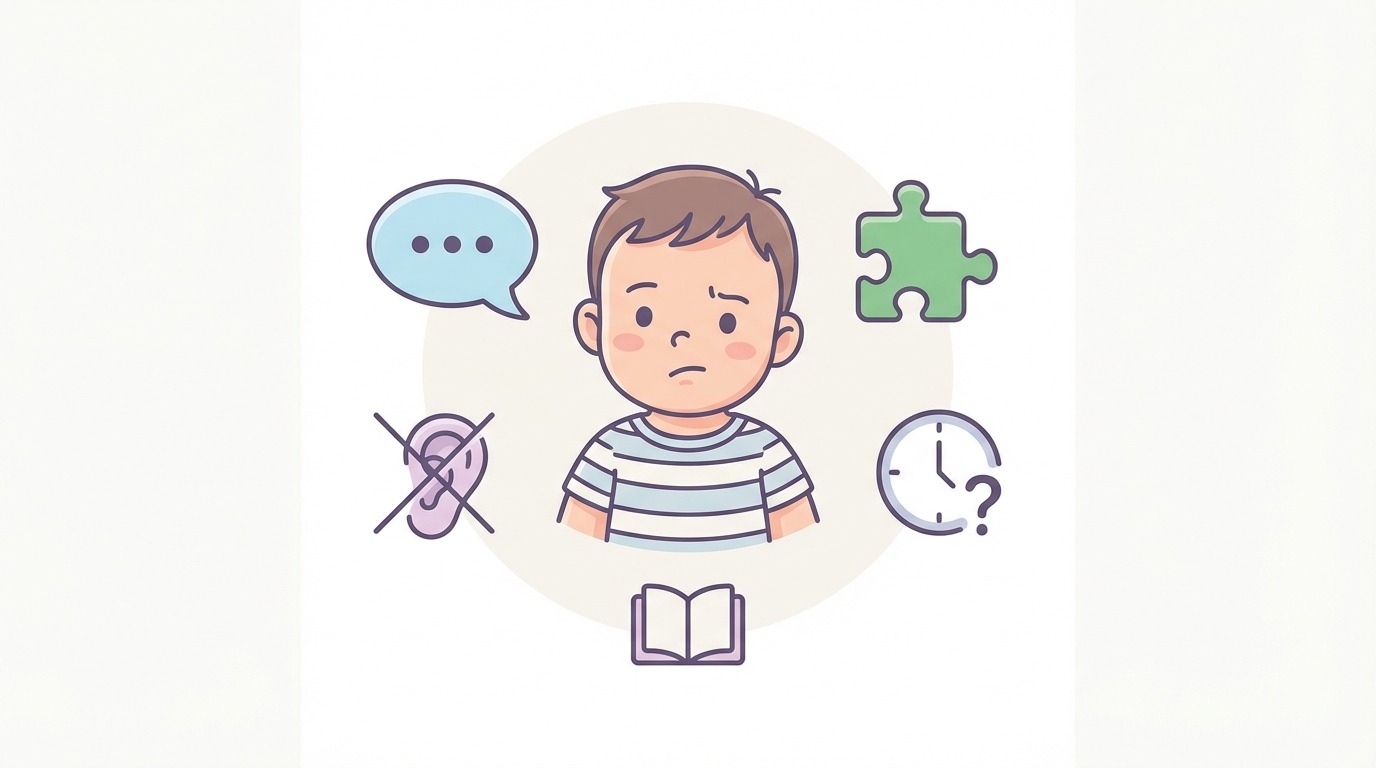
Social interaction and play: boosting communication acts without pressure
Language is born from encounter. Daily routines become training scenes. During dressing, we comment, wait, let the child initiate. During meals, we offer a binary choice. Then, we reinforce every attempt, even approximate. This is how communication acts gain in frequency and quality.
Shared reading remains a gem. Albums invite naming, guessing, commenting. For ideas, a detour through these reading resources inspires short and effective rituals. Then, puppet theater frees the imagination. Incidentally, the power of puppets supports joint attention and turn-taking, even in very reserved children.
Micro-techniques that change everything
Speak less, but better. Short sentences are calibrated. Pauses are made. The “magical wait” of 5 to 10 seconds opens a space for initiative. Also, follow the child’s interest. Label what they look at, not what you want them to look at. Then, “stretch” their production one notch: “dodo” becomes “teddy bear sleep.” These small gains stacked create an upward slope.
Symbolic play propels narration. A toy tea set, figurines, a cardboard box, everything works. Actions and sounds are linked. Every attempt is valued. Pleasure feeds repetition, and repetition solidifies circuits.
Concrete organization at home
- 📚 10 minutes of dialogic reading in the evening
- 🎭 10 minutes of puppets on Wednesday (simple DIY via craft videos)
- 🎲 15 minutes of free play per day, parent at eye level
- 🗣️ Positive repetition, gentle reformulation, realistic expectations
- ⏳ Less passive screens, more turn-taking
To visualize concrete approaches, a video search guides the first steps. It allows observing effective interactions in varied contexts.
By adding a joyful gesture to words, language takes root. Consistency without rigidity then becomes the best ally.
Screening, orientation, and care: when to consult and how to organize
Faced with doubt, the first step is to consult the pediatrician or general practitioner. The professional checks hearing, oral skills, comprehension, and presence of functional communication acts. If necessary, they refer for a speech therapy assessment. An ENT screening may complement the exam. The goal is to identify early the area to support.
The speech therapy assessment explores phonology, vocabulary, morphosyntax, and pragmatics. The evaluation also adjusts the place of a neurological cause or an environmental cause. Then, a care plan arises from needs. Sessions rely on concrete objectives, visible at home and in daycare.
Coordination and educational continuity
Upon entering kindergarten, coordination with the educational team maintains momentum. The article on the role of school staff details the articulation between caregivers and teachers. This continuity secures the child. Expectations become clear. Progress gains stability.
Anticipating the 3-5 year relay helps to choose the right pace. An overview of development between 3 and 5 years allows projecting realistic goals, without skipping steps. Patience and fine adjustment pay off.
Screening aid table
| Age ⌛ | Key milestones 🧭 | To watch for 👀 |
|---|---|---|
| 12-18 months | Gestures, first words, joint attention | No babbling, no pointing |
| 24 months | 50 words, 2 words combined, follows instructions | No words, no combinations, regression |
| 36 months | Simple sentences, questions, symbolic play | Very low intelligibility, misunderstanding |
Short case study. Emma, 2 and a half years old, shows articulation difficulties and few combinations. An assessment confirms a phonological delay without other disorder. A parental stimulation plan and 12 sessions help her. Over weeks, her intelligibility improves, and sentences lengthen.
As soon as doubt persists, early action reduces the path to overcome. Clarity of the journey supports the whole family’s confidence.
Preventing pitfalls and accompanying with kindness: myths, screens, family rhythm
Myths die hard. “Boys speak later” has no solid basis. “Bilingualism delays” often misleads. The latter can redistribute vocabulary between languages without hindering the structure of language. To decide, one must observe the overall communication, not only production in one language.
Passive screens eat into relational time. Their use must not replace reciprocal exchanges. If present, they should stay short, interactive, and always commented on. The simple rule “talk before showing” protects social interaction routines. The human bond structures attention. Language then prospers.
Parental balances and positive environment
Wanting to do well can turn into over-control. A look at very protective parenting attitudes helps to balance accompaniment. The child needs space to try, make mistakes, and try again. Autonomy in play, even briefly, promotes verbal initiative. Encouraging without correcting repeatedly establishes a conducive climate.
Physical comfort also matters. A child bothered by digestive troubles sleeps poorly and remains irritable. Even if this does not directly cause a language disorder, the context weighs on engagement. Information on lactose intolerance in children helps exclude some daily irritants. A soothed child plays more and speaks better.
Realistic weekly routine
- 🗓️ Monday: 10 minutes of “guessing reading”
- 🎶 Tuesday: face-to-face action songs
- 🎭 Wednesday: improvised puppet theater
- 🥣 Thursday: spoken recipes, binary choices at meals
- 🚗 Friday: narrating trips “who sees the red bus?”
- 🌳 Weekend: free outdoor play, short and warm comments
To keep on track, choose two rituals maximum, then stick to them. Regularity is better than excess. Language loves joyful repetition, not pressure. A stable climate, clear expectations, and positive reinforcements sketch a simple and durable path.
“Toddlers’ language grows like a garden: each day a gesture, each week a bud.” ✨
How to differentiate language delay and language disorder?
Language delay corresponds to a temporal lag with a preserved overall progression. A language disorder (including dysphasia) reflects a durably atypical organization affecting vocabulary, syntax, and often comprehension. The red flags are absence of babbling at 12 months, no words at 18 months, no combinations at 24-30 months, or regression. A speech therapy assessment decides.
Is stuttering at 2-3 years always worrisome?
No. Disfluencies are frequent during acquisition leaps. They are concerning if they persist, are accompanied by tension, avoidance, or social impacts. Early advice reassures and offers communication adjustments to limit emotional burden.
What home activities stimulate language without materials?
10 minutes of dialogic reading, descriptions of daily gestures, binary choices, improvised puppets, action songs, waiting 5 to 10 seconds to let the child initiate, and gentle reformulation. The key: reciprocal interactions, short sentences, and shared pleasure.
Do screens always harm language?
Passive and prolonged exposure harms interactions and joint attention. Occasional, co-viewed, and commented use can limit negative impact. Nothing replaces face-to-face exchanges, symbolic play, and shared reading.
When to consult a specialist?
As soon as doubt persists, in case of regression, absence of words at 18 months, or major comprehension difficulties. The primary care physician coordinates exams (ENT if needed) and refers to speech therapy. Acting early maximizes chances of catch-up.